AI Website Funnel: Boost Service Business Conversions in 2026
Unlock the potential of your service business with an AI website funnel. Learn to streamline lead generation, qualification, and conversion effectively.

How an AI Website Funnel Helps Service Businesses Turn Visitors Into Customers
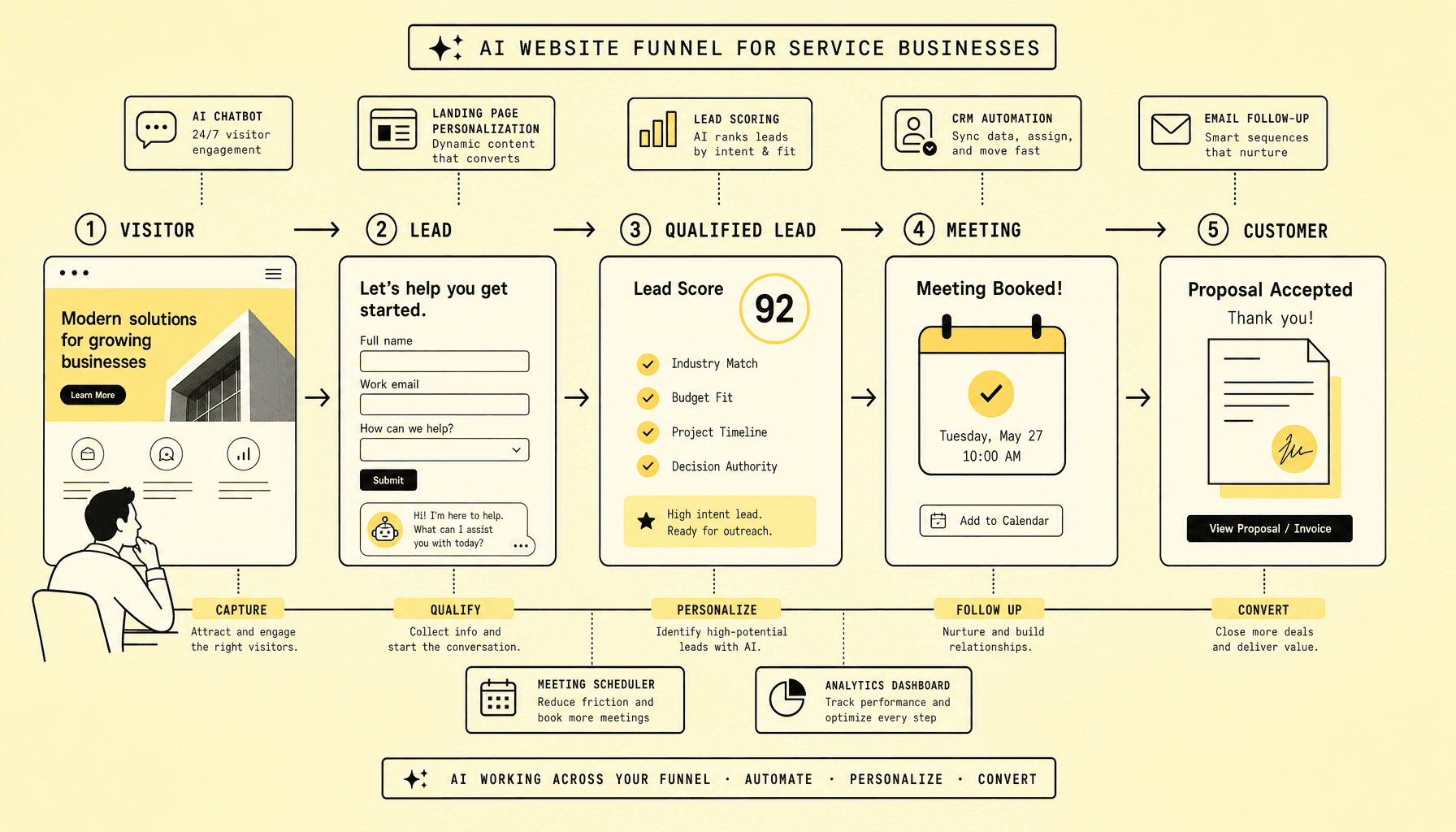
Traffic is expensive, attention is short, and a basic contact form often wastes both. If your website treats every visitor the same, your team ends up sorting weak inquiries, chasing slow replies, and missing people who were ready to book. An AI website funnel fixes that by moving people through a staged path: visitor → lead → qualified lead → meeting → customer. It combines AI lead generation, qualification, personalization, and follow-up so the website does more than collect form fills.
For service businesses, an AI sales funnel cuts friction at each step. Chatbots and smart forms capture intent, qualification logic filters by budget, timeline, and location, scheduling tools book meetings, and CRM automation drives follow-ups. One rule matters all the way through: user experience is as important as functionality, because a fast funnel that feels robotic will still lose good prospects.
Key Takeaways for Building an AI Website Funnel
- Build the AI website funnel as a staged system: visitor → lead → qualified lead → meeting → customer. Each step needs a distinct job, not one generic contact form.
- Match AI tools to funnel stage: chatbots, smart forms, and behavioral analytics for AI lead generation; lead scoring, routing, and CRM automation for the AI conversion funnel; scheduling and email/SMS sequences for the AI sales funnel.
- Qualify early. Ask for budget, timeline, location, and service need before sales gets involved -- it protects team time and improves meeting quality.
- Personalization and follow-up drive momentum, but avoid robotic automation. User experience is as important as functionality, especially for service business automation.
- Measure ROI with conversion rate, lead-to-meeting rate, response time, cost per lead, and close rate. At Imversion Technologies Pvt Ltd, we treat optimization as ongoing -- not a one-time setup.
Why Does a Service Business Need an AI Website Funnel Instead of a Basic Contact Form?
A basic contact form underperforms because it asks every visitor the same question, then forces your team to do the sorting later. That is slow. For service businesses with limited sales bandwidth, slow usually means missed intent, delayed replies, and weak follow-up.
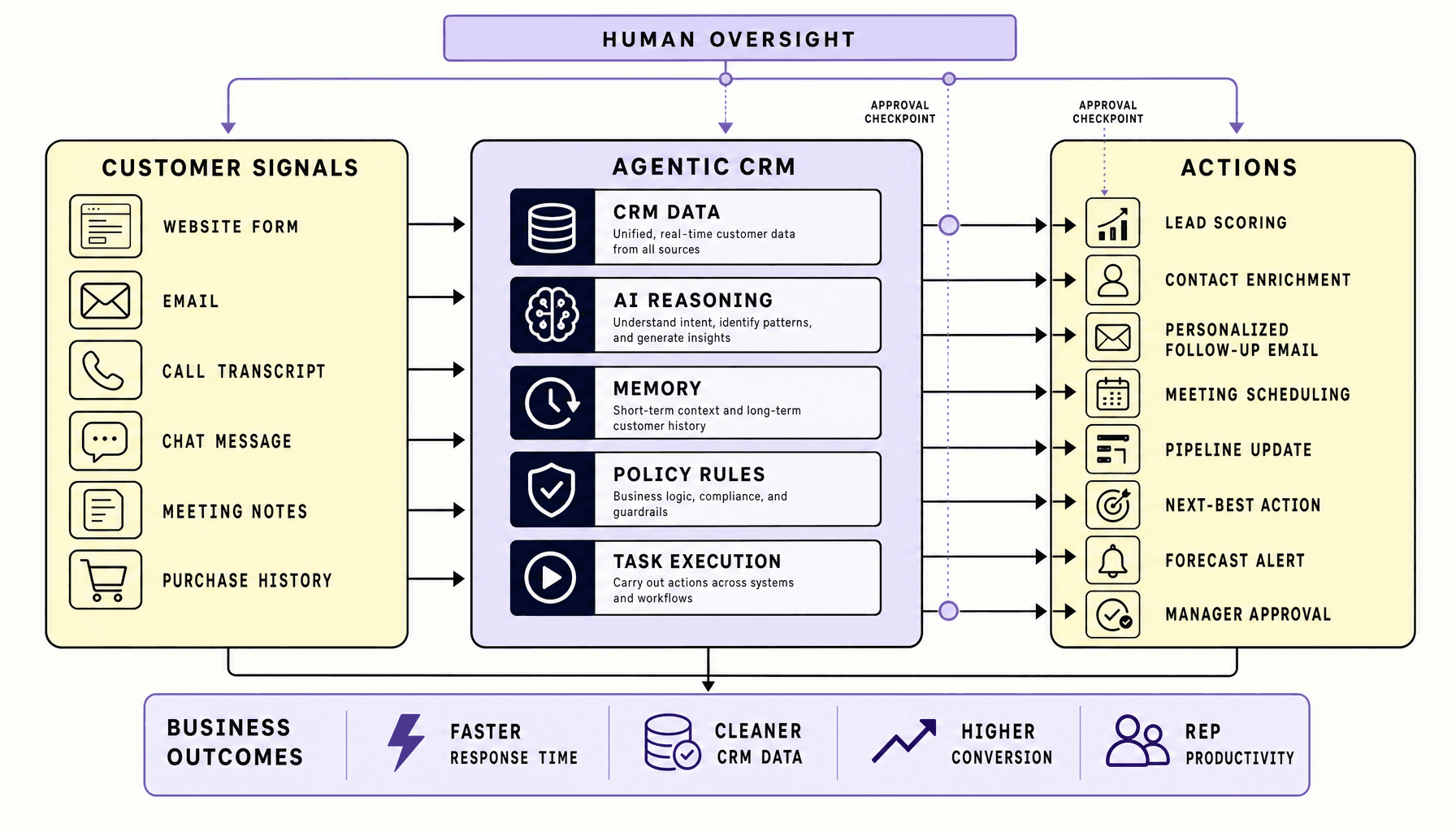
An AI website funnel works better because it turns a passive website into an active intake system. Instead of waiting for someone to fill out a generic form and hoping your team responds in time, the funnel captures context up front: service type, urgency, budget, timeline, location, and buying intent. Then it routes the lead into the right path -- sales call, estimate request, nurture sequence, or disqualification.
Research has long shown that faster lead response improves contact and conversion outcomes, which is why manual inbox checking is a poor default for AI lead generation. In practice, a law firm, agency, or home services company does not need more raw inquiries as much as it needs faster qualification and cleaner lead routing into a CRM and marketing automation workflow.
| Setup | Best fit | Main risk | Human handoff |
|---|---|---|---|
| Basic contact form | Low-volume inquiries | Slow response, poor qualification | Manual review after submission |
| Smart form + CRM automation | Moderate lead flow | Partial context, inconsistent routing rules | Sales reviews scored leads |
| Full AI funnel for service businesses | High-intent service sales | Over-automation if prompts are weak | Humans take meetings and pricing conversations |
The next step also changes. Someone asking for urgent repair should see scheduling options now. A consulting lead with a longer timeline may need a case-study sequence first. User experience is as important as functionality -- if the path feels generic, conversion drops even when traffic is good.
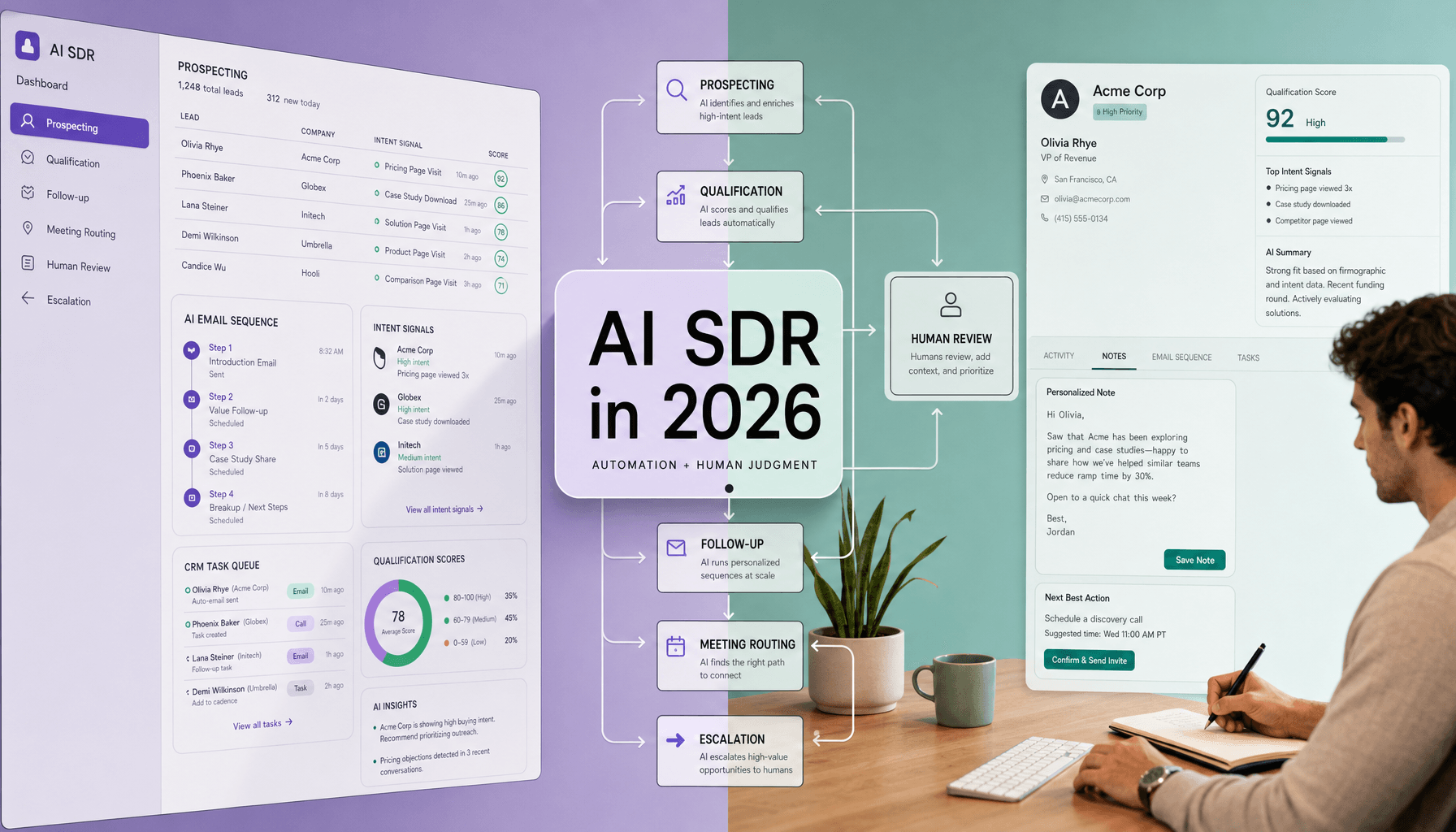
Our recommendation is simple: use service business automation as a speed and consistency layer, not as a replacement for consultative selling. Let AI capture, qualify, score, and follow up. Keep humans in the loop for objections, scope, and pricing. That balance makes an AI funnel for service businesses more effective than a static website with a contact form.
What Are the 5 Stages of an AI Sales Funnel From Visitor to Customer?
Most funnel problems do not start at closing. They start earlier, when the website captures too little context, asks too much too soon, or leaves qualified people waiting. A practical AI sales funnel for a service business has five stages: visitor, lead, qualified lead, meeting, and customer. The pattern is simple: reduce friction early, add structure in the middle, and keep closing more human-led.
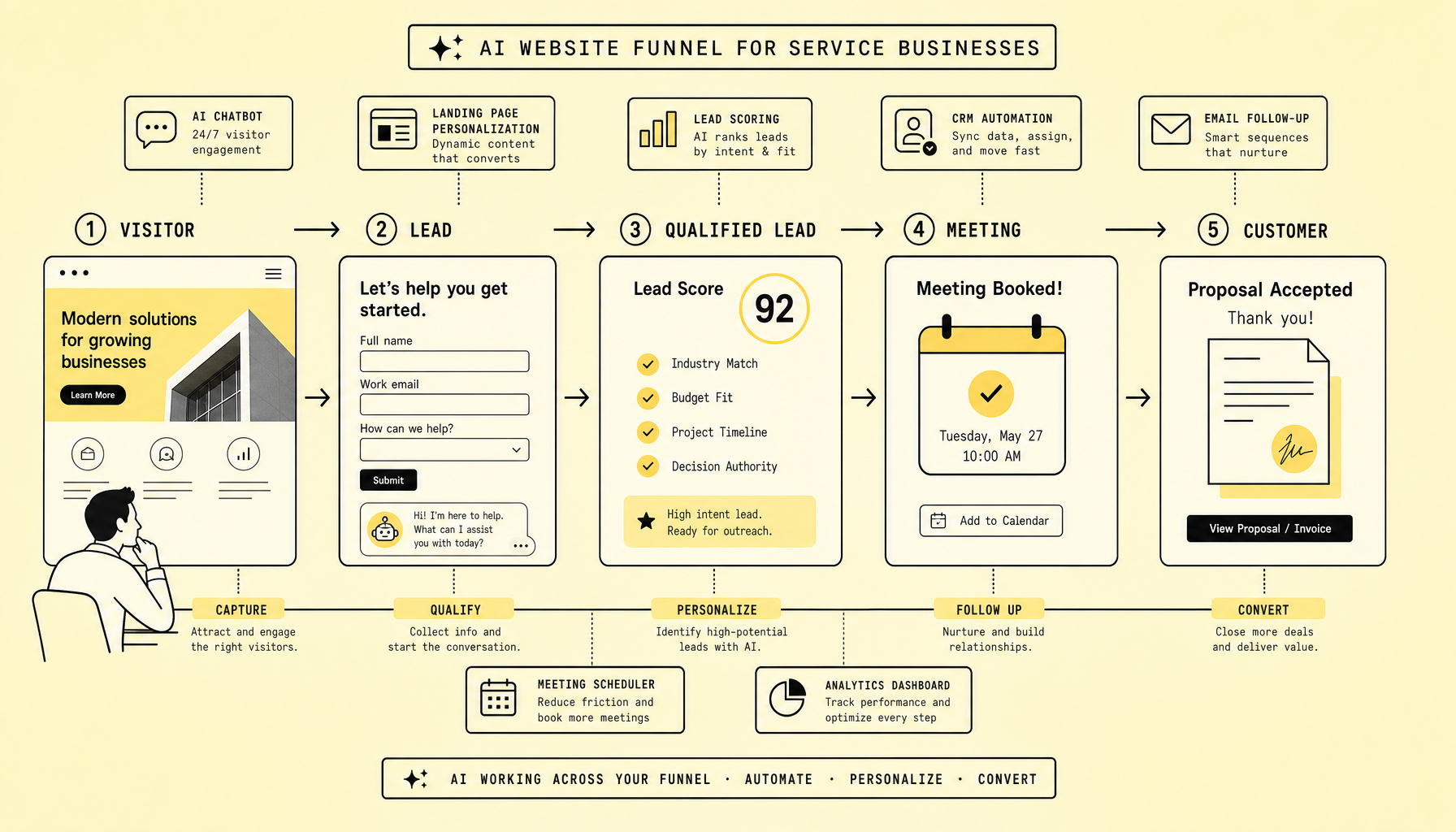
1. Visitor → Lead
The goal is capture. A visitor arrives from search, ads, referrals, or a return visit, and the conversion action is a form submission, chat start, or quote request.
At this stage, use smart forms or chat to help people find the right service and share contact details once intent is clear. Measure visitor-to-lead rate, bounce rate, and form completion rate.
2. Lead → Qualified Lead
Once someone raises a hand, the issue shifts from capture to filtering. A new inquiry enters the system, and the conversion action is a completed qualification flow.
Useful fields often include service type, timeline, location, urgency, budget range, and decision-maker status. AI can support lead scoring, tagging, and routing, but there is a tradeoff: if the intake flow asks too many questions, conversion can drop. Start with a short set of fields, then refine based on what your sales team actually uses.
3. Qualified Lead → Meeting
This is where momentum is either preserved or lost. The goal is booking. Once a lead meets your qualification threshold, the next conversion action is a scheduled call, consultation, or estimate appointment.
Use scheduling links, calendar sync, and automated reminders to reduce delays. Track lead-to-meeting rate, response time, and no-show rate. This stage often breaks when teams qualify leads but do not follow up quickly or with enough context.
4. Meeting → Customer
By this point, speed matters less than trust. The goal is trust and decision support. The trigger is an attended consultation, and the conversion action is a signed agreement, accepted proposal, or paid deposit.
AI can help with call summaries, notes, and follow-up drafts. Still, pricing, objections, and scope discussions usually need human judgment. Late-stage automation that feels robotic can hurt conversion more than it helps.
Automate repetitive qualification early; keep relationship-heavy closing steps personal.
5. Customer → Optimization Loop
Closing the deal is not the end of the funnel. It is where the feedback becomes useful. After the sale, use CRM reporting and attribution tracking to see which channels, pages, and messages produced qualified leads and customers. Watch close rate, cost per lead, and stage-by-stage conversion. Without that feedback loop, the funnel becomes a set of disconnected tools instead of a system you can improve.
Which AI Tools Should Power Each Stage of an AI Website Funnel?
Too many teams assemble tool stacks first and workflow logic later. That usually creates messy handoffs, duplicate data, and follow-up gaps. The best AI website funnel is not a pile of tools. It is a connected system where each stage has one job, one handoff, and one clear success metric.
Stage-by-stage tool mapping
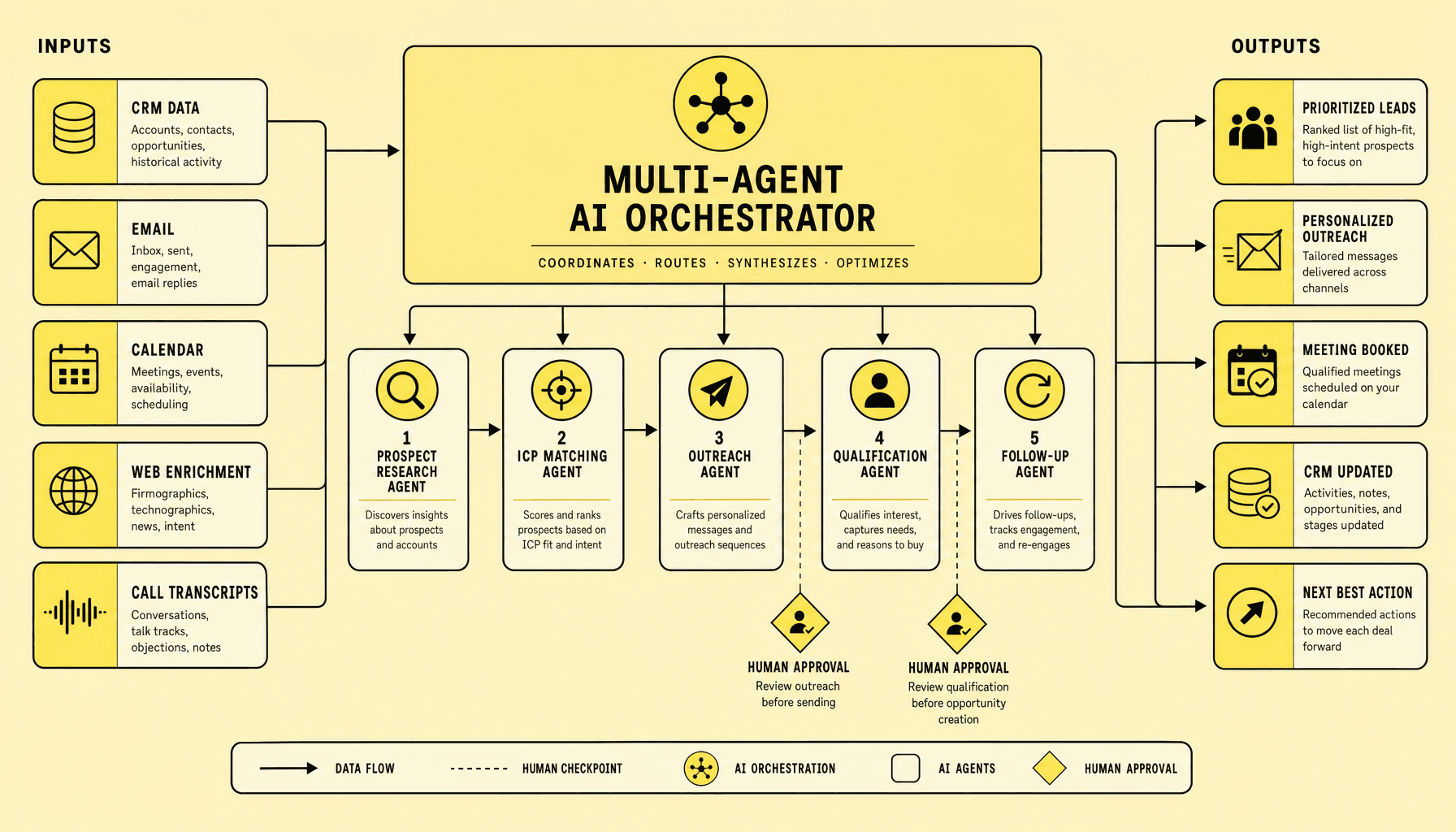
For visitor → lead, use an AI chatbot, landing page testing tools, and behavioral analytics. The chatbot handles first-contact questions, routes visitors to the right service, and captures intent without forcing everyone into the same form. Landing page tools help tailor copy by service, location, or traffic source. Behavioral analytics shows where visitors stall or abandon.
For lead → qualified lead, use smart forms and lead scoring. Smart forms should adapt based on answers and collect fields such as budget, timeline, location, urgency, and service type. Lead scoring can then sort submissions into fast-response, nurture, or disqualify. This only works if the form inputs are clean and standardized.
For qualified lead → meeting, use personalization plus calendar scheduling. Personalization can adjust email copy, case-study recommendations, or next-step prompts based on service interest. Scheduling tools should then offer the right rep, time zone, and meeting type without back-and-forth.
For meeting → customer, use CRM automation and email workflows. The goal is disciplined follow-up: reminders, summaries, proposal nudges, and reactivation for stalled deals. Keep the tone controlled so automation does not make the brand feel robotic.
| Funnel stage | AI tool category | Best fit | Main risk | Human handoff |
|---|---|---|---|---|
| Visitor → Lead | AI chatbot + landing page tools | High-traffic service pages | Generic bot responses | Complex questions |
| Lead → Qualified Lead | Smart forms + lead scoring | Filtering by budget/timeline | Bad data, weak scoring logic | Edge-case qualification |
| Qualified Lead → Meeting / Customer | Personalization engine + calendar scheduling + CRM automation | Faster booking and follow-up | Broken integrations | Sales call, proposal, close |
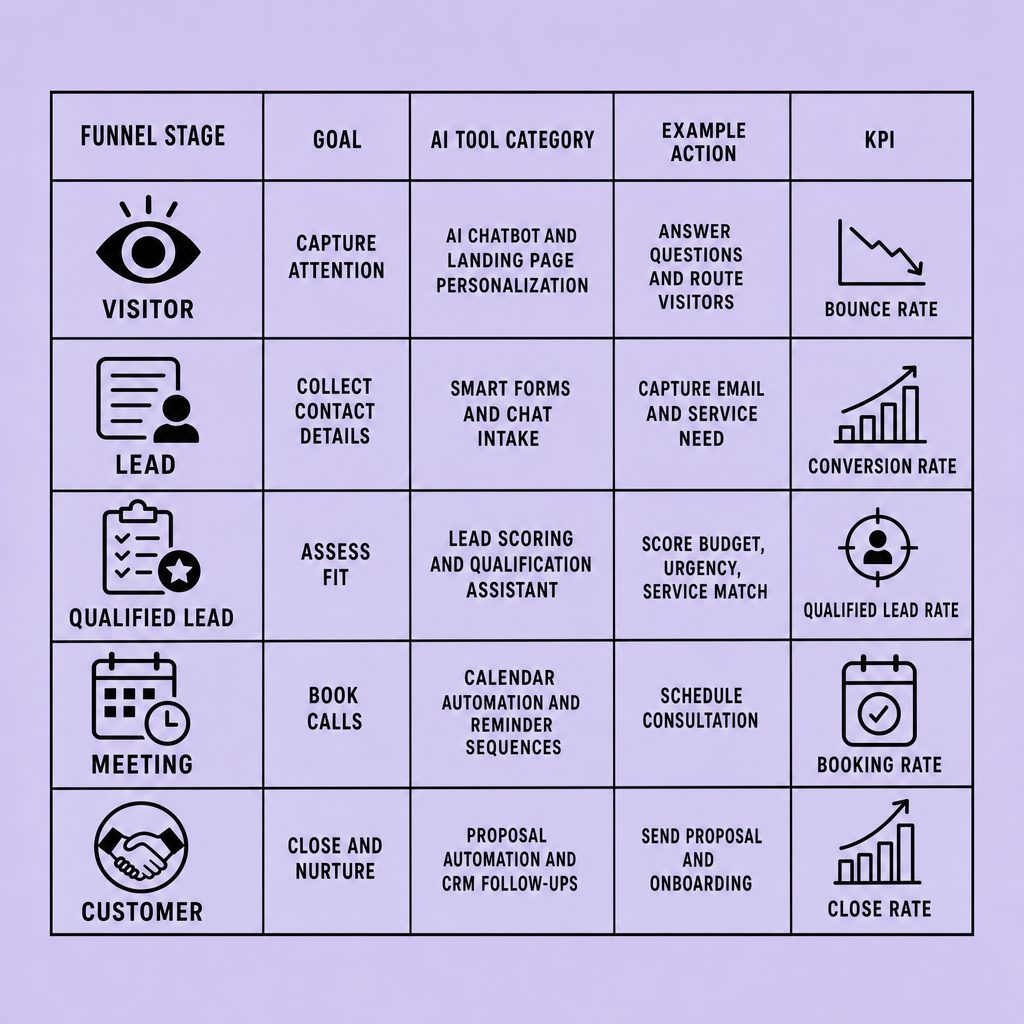
How to choose the stack
Start with integration, not feature lists. Choose tools that connect cleanly with your CRM and calendar first. Simpler usually wins. Even a strong AI sales funnel will struggle if chat, forms, scoring, scheduling, and CRM automation do not share data cleanly.
One common mistake is buying a platform that promises an end-to-end AI conversion funnel, then discovering weak routing, limited reporting, or poor human handoff controls.
A practical rollout is to start with one service line, track conversion rate, lead-to-meeting rate, response time, and cost per lead, then expand after the workflow is stable.
How Do Lead Capture, Qualification, Personalization, and Follow-Ups Work in an AI Website Funnel?
These four functions only work well when they behave like one system. In a service-business funnel, lead capture starts the conversation, qualification sorts demand, personalization changes the next step, and follow-ups keep qualified prospects moving toward a meeting instead of stalling in the inbox.
Lead Capture: Keep the First Step Light
The first mistake teams make is asking for too much too early. Start with a clear offer: consultation, estimate, audit, case review, or service-specific checklist. Then use a smart form or AI chatbot that asks only for essential details upfront: name, email, phone, service type, and one intent signal.
The goal is to reduce friction at the first conversion. Instead of forcing a full intake immediately, collect deeper details later through chat, email, or the booking step.
A practical setup might include:
- an AI chatbot that answers FAQs and suggests the right service
- a smart form connected to your CRM
- behavioral tracking to spot drop-off points
Qualification: Ask What Sales Actually Needs
Once a lead comes in, qualification should reflect how your team actually sells. After someone converts, qualify quickly with questions tied to fit and urgency: budget, timeline, location, service type, company size, project scope, or urgency. The exact questions depend on the business. Home services often need service area and urgency first. Agencies and consultants may care more about budget and timeline.
Keep the experience structured. Instead of showing a long form, sequence questions across steps so visitors are not asked for everything at once.
Then score and segment the lead. A high-intent inquiry with strong fit and urgency can go straight to a scheduler and internal alert. A lower-intent lead can move into email or SMS nurture with helpful content and a lighter booking prompt.
Personalization and Follow-Ups: Route by Intent
Changing a few words in an email is not enough. Personalization should change the path, not just the wording. If someone selects “urgent repair,” show fast-response messaging and immediate scheduling. If they indicate they are still comparing options, offer educational content and a nurture sequence before pushing for a call.
Follow-up should begin immediately after the form fill or chat ends. Automate the first response, then use CRM workflows for reminders, SMS check-ins, no-show recovery, and re-engagement when no meeting is booked.
To improve the system over time, track response time, lead-to-meeting rate, cost per lead, and qualified lead rate. That is what turns AI lead generation into a working service-business funnel rather than a disconnected set of tools.
How Do You Optimize an AI Website Funnel, Avoid Common Mistakes, and Measure ROI?
A funnel can look busy and still perform badly. More form fills do not mean better sales. Optimize the AI website funnel by measuring each handoff, not just top-of-funnel volume. Track visitor-to-lead conversion rate, lead quality, response time, lead-to-meeting rate, customer acquisition cost, pipeline attribution, and ROI. In practice, the strongest signal is qualified meetings and closed customers, because AI lead generation can inflate form fills without improving revenue.
Use A/B testing on offers, chat prompts, form length, scheduling flow, and follow-up timing. Keep the experience human -- over-automation, weak CRM integrations, generic personalization, poor qualification logic, and missing tracking break the AI conversion funnel fast.
For service business automation, connect chatbot, smart form, scheduler, and CRM data into one AI sales funnel view.
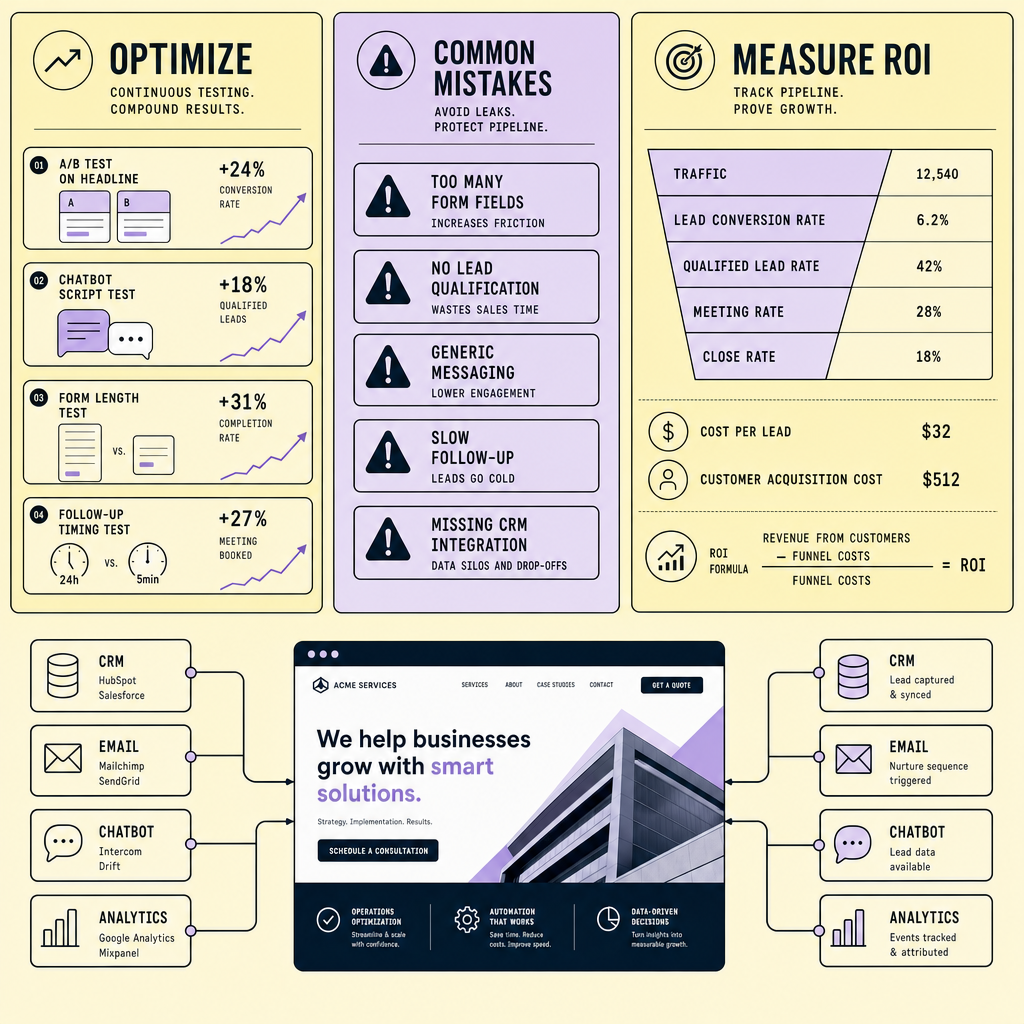
Best practice: optimize for sales outcomes, not raw lead counts.
SEO FAQs
What is an AI website funnel?
A staged system that moves visitors to leads, qualified leads, meetings, and customers using automation and personalization.
How does AI improve lead generation for service businesses?
It captures intent faster, qualifies leads automatically, and routes high-fit prospects to the right next step.
Which KPIs matter most in an AI conversion funnel?
Conversion rate, cost per lead, lead-to-meeting rate, response time, customer acquisition cost, and ROI.
What are common AI funnel mistakes?
Weak offers, poor integrations, over-automation, bad qualification, and incomplete tracking.
How do you prove AI funnel ROI?
Compare funnel costs against pipeline and closed revenue attributed to qualified meetings and customers.
Frequently Asked Questions
What is an AI website funnel for a service business?
An AI website funnel is a structured website journey that uses automation, data capture, and decision logic to move visitors toward becoming booked and qualified opportunities. For service businesses, it works best when it combines intent capture, routing, scheduling, and follow-up into one connected process instead of treating every inquiry the same.
How does an AI website funnel differ from a traditional sales funnel?
An AI website funnel differs from a traditional sales funnel because it reacts in real time to visitor behavior and answers instead of waiting for manual review. It can personalize next steps, score leads instantly, trigger booking options, and push data into a CRM, which reduces delay and improves handoff quality.
Which service businesses get the highest ROI from AI lead generation?
Service businesses with high-value sales, repeat inquiry volume, or urgent response needs usually see the strongest ROI from AI lead generation. Examples include law firms, agencies, consultants, home services, clinics, and B2B providers where faster qualification and booking can directly increase close rates and reduce wasted sales time.
How long does it take to optimize an AI conversion funnel?
An AI conversion funnel usually needs several weeks of live traffic before meaningful optimization decisions can be made. Early wins often come from fixing form friction, routing errors, and slow follow-up, while deeper gains require testing offers, qualification logic, and stage-specific messaging over multiple conversion cycles.
Why should service business automation include human review points?
Service business automation should include human review points because high-value deals often depend on judgment, trust, and nuance that automation cannot fully handle. Human checkpoints improve pricing accuracy, catch edge-case leads, and prevent robotic interactions from hurting conversion during qualification, proposal, and closing conversations.
Make Imversion a preferred source on Google
Like this kind of AI and software analysis? Add Imversion as a preferred source so Google can highlight our articles for you in Search, AI Overviews, and AI Mode.