chunking strategies for RAG: Experiment-Driven Insights for 2026
Learn how to choose chunking strategies for RAG through a data-driven approach. Compare various methods and enhance retrieval efficiency!
On this page
How to Choose chunking strategies for RAG Without Guesswork
A bad chunking default quietly poisons a RAG system. Retrieval gets noisier, prompts get bloated, and costs climb before anyone can clearly explain why. The fix is simpler than most teams make it: choose chunking strategies for RAG through experiments, not instinct. The right default is the one that wins on retrieval quality, context waste, latency, and cost for your documents, queries, and context window.
Teams often copy a chunk size and overlap from a tutorial. Then answers get worse, context gets repetitive, and retrieval gets expensive. A better approach is to compare fixed-size chunking, semantic chunking, structural document chunking, parent-child, and document-aware rules on the same eval set. Decisions should be backed by data.
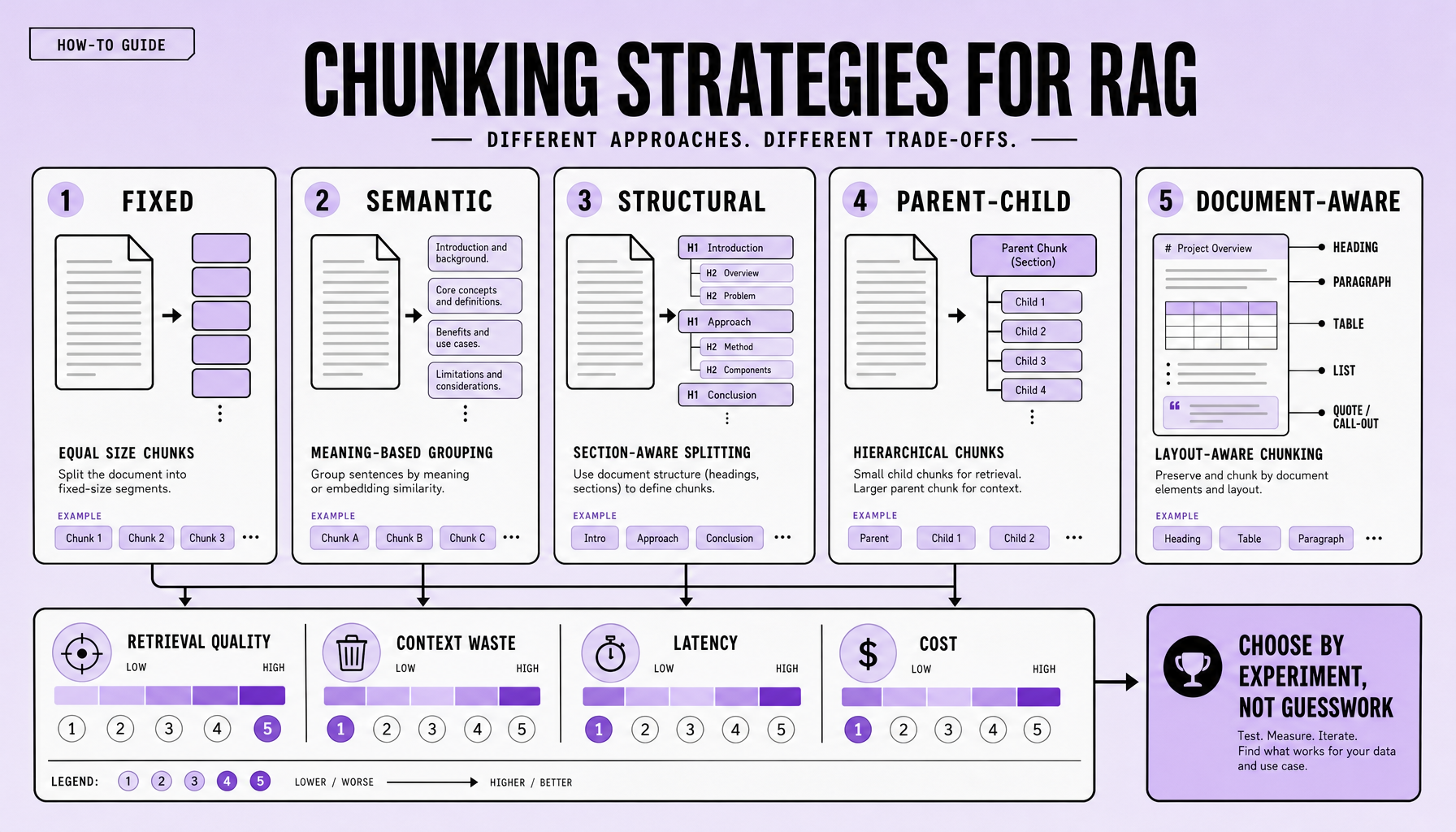
A practical starting point: use fixed-size chunking as the baseline, then test semantic chunking or structural rules for policies, API docs, PDFs, tables, and code-heavy content. Parent-child often earns its keep when small chunks retrieve well but larger sections answer better. One warning -- overlap helps recall, but too much overlap inflates duplicate context, latency, and token spend.
Key Takeaways for chunking strategies for RAG
-
No single default wins everywhere. Fixed, semantic chunking, structural, parent-child, and document-aware document chunking each solve a different problem -- and each breaks in a different way. Teams that copy a popular setup often get worse retrieval, noisier context, and higher token spend.
-
Chunk overlap helps only when boundaries are the real failure point. It can rescue split definitions, tables, or code blocks. Too much chunk overlap inflates index size, repeats evidence in the prompt, and increases latency and cost without improving answers.
-
The best chunking strategies for RAG depend on document shape and query style. API docs, policies, PDFs, and mixed-content manuals rarely behave the same, so one document chunking policy across all files is usually a lazy shortcut.
-
Use metrics to choose the default. Measure Recall@k or MRR for retrieval quality, context waste for prompt efficiency, plus latency and token cost. At Imversion Technologies Pvt Ltd, the defensible default is the one backed by data.
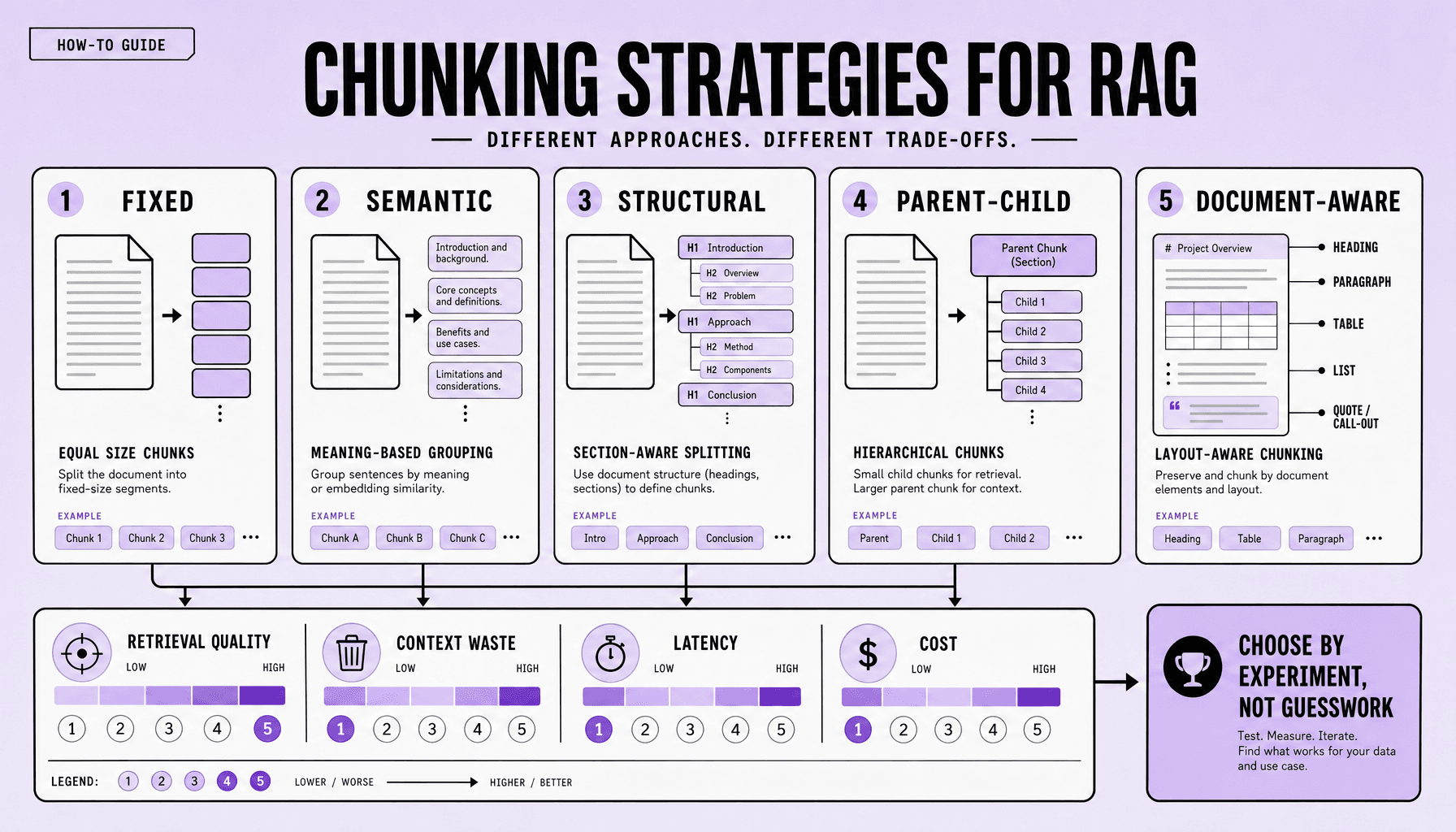
Compare chunking strategies for RAG: Fixed, Semantic, Structural, Parent-Child, and Document-Aware Chunking
Most chunking mistakes start the same way: a team picks one strategy because it is easy to explain, then expects it to behave well across every document type. That rarely holds up in practice. The right document chunking approach depends on document shape first, then query style, context window, and what the retriever must optimize.
Teams often start with fixed-size chunking because it is easy to ship. Fair. It is simple, fast, and works surprisingly well for clean prose in a vector database. But it also slices through ideas without caring where meaning ends. Definitions get split. Tables break. Code examples lose the setup that makes them useful.
Semantic chunking tries to fix that by grouping sentences through meaning -- often with embeddings or discourse boundaries. Retrieval precision usually improves because chunks hold complete thoughts. The tradeoff is real: semantic chunking is slower to build, harder to tune, and less predictable across mixed corpora with PDFs, lists, tables, and code blocks.
Structural chunking uses headings, sections, bullets, tables, and code fences as boundaries. For manuals, policies, and API docs, that is often the most natural fit. Structure already carries meaning. The catch is that some sections are huge, others tiny, so secondary splitting rules still matter.
Parent-child chunking is often the most practical middle ground for chunking strategies for RAG. Small child chunks improve matching. Larger parent sections give the generator fuller context. Better balance. Higher complexity. It needs extra metadata, two-stage retrieval logic, and more care during indexing.
Document-aware chunking goes one step further and adapts by file type or layout -- maybe one rule for Markdown, another for PDFs, another for tables. Powerful. Engineering-heavy.
A useful default: map method choice to document shape before testing parameters. Prose-heavy corpora often tolerate fixed-size chunking or semantic chunking; mixed technical corpora usually benefit from structural or parent-child chunking.
That progression matters. If a simple splitter already meets the quality bar, adding complexity just creates more tuning work and more failure modes. Teams should move up the complexity ladder only when simpler methods fail on retrieval quality or context waste.
| Approach | Precision | Answer completeness | Setup complexity | Best-fit documents |
|---|---|---|---|---|
| Fixed-size chunking | Medium | Medium-low | Low | Plain prose, uniform text |
| Semantic chunking | High | Medium | Medium-high | Essays, FAQs, narrative content |
| Structural chunking | High | High | Medium | Manuals, policies, API docs |
| Parent-child chunking | High | High | High | Mixed technical corpora |
| Document-aware chunking | Medium-high to high | High | High | Heterogeneous files, layout-heavy docs |
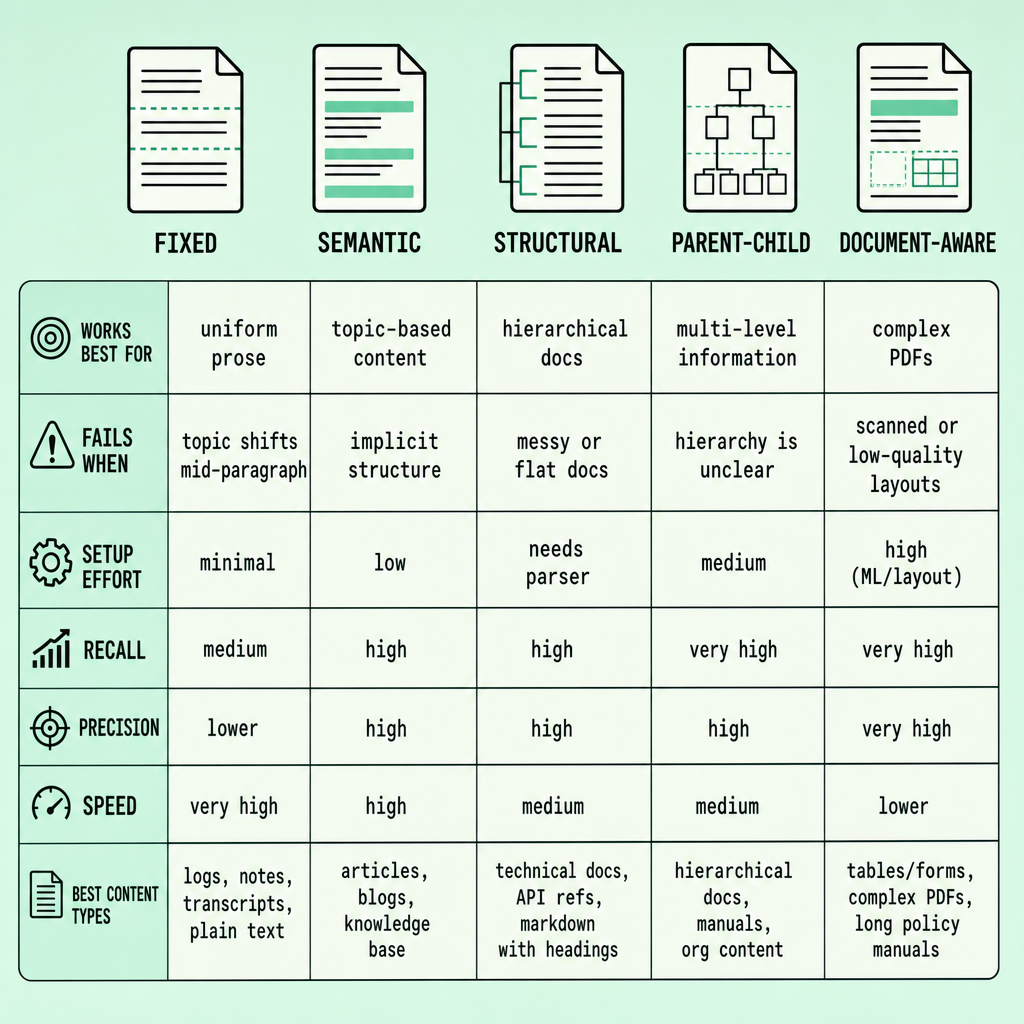
Ship the default that wins in testing -- not the one that sounds smartest.
How chunking strategies for RAG use Chunk Overlap to Change Recall, Context Waste, and Cost
Overlap looks harmless until it starts flooding retrieval with near-duplicates. Teams add it to protect meaning at chunk boundaries, which is sensible, but the same setting can also bloat the index, repeat evidence in prompts, and raise token cost on every query. So the question is not whether overlap is good or bad. The question is whether boundaries are actually your failure point.
Overlap helps for one reason: boundaries are blunt. A fixed splitter can cut a definition in half, break a numbered list between steps, or split a code snippet right before the line that makes it understandable. In those cases, chunk overlap protects meaning by repeating a small slice of text across adjacent chunks so the retriever still has a complete unit to match.
But overlap is not free.
Every repeated token shows up twice -- once in the index, and often again in retrieved context. That can improve retrieval recall near boundaries, yet it also creates duplicate context, larger storage footprints, more retrieval redundancy, and higher prompt tokens. Answer completeness may go up while context efficiency goes down. This is why document chunking should be measured, not copied from a blog post. Decisions should be backed by data.
Where overlap helps
Overlap tends to help most when chunking is mechanically simple:
- fixed-size document chunking over long prose
- PDFs with broken paragraphs
- API docs where parameter descriptions spill across sections
- code blocks or tables that do not fit neatly into one token window
Semantic chunking and structural chunking often need less overlap because they already preserve complete ideas or explicit document boundaries. Not none. Just less.
Where overlap turns into waste
Too much chunk overlap can flood top-k retrieval with near-duplicates. And that hurts RAG retrieval quality in a different way: the model sees repeated evidence instead of broader evidence. One query gets three almost-identical chunks, while a missing section never makes it into context.
Treat overlap as boundary insurance, not a universal safety net.
A practical test matrix is simple: keep chunk size constant, then compare 0%, 10%, 20%, and 30% overlap. Measure Recall@k, MRR, duplicate context rate, latency, and prompt tokens per answer. For parent-child setups, test overlap on child chunks only.
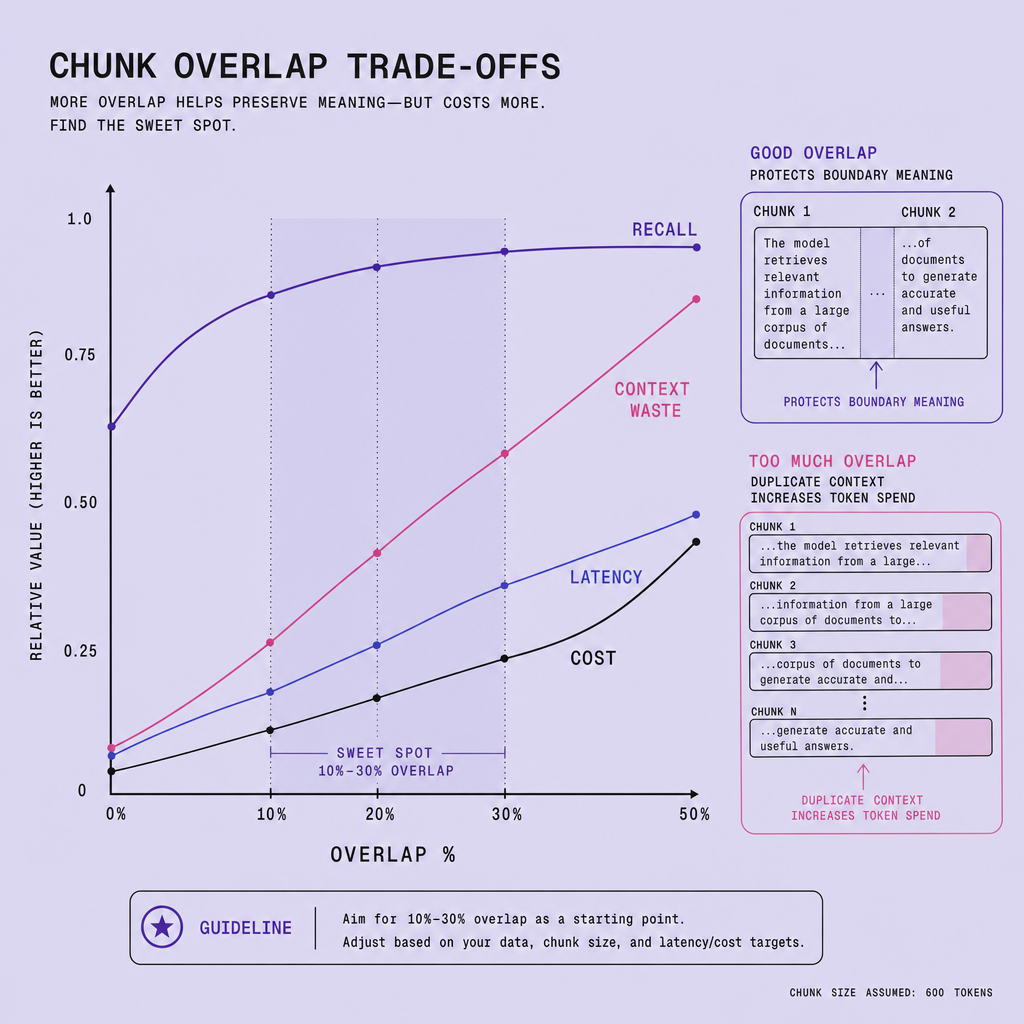
The right range depends on chunk size, query style, and document structure. Small chunks often need more protection. Large chunks often need less. If semantic chunking already keeps related sentences together, extra overlap may buy very little while increasing cost on every query.
Metrics to Measure Before Choosing a Default Chunking Strategy
Chunking debates get vague fast when teams skip metrics. One setup “feels cleaner,” another “seems more complete,” and neither claim survives close inspection. Pick metrics before picking a default. Otherwise teams compare chunking strategies for RAG by feel, ship the one that looks good, and miss the quiet failures -- weak retrieval, bloated prompts, and rising token cost.
Measure retrieval quality first
For retrieval-stage decisions, track whether document chunking helps the retriever return the right evidence.
Recall@k asks a simple question: did the system retrieve any relevant chunk in the top k results? High Recall@k matters for search-heavy assistants, policy lookup, and long-tail questions where missing one key passage breaks the answer.
Precision@k asks the opposite question: how many of the top k chunks were actually relevant? This becomes critical when semantic chunking or fixed-size chunking returns too many near-matches that waste context window space.
MRR -- Mean Reciprocal Rank -- rewards systems that place the first relevant chunk earlier. If users or downstream rerankers depend on the top result being strong, MRR matters more than raw recall.
nDCG is useful when relevance has grades, not just yes/no. For example, one chunk may fully answer a question, while another only mentions the term.
Define one primary retrieval metric based on product behavior first. Search assistants often prefer recall. Cost-sensitive workflows may accept slightly lower recall for cleaner top-k results.
That separation keeps evaluation honest. A retriever can look strong on one metric and still create bad prompts downstream.
Then test end-to-end answer support
Good retrieval numbers do not guarantee good answers. Parent-child chunking often proves this point: retrieval may look similar to smaller chunks, but answer completeness improves because the generator receives enough surrounding context.
Track answer completeness, citation support, and factual grounding against a labeled QA set. A practical pass/fail question works well: did the returned context contain enough information for the model to answer fully and correctly?
Separate retrieval-stage metrics from QA-stage metrics. The best retrieval metric is not always the cheapest system to run.
Track operational drag and cost
Quality is only half the decision. A chunking strategy that improves recall by a small margin but doubles storage, ingestion time, or prompt tokens may be the wrong default.
Latency should be split in two parts: indexing latency and query-time latency. Semantic chunking and document-aware chunking can improve RAG retrieval quality, but they often cost more upfront during ingestion. Query-time latency covers retrieval, reranking, parent expansion, and prompt assembly.
Also measure indexing time, storage growth, and context waste. Context waste means irrelevant or duplicate tokens sent to the model -- often caused by overlap, oversized parent chunks, or redundant top-k hits. That directly increases token cost, even when answer quality barely moves.
So rank chunking candidates on four axes: retrieval quality, answer support, latency, and cost. Decisions should be backed by data.
An Experiment Design to Test Chunking Strategies on Your Documents
If chunking tests are sloppy, the conclusions will be sloppy too. Teams often change the splitter, embeddings, retrieval depth, and reranker together, then act surprised when the results are impossible to interpret. Treat chunking as a controlled test, not a preference. If the goal is better RAG retrieval quality, the experiment has to isolate chunking from everything else.
Start with a representative document sample. Not just clean prose. Include the formats your system actually serves: PDFs, policy docs, API references, tables, FAQs, and code-heavy pages if they exist. A small but mixed test set beats a large, biased one.
Then build a labeled query set from real user intents. Include lookup queries, summarization requests, comparison questions, and multi-hop prompts that require details from more than one section. This matters because semantic chunking may help pinpoint concept-heavy answers, while structural or parent-child approaches may do better on long-form completeness.
Next, define the chunking grid. Test the main document chunking families under the same evaluation harness:
- fixed-size chunks
- semantic chunking
- structural chunking
- parent-child chunking
- document-aware chunking
For each, vary chunk size and overlap in a simple grid -- for example, small, medium, and large chunks, each with low and moderate overlap. Enough coverage to see patterns. Not so much that the test becomes noise.
Do not change chunking and retriever settings at the same time. If embeddings, top-k retrieval, or reranking move too, the comparison stops being valid.
Hold the stack constant: same embedding model, same vector database, same reranker, same top-k, same metadata filters, same prompt template. Understanding why one setup wins requires controlled variables.
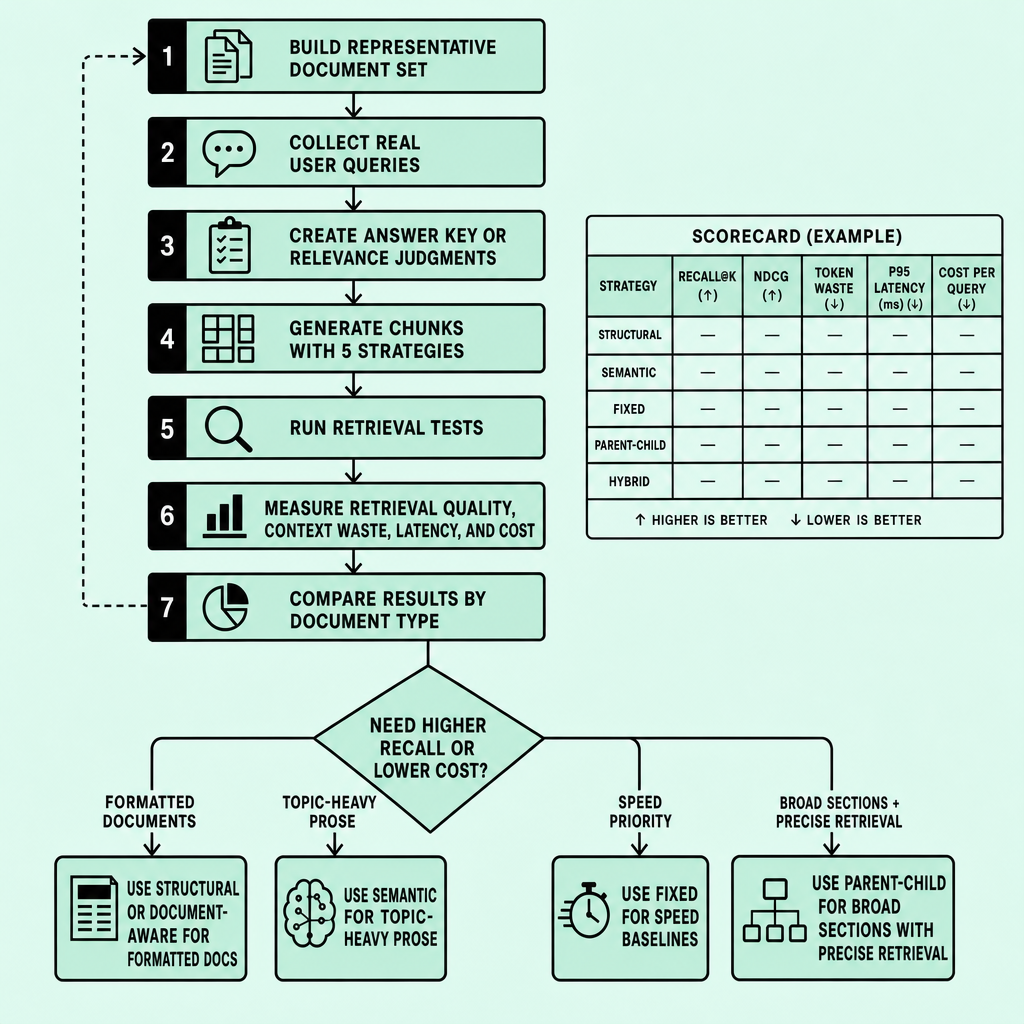
Record every run in a scorecard. At minimum, track Recall@k, MRR, answer completeness, context waste, latency, and token cost. Teams comparing chunking strategies for RAG should also note failure modes -- split tables, broken definitions, duplicated context, missed headers. The best default is the one that wins consistently, not the one that sounds advanced.
A Decision Framework for Setting Your First Production Default
Production defaults have a habit of becoming permanent, even when they were chosen in a rush. That is why the first choice should be boring in the best sense: easy to defend, easy to measure, and easy to revisit. Start with the simplest chunking default that clears your retrieval and answer-quality bar, then add complexity only when test results show a clear reason. For most teams, that first production choice should be based on four pressures: document shape, query style, context window limits, and operating budget.
If the corpus is clean technical documentation with stable headings, structural chunking usually deserves the first shot because it preserves sections, tables, and code fences better than blunt fixed splits. If the content is mostly long-form prose, fixed-size chunking with modest overlap is often the better starting point because it is cheap, predictable, and easy to tune. Mixed enterprise search is where simple defaults fail more often: PDFs, policies, slide exports, scanned text, and wiki pages rarely behave like one document family.
Use semantic chunking when meaning boundaries matter more than layout. Use parent-child only after testing reveals a repeatable pattern: retrieval works better on smaller chunks, but answer completeness drops during generation. That added indexing and retrieval complexity should solve a measured problem, not a hypothetical one.
Choose the first production default by measured Recall@k, MRR, context waste, latency, and token cost -- not by popularity.
Quick matrix:
- API docs: structural, then parent-child if sections are too fragmented
- Policy manuals: structural or document-aware chunking
- Long-form prose: fixed-size chunking, test semantic chunking next
- Mixed enterprise files: document-aware chunking first
Once a default is in production, treat it as provisional. Re-test when the corpus changes, the model changes, or user queries shift.
Frequently Asked Questions
What are the biggest mistakes teams make when testing chunking strategies for RAG?
The biggest mistakes are changing multiple variables at once, using a narrow query set, and judging quality only by answer fluency. A valid chunking test holds embeddings, reranking, and top-k constant while comparing chunking alone. It also includes hard queries, ambiguous queries, and format-heavy documents so the default does not overfit to easy cases.
How does metadata improve chunking strategies for RAG?
Metadata makes retrieval more selective even when chunk boundaries are imperfect. Labels such as document type, section title, version, product name, and access tier help filtering and reranking reduce false positives. In practice, strong metadata can let a simpler chunking strategy perform like a more complex one, which lowers engineering effort without sacrificing quality.
Why should I evaluate chunking separately for retrieval and generation?
Retrieval and generation fail in different ways, so they should not be scored as one blended outcome. A strategy can retrieve highly relevant small chunks but still starve the model of surrounding context needed for a complete answer. Separate evaluation reveals whether the problem is matching the right evidence or supplying enough evidence for synthesis.
What is a good fallback if none of the chunking strategies for RAG performs consistently well?
A good fallback is a hybrid policy based on document class rather than one global default. For example, use structural chunking for docs with headings, fixed-size chunking for clean prose, and parent-child only for long technical sections. This approach is easier to operationalize than fully document-aware logic while still addressing major format differences.
How often should chunking strategies for RAG be re-tested after launch?
Chunking should be re-tested whenever the corpus, embedding model, retriever, or user query mix changes in a meaningful way. It should also be reviewed on a fixed cadence, such as quarterly, because gradual shifts in document formats or search behavior can erode performance slowly. A stable default is useful, but it should never be treated as permanent.
Make Imversion a preferred source on Google
Like this kind of AI and software analysis? Add Imversion as a preferred source so Google can highlight our articles for you in Search, AI Overviews, and AI Mode.