Deterministic Workflows vs AI Agents: When Simple Wins in 2026
Discover when to avoid AI agents in deterministic workflows, and what more effective alternatives exist for your systems. Simplify and enhance your processes!

Deterministic Workflows vs AI Agents: The Short Answer
A lot of teams reach for AI agents when the workflow is already fully mapped. That is where projects get slower, debugging gets uglier, and ops inherits problems nobody needed to create.
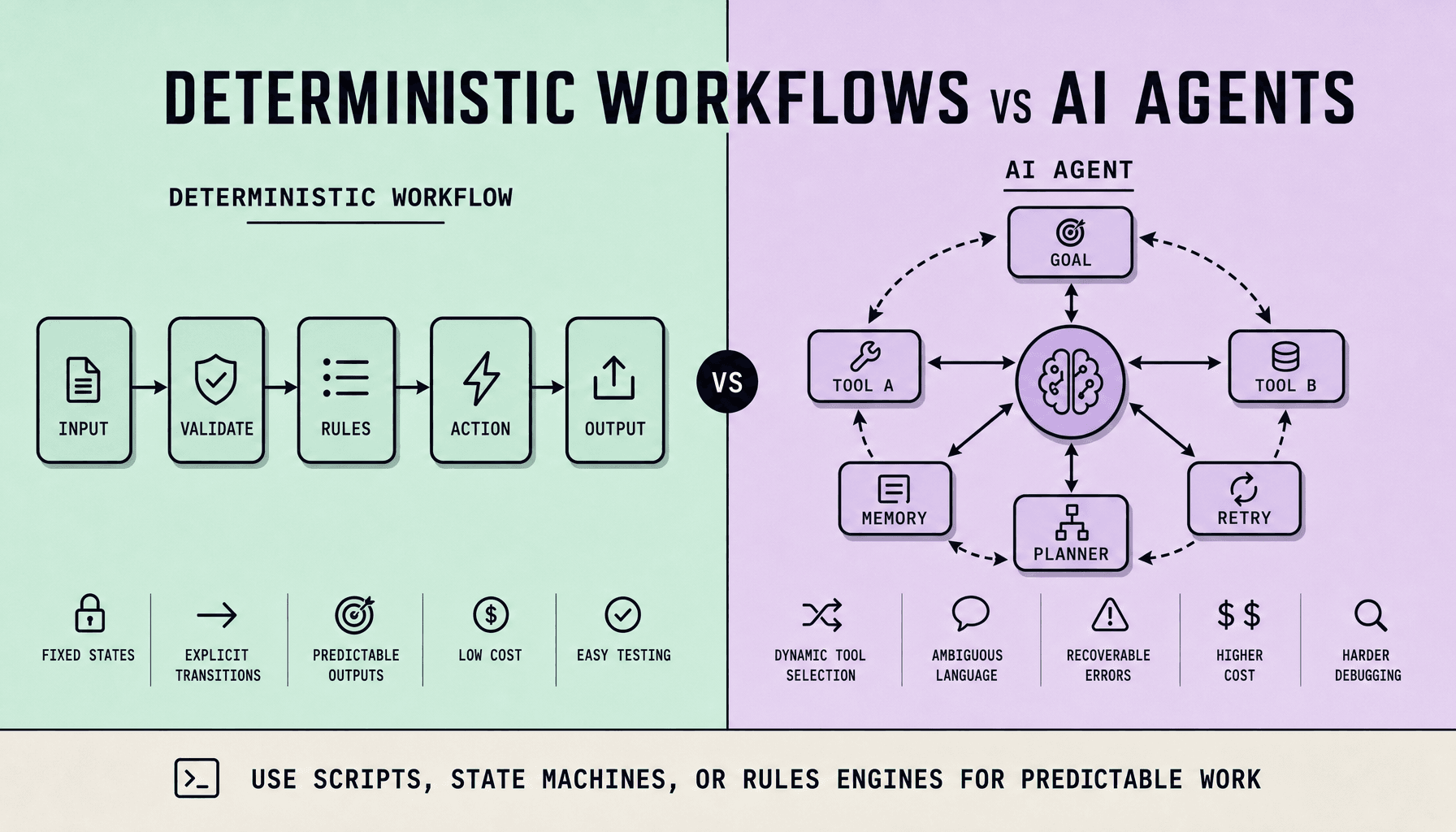
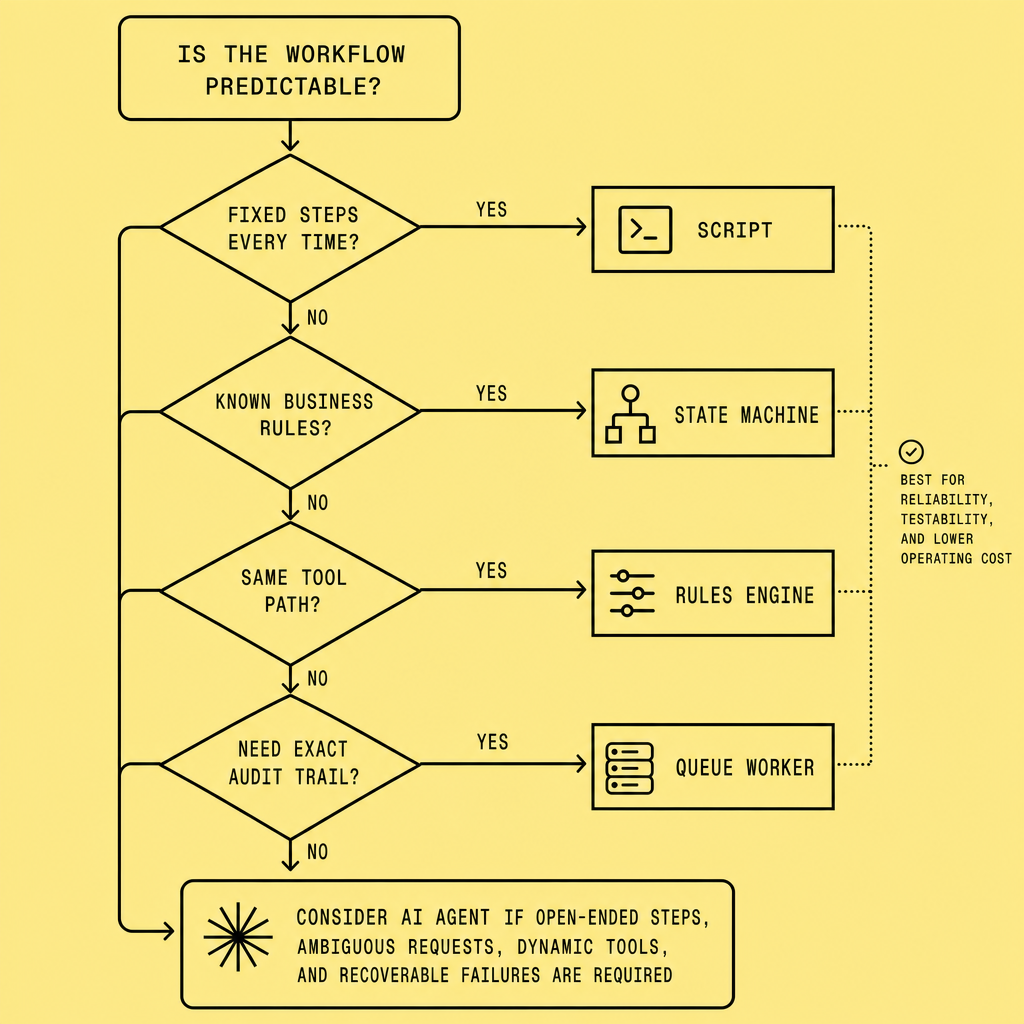
In deterministic workflows vs ai agents, the short answer is simple: if the steps are repetitive, fixed, and fully specifiable in advance, agents are a poor fit. This is exactly when not to use ai agents -- build scripts, state machines, or a rules engine instead.
Teams often force agentic behavior into workflows that already map cleanly to cron jobs, queues, BPMN flows, AWS Step Functions, Temporal, or Drools. That choice adds cost, debugging pain, weaker audit logs, and avoidable failure modes. A practical rule: if you can describe the valid states, transitions, thresholds, retries, and exception paths upfront, use deterministic control flow. Save true ai agent use cases for open-ended steps, ambiguous language, dynamic tool selection, or recoverable errors where the next action cannot be reliably hardcoded. At Imversion Technologies Pvt Ltd, we turn down agent work when a rules engine vs ai agent decision clearly favors the simpler system.
Key Takeaways
-
Start with a hard filter: if the workflow has fixed steps, known branches, explicit thresholds, and strict SLAs, choose deterministic systems first. In deterministic workflows vs ai agents, scripts, queues, BPMN flows, Temporal, Airflow, AWS Step Functions, or a rules engine usually win on reliability, cost, testing, and audit logs.
-
Most inflated ai agent use cases are not agent problems at all. Form routing, invoice approvals, support triage for known categories, ETL sync, onboarding flows, and ticket escalation are classic examples of when not to use ai agents.
-
The better replacement depends on the job. Use OCR plus validation rules for document intake, a rules engine vs ai agent for policy-heavy decisions, classifiers plus retrieval for triage, and state machines for predefined transitions.
-
Agents earn their complexity only when steps are open-ended, language is ambiguous, tool choice must adapt at runtime, and errors can be recovered without corrupting the workflow.
-
We turn down agent builds when simpler systems fit better, because simpler architectures are easier to debug, govern, and ship.
Why the AI Agent Hype Breaks on Predictable Workflows in Deterministic Workflows vs AI Agents
The hype usually falls apart the moment a predictable workflow hits production.
AI agents are often the wrong abstraction for predictable workflows because they trade operational control for flexibility you do not need.
That trade sounds exciting in demos. In production, autonomy brings baggage -- LLM latency, token cost, prompt fragility, harder debugging, weaker audit logs, and more governance work around tool permissions and failure handling. If the path is already known, the tools are fixed, and the acceptable outcomes are explicit, an agent is solving the wrong problem. This is the practical line for when not to use ai agents.
Deterministic systems win here because they are easier to specify, test, and operate. A cron job, queue worker, BPMN flow, AWS Step Functions state machine, Temporal workflow, or Drools policy set can express known steps directly. No hidden reasoning loop. No surprise tool call. Far less ambiguity during incident review.
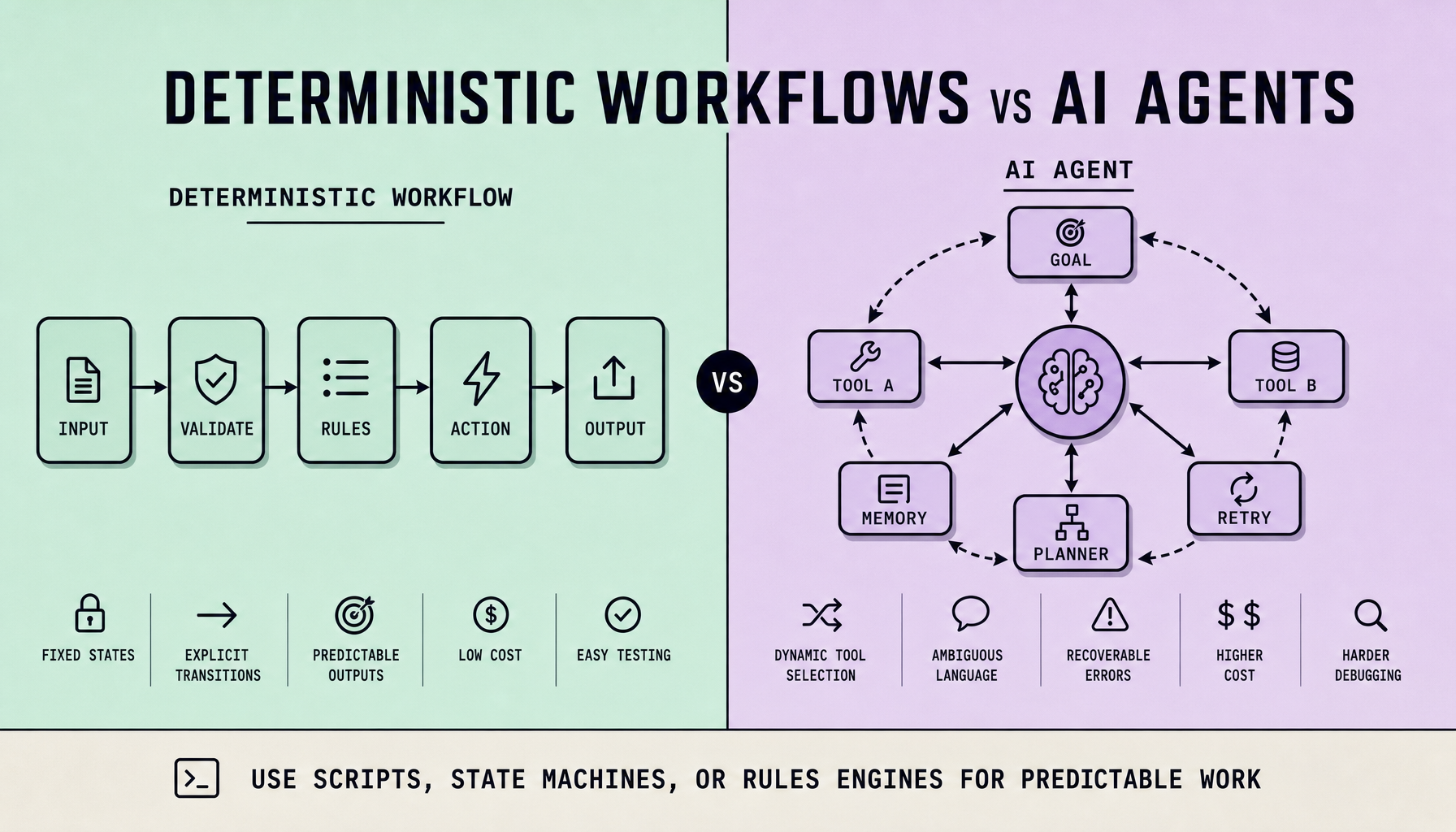
Scripts, state machines, rules engines, and agents -- a practical comparison
| Approach | Best fit | Main risk | Ops/Audit profile |
|---|---|---|---|
| Scripts + queues | Fixed sequences, ETL sync, scheduled tasks | Brittle if branching grows | Simple logs, easy retries, low overhead |
| State machines / BPMN / Temporal | Multi-step workflows with known states and SLAs | Design complexity if over-modeled | Strong observability, explicit transitions, reliable recovery |
| Rules engines like Drools | Policy-heavy decisions, thresholds, routing | Rule sprawl | Auditable decisions, deterministic outcomes |
| AI agents | Open-ended tasks with ambiguous inputs and shifting tool needs | Nondeterminism, latency, governance burden | Harder evaluation, more runtime variability, heavier controls |
The rules engine vs ai agent decision is usually straightforward: if approval thresholds, routing logic, and exception handling can be written as rules, write them as rules. The same goes for scripted automation vs ai agents. Use scripts for invoice sync, onboarding steps, retry queues, and document routing where success paths are predefined.
Our recommendation is blunt. Architecture should follow uncertainty. Do not pay for flexibility you do not need, especially in audited or high-volume workflows. We care about user experience as much as functionality, and users feel operational sloppiness fast -- delayed actions, inconsistent outputs, and unexplained failures.
At Imversion, we turn down agent work when a simpler system will be faster, cheaper, and easier to govern.
What Deterministic Workflows Are and Why They Beat AI Agents on Reliability
If the path is knowable in advance, wrapping it in an agent is usually a mistake.
A deterministic workflow has fixed states, explicit transitions, known business rules, predeclared inputs and outputs, and repeatable outcomes. Think invoice approval thresholds, onboarding steps, ETL sync jobs, or document routing with a clear decision tree. Teams often mistake “uses language” for “needs an agent.” The better question is simpler: do we already know the valid branches, retries, deadlines, and exception paths? If yes, deterministic workflows vs ai agents is usually not a close call.
That reliability is not abstract. These systems are easier to test with fixtures, monitor with structured logs, replay from event history, secure with scoped permissions, and audit with clear state changes. A Temporal workflow, an Apache Airflow DAG, a BPMN flow, or even a cron-driven script gives us observable execution and explicit failure handling. An AI agent introduces probabilistic decision-making where many teams actually need controls.
In practice, when not to use ai agents comes down to one test: if we can specify the workflow before runtime, we should.
Scripts for linear, scheduled, and low-branch flows
Use scripts when the sequence is short and stable -- backup jobs, CSV imports, webhook processing, nightly reconciliation. This is the clearest case for scripted automation vs ai agents. A script plus queues and retries is cheaper to run, easier to diff in code review, and simpler to secure than an agent deciding what to do next.
State machines for governed multi-step processes
Here, control is the advantage. In state machines vs ai agents, state machines fit onboarding flows, ticket escalation, approval chains, and document review because valid states are predefined: submitted, validated, approved, rejected, escalated. No improvisation. Just explicit transitions, SLAs, and recoverable errors.
Rules engines for policy-heavy decisions
Some workflows do not need reasoning. They need policy.
A rules engine vs ai agent is the right choice when decisions follow thresholds, eligibility logic, or compliance policy. Tools like Drools work well for discount rules, fraud flags, routing logic, and approval gates. Policy logic changes often, and readable rules are far easier to review, test, and audit than hidden agent behavior.
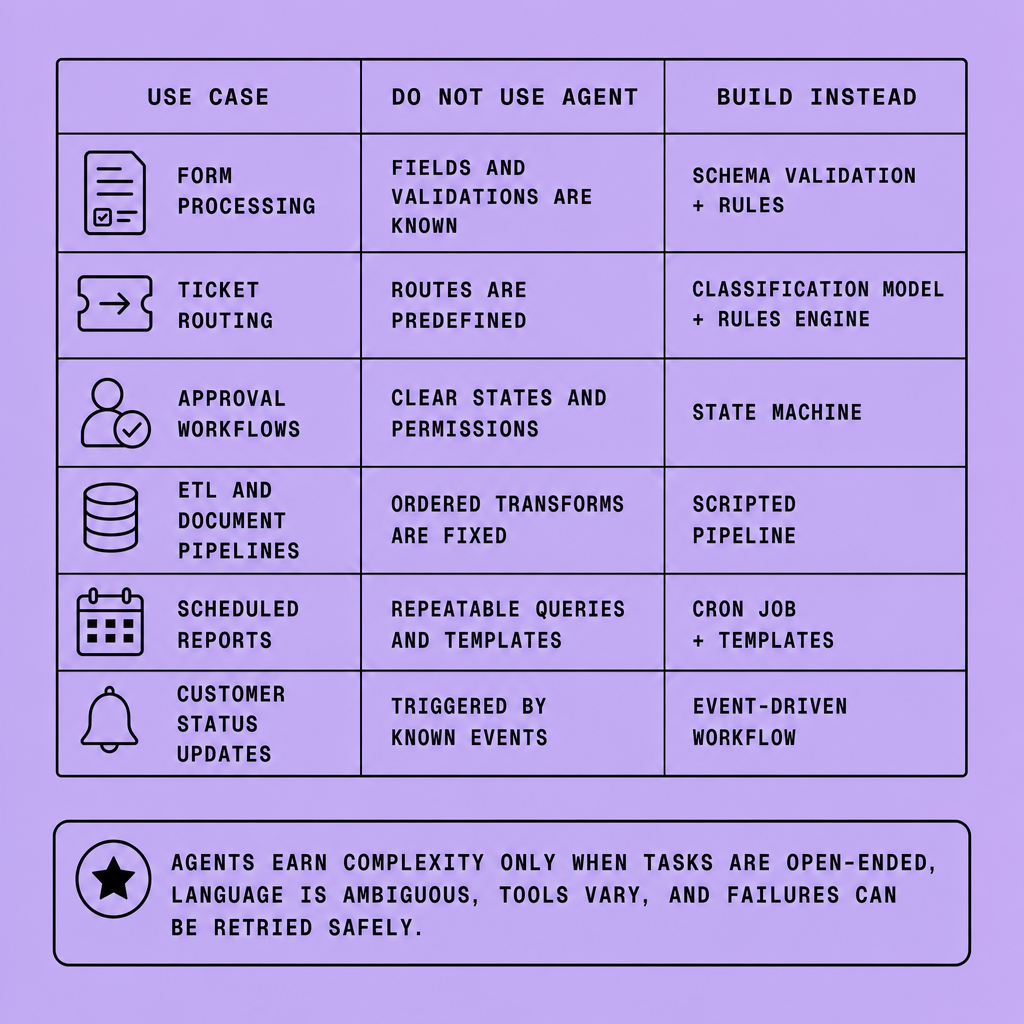
Six False AI Agent Use Cases and What to Build Instead
This is where a lot of teams overcomplicate solid workflow problems.
Most “agent” pitches in operations are mislabeled workflow problems. If the happy path is known and exceptions can go to humans, this is usually when not to use ai agents.
Form processing and document routing
Documents look messy, so teams label the whole thing agentic: PDFs, scans, email attachments, inconsistent layouts. The actual job is usually fixed -- OCR, field extraction, validation, then routing to a known queue. That is not autonomy; it is parsing plus rules.
Build OCR or extraction with a validation layer, then route through a rules engine like Drools or a BPMN flow. Add exception queues for low-confidence fields.
Invoice matching and approvals
“Finance agent” sounds modern. The workflow usually is not. Match PO to invoice, check vendor rules, apply approval thresholds, then escalate exceptions. Known steps. Known controls.
Use deterministic approval logic, audit logs, and retries. A state machine or AWS Step Functions flow is usually better than an agent that can improvise around policy. The tradeoff is simple: less flexibility, much better auditability.
Support triage for known categories
Natural language is not enough reason to add autonomy.
Support teams often ask for ai agent use cases here because tickets arrive in natural language. But if categories are known — billing, login, refund, bug report — use a classifier plus retrieval and a decision tree. Route, suggest, escalate.
Keep actions gated. A classifier can be wrong in measurable ways; an agent can be wrong in harder-to-debug ways. In a rules engine vs ai agent decision, triage usually favors control unless categories change constantly.
ETL and back-office sync
This is rarely agent work. ETL pipelines, ERP sync, CRM updates, and scheduled exports already have explicit source-target mappings, schemas, and failure policies.
Build scripts, queues, a scheduler, and idempotent retries. Airflow, cron jobs, or Temporal are better fits because reliability beats improvisation.
Onboarding, ticket escalation, and renewal reminders
These flows come with predefined states, timers, SLAs, and owners. That is classic state machines vs ai agents territory.
Use Temporal, BPMN, or AWS Step Functions. These tools are easier to maintain, audit, and hand off across teams.
Access reviews and structured internal approvals
Role reviews, policy attestations, procurement sign-off, and entitlement checks are often framed as “autonomous governance.” That framing hides the real shape of the work. The rules, deadlines, approvers, and evidence are known upfront.
Build a rules engine with approval thresholds, reminders, and exception queues. If policy is stable, deterministic systems usually win; if policy is ambiguous and changes often, use AI only for drafting or summarizing, not final approval.
When AI Agents Genuinely Earn Their Complexity
Some tasks do justify the overhead. Most do not.
Use an agent only when the system must resolve real uncertainty at runtime. Not just process text. That is the line.
The strongest ai agent use cases share four traits: the next step is not fully knowable in advance, the input is ambiguous, the right tool cannot be hardcoded, and mistakes can be detected and corrected through a recovery loop. If those conditions are absent, this is still when not to use ai agents -- and the rules engine vs ai agent decision should land on the deterministic side.
Valid signals for agentic design
An agent starts to earn its overhead when a planner-executor pattern can add value:
- Open-ended steps: the workflow needs decomposition at runtime, not a fixed BPMN path or AWS Step Functions graph.
- Ambiguous language: user intent is messy enough that a classifier or form schema will not reliably map it.
- Dynamic tool selection: the system must choose among APIs, retrieval pipelines, search, SQL, or human-in-the-loop escalation based on context.
- Recoverable errors: the task supports retry, fallback, permission checks, and bounded correction without causing unsafe side effects.
What still stays deterministic
Even in systems with one agentic step, most of the surrounding control plane should stay boring on purpose.
If the sequence is known -- invoice thresholds, ETL sync, document routing, onboarding states, approval SLAs -- build scripts, Temporal workflows, queues, or Drools rules first. These systems are easier to test, audit, and debug.
Even valid agent use cases need guardrails: bounded autonomy, tool permissions, approval thresholds, audit logs, and a clear fallback path.
In practice, we turn down agent work when a simpler system will do the job better.
Hybrid Models, Deterministic Workflows vs AI Agents, and Imversion’s Point of View
The cleanest architecture is usually hybrid, not fully agentic.
Use a hybrid architecture by default. Keep the outer workflow deterministic -- queues, BPMN, Temporal, Airflow, AWS Step Functions, or a rules engine like Drools -- and place AI only inside bounded steps such as OCR field extraction, summarization, drafting, classification, or anomaly triage.
That is the practical answer to deterministic workflows vs ai agents: do not hand the whole process to an agent when only one step contains uncertainty.
In scripted automation vs ai agents, we favor scripts, state machines, approval rules, and explicit retries whenever steps, thresholds, branches, and SLAs are known upfront. Those systems are easier to test, easier to audit, and easier to operate because the path is visible before runtime. If a task instead depends on ambiguous language, open-ended retrieval, dynamic tool choice, or recoverable errors that require contextual adaptation, bounded autonomy may be justified. Even then, constrain it with clear inputs, output checks, timeouts, escalation rules, and human review.
Our position is straightforward: decline agent designs when when not to use ai agents is already obvious. A rules engine vs ai agent decision should usually favor the simpler system when it can meet the requirement safely and predictably. The best ai agent use cases are narrow, monitored, and attached to deterministic control planes rather than replacing them.
Frequently Asked Questions
What is the simplest way to decide between deterministic workflows vs ai agents?
The fastest decision test is to ask whether the workflow can be specified before runtime with clear states, rules, retries, and exception paths. If the answer is yes, deterministic systems are the right default because they are easier to test, explain, secure, and operate under production constraints.
How do deterministic workflows vs ai agents differ in compliance and auditability?
Deterministic workflows produce explicit transitions, reproducible outcomes, and structured logs that make audits straightforward. AI agents introduce variable reasoning paths and runtime choices, which means teams usually need extra controls, logging, review steps, and policy boundaries to reach the same compliance standard.
Why should a team avoid using agents for approval workflows?
Approval workflows usually depend on fixed thresholds, named approvers, deadlines, and escalation rules. That structure makes them better suited to rules engines or state machines, which preserve a clean audit trail and predictable enforcement. Agents can add ambiguity exactly where policy interpretation needs to stay consistent.
When is a hybrid system better than a fully agentic design?
A hybrid system is better when only one part of the process is uncertain, such as summarizing text or extracting messy fields, while the rest of the workflow is known. In that setup, deterministic orchestration keeps control, and AI is limited to a bounded task with validation and fallback.
What hidden costs do teams miss when comparing deterministic workflows vs ai agents?
Teams often underestimate evaluation overhead, permission design, prompt maintenance, runtime variance, and incident response complexity. The real cost of an agent is not just model usage; it is the operational burden of proving that dynamic behavior remains safe, reliable, and understandable over time.
Make Imversion a preferred source on Google
Like this kind of AI and software analysis? Add Imversion as a preferred source so Google can highlight our articles for you in Search, AI Overviews, and AI Mode.