LLM Gateway: Essential Functions in Production Stacks
An LLM gateway is vital for managing model integrations, routing, and security in production AI stacks. Explore its essential functions.

On this page
What an LLM gateway should do in a production AI stack
Direct model integrations feel fine right up until they become an operational mess. One service has its own retry logic, another stores provider keys where it should not, and nobody can say with confidence which team drove last week’s spend spike. That is the point where an LLM gateway stops being architecture theater and starts being necessary.
LLM Gateway Key Takeaways
-
An LLM gateway should centralize provider abstraction so apps call one stable interface while the gateway handles OpenAI, Anthropic, Google, Azure OpenAI, or a self-hosted vLLM backend behind the scenes. That removes duplicated SDK logic quickly.
-
LLM routing belongs in the gateway. Route by latency, token cost, region, tenant tier, or task type -- for example, cheaper models for drafts and stronger models for final responses. But routing needs measurement. Decisions should be backed by data such as p95 latency, token usage, error rate, and cache hit rate.
-
An AI gateway or LLM proxy must keep API keys server-side, enforce auth, and apply per-user, per-team, or per-tenant quotas on requests, tokens, spend, or concurrency. Without that, spend drifts and access control becomes messy.
-
Production gateways also need observability and guardrails: structured logs, OpenTelemetry traces, cost allocation by team or app, prompt/response capture with redaction, and PII controls before data reaches a provider.
-
Retries, timeouts, caching with Redis, and fallback between providers are gateway duties. Agent orchestration is different -- it manages tool use, memory, and multi-step workflows, not the policy, security, and reliability layer underneath.
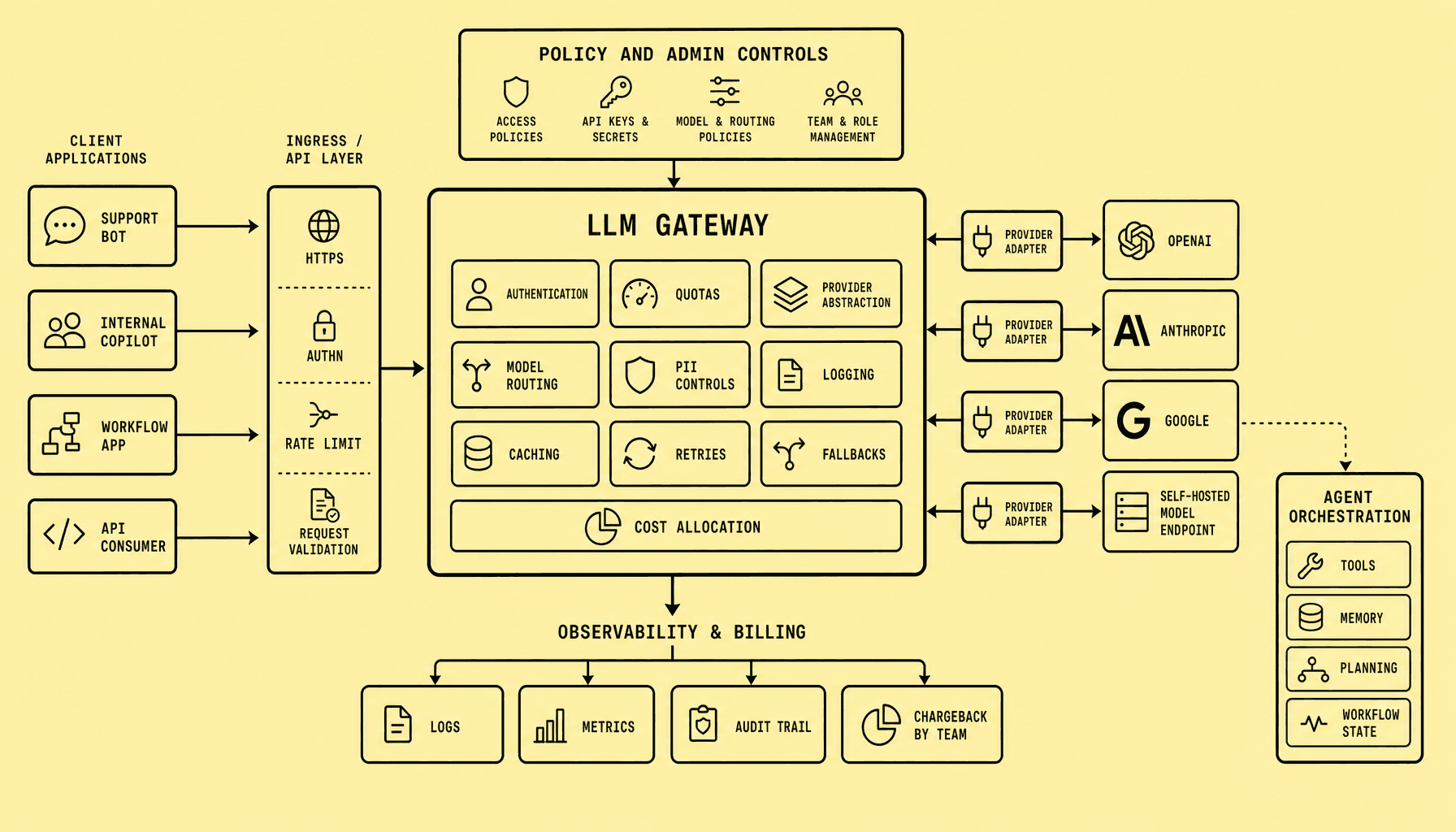
Core LLM gateway responsibilities: abstraction, routing, guardrails, and economics
Most teams do not decide to build a messy AI stack. They get there by accretion. A few direct SDK calls turn into ten. Retry logic forks. Provider auth gets copied between services. Then someone asks a basic operations question -- which app is expensive, which route is slow, which tenant hit limits -- and there is no clean answer.
An LLM gateway should own the boring but critical parts of a production AI stack. Teams usually start with direct SDK calls to OpenAI, Anthropic, Google, or Azure OpenAI. Then things sprawl -- API keys leak into services, retries behave differently across apps, and nobody can answer a simple question like which team burned the budget last week.
The gateway fixes that by creating one stable API and one policy surface across providers.
Access layer
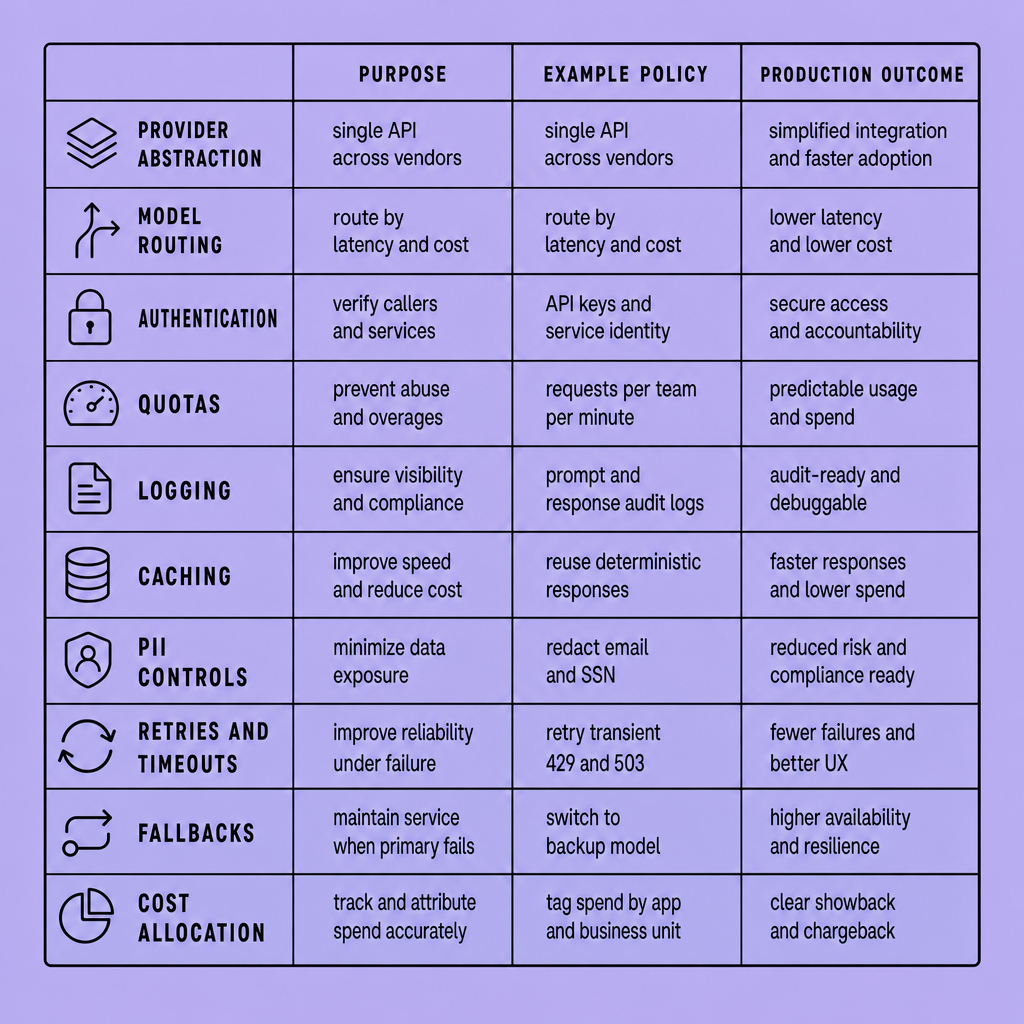
First, provider abstraction. Applications should call a consistent endpoint such as /generate or /chat, while the AI gateway translates payloads, auth, and response formats for each backend -- including self-hosted vLLM. That reduces lock-in because migrations stop being app-by-app rewrites. One contract in front. Provider-specific mess behind it.
Authentication and authorization belong here too. Keep provider keys server-side. Enforce RBAC so a support bot can use approved low-risk models, while a regulated workflow can be restricted to a narrow set of deployments or regions.
Control layer
The common failure here is mixing routing with orchestration and pretending they are the same problem. They are not.
Model routing is not agent orchestration. The gateway decides which model should handle a request based on policy: latency target, tenant tier, region, safety class, or token cost. An example is simple and useful: route drafting to a cheaper model, then send final answer generation to a stronger model. The agent decides what steps to take. The gateway decides where each model call goes.
Quotas and rate limiting sit beside routing. Per-user, per-tenant, or per-application controls should cover request rate, token quotas, concurrency, and spend caps. Decisions should be backed by data -- p95 latency, error rate, and token usage tell teams whether a route is smart or just familiar.
Reliability layer
This is where shortcuts become expensive. If the gateway cannot explain failures, compare providers, or keep repeated requests from wasting money, it is not doing enough.
Production gateways need observability, not just logs. Capture request metadata, model choice, latency, token counts, cache status, and failure reasons. Export traces and metrics through OpenTelemetry so operators can debug slow paths and compare providers cleanly.
Caching belongs here as well. A Redis-backed semantic or prompt-response cache can cut repeat cost and latency, but only for safe workloads. Don’t cache blindly if prompts contain user-specific or sensitive context.
Retries, timeouts, and fallbacks are gateway work. Use bounded retries for transient failures. Fail over from one provider to another only when prompts, tools, and policy constraints are compatible.
A useful gateway is judged less by how many providers it supports and more by whether it centralizes the controls every team would otherwise rebuild badly.
Finance and ops layer
If spend cannot be tied back to teams, features, or tenants, the gateway is missing one of its main jobs.
Cost allocation is a first-class responsibility. Track spend by team, application, tenant, and feature. Token-based pricing varies by model, so chargeback needs request-level accounting. Without that, an AI gateway is just a proxy with better branding.
LLM gateway vs agent orchestration: where the boundary should be
The confusion starts early because both layers touch model calls. But they should not own the same concerns. Once they do, policy drifts and operations get unpredictable.
The boundary should be strict: the LLM gateway owns control, and agent orchestration owns execution.
Teams blur this line early. They put provider SDK calls, retries, API keys, and ad hoc failover inside LangGraph or AutoGen flows because it feels faster. But that choice spreads policy across every workflow. Spend gets harder to attribute. Quotas drift. Outage handling becomes inconsistent. And one agent silently behaves differently from another.
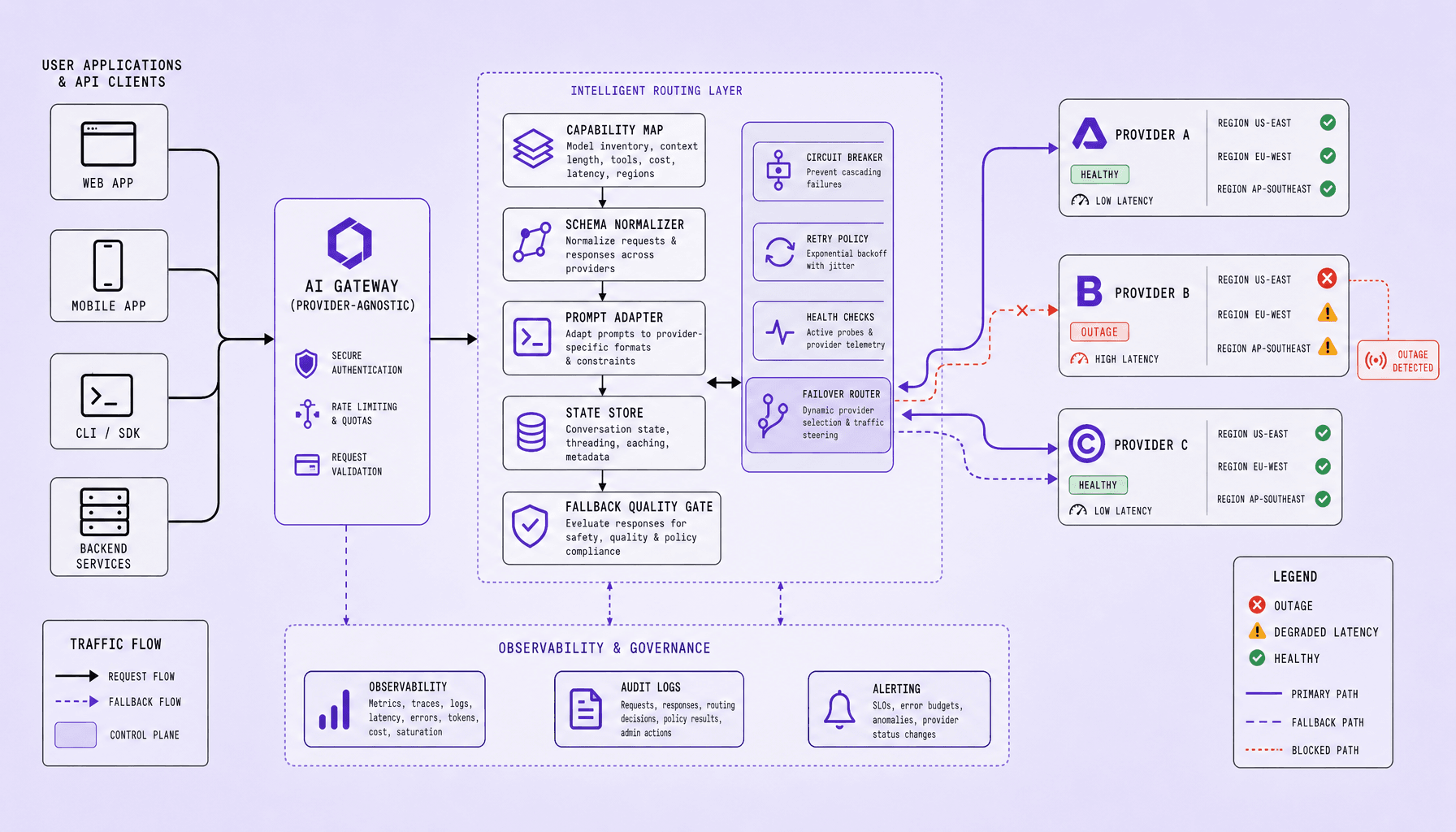
An LLM gateway -- whether exposed as an LLM proxy or a broader AI gateway -- should act as the policy enforcement point and control plane. It should centralize provider abstraction, LLM routing, authentication, quotas, logging, caching, PII controls, retries, fallbacks, and cost allocation. The orchestration layer is the data plane for agent behavior: multi-step workflows, tool calling, memory, planning, branching, stateful execution, and human approval steps.
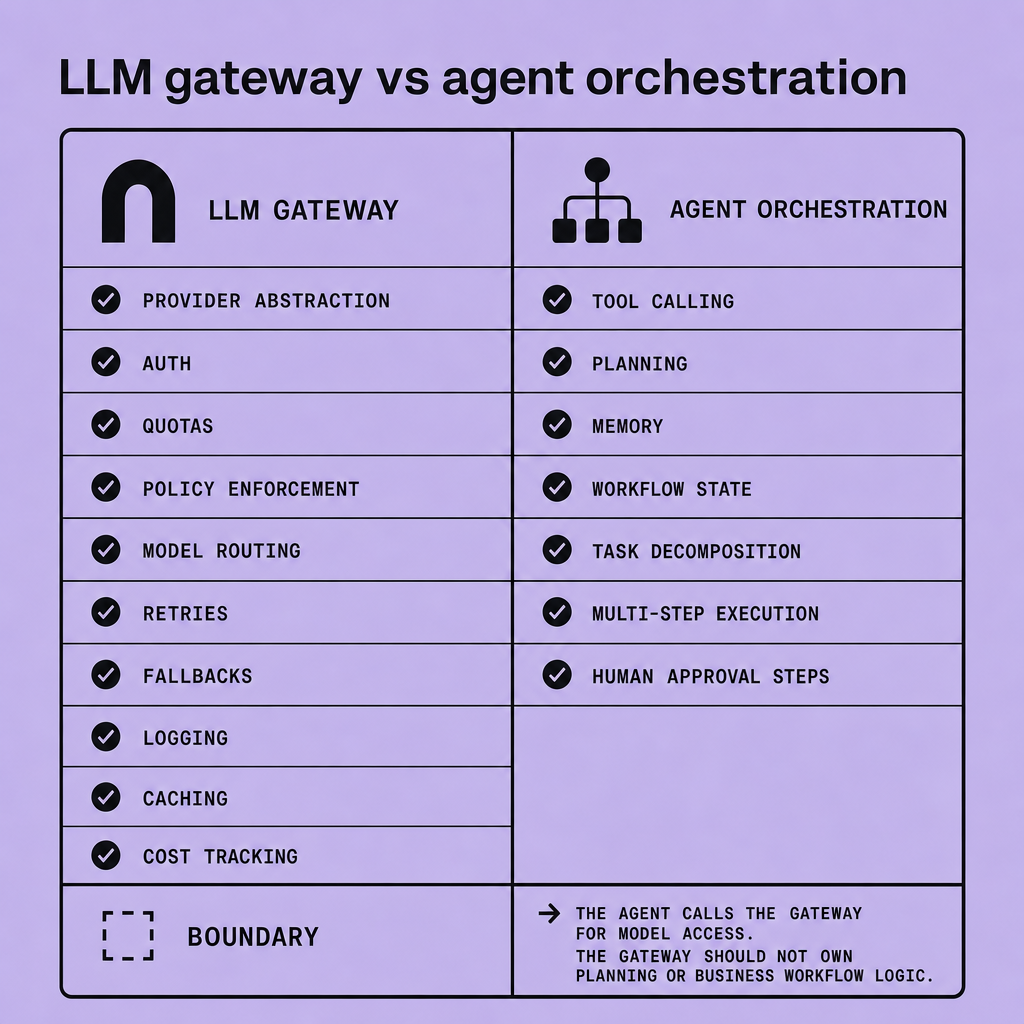
Clarity is better than complexity. If orchestration code owns auth or failover, business logic and infrastructure policy get tangled fast.
Ownership by layer
| Dimension | Gateway | Orchestration layer | Shared integration point |
|---|---|---|---|
| Access and governance | API key protection, auth, quotas, tenant policy | Uses approved access path only | Caller identity passed downstream |
| Reliability and routing | Provider abstraction, LLM routing, retries, fallbacks, health-based failover, model routing | Chooses workflow path or next tool | Orchestrator can request model intent; gateway enforces final route |
| Execution logic | No workflow state | Planning, tool calling, memory, state, human handoff | Trace IDs, metadata, usage events |
| Observability and economics | Token logs, p95 latency, cache hit rate, chargeback by team/app | Step-level traces and task outcomes | OpenTelemetry spans, request correlation |
A clean production design looks like this: application or workflow engine -> orchestration layer -> LLM gateway -> OpenAI, Anthropic, Google, Azure OpenAI, or vLLM. Redis can sit behind the gateway for response caching. OpenTelemetry can stitch traces across both layers.
One practical caveat. Shared concerns still need contracts. The orchestrator may label a request as “draft,” “premium tenant,” or “PII-sensitive,” but the gateway should make the final routing and enforcement decision. Reliability disappears when every agent invents its own infrastructure rules.
Architecture components of an LLM gateway in production
A production-ready AI gateway needs a small set of well-placed components, not a pile of abstractions. Teams usually feel the pain after direct SDK integrations spread across services: keys end up everywhere, routing logic forks by app, and outage handling becomes inconsistent.
Ingress and API layer
The front door has one job: accept requests in a controlled way before provider-specific complexity leaks upstream.
The front door is usually an API gateway or LLM proxy built on Kong, Envoy, NGINX, or a custom service. It should expose one stable interface -- for example /chat, /responses, or /embeddings -- and terminate client auth, enforce basic rate limits, and attach tenant metadata before any provider call happens.
This layer should not contain business workflows. It should normalize requests and pass them downstream.
Provider adapters and routing engine
Abstraction sounds tidy on paper. In practice, it means someone has to absorb all the provider quirks so applications do not have to.
Behind ingress, provider adapters translate one internal request shape into OpenAI, Anthropic, Google, Azure OpenAI, or vLLM-specific payloads and auth formats. That is the abstraction layer.
Then the routing engine decides where the call goes. Common criteria include latency, token cost, region, tenant tier, and model capability. A practical rule is simple: draft tasks can go to a cheaper model, while high-stakes outputs route to a stronger one. Explicit routing rules are usually easier to operate than opaque heuristics.
Policy, security, and secrets
This section is where governance stops being a slide and becomes code.
Policy checks should run before outbound calls. This is where per-tenant quotas, model allowlists, content rules, and PII redaction belong. If a request includes sensitive fields, redaction should happen here, before the payload reaches any external provider.
Server-side key management is non-negotiable. Provider credentials belong in a secrets manager, not in browsers, mobile apps, or scattered microservices.
Cache, reliability, and observability
Reliability is not one feature. It is the accumulation of a few disciplined controls applied in one place.
A Redis cache can sit after policy checks and before provider dispatch for repeatable prompts, embeddings, or response fragments. Retries, timeouts, circuit breaker logic, and fallbacks should sit around the outbound provider call -- not hidden inside application code -- so the gateway can fail over cleanly when a provider degrades.
Observability should capture each hop with OpenTelemetry traces, request IDs, token usage, cache hit rate, p95 latency, and provider error codes. Billing or chargeback can use the same usage stream to allocate spend by team, application, or tenant.
Request path: app request -> ingress/auth -> policy and PII redaction -> cache lookup -> routing -> provider adapter -> model provider -> response normalization -> usage logging and chargeback -> application response.
Implementation checklist for deploying an LLM gateway safely
The first milestone is simple: force all model traffic through one governed path. Not agent flows. Not fancy orchestration. One path through the LLM gateway so keys, spend, failures, and audit data stop hiding inside app code.
v1: minimum controls before production
Before teams debate advanced routing, they need the basics that prevent chaos.
Start with the controls that remove chaos fast:
- Provider abstraction: expose one internal API for chat, embeddings, and moderation-style calls. The AI gateway should translate to OpenAI, Anthropic, Google, Azure OpenAI, or a self-hosted vLLM backend behind the scenes.
- Central auth and RBAC: keep provider API keys server-side only. Apps authenticate to the gateway, not to providers. A clean acceptance criterion: all provider keys are removed from application code and client configs.
- Tenant tagging and quotas: every request should carry tenant tagging, app ID, and environment. Then enforce spend caps, request limits, token limits, or concurrency limits per tenant.
- Audit log and spend metadata: log model, tenant, latency, status, prompt token count, completion token count, estimated cost allocation tags, and fallback events. Another acceptance criterion: 100% of traffic is tagged by tenant and application.
- PII controls: redact or hash sensitive fields before storage. A PII scanner should run on prompts and outputs that enter logs or traces.
- Retry budget and circuit breaker: retry only safe failures, with a bounded retry budget. Add a circuit breaker so one failing provider does not drag the whole system down.
One mistake breaks this entire setup: letting teams bypass the gateway for a “temporary” integration. Temporary paths become permanent blind spots.
what to add as usage grows
Once visibility is stable, the gateway can get smarter. Before that, “smart” usually means harder to debug.
Add LLM routing rules based on latency, token cost, region, tenant tier, and provider health. Put fallback policy behind explicit triggers such as rate limits, 5xx errors, or timeout thresholds. Add cache policy for deterministic or near-duplicate requests, backed by Redis, with clear TTL rules and a cache hit rate metric.
Because decisions should be backed by data, routing changes should be judged by p95 latency, error rate, cache hit rate, and cost allocation by team or product -- not by instinct.
Never log raw prompts by default. If prompts may contain support tickets, contracts, or user messages, raw logging creates an avoidable compliance and trust problem.
Production examples: how LLM routing, fallback, and cost allocation work in practice
Production pressure exposes whether the gateway is really acting as a control plane or just forwarding requests with nicer naming. Routing, fallback, and spend tracking are where that difference becomes obvious.
In production, an AI gateway should make model choice, failure handling, and spend tracking explicit. The point is not “smart” model selection for its own sake. The point is to enforce business rules at one control point so applications do not each invent their own routing, retry, and billing logic.
A support chatbot is a clear routing example. Low-risk FAQ prompts can go to a smaller, cheaper model first, while refund disputes, account recovery, or policy exceptions route to a stronger model based on prompt class, tenant tier, geographic policy, or p95 latency targets. That is production routing: deterministic policy at the edge, not opaque guesswork inside every app service.
An internal copilot shows why fallback matters. If one provider starts timing out or returns elevated error rates, the gateway can retry on the same route within policy, then fail over to another approved provider when health checks or SLA thresholds mark the primary path degraded. Teams often keep fallback paths warm with canary traffic so failover is tested before an incident. The tradeoff is consistency: model behavior, formatting, and tool use may change across providers, so fallback policy should define where that variation is acceptable.
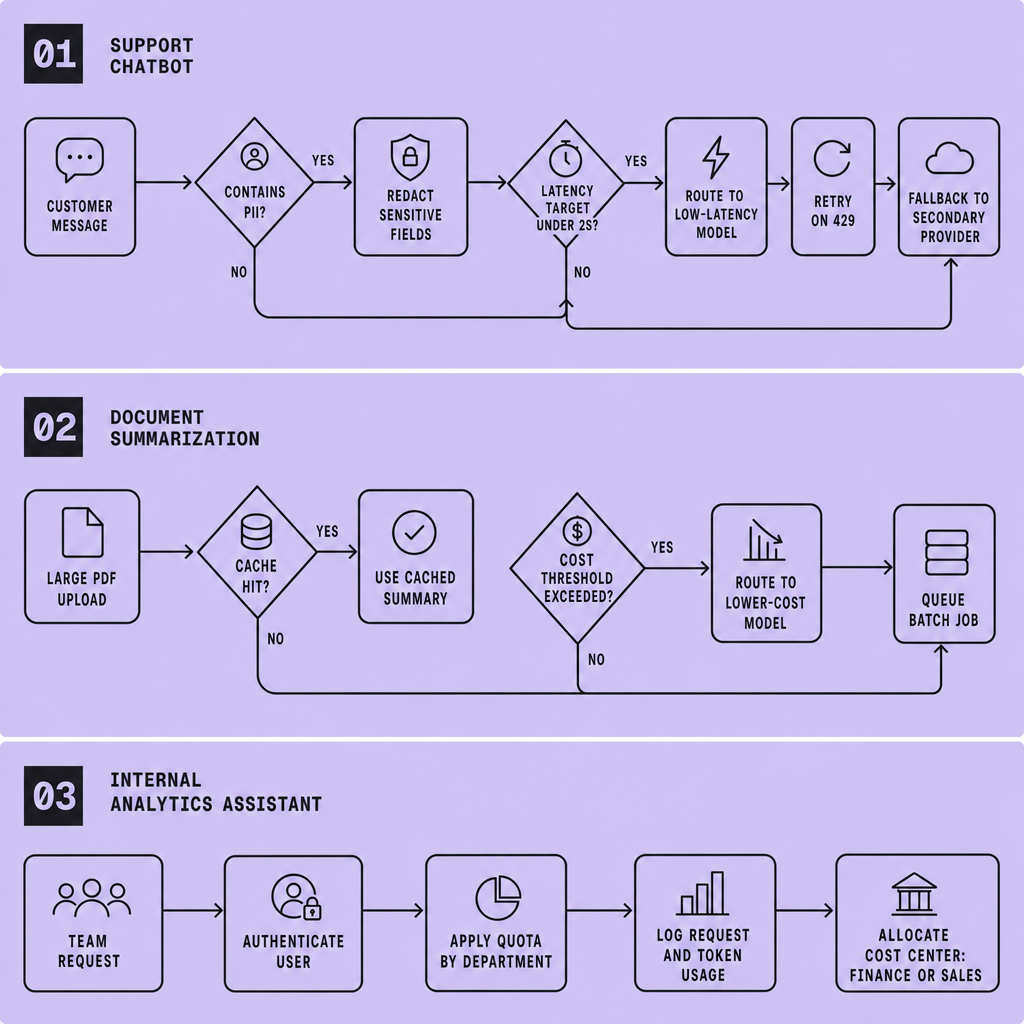
Cost allocation is the finance-facing version of the same control plane. The gateway can tag each request by team, app, environment, tenant, or budget code, then emit token and request metadata into centralized logs or telemetry. That makes monthly chargeback, budget alerts, and route tuning possible from one audit trail instead of stitched-together provider invoices.
Frequently Asked Questions
What is the difference between an LLM gateway and an API gateway?
An API gateway manages generic traffic concerns such as authentication, rate limiting, and request forwarding, while an LLM gateway adds model-specific controls such as provider abstraction, token accounting, prompt and response logging policies, model routing, fallback handling, and AI-specific guardrails. In production, many teams use both, but the LLM gateway owns the model control plane.
How does an LLM gateway help with compliance and audits?
An LLM gateway creates a single enforcement point for redaction, access policy, region restrictions, retention settings, and usage records. That matters for audits because teams can show one governed path for model traffic, one place for approval rules, and one source of truth for who sent what, under which policy, at what cost.
Why should an LLM gateway make the final routing decision instead of the agent?
An agent can suggest intent, such as draft, premium, or sensitive, but the gateway should make the final routing decision because it has the full policy context. Centralizing that choice prevents individual workflows from bypassing quotas, using disallowed models, or applying inconsistent fallback logic during outages and cost spikes.
When should a team avoid caching in an LLM gateway?
A team should avoid caching when prompts or outputs contain user-specific context, regulated data, rapidly changing facts, or workflow state that could make a reused answer misleading. Caching is most useful for repeatable, low-variance requests, but it becomes risky when correctness, privacy, or personalization matters more than speed or cost savings.
What should cost allocation from an LLM gateway actually include?
Cost allocation should include the caller identity, tenant, application, environment, feature, selected model, token counts, cache result, fallback events, and estimated request cost. That level of detail lets finance and engineering reconcile spend accurately, identify expensive workflows, and decide whether higher quality models are producing enough business value to justify their cost.
Make Imversion a preferred source on Google
Like this kind of AI and software analysis? Add Imversion as a preferred source so Google can highlight our articles for you in Search, AI Overviews, and AI Mode.