Prompt Caching Economics: Fragility in Cost-Saving Strategies
Discover how prompt caching economics impacts enterprise costs, the importance of stable context, and when caching may fall short.


On this page
How prompt caching economics changes the cost of repeated LLM context
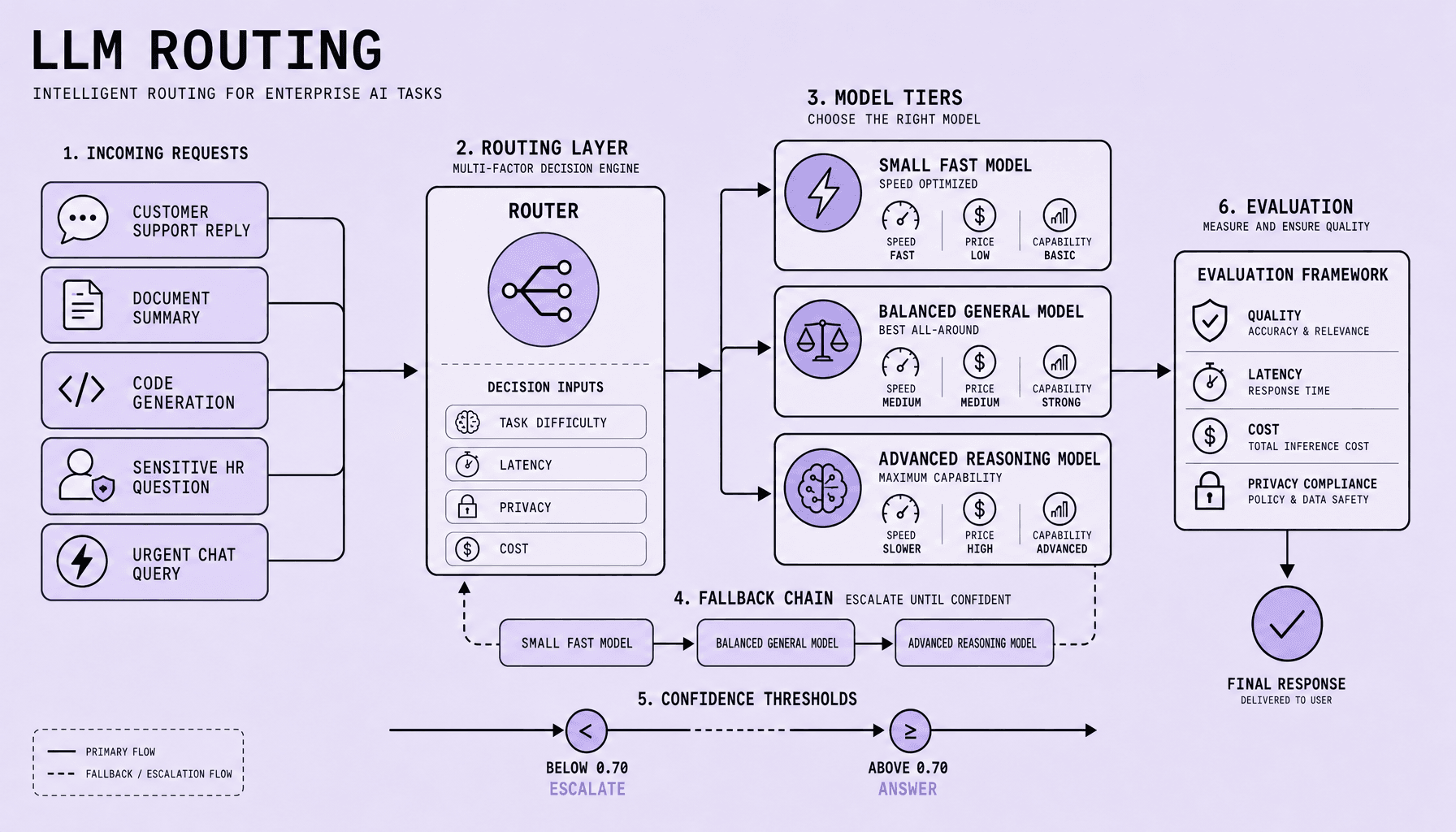
If your LLM bill keeps climbing even though the app is sending "the same context" over and over, the problem is usually hidden in the prefix. Long system prompts, policy blocks, tool schemas, and scaffolding get reprocessed on every call unless the provider can reuse them. Prompt caching changes that math by turning a repeated prefix into an amortized setup cost instead of a full-price charge every time.12
The catch is that the savings are fragile. Most prompt caching and LLM prompt caching systems need an exact or near-exact repeated prefix, stable routing through the same provider path, and enough reuse to justify the first uncached pass.23 Keep editing the system prompt, rotating tool schemas, injecting different retrieval blocks near the top, or sending requests through inconsistent model routes, and cache hits drop. Once that happens, the economics fall apart.
Provider behavior differs too. Some vendors expose discounted cached input pricing. Others focus on lower prefill latency. Some make cache behavior less predictable across sessions or regions.145 In practice, prompt caching helps most with long system instructions, policy text, codebase scaffolding, and agent memory frames that stay stable across many requests. At Imversion Technologies Pvt Ltd, the useful heuristic is simple: clarity beats complexity -- keep reusable context fixed, measure cache-hit rate, and assume little benefit when prompts are short, personalized, or frequently invalidated.36
Key Takeaways on prompt caching economics
-
Prompt caching economics only gets attractive when a large, stable prefix is reused often enough to offset the first uncached pass. Long system prompts, policy blocks, tool schemas, product catalogs, and agent setup context are the usual winners.125
-
Cache-hit assumptions drive the model. Exact-prefix matching, provider-specific minimum token thresholds, and short cache lifetimes can crush expected prompt caching cost savings if teams keep editing headers, timestamps, or retrieval order.246
-
Provider behavior is not uniform. Some forms of context caching lower input cost, some improve latency, and some do both -- but mostly on prefill, not output generation. So bills do not fall as much as teams expect when completion tokens dominate.125
-
Routing can quietly kill LLM prompt caching. If the same request pattern gets split across models, regions, or inference clusters, reuse drops and the economics break. Decisions should be backed by data -- measure hit rate, cached-token share, and end-to-end latency before assuming savings.37
-
Prompt caching produces little real benefit for short prompts, highly personalized prompts, volatile RAG prefixes, or agent sessions where memory scaffolding changes every turn. In those cases, prompt caching is more theory than operational win.34
Why long system prompts and enterprise context change prompt caching economics
Most teams do not start thinking about prompt caching because of architecture elegance. They start because repeated context has become expensive.
Prompt caching only changes unit economics when the costly part of the request is the same long prompt prefix sent over and over. That is why long system prompt content, enterprise policy block text, tool schema definitions, retrieval context scaffolding, and agent-session setup create the strongest case for LLM prompt caching.12
The mechanism is simple. The first call still pays full prefill cost because the model must ingest that entire prefix. Later calls can become cheaper or faster if they begin with the exact same token sequence and the provider supports prefix reuse or discounted cached-input pricing.245 So prompt caching economics is mostly about amortization.
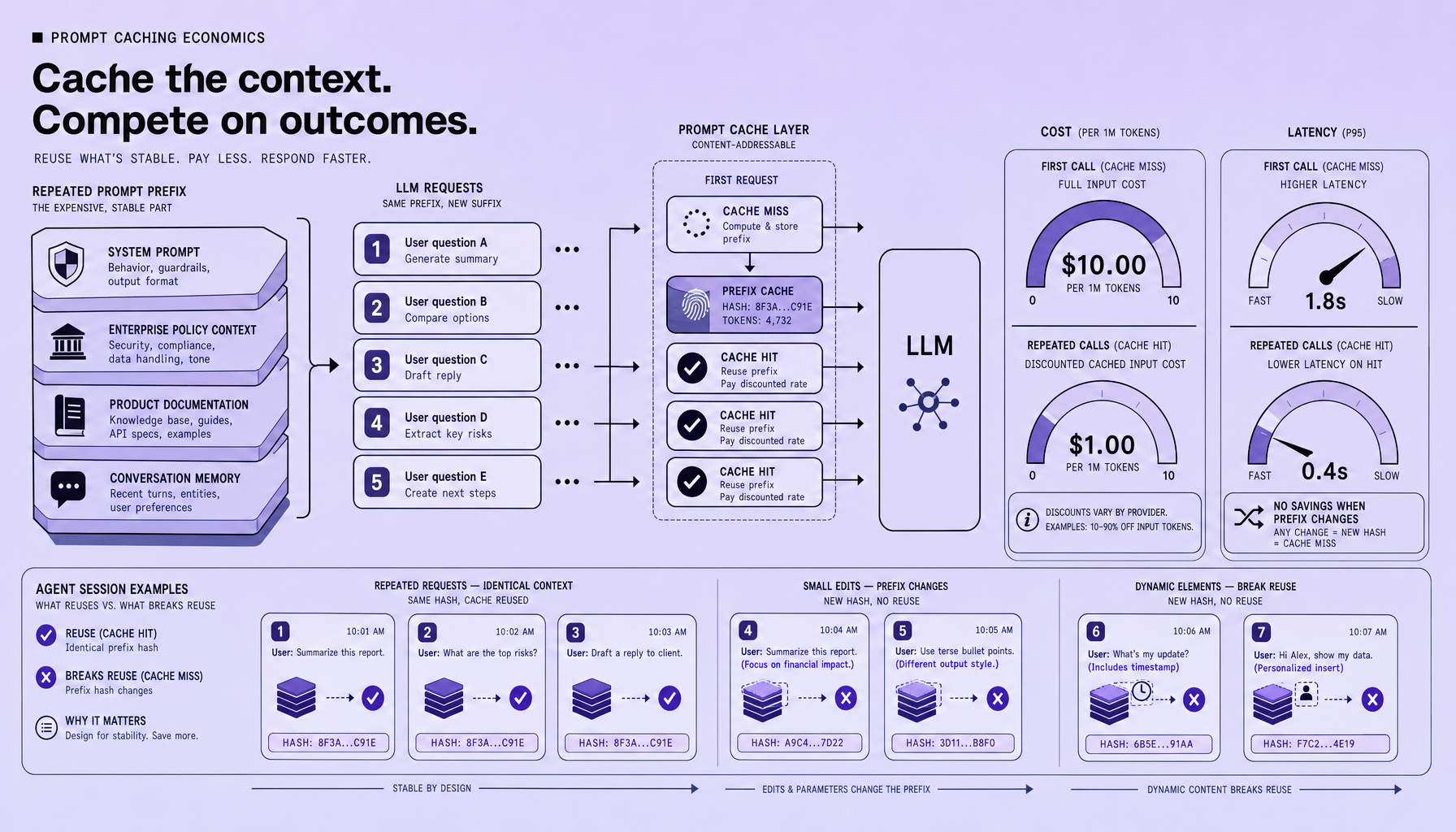
And the savings usually come from input processing, not output generation.125
A practical example makes this clearer. Suppose an application sends a 10,000-token reusable prefix -- system prompt, enterprise policy block, tool definitions, and retrieval scaffolding -- before every user query. On the first request, all 10,000 tokens are billed and prefetched normally. If the next 999 requests reuse that same prefix exactly, the economics shift: one expensive setup pass, then a discounted repeat path for the cached prefix, with only the variable tail priced normally.24 Double that to 20,000 tokens and the benefit grows, because the repeated prefill portion is larger. Reuse count matters just as much. A long prefix reused three times behaves very differently from one reused 3,000 times.
That is where many teams get tripped up. Provider implementations differ, so "cached" does not mean one standard discount. Some expose cached-input pricing directly. Others emphasize latency improvement or enforce strict cache matching and time-window rules.125 Exact-prefix sensitivity is the catch. Change a timestamp, reorder a tool schema, inject different retrieval context near the top, or route the request to a different model path, and the cache hit can disappear.36
Treat reusable context like infrastructure: model it as a setup expense plus a discounted repeat path, not as a fully variable cost on every call.
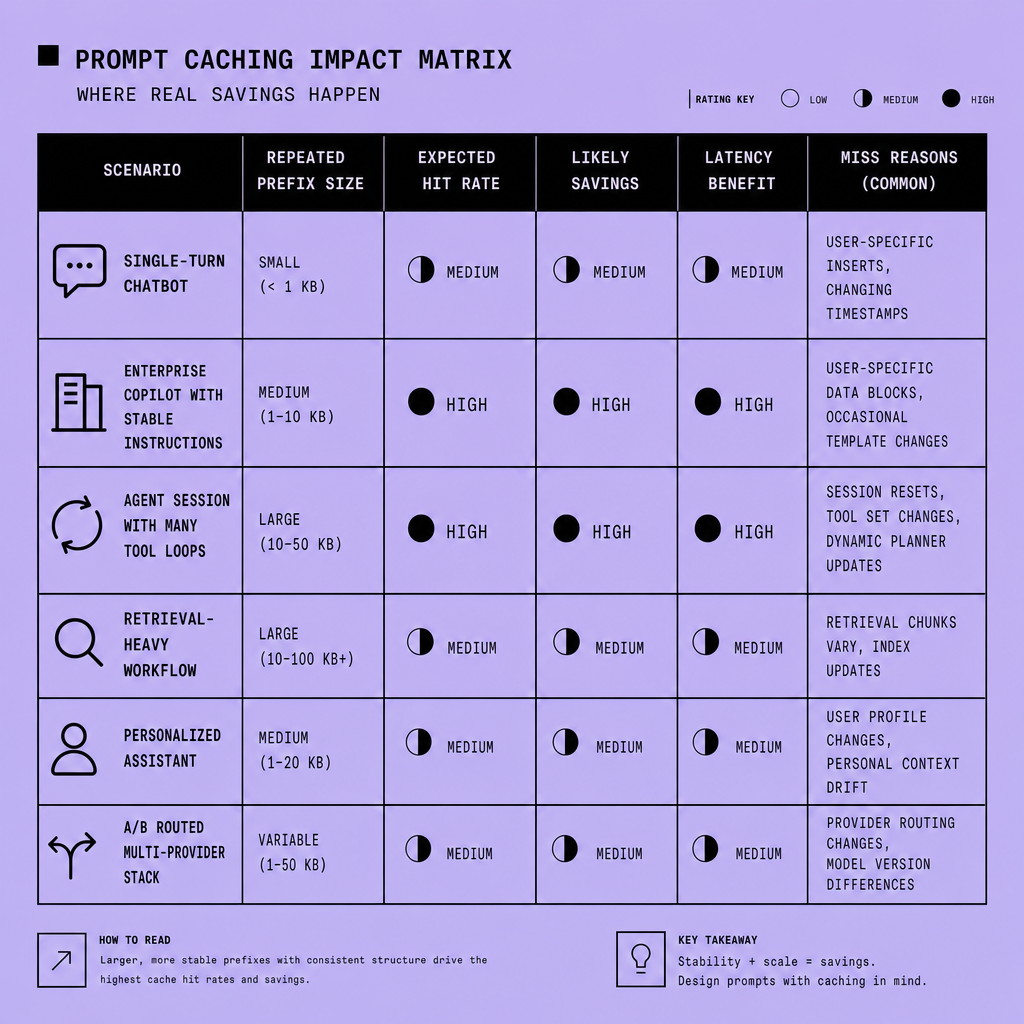
This is also why prompt caching cost savings often disappoint in production. Teams hear "prompt caching" and expect lower bills across the board, but real workloads are messy. Dynamic RAG snippets, per-user personalization near the front of the prompt, A/B prompt variants, and router-driven model changes all break reuse.37 The logic is straightforward: savings grow with prefix length, hit rate, and routing consistency. If those three are weak, prompt caching produces little real benefit.
How agent sessions, copilot flows, and cache-hit assumptions affect real savings
The advertised discount is not what decides savings. Hit rate does.
In agentic systems, the repeated prefix often includes session state, tool calling schemas, memory summaries, codebase context, safety rules, and planner instructions. A copilot may resend the same repository map and tool list on every turn; an enterprise agent may keep replaying policy text, product catalog slices, and approval rules.235 That is where LLM prompt caching and context caching can help. But only if those tokens stay stable enough to be reused.
Small changes break the story fast.
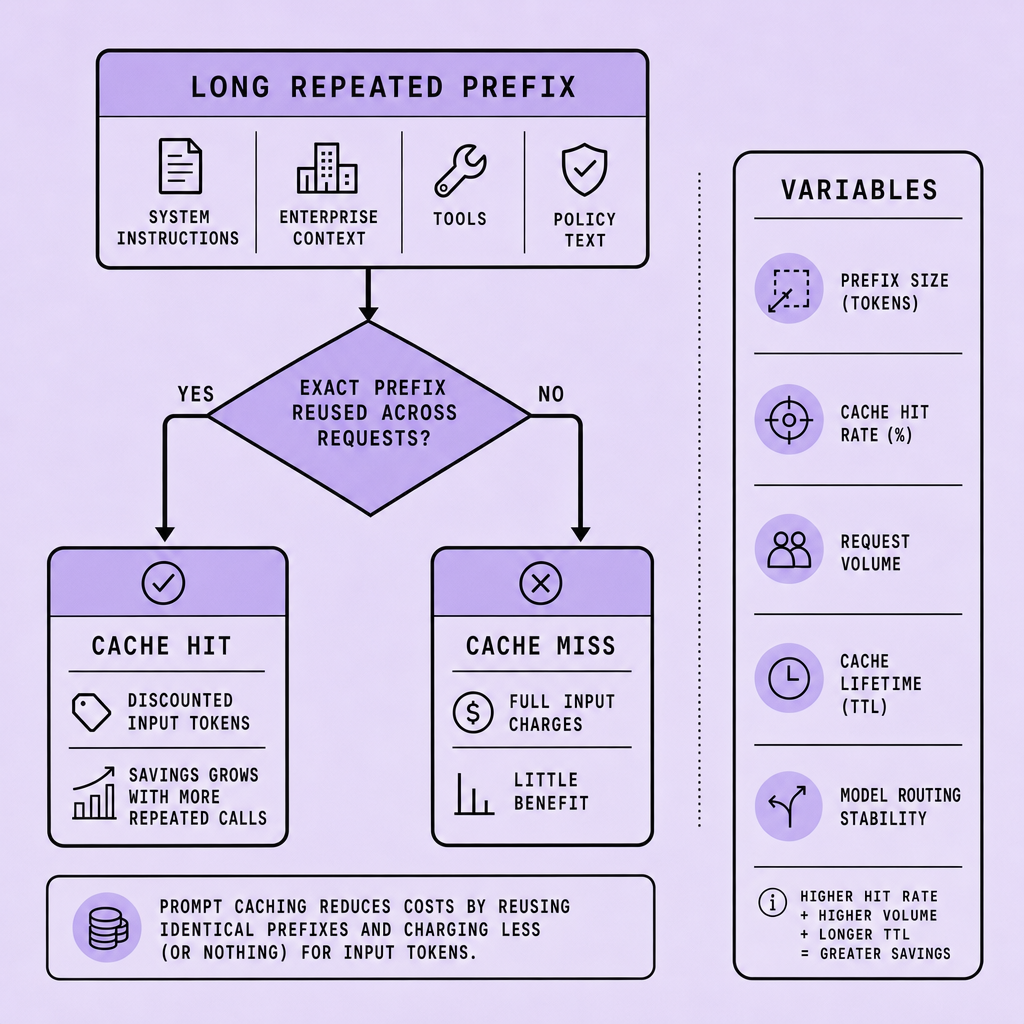
A timestamp inserted near the top of the prompt, a reordered tool list, a different memory summary, or routing the next turn to a different model deployment can reduce cache reuse because many prompt caching systems depend on exact or near-exact prompt prefix matches.124 In long-running AI agent caching flows, this happens constantly. Session churn makes it worse: if users ask one or two questions and leave, the expensive setup gets paid once and reused barely at all.37
A simple way to estimate effective savings:
effective savings ≈ repeated prefix tokens × cached-input discount × cache hit rate × requests per session, adjusted for session churn
So if 12,000 prefix tokens are theoretically discountable, but only 40% of turns hit cache because prompts drift, then the realized benefit is 0.4 times the advertised discount before considering dropped sessions, model routing misses, or invalidation. Decisions should be backed by data -- teams should measure effective hit rate from production traces, not from prompt templates.236
Where copilot and agent flows usually win for prompt caching economics
Some workflows are naturally friendlier to caching than others. Coding assistants and internal copilots usually have the best setup because they resend large, stable scaffolding across many turns: tool schemas, codebase summaries, file trees, and organization-specific instructions.357 They can also see latency gains on the prefill side, not just lower input cost.24
When LLM prompt caching produces little real benefit for prompt caching economics
Other workflows look promising in slides and underperform in production.
If prompts are short, sessions are brief, retrieved context changes every turn, or the system rewrites the top of the prompt on each request, LLM prompt caching may look good on paper and disappoint in billing.36 That shifts the engineering priority: design stable prefixes on purpose, then validate actual cache-hit behavior before forecasting savings.
Provider differences, routing layers, and why identical prompts still miss cache
A cache miss often has less to do with the model than with everything that happened before the request reached it.
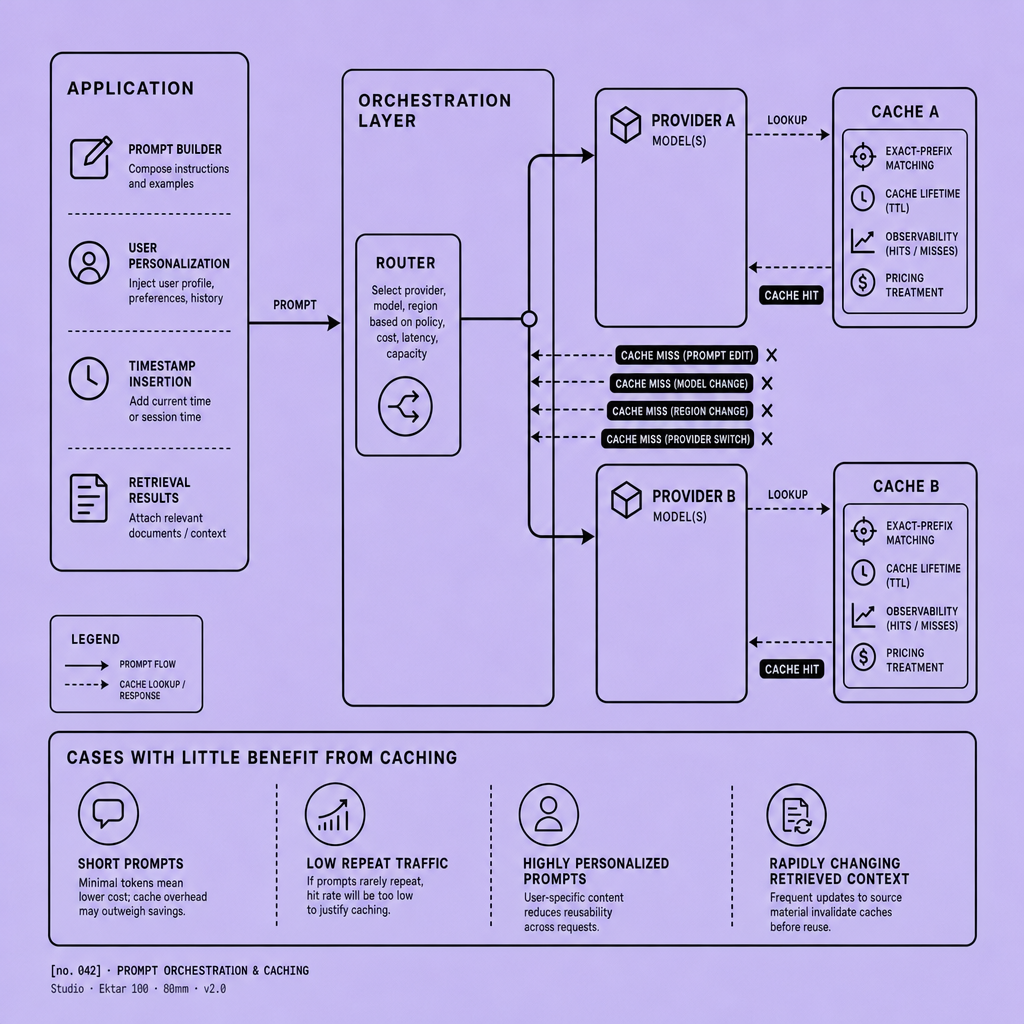
Provider APIs do not treat prompt caching, LLM prompt caching, or context caching the same way. Some require an exact token-prefix match. Others surface cached-input discounts more clearly than latency gains, while some present it as context caching with short reuse windows and limited observability.125 That means two prompts that look identical in application logs can still miss cache if whitespace changed, tool schemas were reordered, or tokenization shifted after a template update. Same meaning is not enough. In some setups, even the same bytes are not enough if the request lands in a different cache scope.
What differs across providers
A practical comparison looks like this:
| Dimension | Common provider variation | Why it affects results |
|---|---|---|
| Match rule | Exact prefix or tokenized-prefix reuse | Small prompt assembly changes kill hits |
| Benefit type | Cost discount, latency reduction, or both | Savings may appear in billing, not UX |
| Cache lifetime | Short-lived or session-bounded reuse windows | Low-frequency traffic may never reuse in time |
| Observability | Clear cached-token metrics vs limited reporting | Hard to verify real hit rate |
| Cache scope | Region, model, tenant, or replica scoped | Routing can fragment locality |
Public explainers commonly describe exact-prefix behavior and note that the gain applies to prompt prefill rather than output generation.24 Recent work on long-horizon agents also shows that cache value depends more on stable repeated context and reuse patterns than on prompt length alone.3
Why routing quietly breaks cache locality
Even with a stable prompt, infrastructure can sabotage reuse. A gateway may send otherwise identical requests to different model snapshots for A/B testing. A load balancer may split traffic across regions. Failover may move requests after a transient error. Tenant isolation can pin customers to separate serving pools. A multi-model router may also switch backends based on latency or cost policy.
All of that reduces cache locality.
Before blaming the provider, standardize prompt assembly and minimize unnecessary routing variance. Orchestration layers often erase the conditions prompt caching needs.
That is the practical point. Headline cache discounts mean very little if repeated prefixes are unstable, routed across fragmented pools, or reused too slowly. In those cases, prompt caching becomes more of a theoretical optimization than a meaningful source of savings or speed.156
Cache invalidation, latency effects, and when prompt caching produces little real benefit
This is where expectations usually break. Prompt caching is easy to overestimate because the invalidation rules are stricter than most teams assume.
Small edits to a system prompt, a new timestamp, user-specific inserts, retrieval augmentation that reshuffles chunks, TTL expiry, or model versioning can all force a fresh prefill pass even when the request looks "basically the same." Many providers require an exact or near-exact repeated prefix, so routing changes, prompt assembly order, and cache scope matter as much as the text itself.245
Latency gains are narrower than the marketing suggests. Prompt caching mostly cuts prefill work: the time and compute needed to ingest repeated context. It usually does far less for generation time, so long outputs, slow tool calls, multi-step agent loops, or downstream application work can keep end-to-end latency only modestly better even with decent hit rates.136 In other words, a cache hit can materially reduce input processing while leaving the user-visible response time only somewhat improved.
That same distinction matters for economics. If the repeated prefix is small, misses are common, or the expensive part of the workflow sits elsewhere, the theoretical discount will not translate into large real savings. Workloads with short prompts, low reuse, highly personalized context, frequent retrieval reshuffling, or output-heavy spend often see limited benefit from prompt caching in practice.37
So prompt caching is not the universal first optimization. In many flows, prompt simplification, output-length control, fewer tool hops, and more stable request construction improve both cost and latency more reliably. The practical screening question is simple: how much of the prompt is truly stable, and is that stable portion expensive enough to matter?
References
- Prompt Caching in Production AI Systems: Architecture, Economics ...
- What is prompt caching? How it reduces LLM cost and latency
- An Evaluation of Prompt Caching for Long-Horizon Agentic Tasks
- Prompt caching explained: lower AI cost and latency - Husk.
- Context Caching: Make AI Agents Faster and Cheaper (2026)
- How prompt caching cut our production AI agent input costs by ...
- Prompt Caching breakdown: Cut token spend in 2026
- Prompt Caching Explained: Stop Overpaying for AI Agents
Footnotes
-
https://medium.com/@adnanmasood/prompt-caching-in-production-ai-systems-architecture-economics-and-governance-a907437dfd74 ↩ ↩2 ↩3 ↩4 ↩5 ↩6 ↩7 ↩8 ↩9 ↩10 ↩11
-
https://www.braintrust.dev/articles/what-is-prompt-caching ↩ ↩2 ↩3 ↩4 ↩5 ↩6 ↩7 ↩8 ↩9 ↩10 ↩11 ↩12 ↩13 ↩14 ↩15 ↩16 ↩17
-
https://arxiv.org/html/2601.06007v2 ↩ ↩2 ↩3 ↩4 ↩5 ↩6 ↩7 ↩8 ↩9 ↩10 ↩11 ↩12 ↩13 ↩14
-
https://www.usehusk.com/blog/prompt-caching-cost-savings ↩ ↩2 ↩3 ↩4 ↩5 ↩6 ↩7 ↩8 ↩9
-
https://atlan.com/know/context-caching/ ↩ ↩2 ↩3 ↩4 ↩5 ↩6 ↩7 ↩8 ↩9 ↩10 ↩11
-
https://www.flexera.com/blog/ai/prompt-caching-breakdown/ ↩ ↩2 ↩3 ↩4 ↩5 ↩6 ↩7
-
https://derivai.substack.com/p/prompt-caching-production-ai-agent-costs ↩ ↩2 ↩3 ↩4 ↩5
Frequently Asked Questions
What is the break-even point for prompt caching economics?
The break-even point for prompt caching economics is when the reused prefix is large enough, repeated often enough, and matched consistently enough that the first uncached prefill cost is outweighed by later discounted or accelerated requests. In practice, teams should model break-even using prefix length, hit rate, request volume, and cache lifetime rather than assuming any published discount automatically pays off.[^2][^8]
How does prompt caching economics change in multi-tenant enterprise apps?
In multi-tenant enterprise apps, prompt caching economics improves when many users share the same policy blocks, tool schemas, and workflow instructions, but weakens when each tenant gets heavily customized headers or isolated routing pools. Shared reusable context raises cache density, while tenant-specific prompt variations fragment reuse and reduce realized savings.
Why can prompt caching improve cost but barely change user-perceived speed?
Prompt caching usually accelerates prompt prefill, not token generation, tool execution, retrieval, or downstream app work. That means billing can improve even when end-to-end response time moves only modestly, especially in agent workflows where tool calls and long outputs dominate latency.[^2][^3]
When should teams avoid over-investing in prompt caching economics?
Teams should avoid over-investing in prompt caching economics when prompts are short, sessions are brief, prefixes are highly personalized, or retrieval content changes near the start of every request. In those cases, simpler optimizations such as reducing prompt size, stabilizing templates, and cutting output length often produce more reliable savings than cache engineering.
Does retrieval-augmented generation always benefit from prompt caching?
No. Retrieval-augmented generation only benefits reliably when the reusable scaffold stays fixed and the changing documents are appended after the stable prefix. If retrieved chunks are inserted near the top, reordered frequently, or refreshed every turn, cacheability drops because many systems depend on exact or near-exact prefix reuse rules.[^1][^5]
Make Imversion a preferred source on Google
Like this kind of AI and software analysis? Add Imversion as a preferred source so Google can highlight our articles for you in Search, AI Overviews, and AI Mode.