LLM Provider Resilience: Ensuring AI Infrastructure Stability
Discover how to build resilient AI applications by designing for model provider failures. Learn about failover, circuit breakers, and more.

On this page
LLM Provider Resilience Means Designing for Failure Before It Happens
Most AI outages do not start with a dramatic red status page. They start when a model still responds, but your parser breaks, latency spikes, tool calls drift, or a fallback model returns output your app cannot safely use. LLM provider resilience is built for that moment. It depends on provider-agnostic contracts, AI failover paths, circuit breakers, quality gates, and outage testing -- not simple vendor switching after production breaks.
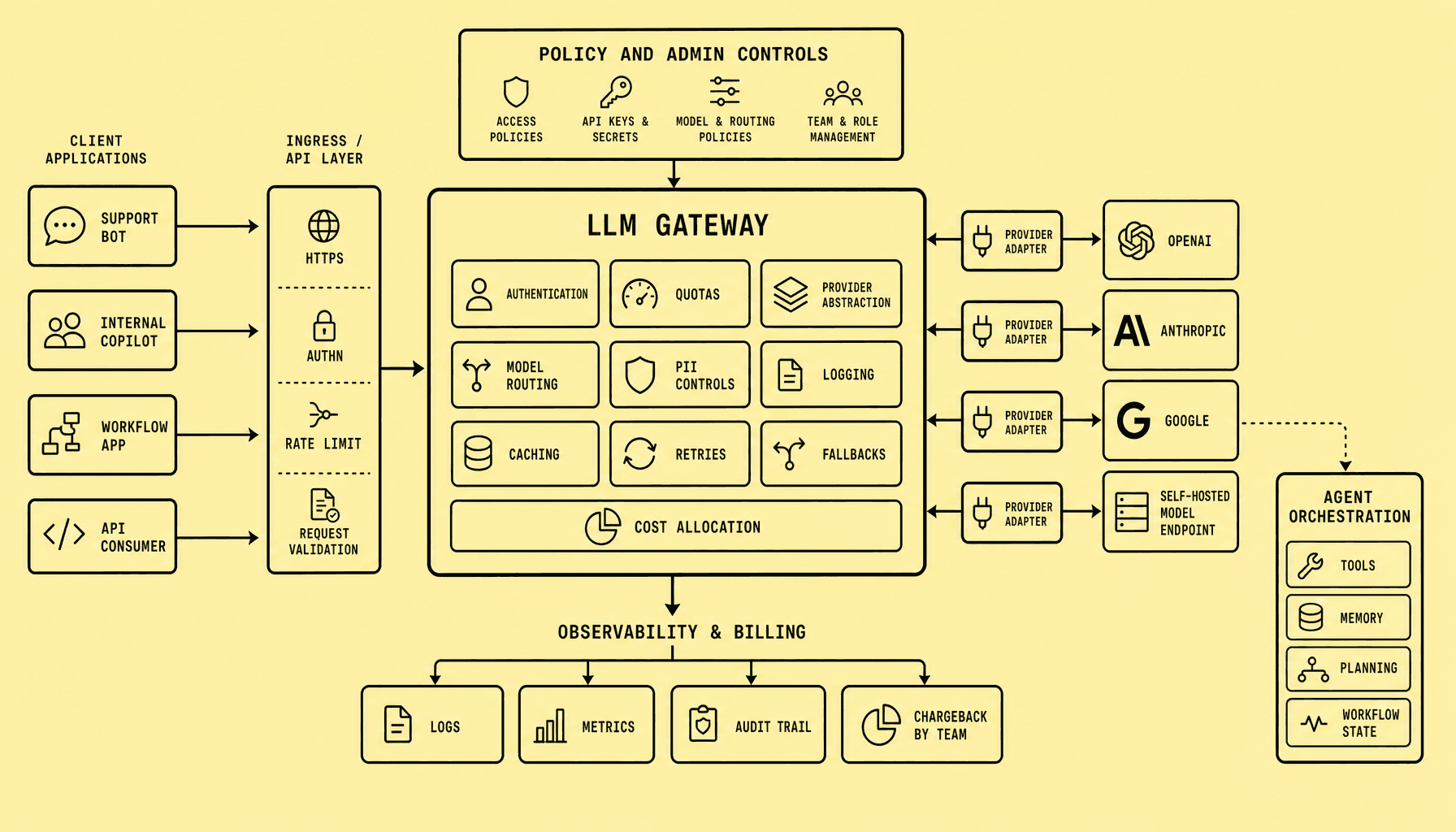
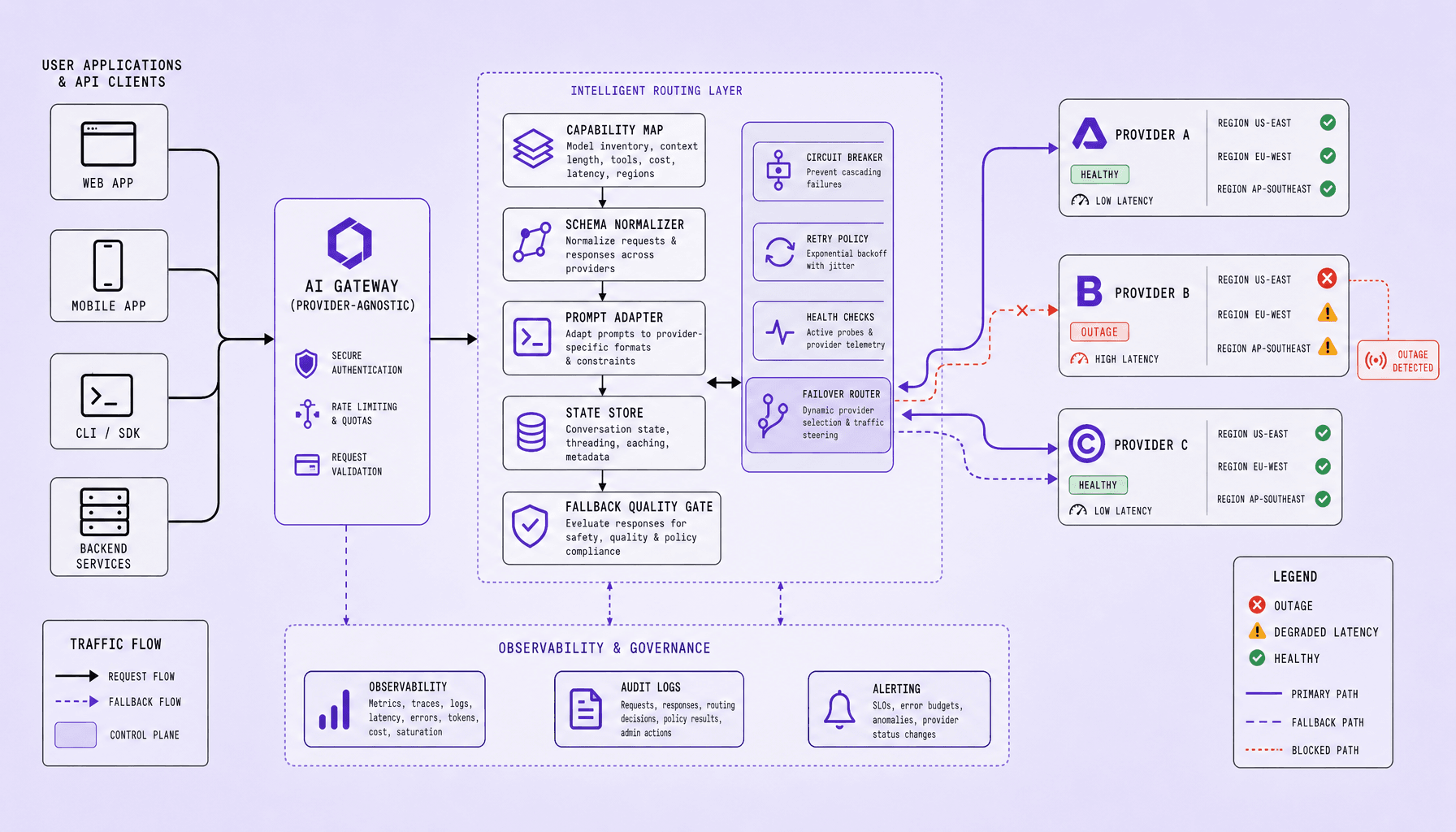
Teams often assume model portability means swapping one API key for another. It does not. OpenAI, Anthropic, Google, Azure OpenAI, and Bedrock differ in schema shape, context limits, tool calling, JSON behavior, and regional availability. Your AI infrastructure needs a routing layer that normalizes requests, tracks capability mismatches, and preserves state during failover.
Guardrails are what keep a backup path from becoming a second failure. Circuit breakers should stop repeated bad calls, fallback quality gates should reject weak structured output, and prompt portability should be tested before an incident. Monitoring is as important as deployment because a backup model can fail differently, not just later.
Key Takeaways for LLM Provider Resilience
- Build for swapability first. Real LLM provider resilience depends on model portability through a provider-agnostic schema, prompt templates that avoid vendor-specific quirks, and a routing layer that knows capability mismatches like context limits, JSON mode behavior, and tool-calling differences.
- Treat failover as a guarded path, not an automatic win. Your AI failover flow should enforce fallback quality gates for schema validity, safety checks, and task fitness before backup output reaches users.
- Use circuit breakers and regional controls. Fast failure, retry limits, cooldown windows, and region-aware routing stop one unstable provider from cascading across your AI infrastructure.
- Preserve state carefully. Conversation memory, tool results, idempotency keys, and queued work must survive provider switches without duplicating actions or corrupting session flow.
- Test outages on purpose. Provider outage testing -- including synthetic failures, latency spikes, and degraded structured output -- exposes weak assumptions before production does. Monitoring is as important as deployment.
What Breaks First When External Model Providers Fail
What fails first is usually not the whole API. It is the contract you assumed would stay stable.
In practice, most incidents are partial failures: latency spikes, rate limits, quota exhaustion, a regional outage, or structured output that suddenly stops matching your parser. Public provider status pages have shown this pattern more than once across major vendors -- degraded performance, elevated errors, or region-specific impact rather than clean downtime. That matters because brute-force retries can turn a slow failure into a larger one.
That leads to the hard part. AI failover is tougher than ordinary API failover for one reason: behavior changes, not just availability.
A backup model may accept the same request and still break your feature. JSON fields can move. Tool calling can differ in argument formatting or whether the model calls a tool at all. Safety-policy differences can block prompts that worked a minute earlier on another provider. Even with a compatible schema, model portability is never perfect because context limits, refusal patterns, and structured output reliability vary across vendors.
So what should you plan for in your AI infrastructure?
Full outages are obvious. Harder cases are silent quality degradation and malformed structured output. Your endpoint returns 200, but the answer quality drops, a required key is missing, or the tool payload is invalid JSON. Those failures often hit user flows before your uptime dashboard notices. Monitoring is as important as deployment -- especially for AI features where an SLI should include schema-valid response rate, tool success rate, and latency by provider, not just HTTP success.
The practical move is to separate transport retries from model-routing decisions. Retry transient network errors once or twice with jitter. But if latency crosses your SLO, rate limits persist, or schema validation fails, trip a circuit breaker and route only workloads that the fallback model can actually handle. At Imversion Technologies Pvt Ltd, this is the boundary I would enforce: fail over with quality gates, not hope.
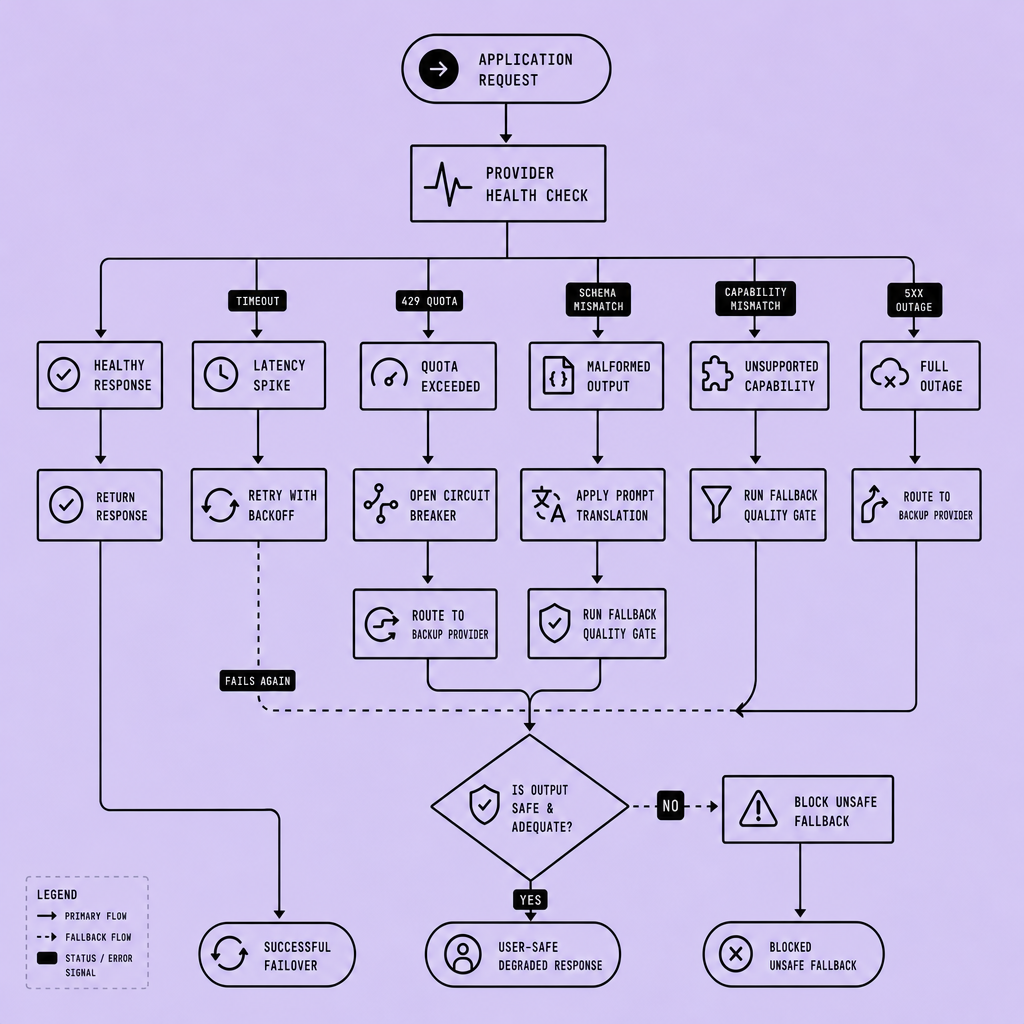
That is the difference between having a second provider and having resilience. LLM provider resilience comes from tested routing logic, state-aware recovery, and realistic provider outage drills.
Architecture Patterns That Make LLM Provider Resilience Practical
A backup provider sounds comforting right up until it returns the wrong shape, breaks tool execution, or fails under the same workload class. The pattern that holds up is not “add another vendor.” It is an AI infrastructure layer that can switch providers, preserve state, and block bad fallback output before users see it.
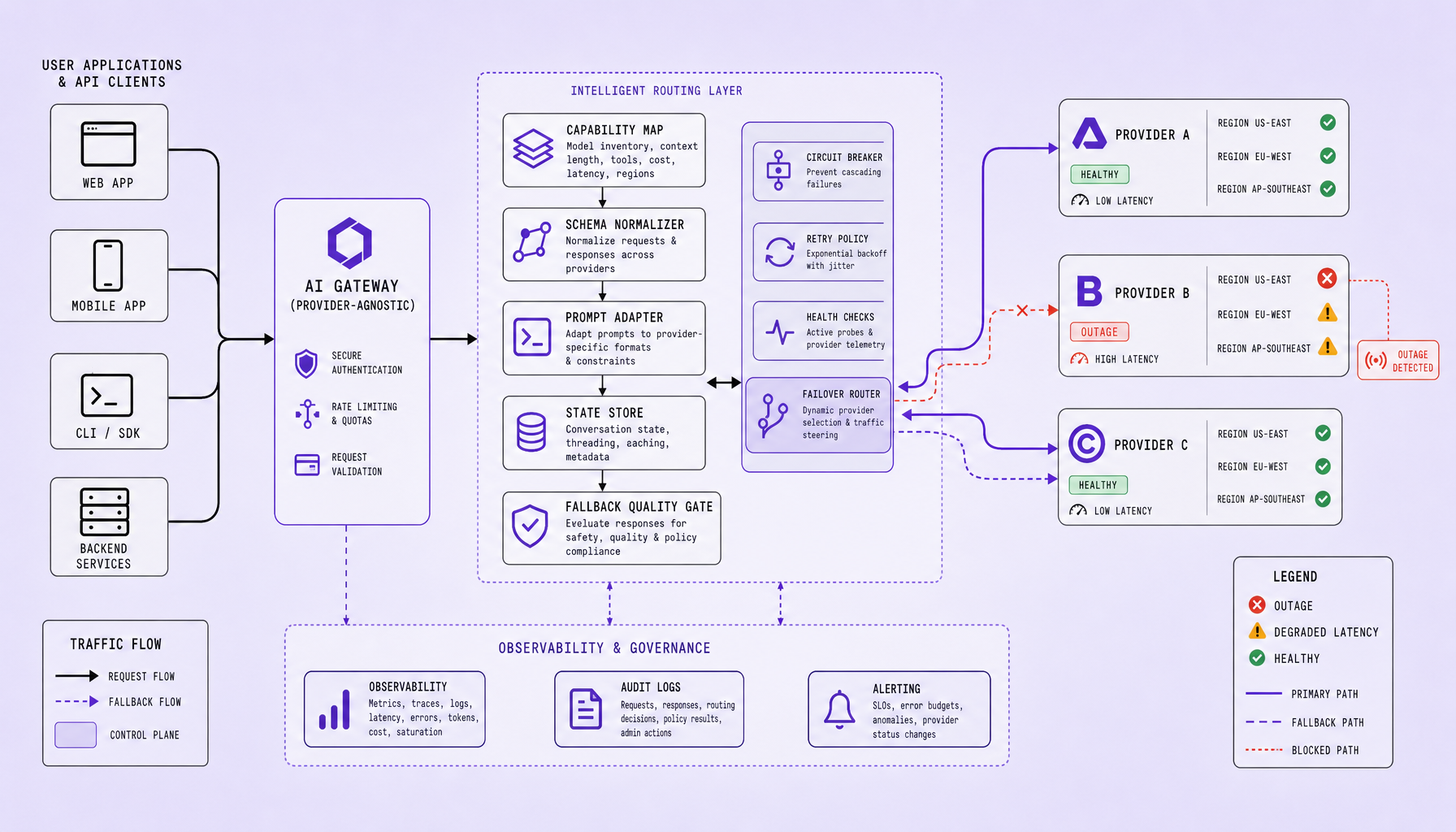
Start with a provider-agnostic interface behind an AI gateway. Your application sends one internal schema for prompts, tools, metadata, and expected output shape, while adapters translate that contract to OpenAI, Anthropic, Google, Azure OpenAI, or Bedrock. That is the base for model portability. Without it, failover becomes emergency rewrite work.
Next comes routing. It should choose models by workload, not just availability. A drafting task can tolerate a fallback model with a different style. A transactional workflow that depends on strict JSON, tool calling, or long context needs tighter routing rules and capability checks. Providers differ on context windows, safety filters, and structured output behavior, so your router needs explicit match rules, not blind round-robin.
Compare the practical patterns
| Pattern | Best fit | Complexity | Latency/Cost impact | Resilience benefit |
|---|---|---|---|---|
| Provider-agnostic gateway | Any multi-provider setup | Medium | Low | High portability |
| Active-passive failover | Critical sync user flows | Medium | Low until failover | Strong recovery with simpler ops |
| Active-active routing | High-volume, always-on workloads | High | Higher cost and routing overhead | Best outage tolerance |
| Queue-based async processing | Summarization, enrichment, batch jobs | Medium | Higher latency, controlled cost | Prevents user-facing blockage |
Failover modes and workload design
For synchronous features, active-passive is the safer default. One primary model handles traffic; a fallback activates only after health checks, timeout thresholds, or circuit breakers trip.
Active-active fits systems where regional outages or quota pressure are common. You keep multiple providers warm, spread requests, and continuously test compatibility in production. Monitoring matters as much as deployment: if you do not track schema validity, retry rates, and fallback quality, your backup path becomes a hidden failure mode.
For non-blocking workloads, use a message queue. Put long-running generation, document enrichment, or background classification behind asynchronous workers so provider instability does not freeze the request cycle.
Graceful degradation beats total failure
This is where architecture becomes product judgment. Not every feature needs identical failover behavior. If the premium model is unavailable, chat can fall back to shorter answers, summarization can defer, and high-risk actions can pause for human review. Practical LLM provider resilience means matching the pattern to business criticality, state sensitivity, and acceptable quality loss.
Model Portability Depends on Compatible Schemas, Capability Maps, and Prompt Discipline
Most teams do not discover their portability problem during implementation. They discover it during an incident, when the primary provider is struggling and the fallback path exposes every hidden assumption in the app. If you want real LLM provider resilience, treat portability as a contract problem first, not a vendor shopping exercise. Their app works against one model API, then an outage forces AI failover and suddenly message roles, tool formats, JSON behavior, and token limits no longer line up.
Start with compatible schemas. Define one internal request and response contract for your application, then write adapters for each provider. Normalize roles such as system, user, and assistant. Normalize metadata too -- request IDs, safety flags, tool results, finish reasons, and usage fields. For structured output, validate against a JSON schema in your own layer instead of trusting every provider to enforce the same rules the same way. Consistency in environments is critical, and the same applies to AI contracts.
That still is not enough. Model portability usually breaks on capability mismatches, not payload shape. One model may support function calling cleanly, another may only approximate it through text. Context window limits differ. Tokenization differs. Even when two vendors claim structured output support, one may be strict and another may drift under load or with long prompts. So build a capability map that records what each model can actually do for your workloads: context window, function calling, streaming, JSON reliability, rate-limit profile, and region availability.
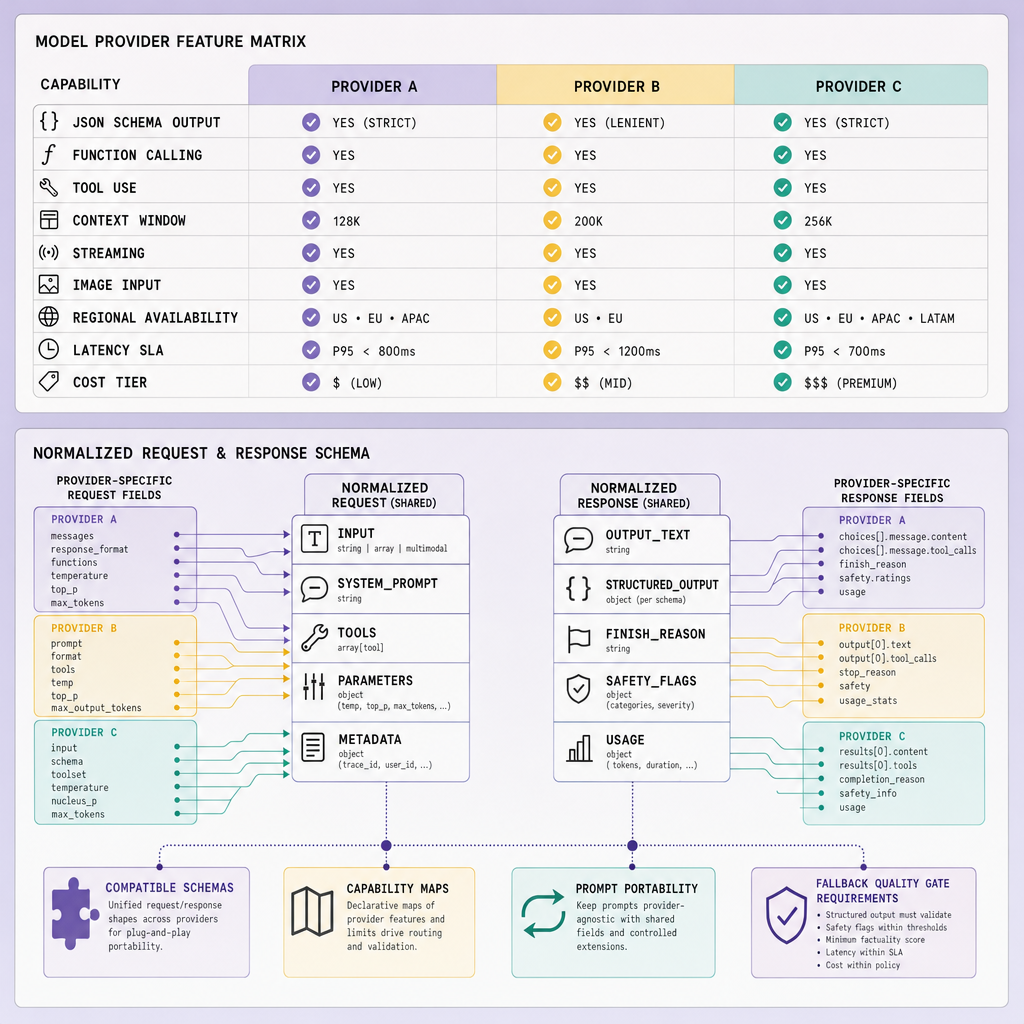
Prompt portability needs the same discipline. Keep prompts in reusable templates. Avoid provider-specific control syntax unless your routing layer can swap variants deliberately. In practice, prompts fail across providers because instruction priority, formatting tolerance, and output tendencies are not identical. Perfect portability is unrealistic.
Aim for managed compatibility: lower switching cost, faster incident recovery, and fewer broken user flows.
From there, make portability measurable. Run regression tests on critical prompts and schemas before promoting a fallback model. Include golden tasks for extraction, summarization, tool use, and refusal handling. If fallback output fails schema validation or quality gates, do not silently accept it. Route, retry, or degrade the feature safely. That is how you turn model portability from a slide-deck promise into working AI infrastructure.
Circuit Breakers and Fallback Quality Gates Prevent Bad AI Failover for LLM Provider Resilience
The fastest way to make an outage worse is to keep sending traffic to a model that is already timing out or returning malformed output. That is what circuit breakers prevent.
In reliable software systems, circuit breakers watch failure rate, latency, and timeout patterns, then open after a threshold so your app stops sending repeated calls to an unstable provider. During that open state, you route to a backup model, a cached response, or graceful degradation. Short retries still have a place, but only inside a strict retry budget. Otherwise, your AI failover path can amplify an outage instead of containing it. This also protects downstream queues, workers, and user-facing latency from being dragged down by one failing dependency.
Now the second half of the problem: failover alone is not LLM provider resilience. A backup response is only useful if it is safe, usable, and appropriate for the task.
Fallback quality gates should validate output before it reaches the user:
- schema validation for JSON or tool-call structure
- answer completeness checks against required fields
- hallucination risk heuristics such as unsupported claims, missing citations when required, or instruction drift
- confidence rules, including abstain-or-escalate behavior
- task-specific acceptance thresholds for extraction, summarization, or customer support replies
There is a real tradeoff here. Strict gates reduce bad outputs but increase graceful degradation; permissive gates preserve availability but can leak low-quality answers. The right setting depends on impact. Use tighter gates for high-risk workflows and looser ones for low-stakes tasks. Monitor pass rates, rejection reasons, and user-visible degradation separately for primary and fallback paths, because the backup model may fail in different ways even when it stays available.
Regional Outages, State Handling, and Provider Outage Testing in AI Infrastructure
A second region or second provider looks like redundancy on paper. It stops being redundancy the moment session continuity breaks, duplicate tool actions fire, or a regional failover lands on a model that cannot support the same workflow. If your AI infrastructure cannot survive that, the backup path will fail at the worst moment.
State handling is where AI failover gets messy. A chat app does not just hold messages; it carries tool results, partial JSON, user intent, and sometimes side effects like ticket creation or database writes. Keep conversation state outside the model provider, store provider responses with request IDs, and make tool execution idempotent. If you retry after a timeout, your system must know whether the model failed, the tool failed, or the response arrived late. That is replay safety.
Regional failure planning needs the same realism. Route traffic by health, latency, and capability, not just vendor name. A secondary region or provider may have different context limits, JSON mode behavior, streaming support, or quota ceilings, which can break portability in subtle ways. A grounded default is active-passive failover for high-risk workflows and controlled load spreading for lower-risk ones. That tradeoff reduces blast radius, but it may increase steady-state cost and operational complexity.
Then test it on purpose. Run provider outage testing deliberately. Synthetic testing and chaos-style cutovers expose hidden assumptions before production does.
- Simulate provider 5xx errors, long-tail latency, auth failures, and malformed structured output
- Verify failover success, session continuity, cost drift, and fallback quality gates
- Track observability signals: breaker state, retry counts, output validation failures, duplicate tool attempts, and per-provider latency
Monitoring is as important as deployment, because the first successful failover often reveals quality, behavior, and cost regressions you never saw in staging.
Frequently Asked Questions
What is LLM provider resilience in practical engineering terms?
LLM provider resilience is the ability of an AI system to continue delivering safe, usable results when a model provider degrades, changes behavior, or becomes unavailable. In practice, it combines routing, schema normalization, state management, quality validation, and controlled fallback behavior rather than relying on a simple provider switch.
How does LLM provider resilience affect compliance and auditability?
LLM provider resilience affects compliance because failover can change where data is processed, which safeguards are applied, and how outputs are logged. A resilient design should enforce the same audit trails, retention rules, redaction controls, and regional policies across primary and fallback providers so outages do not create governance gaps.
Why should AI failover include cost controls as well as uptime controls?
AI failover should include cost controls because backup providers or regions may have different pricing, tokenization behavior, and retry patterns that increase spend during incidents. Effective resilience plans set per-provider budgets, throttle low-priority workloads, and surface cost anomalies quickly so availability events do not become financial surprises.
How often should teams test provider outage scenarios for AI infrastructure?
Teams should test provider outage scenarios on a regular schedule and after any major routing, prompt, or schema change. Quarterly game days are a strong baseline for most organizations, while critical systems benefit from monthly synthetic tests that validate failover logic, degraded modes, observability, and rollback procedures.
What metrics best show whether LLM provider resilience is actually improving?
The best metrics for LLM provider resilience include schema-valid response rate, fallback success rate, circuit breaker activation frequency, median and tail latency by provider, duplicate tool execution rate, and user-visible degradation rate. These measures show whether the system is preserving both technical correctness and acceptable product behavior during disruptions.
Make Imversion a preferred source on Google
Like this kind of AI and software analysis? Add Imversion as a preferred source so Google can highlight our articles for you in Search, AI Overviews, and AI Mode.