Progressive Delivery: Strategies for AI Agent Reliability
Explore practical strategies for progressive delivery in AI agents, focusing on safe deployments, versioning, and robust observability.
On this page
Progressive Delivery for AI Agents Reduces Release Risk in Production
A clean deploy does not mean a safe AI release. You can ship an agent update, keep uptime green, and still watch answer quality, tool reliability, or policy behavior slip in production. Progressive delivery cuts that risk by releasing change in stages instead of pushing it everywhere at once. For LLM deployment, that means shipping a versioned agent bundle -- prompt, model, tools, and guardrails -- to limited traffic first, then expanding only if agent-specific health signals stay healthy.
Standard feature flags are not enough here because AI agents do not behave like deterministic services. A prompt tweak can raise hallucination rate or tool-call failures even when infrastructure looks perfectly normal. Treat each release -- for example, agent-v42 with a model ID, prompt template version, tool schema version, and guardrail config -- as a measurable unit. Start with internal users or low-risk tenant cohorts, watch task success, policy violations, escalation-to-human, latency, and token cost, then roll forward or roll back. Monitoring carries as much weight as deployment, because noisy outputs can hide a bad release if you only watch infrastructure metrics.
Key Takeaways
- Treat each AI agent deployment as a versioned release bundle -- for example,
agent-v42with prompt template, model ID, tool schema, retrieval settings, and guardrails. If you cannot name exactly what changed, you cannot debug or roll back cleanly. - Use progressive delivery with cohort-based rollout, not broad exposure. Start with internal users, then low-risk tenants, then limited production traffic using canary deployments and traffic splitting.
- Measure more than uptime. Strong agent observability for LLM deployment should track task success, tool-call failures, hallucination rate, policy violations, escalation-to-human rate, latency, and token cost.
- Set rollback rules before release. Because statistical noise is normal, require guardrail thresholds and a clear stop condition instead of waiting for anecdotal failures.
- Keep environments consistent across staging and production -- small config drift can hide regressions until real users feel them.
Why Probabilistic Systems Need Progressive Delivery Instead of Standard Releases
Normal release practices start to fail when behavior can change without a code change. That is exactly the problem with AI agent deployment. A prompt edit, model swap, retrieval tweak, or tool schema update can shift outputs in ways staging will not reliably catch. Deterministic systems are usually judged by whether the same input produces the same result. In LLM deployment, some variability is expected, so “it deployed cleanly” tells you very little.
A release can keep uptime green and still erode user trust.
Probabilistic behavior changes what “healthy” means
Classic health checks focus on crashes, latency, and HTTP 500s. Those still matter. They are just not enough for agents. An AI agent can return a fast, valid response that is still wrong, unsafe, or off-policy.
Even a small prompt change -- say moving from “be concise” to “be decisive” -- may increase unsupported claims without triggering a single infrastructure alert. A model change or temperature adjustment can also shift refusal behavior, tool calling, and answer style. Progressive delivery matters here because you need to compare behavior under real traffic, not just confirm service availability.
Track AI-specific signals alongside standard telemetry: unsupported-claim rate, tool-call error rate, policy violations, escalation-to-human rate, resolution quality, latency, and cost.
Hidden dependencies make agent releases harder to isolate
The agent is rarely one artifact. It is a versioned bundle: prompt template, model ID, retrieval settings, tool contracts, memory rules, and guardrails. Change one layer and another may regress.
For example, renaming a calendar tool field from start_time to starts_at can quietly break tool use even if the API remains healthy. Versioning is release control, not documentation overhead.
Production-only risks appear after rollout starts
Pre-production tests still help, but they miss real user phrasing, long-tail workflows, and cohort-specific risk. Small samples can mislead too; what looks like improvement may only be noise.
So the safer path is staged rollout: start with internal users, then low-risk cohorts, then broader traffic. Define rollback criteria before release. If agent-v42 increases unsupported claims, policy violations, or tool-call failures beyond an agreed baseline, roll it back even if uptime stays normal.
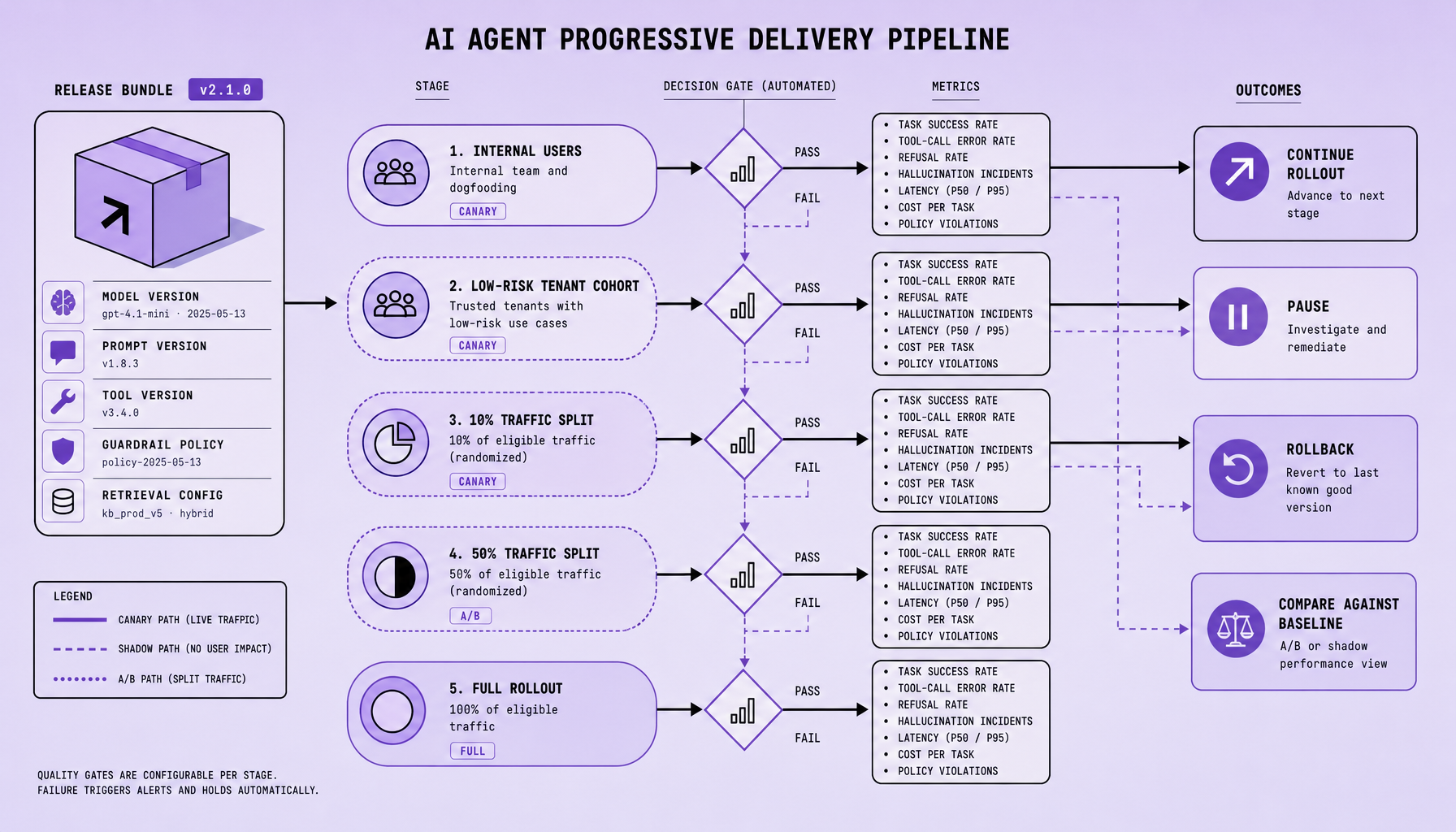
That costs speed. You add setup, monitoring, and release discipline. For probabilistic systems, though, that friction is usually cheaper than debugging a full rollout after trust or safety has already slipped.
For AI agent deployment, safe release decisions should be based on behavior quality, not infrastructure health alone.
Traffic Splitting and Tenant Cohorts for Safer Progressive Delivery
Rolling out an agent update to “random users” is easy. It is also a weak safety plan. For AI agent deployment, random-only sampling often hides the failures that matter most -- latency spikes for API consumers, hallucinations for knowledge workflows, compliance drift for regulated tenants, or bad tool actions for high-trust automation paths.
Use traffic splitting and tenant cohorts together.
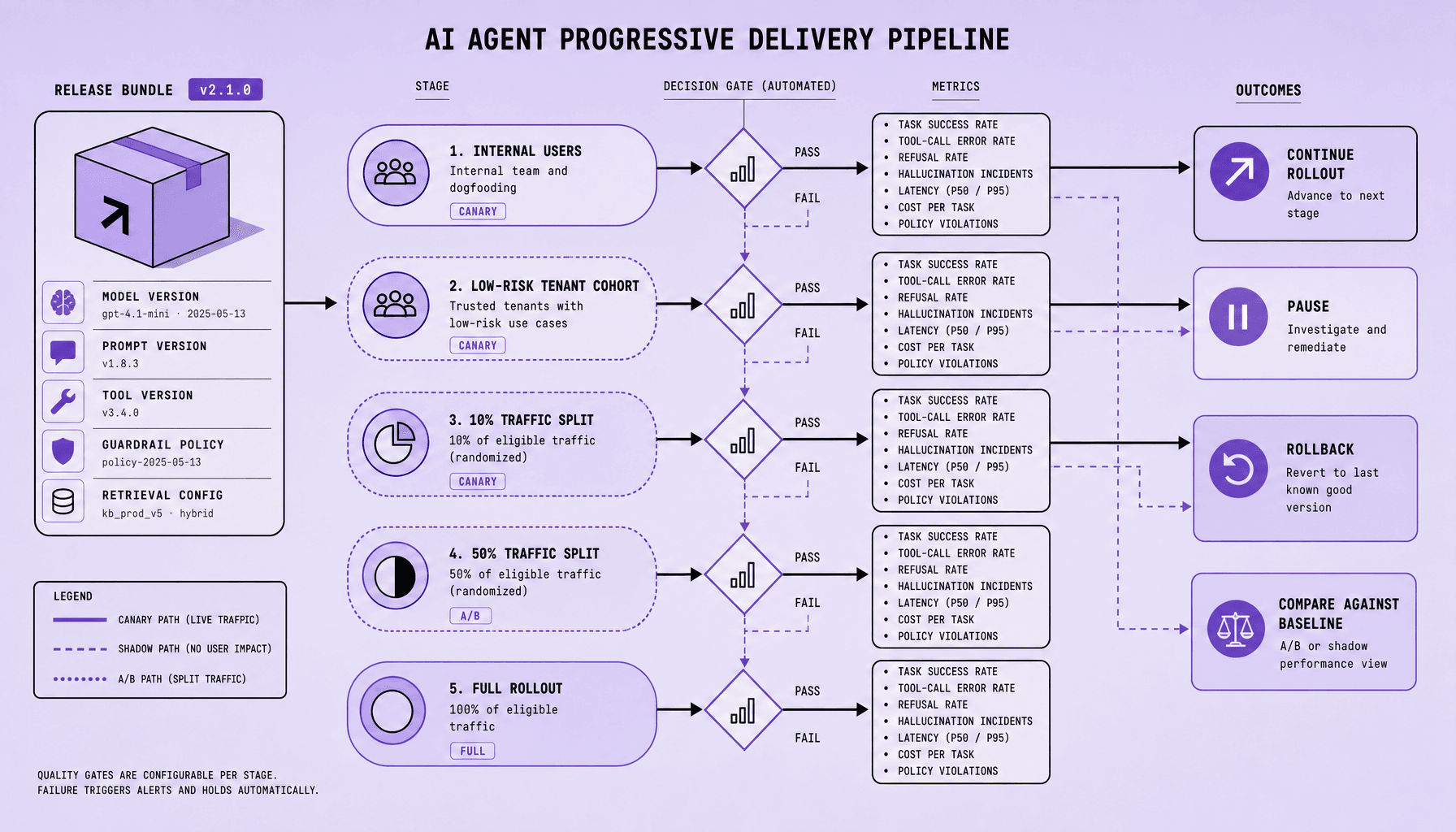
Start with a versioned release bundle such as agent-v42, then stage exposure in a fixed progression: internal users first, low-risk tenants second, then controlled production percentages like 1%, 5%, 25%, and only then broader rollout. This is where progressive delivery becomes more than feature flags. You are limiting blast radius while learning how the new agent behaves under real traffic.
Choose cohorts by business risk, not convenience
Teams often default to simple canary deployments across all traffic. That can give you the wrong picture if your tenants are not interchangeable.
A better cohort plan isolates risk dimensions such as:
- geography and language mix
- regulated vs non-regulated customers
- API users vs chat users
- premium accounts vs standard tiers
- tenants with high action volume vs read-only usage
Sensitive cohorts should usually be delayed or split separately. If a new prompt or model increases unsupported claims by a small amount, a low-risk internal FAQ assistant may tolerate that. A regulated customer workflow should not.
Align cohorts to customer harm potential, not just routing simplicity.
Practical rollout mechanics and stop conditions
Use feature flags or routing rules at the tenant and percentage level. Keep the old and new bundles live so you can compare agent-v41 against agent-v42 under similar traffic.
Recommended stop conditions for LLM deployment are straightforward: pause or roll back if you see sustained increases in policy violations, tool-call failures, escalation-to-human rate, latency, or token cost beyond your accepted threshold. Outputs are noisy, so do not react to one bad response. Look for patterns across a cohort.
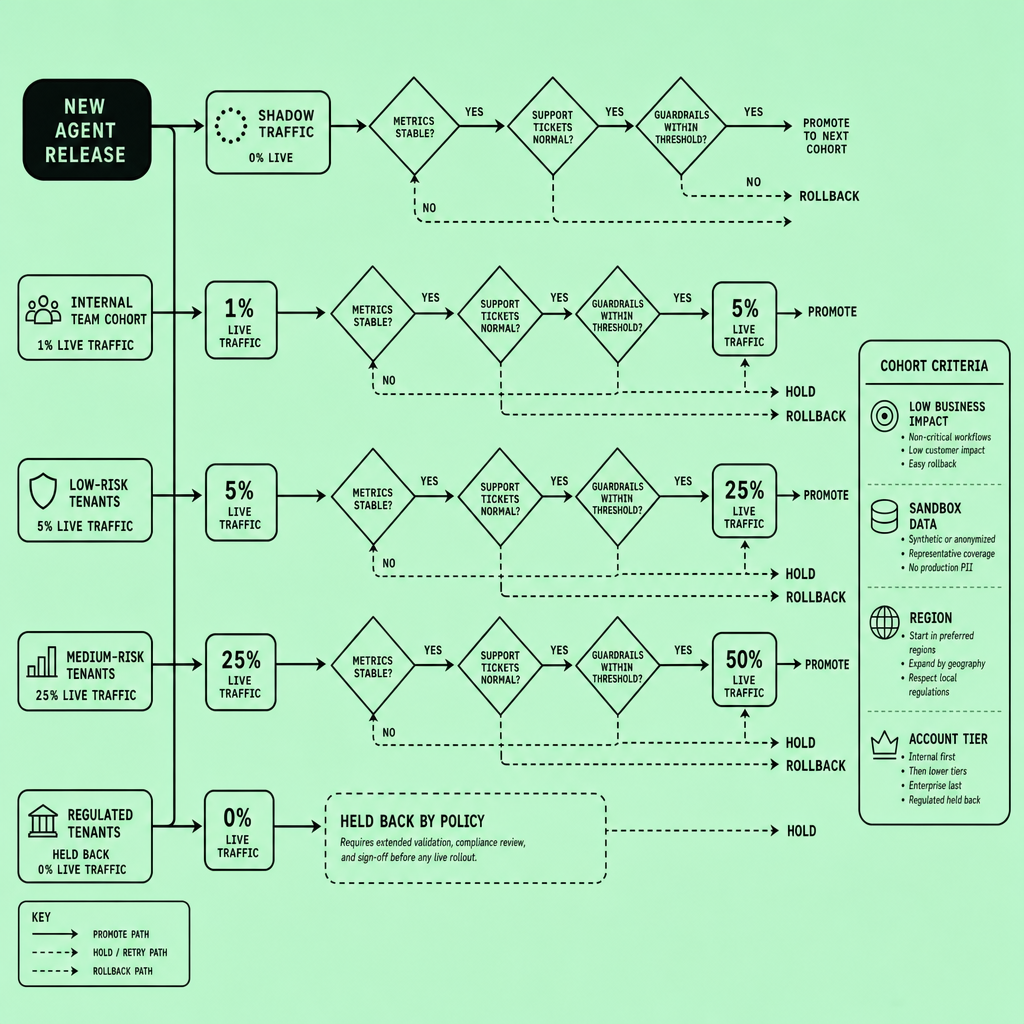
At Imversion Technologies Pvt Ltd, I’d treat consistency in environments as non-negotiable here -- if staging, shadow traffic, and production differ too much, your traffic splitting results become hard to trust. Once that happens, the whole progressive delivery process gets weaker.
Model Versioning Must Include Prompts, Tools, and Guardrails
Versioning the model alone is too weak for real AI agent deployment. If your team ships a prompt edit, changes a tool schema, or tightens a policy rule without tying it to the same release record, you lose the one answer you need during an incident: what changed?
For safe LLM deployment, treat each release as an immutable bundle -- not a single model tag. A practical bundle might look like agent-v42 and include:
- prompt template version
- system instruction version
- model ID
- tool contract or schema version
- retrieval settings such as chunking, top-k, and reranking mode
- policy or guardrail configuration
That is the level of model versioning AI agents actually need.
What to version in one lookup
A weak setup tracks gpt-x.y and stops there. But agent behavior also shifts when you change prompt-v18, sys-v7, tool-order-create-v3, retrieval-v5, or policy-safe-actions-v4. In practice, incomplete versioning slows debugging more than the bug itself. If a team cannot answer “what changed?” in one lookup, rollback becomes guesswork.
Use clear, durable naming. For example: agent-v42 = model:gpt-4.1-mini + prompt:v18 + sys:v7 + tools:v3 + retrieval:v5 + policy:v4. Keep the identifier immutable. Never reuse agent-v42 for a later tweak. Consistency in environments is critical -- if staging and production resolve different prompt or schema versions behind the same name, your rollout data is polluted.
| Scope | What gets versioned | Operational risk |
|---|---|---|
| Weak | Model ID only | Root cause stays ambiguous |
| Better | Model + prompts | Tool and retrieval drift still hidden |
| Strong | Model + prompts + tools + retrieval + guardrails | Fast rollback, cleaner audits |
Why strong versioning improves rollout safety
Strong versioning supports reproducibility, debugging, auditability, and rollback across progressive delivery stages. You can compare agent-v41 against agent-v42 by cohort, inspect guardrail metrics, and roll back the full bundle if tool-call errors or policy violations rise.
This matters for LLM deployment because the model swap may not be the failure. The break can sit in a tool schema mismatch, a stricter guardrail, or retrieval settings that changed answer quality under production traffic.
Progressive Delivery and Agent Observability Require Guardrail Metrics, Not Just Uptime
If your dashboard says the agent is “up” but users are getting wrong, unsafe, or costly answers, the rollout is not healthy. Uptime is table stakes. For AI agent deployment and LLM deployment, release health has to be judged by behavior.
Track a small approval scorecard before rollout, then use the same scorecard for every cohort and version -- agent-v42 versus agent-v41, internal users versus regulated accounts, chat users versus API consumers. Good agent observability should cover quality, safety, reliability, and cost:
- task success or resolution rate
- tool-call error rate
- hallucination rate or unsupported-claim rate
- policy violation rate
- escalation-to-human rate
- latency
- token cost
- context-window overflows
Some of these are leading indicators. Tool-call failures, policy violations, overflow events, and latency regressions show trouble fast during LLM deployment. Business outcomes like retention, CSAT, or deflection lag behind and are too slow for first-line rollout control.
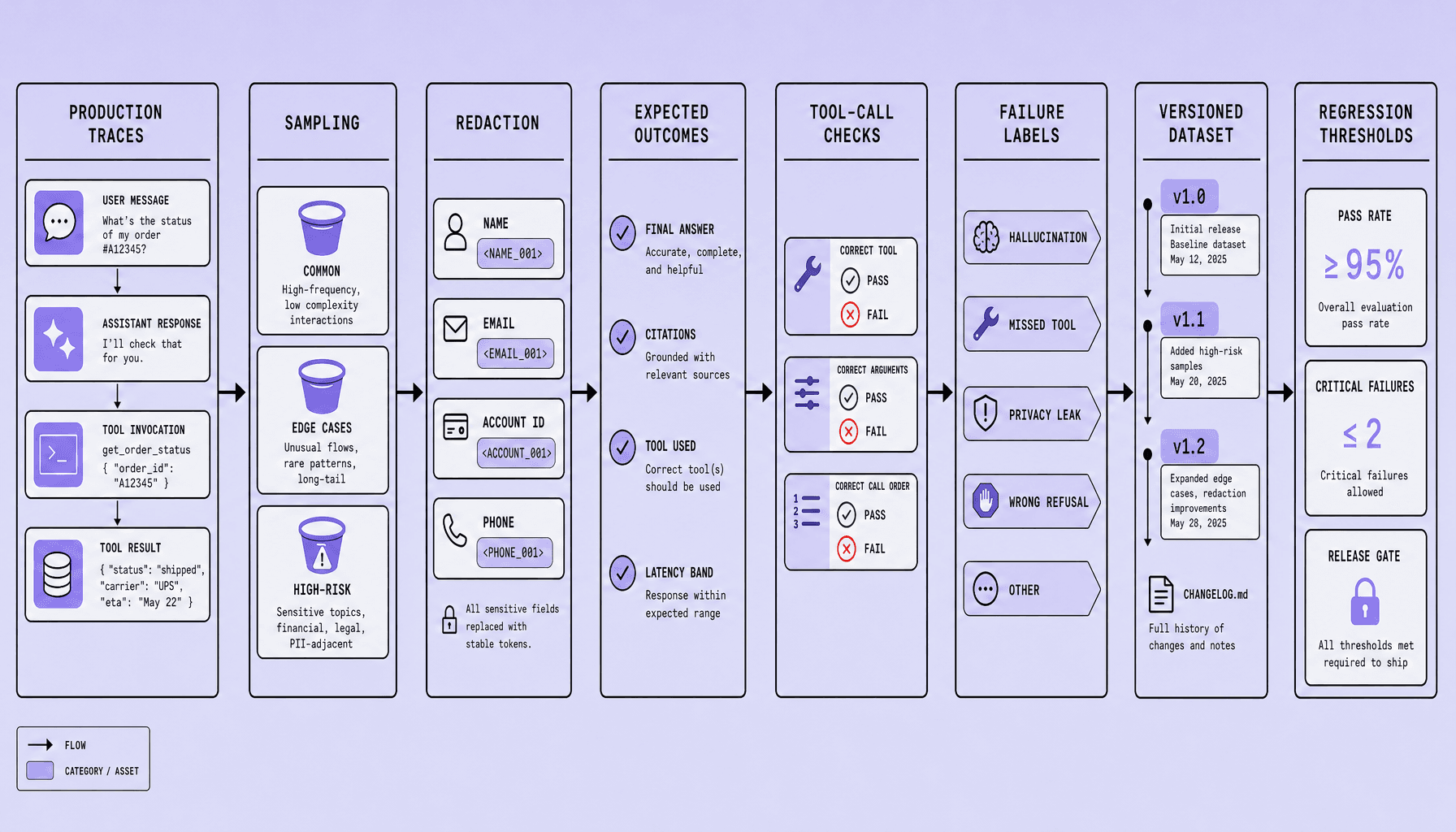
From there, instrument tracing at the request level. Log the release bundle, prompt version, model ID, tool schema version, retrieval settings, tenant cohort, and final outcome for every run. Then attach offline or sampled online evaluations so you can compare versions on the same task types, not just anecdotal transcripts.
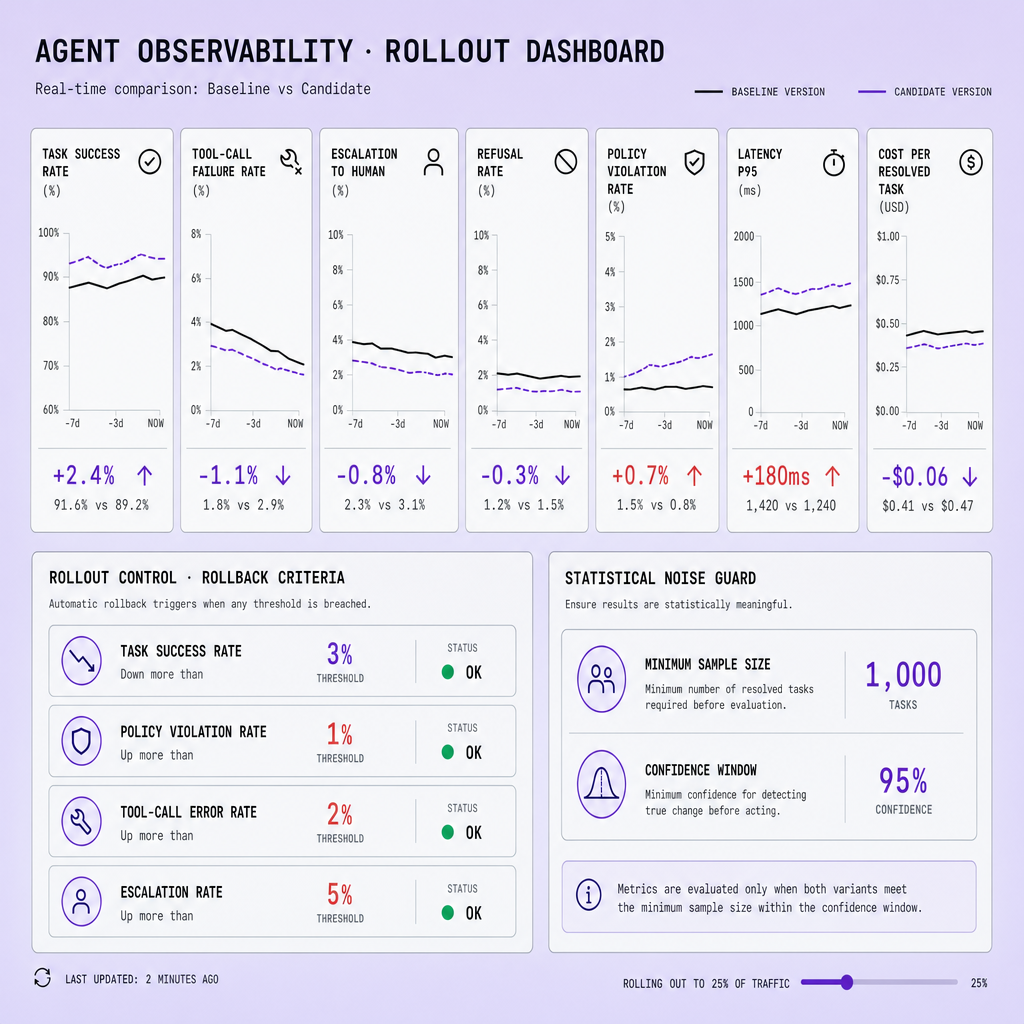
Monitoring is as important as deployment -- because a faster answer with lower token cost is still a bad release if hallucination rate or escalation spikes.
One caveat remains: better answer quality often costs more tokens and time. Define rollback criteria in advance so statistical noise does not turn normal variation into a false alarm.
Rollback Criteria for AI Releases Must Account for Statistical Noise
Three ugly transcripts are not enough to roll back an AI agent deployment. Three good ones are not enough to promote it either. In progressive delivery, stochastic outputs create noise: the same prompt can vary across runs, and rare failures may appear only after more traffic. So rollback criteria should be defined before the rollout starts, not improvised after a bad screenshot lands in chat.
For each release bundle -- for example, agent-v42 with explicit model versioning across prompt, model, tools, retrieval, and guardrails -- set three things in advance: a minimum sample size, an evaluation window, and metric thresholds tied to user risk. Separate immediate rollback triggers from metrics that need trend confirmation.
Hard-stop conditions should be narrow and serious: policy violations, unsafe tool actions, broken tool-call paths, or sudden token-cost explosions. Trend metrics should usually wait for enough volume to reduce false alarms: latency drift, escalation-to-human rate, task success rate, retry rate, and tool-call error rate. This tradeoff matters. Roll back too fast and you may reject a genuinely better release because of normal variance. Wait too long and you expand the blast radius of a real regression.
A practical rule is to use stricter thresholds for high-severity failures and more evidence for lower-severity quality shifts. Good agent observability makes that possible, because you need cohort-aware monitoring, not just aggregate dashboards. For LLM deployment, pre-agreed rules beat memorable anecdotes.
Progressive Delivery with Canary, Shadow, and A/B Rollout Strategies for AI Agent Deployment
The best rollout strategy is usually the one your team can measure, explain, and reverse quickly. Fancy release patterns do not help if traceability is weak and rollback is slow. For many teams, canary deployments beat more complex experiments until scorecards, logging, and release discipline are reliable. The goal is not only to ship safely, but to learn whether a new agent bundle behaves better under real traffic.
| Approach | Best fit | Main risk | Safe-use prerequisite |
|---|---|---|---|
| Canary | Prompt, model, or tool updates in production | Bad behavior reaches users | Feature flags, tenant cohorts, fast rollback |
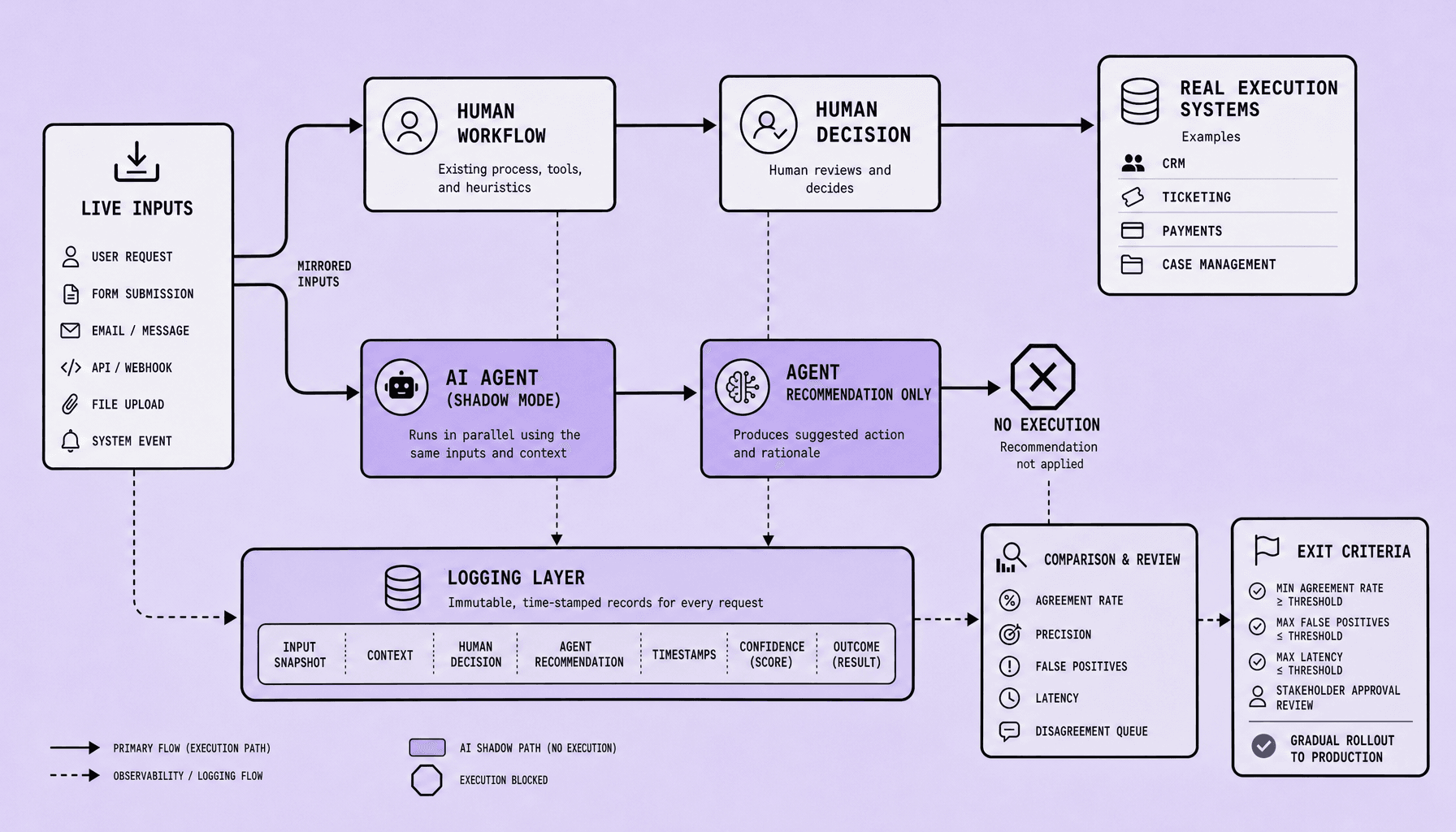
| Shadow deployment | Compare new agent behavior without user impact | False confidence if offline-only review is weak | Full trace logging, version tagging, side-by-side evals |
| A/B testing | Competing agent variants with clear business goals | Noise masks true differences | Stable metrics, enough volume, fixed success criteria |
Canary fits most progressive delivery and LLM deployment flows: start with internal users, then low-risk tenants, then broader cohorts if guardrail metrics hold. Shadow deployment is useful for risky model swaps, retrieval changes, or tool-schema updates because it exposes behavioral drift before users see it. A/B testing is best for optimization questions like resolution rate or cost per task, not as your primary safety check.
A practical recommendation: default to canary first, use shadow when behavior is hard to predict, and reserve A/B for mature systems with enough volume to detect real differences. The tradeoff is speed versus certainty: canaries provide fast signal but expose some users, shadow reduces user risk but may miss live-user effects, and A/B can answer business questions but is easy to misuse when variance is high. Keep release bundles versioned, log prompt/model/tool IDs on every trace, and define rollback rules before promotion.
Frequently Asked Questions
What is progressive delivery for AI agents?
Progressive delivery for AI agents is a staged release process that exposes a new agent bundle to limited traffic before broad rollout. It reduces deployment risk by checking behavior, safety, tool reliability, and cost under real usage rather than assuming a technically successful deploy is production-safe.
How does progressive delivery differ from standard canary releases for LLM deployment?
Progressive delivery for LLM deployment goes beyond routing a small percentage of traffic to a new version. It requires versioning prompts, models, tools, retrieval settings, and guardrails together, then evaluating agent-specific health signals such as refusal rate, tool misuse, policy adherence, and resolution quality by cohort.
Why should AI agent deployment use tenant cohorts instead of random traffic only?
AI agent deployment should use tenant cohorts because risk is not evenly distributed across users. Grouping traffic by business sensitivity, workflow type, region, or automation level exposes failures that random sampling can hide and helps teams protect high-impact customers while still collecting meaningful rollout evidence.
What metrics are most useful for agent observability during a rollout?
The most useful agent observability metrics during a rollout are the ones that reveal harmful behavioral drift early. These usually include task success, tool-call failure rate, escalation rate, refusal rate, policy violations, latency percentiles, cost per resolved task, retry rate, and context-window overflow frequency.
How should teams set rollback criteria when results are noisy?
Teams should set rollback criteria by separating hard-stop events from trend-based regressions before the rollout starts. Immediate rollback should cover severe failures like unsafe actions or policy breaches, while lower-severity changes should require enough sample volume and a defined evaluation window to avoid reacting to normal statistical variation.
Make Imversion a preferred source on Google
Like this kind of AI and software analysis? Add Imversion as a preferred source so Google can highlight our articles for you in Search, AI Overviews, and AI Mode.