Production Trace Evaluation: Turning Real Logs into Test Cases
Learn how production trace evaluation converts messy live logs into reusable test cases, improving model reliability beyond synthetic benchmarks.

On this page
How production trace evaluation turns live interactions into reusable test cases
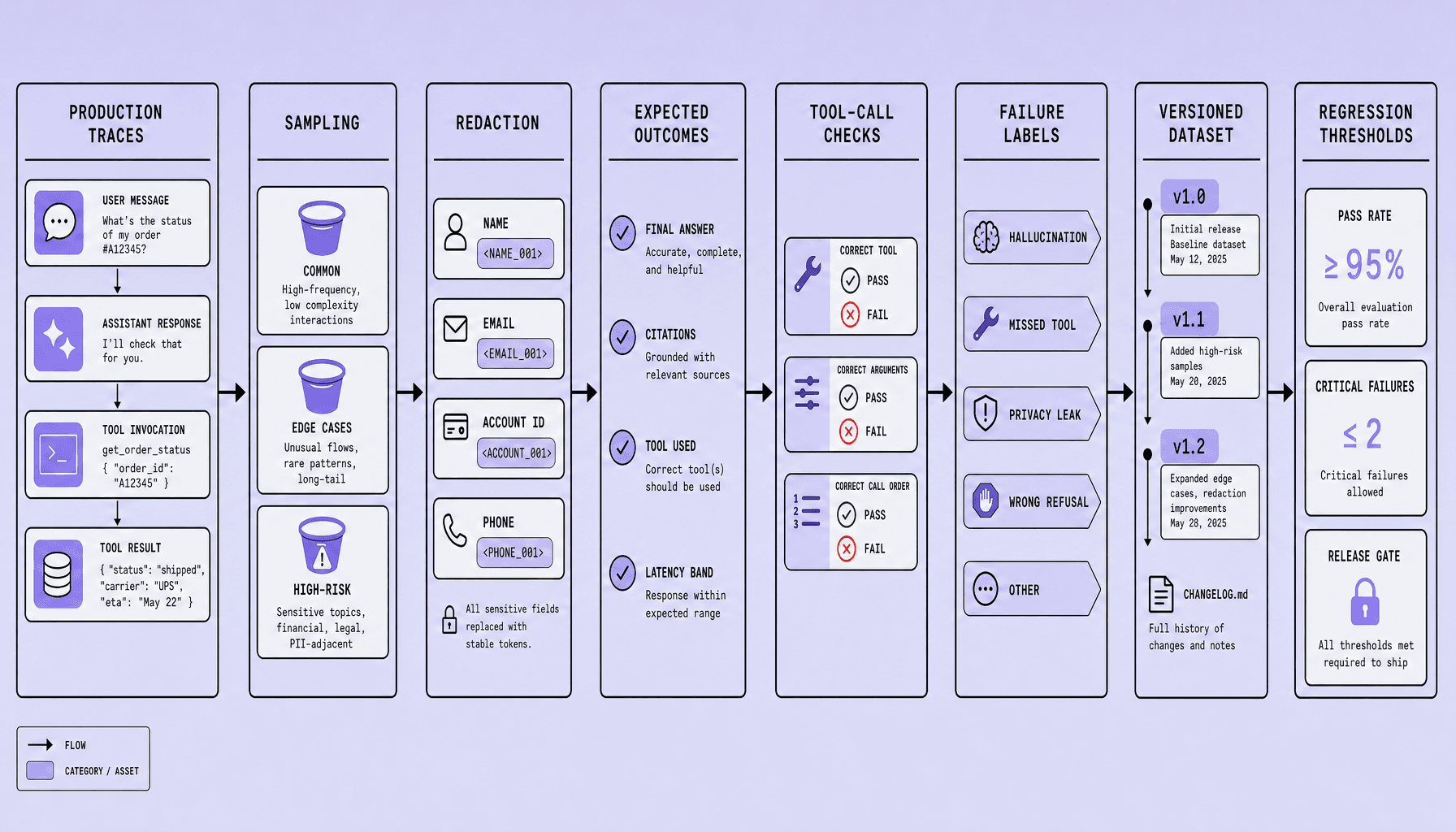
Most teams find out too late that a clean eval set can hide a messy production system. The model looks solid in testing, then live traffic hits it with partial context, broken tool chains, retries, refusals, and edge cases nobody bothered to model. Production trace evaluation closes that gap by turning messy live logs into redacted, labeled, versioned test cases that teams can run again and again. Unlike synthetic-only benchmarks, it makes an LLM evaluation dataset reflect real user behavior, real tool use, and real failure paths.
The workflow is straightforward, but it needs discipline. Sample common traces and rare, high-risk ones -- refunds, escalations, refusals, timeout chains, broken multi-tool calls. Random sampling misses what hurts most. At Imversion Technologies Pvt Ltd, this is the practical lesson: decisions should be backed by data, so slice cases by language, product surface, and task complexity instead of trusting one blended pass rate.
Then redact hard. Replace sensitive values with stable placeholders like [EMAIL_1] or [ACCOUNT_ID_1], including values buried inside tool outputs. For each trace, define expected outcomes: acceptable final answer, required tool-call JSON, blocked actions, and failure labels.
And version everything. Tag dataset updates as v1.2 or v1.3, track what changed, and set regression thresholds for production failure regression testing. Good trace based testing does not replace synthetic evals. But it prevents training the system only on neat examples while production keeps sending chaos.
Key Takeaways for production trace evaluation
-
Real traces beat synthetic-only benchmarks for one reason: they capture the messy workflows users actually trigger -- partial context, tool failures, retries, refusals, and awkward edge cases. A strong LLM evaluation dataset needs that mess, or it will reward polish instead of reliability.
-
Sampling cannot be passive. Random draws overrepresent easy traffic, so a useful real world eval dataset mixes common requests with intentionally oversampled rare paths such as refunds, escalations, timeout chains, and multi-tool breakdowns. Decisions should be backed by data -- slice by language, surface, and task risk.
-
Redaction must hide sensitive data without flattening the trace. Replace values with stable placeholders like
[EMAIL_1]or[ACCOUNT_ID_2], and preserve tool-call shape, argument order, and error payload structure. Otherwise, production trace evaluation loses the behavior you need to test. -
Expected outcomes should cover more than final text. Check whether the model called the right tool, passed valid JSON, respected refusal rules, and ended in the right state. Label failures clearly so production failure regression testing catches repeat defects, not just bad wording.
-
Version the dataset like code --
v1.2,v1.3-- and set regression thresholds by slice. That gives teams a way to block releases on meaningful drops without training only against synthetic examples or a narrow set of known failures.
Build a production trace evaluation dataset with representative and high-risk samples
A production trace eval dataset usually looks healthy right up until it misses the exact failures that cause real damage. That is the problem with random sampling alone. Live traffic is dominated by common, easy requests, so a naive sample overrepresents paths the system already handles well and underrepresents failures that matter most. The result is misleading: an LLM evaluation dataset can post a strong pass rate while regression risk is quietly getting worse.
Sample for reality, then sample for risk
A useful real world eval dataset should include two separate slices:
- a traffic-weighted slice that mirrors what users do most often
- a risk-weighted slice that overrepresents expensive failures, sensitive workflows, and operational edge cases
Keep both slices separate. A single blended set can hide a bad tradeoff: a model change may improve common FAQ traffic while quietly breaking refund disputes, escalation paths, or timeout recovery.
A practical sampling plan for trace based testing usually combines:
- high-frequency traces for baseline realism
- rare but business-critical traces
- segmented slices by user type, language, geography, product surface, and task complexity
If refund disputes make up only a small share of traffic but carry high business risk, include them intentionally through oversampling. Otherwise, they may vanish from random selection and from your AI agent evaluation cases until a bad release reaches users.
Redact without destroying the trace
Raw traces are messy and sensitive. Redact PII, secrets, regulated content, and uploaded document text before reuse, but preserve structure. Replace john.smith with [EMAIL_1], acct_98422 with [ACCOUNT_ID_1], and keep placeholders consistent across the trace.
That consistency preserves what the case is testing: memory, tool grounding, and reference resolution. Human review still matters for edge cases, especially tool outputs and free-form text where sensitive data tends to hide.
Define outcomes, checks, and failure labels
Once the sample is right, the next failure point is vagueness. Each case needs expected outcomes that are testable. Sometimes that is a reference answer. Often it is an acceptance contract:
- correct final action or response
- required tool calls, in order if sequence matters
- forbidden tool calls
- expected arguments in tool-call JSON
- acceptable refusal or escalation behavior
- latency or retry expectations for timeout paths
Label failures explicitly: wrong_tool, missing_escalation, hallucinated_policy, timeout_unhandled, privacy_leak. Simple labels are usually more useful than elaborate taxonomies because teams need labels they can act on.
Version the dataset and set regression gates
Without versioning, even good eval cases drift into confusion. Version the dataset like code: v1.2, v1.3. Record what changed: new geographies, new refusal cases, updated redaction rules, or replaced expected outputs. Then define slice-level thresholds, not just one overall pass rate. A release may need to hold overall accuracy steady while improving Spanish support and avoiding regression in dispute handling.
Synthetic sets are still useful for controlled coverage. But if they replace real traces, the system gets optimized for tidy tests instead of messy production behavior.
Redaction and privacy controls that preserve production trace evaluation value
Privacy mistakes can make a dataset unusable. Over-redaction can make it pointless. The balance is narrower than it first appears: remove sensitive data while keeping the structure, sequence, and constraints that make the case valuable for a real world eval dataset.
Mask data, not behavior
Start by stripping or masking obvious sensitive fields: PII, secrets, regulated content, and sensitive tool outputs. That usually includes names, emails, phone numbers, account IDs, street addresses, API keys, auth tokens, uploaded document text, and payment-related fields. In tool-call JSON, this often means replacing values while preserving keys, order, and argument shape.
So instead of deleting:
{"email":"john.smith","account_id":"ACC-48392"}
use:
{"email":"[EMAIL_1]","account_id":"[ACCOUNT_ID_1]"}
Consistent placeholders preserve context. If [EMAIL_1] appears in the user message, the assistant reply, and a tool output, the evaluator can still check whether the agent tracked identity correctly across turns. That makes the case usable in an LLM evaluation dataset and in AI agent evaluation cases where memory and tool grounding matter.
Redact with minimum necessary retention
Blanket deletion breaks evals. An agent may need the fact that two emails are different, or that a refund case includes a prior escalation, even if the original values must be hidden. Clarity is better than complexity -- retain only the minimum signals required to evaluate behavior.
Over-redaction can remove the very clues the system needs, so privacy review should optimize for minimum necessary retention, not automatic deletion of every field.
Watch the hidden leak paths
The obvious fields are usually not the hard part. Free-form text and tool outputs are. A CRM note, OCR result, support transcript, or SQL error blob can carry names, addresses, medical details, or secrets embedded inside long unstructured text. Those cases need detection rules plus human review. No shortcut.
For production failure regression testing, version the sanitized dataset like v1.2 and v1.3, and log what redaction policy changed between versions. Otherwise, teams cannot explain why pass rates moved in the LLM evaluation dataset.
Define expected outcomes beyond the final answer with tool-call checks
A polished final answer can still hide a bad system. That is why a reusable eval case needs more than a “good answer” label. It needs a clear definition of success for both the output and the route the agent took to get there. This is where many teams miss real failures in trace based testing.
For simple requests, a reference answer can work. If the trace is “What is the refund window?”, the case may pass if the final response includes the correct policy and no unsupported claims. Production trace evaluation gets harder once tools, retries, and multi-step workflows show up. A polished final answer can still hide bad behavior -- wrong tool, unsafe lookup, stale data, or a refusal that should have happened earlier.
Separate must-pass checks from flexible checks
A practical pattern for AI agent evaluation cases is to split expectations into two layers:
- Must-pass checks: tool-call validation, required refusal behavior, parameter correctness, ordering constraints, timeout handling
- Flexible checks: final wording, tone, summary style, minor formatting differences
Because real traces often allow multiple valid phrasings, exact text matching becomes brittle fast. Acceptance criteria are usually better. For example, instead of requiring one exact sentence, require that the final answer confirms refund eligibility, cites the right order state, and tells the user the next step.
Validate the process, not just the prose
A strong agent evaluation should inspect workflow correctness directly. Example:
- Final-answer-only check: “Did the response tell the user their subscription renews on 2025-03-01?”
- Process-aware check: “Did the agent call
get_subscriptionbefore answering, avoidcancel_subscription, and pass the rightcustomer_idin JSON arguments?”
Order matters too. A support agent should verify identity before exposing account details. A billing agent may need to attempt get_invoice, then handle a tool timeout with a fallback message rather than inventing data. Some traces should pass only if the agent refuses -- for example, when the user asks for another customer’s data.
Understanding why a case passed matters as much as whether it passed, because output-only grading can hide unsafe tool behavior.
In practice, this makes the LLM evaluation dataset far more useful for production failure regression testing: teams can catch answer quality regressions, tool misuse, and broken orchestration in the same case.
Use failure labels, dataset versioning, and regression thresholds to operationalize production failure regression testing
A trace does not become useful just because it came from production. It becomes useful when the team can explain how it failed and preserve that meaning across releases. Raw logs are not enough. They are evidence, not a testing system.
Start with a practical failure taxonomy inside the LLM evaluation dataset. Keep it small, stable, and tied to review decisions. A good baseline includes: hallucination, policy refusal error, wrong tool, missing tool, timeout, formatting break, and partial completion. If an agent returns valid JSON but calls search_orders instead of get_refund_status, label that as wrong tool. If it stops after step one of a multi-step refund workflow, label partial completion. If it refuses a safe request because the policy prompt drifted, mark policy refusal error. Teams need the reason, not just the red mark. Otherwise they patch the symptom and miss the regression path.
Version the dataset separately from the model
Model version, prompt version, toolchain version, and dataset version should move independently. Different artifacts. Different risks.
Use dataset versioning with clear release notes: v1.2 might add timeout traces and stricter tool-call assertions; v1.3 might rebalance language slices and remove a redaction bug. Semantic versioning works well here because teams can distinguish between label fixes, new cases, and breaking expectation changes. That separation matters in production failure regression testing: if pass rates move, the team needs to know whether the model changed, the eval changed, or both.
Set thresholds by slice, not just one overall score
One aggregate pass rate hides too much.
Set explicit regression thresholds for slices such as refunds, escalations, refusals, or non-English traffic. For example, a release might tolerate a small drop on low-risk formatting cases but require no regression on business-critical refund traces or tool-selection accuracy. That is how AI agent evaluation cases become a release gate instead of a dashboard.
Synthetic cases still help. But if they crowd out real production traces, the system learns the benchmark instead of the workflow.
In practice, the strongest release process blends both: synthetic coverage for breadth, versioned real-trace cases for truth.
A worked production trace evaluation example and best practices to avoid synthetic-only blind spots
The easiest way to fool yourself is to test only polished prompts. A better approach is simpler and harsher: take one messy production trace, convert it into a reusable test case, and repeat that process every release cycle. That is how a real world eval dataset stays honest.
Example: a support trace shows a user asking for a refund. The agent calls get_order(order_id="84721"), then create_refund, but it skips the policy check and includes the user’s full email in the final reply. A reusable eval case should preserve the workflow and decision points, not the private data: [EMAIL_1], [ORDER_ID_1], redacted tool outputs, and metadata such as a timeout, retry, or escalation if those events affected the path.
Define the expected outcome at two levels. Final-answer checks: approve only if policy conditions are met, explain the next step clearly, and do not expose PII. Process checks: look up the order first, validate policy before any refund action, avoid duplicate tool calls, and record whether the agent recovered correctly if a tool failed on the first attempt.
Then attach labels that explain the failure mode, such as policy_miss, pii_leak, tool_sequence_error, missing_recovery, or unnecessary_retry. Add a dataset version tag like golden-dataset v1.3 and a release threshold, such as zero failures on this case.
The best-practice lesson is simple: synthetic prompts can still help with coverage, but they should not be the only benchmark. To avoid blind spots, add fresh production failures each release, especially refusals, escalations, timeout paths, and multi-tool errors that polished demos rarely capture.
Frequently Asked Questions
What is production trace evaluation?
production trace evaluation is a key concept in Show how to convert real production traces into reusable evaluation cases. Cover sampling, redaction, expected outcomes, tool-call checks, failure labels, dataset versioning, regression thresholds, and how to avoid training the system only on synthetic examples.. It provides a structured approach to building reliable solutions in this space.
Why should I use production trace evaluation?
Using production trace evaluation offers significant advantages including better performance, improved maintainability, and stronger type safety compared to alternatives.
How do I get started with production trace evaluation?
Getting started with production trace evaluation involves setting up your development environment, understanding the core concepts, and following the official documentation for a step-by-step guide.
Make Imversion a preferred source on Google
Like this kind of AI and software analysis? Add Imversion as a preferred source so Google can highlight our articles for you in Search, AI Overviews, and AI Mode.