LLM Judge Evaluation: Effective Grading Insights for Teams
Explore when LLM judge evaluation is beneficial for grading and where it can lead to misleading results. Optimize your evaluation strategy now!

On this page
When LLM judge evaluation is useful—and when it starts to mislead
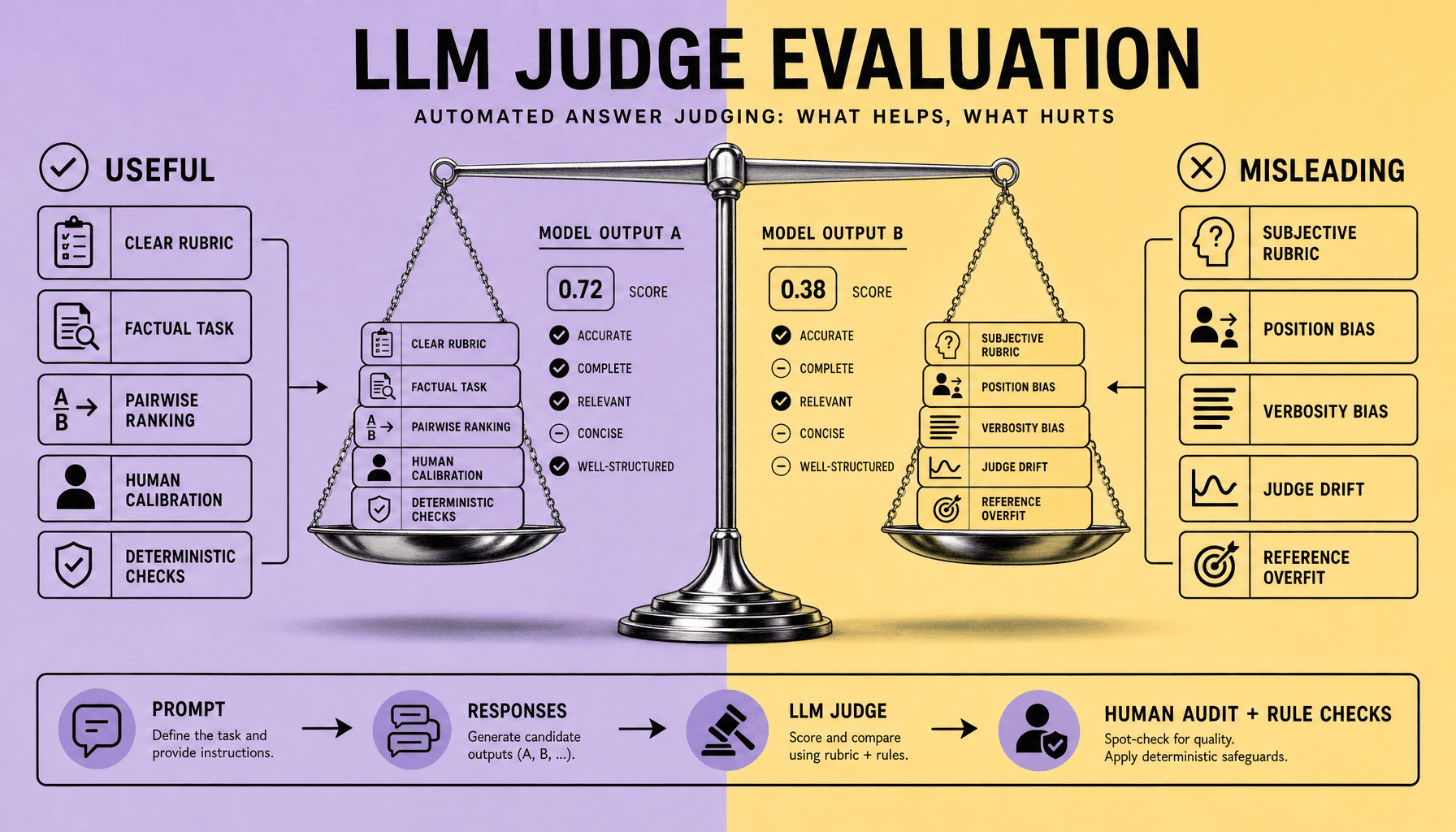
If your team is shipping lots of open-ended AI output, manual review becomes the bottleneck fast. That is where LLM judge evaluation helps. It scales reviews of summaries, support replies, code explanations, and short-form reasoning well, as long as the rubric is explicit and the judge is calibrated against human ratings. It starts to mislead when teams treat model-based grading as ground truth for high-stakes or poorly specified tasks.
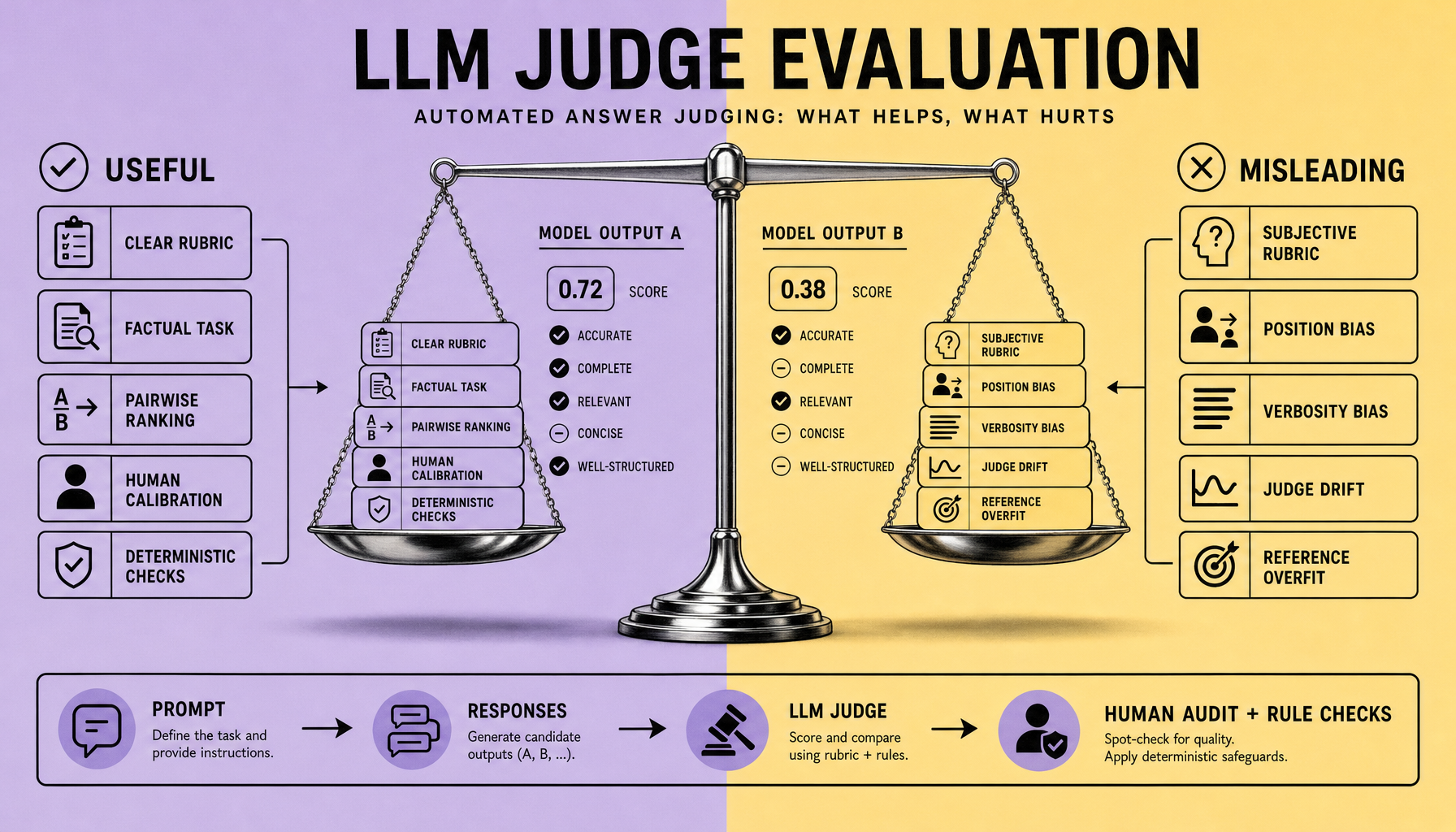
The boundary is simple. Use rubric based evaluation for summaries, support replies, code explanations, or short-form reasoning where qualities like accuracy, completeness, tone, and safety can be defined with score anchors or pairwise preferences. Pairwise beats scalar grading when consistency matters -- asking an LLM as a judge which answer is better is usually steadier than forcing a 1-to-5 score. But reference answers, answer order, and judge-model changes can all skew results. So teams should version the judge prompt and model, measure agreement rate or rank correlation against humans, and combine model-based grading with deterministic checks such as schema validation, citation presence, banned-term rules, and exact-match tests. Clarity is better than complexity.
Key Takeaways for LLM judge evaluation
-
Use LLM judge evaluation for speed and scale on open-ended work, not as ground truth. It fits summaries, support replies, and explanation quality. High-stakes decisions break fast if the rubric is vague or the task hides requirements the judge cannot see.
-
Build rubric based evaluation around observable dimensions -- factual accuracy, completeness, instruction-following, safety, tone -- with clear score anchors and explicit penalties for hallucinations or missed steps. Clarity is better than complexity because vague rubrics invite style bias.
-
Prefer pairwise judgments over scalar scores when ranking outputs. LLM as a judge is usually steadier at “A or B?” than at assigning a fixed 1–5 score across prompts, domains, and revisions.
-
Control LLM evaluation bias directly: randomize answer order to reduce position bias, keep reference answers for tasks with known targets, and version the judge model, prompt, and rubric together.
-
Calibrate against humans on a sampled set, track agreement or rank correlation, and combine LLM as a judge with deterministic checks such as schema validation, required-step checks, exact-match fields, and safety rules.
Where model-based grading helps most—and where it breaks down
The mistake is not using model-based grading. The mistake is asking it to do jobs it cannot do well.
Use model-based grading as an operations tool, not as ground truth.
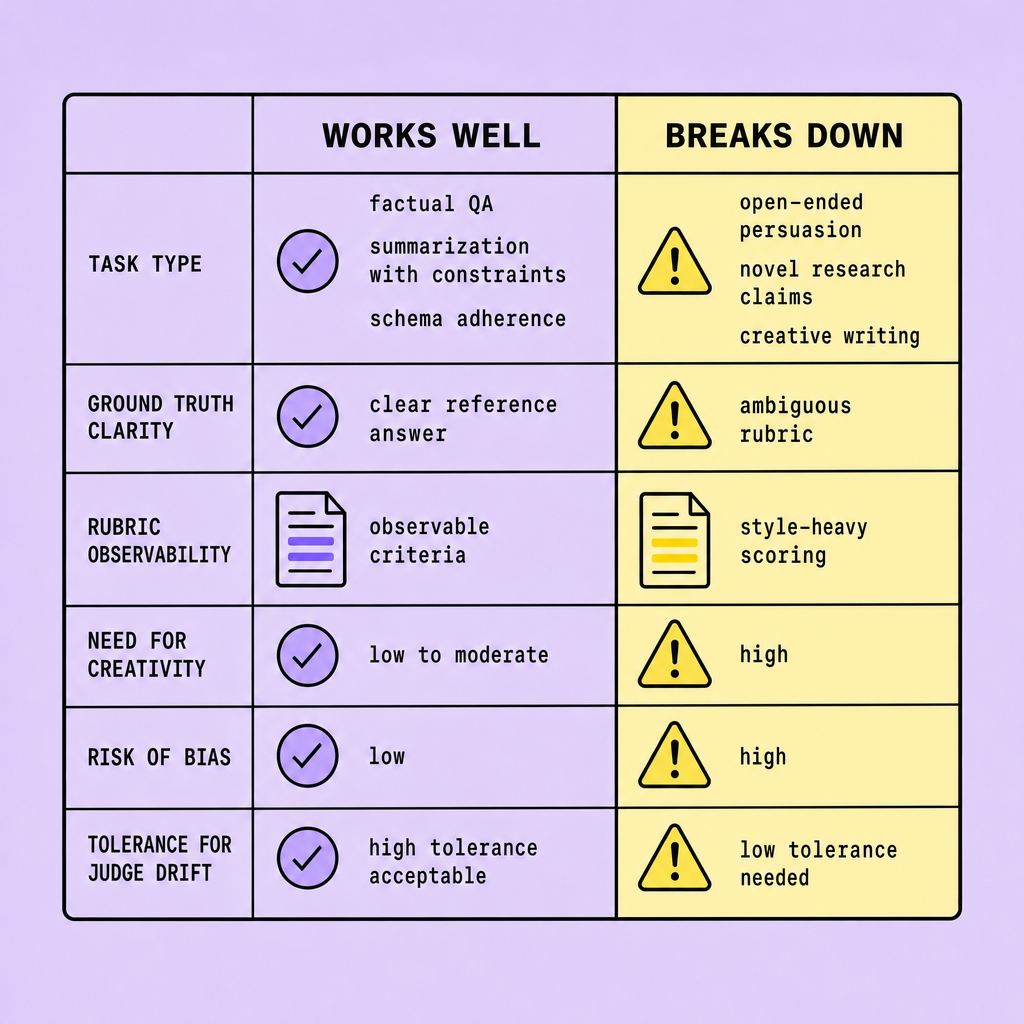
It works well when teams need fast feedback on large volumes of open-ended generation and the rubric is explicit. Think summaries, support replies, short essays, code explanations, or rewrite quality. These are semantic evaluation tasks: the question is not “Did the output match one exact string?” but “Did it answer clearly, completely, and safely?” In that setting, an LLM as a judge can scale review far beyond what human raters can handle.
Good fits
The best rubric based evaluation setups break quality into observable dimensions: factual accuracy, completeness, instruction-following, tone, reasoning transparency, and safety. The rubric needs anchors. A “5” should mean something concrete, such as “no material errors and all required points covered.” Without anchors, LLM judge evaluation drifts toward fluency and style.
Pairwise judgment often beats scalar grading here. Asking a judge model, “Which answer is better under this rubric?” is usually more stable than asking for a raw 1–5 score. Relative comparisons are easier to keep consistent across prompts and domains.
Reference answers can help too -- if they are treated as examples, not the only valid target. For open-ended tasks, one good answer is not the only good answer.
A practical recommendation: calibrate the judge against human raters on a fixed sample before rollout, then track agreement rate or rank correlation after every prompt or model change. At Imversion Technologies Pvt Ltd, that kind of discipline is the difference between a useful signal and dashboard noise. Decisions should be backed by data.
Misleading uses
This is where teams get overconfident.
LLM as a judge becomes risky in high-stakes assessment, compliance review, hidden-constraint tasks, or anything with objectively checkable requirements. If a response must include a specific field, follow a legal rule, pass a unit test, or avoid a banned claim, deterministic checks should lead. Regex, schema validation, test execution, policy rules, and retrieval-backed fact checks are more reliable there.
Judge models also carry bias. Position bias is common -- the first or second answer can get favored depending on prompt format. Judge-model changes matter too. Swap the evaluator model or update its prompt, and the score distribution can move even if output quality does not.
Treat automated judging as a prioritization and monitoring layer, then combine it with deterministic checks and human review for exceptions, audits, and high-stakes decisions.
Because reliable systems matter most.
Rubric design principles that make automated grading less subjective
A vague rubric gives you vague scores. Worse, it gives you confident-looking vague scores.
If teams want model-based grading to be useful, they need to stop asking the judge for a vibe and start giving it a job. A weak prompt invites style bias. A strong automated grading rubric narrows the decision to observable evidence.
Good rubric based evaluation does not ask, “Is this a good answer?” It asks, “Did this answer include the required steps, avoid unsupported claims, and stay within the requested tone?” That shift matters. If you cannot explain why a score was assigned, drift can hide inside a neat-looking number.
Designing observable dimensions
The safest rubrics break quality into dimensions a judge can inspect:
- factual accuracy
- completeness
- instruction following
- reasoning transparency
- tone
- safety
Each dimension needs concrete anchors.
For example, factual accuracy can be scored like this: a 5 means no material errors or invented facts; a 3 means mostly correct but contains one important mistake; a 1 means the answer includes multiple false claims or a clear hallucination. Completeness can use the same structure: did it cover all required points, or did it skip a mandatory step?
Penalties should be explicit too. If a task requires numbered steps, missing one should lower the score. If the answer cites facts not present in the source, define that as a hallucination penalty. If the task forbids chain-of-thought disclosure, the rubric should score concise justification, not private reasoning.
Vague rubrics make LLM as a judge systems reward polish over substance. Smooth prose wins. Correctness gets blurred.
A practical recommendation: document allowed variation. If two phrasings are both valid, say so. If concise and detailed answers can both pass, define the boundary. Clarity beats complexity.
Using reference answers carefully
Reference answers help most on factual, bounded tasks -- extraction, short QA, policy compliance, deterministic summaries. They give the judge a target and reduce arbitrary scoring.
But reference answers become misleading when they act like the only acceptable wording or reasoning path. Creative writing, open-ended explanations, and many coding tasks allow multiple valid outputs. In those cases, a rigid reference answer can punish correct alternatives.
Use a reference answer as evidence, not as a script.
A better pattern is to provide the reference answer, list acceptable variations, and tell the judge to compare meaning rather than wording. Then combine that with deterministic checks where possible -- exact-match fields, schema validation, unit tests, prohibited-term checks, or required-keyword presence. That mix catches what model-based grading misses and makes rubric based evaluation less subjective.
Pairwise vs scalar grading in LLM judge evaluation
Most teams reach for numbers too early.
Ask the judge to pick the better answer by default. Use numeric scores only after the scale has been anchored, tested, and shown to track human judgment on a representative sample.
That is the practical rule.
In LLM judge evaluation, pairwise comparison is usually more stable than scalar scoring because relative judgment is easier than absolute judgment. A judge can often tell that answer A is better than answer B under a clear rubric, even when it struggles to decide whether either one deserves a 3, 4, or 5. That difference matters. Teams often mistake tidy scorecards for reliable measurement, then discover the scores shift when the prompt wording changes, the domain changes, or the judge model is swapped.
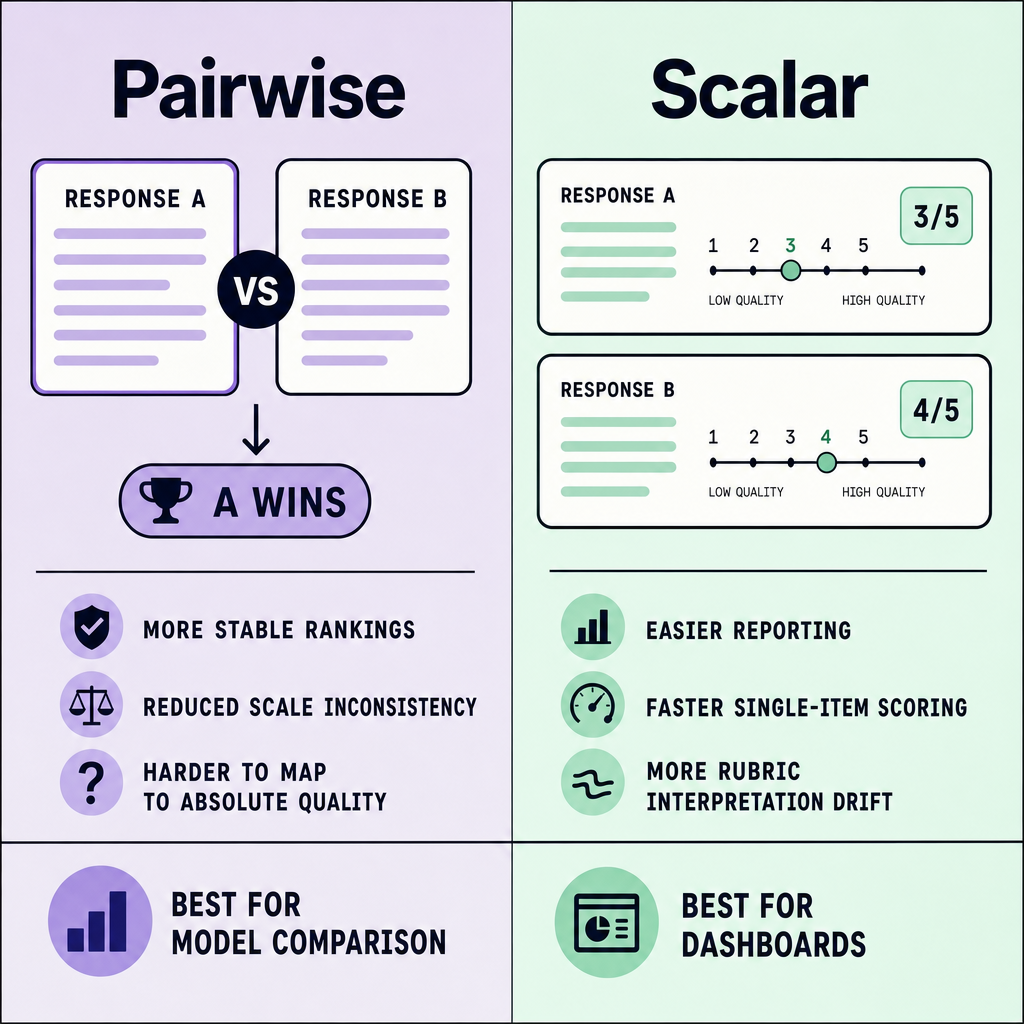
Scalar scoring still has a place. If a team needs thresholding -- pass/fail for policy checks, minimum quality gates before publish, or dashboard trends over time -- scalar scoring is useful. But only with anchored definitions per score level. In rubric based evaluation, a “4” must mean something concrete, not “pretty good.” Clarity is better than complexity, especially here.
| Method | Best fit | Main risk | Human handoff |
|---|---|---|---|
| Pairwise comparison | Ranking variants, A/B testing, preference evaluation | Position bias if answer order is fixed | Review close or split decisions |
| Scalar scoring | Thresholds, dashboards, longitudinal monitoring | Scale drift across prompts, domains, or judge versions | Audit samples near cutoff scores |
| Pairwise to win rate/ranking | Model tournaments, benchmark-style comparisons | Needs enough comparisons to stabilize | Validate top and bottom ranks with humans |
A good pattern is simple: use LLM as a judge in pairwise mode for ranking candidate prompts, model variants, or retrieval settings; then convert results into win rate or a ranking table. Use scalar scoring for operational gates after calibration. Because understanding why a score moved is essential, pairwise prompts should ask for a choice and a brief rubric-grounded reason.
One caveat. Pairwise comparison is not bias-free. Judges can favor the first answer, longer answers, or more polished phrasing. So teams should randomize order, keep formatting consistent, and combine LLM as a judge with deterministic checks for factual constraints, required fields, schema validity, and safety rules.
Position bias, judge-model changes, and other sources of scoring drift in LLM judge evaluation
Model-based grading rarely fails loudly. That is what makes it dangerous.
Teams often blame the rubric when the bigger problem is scoring drift inside the evaluator itself. An LLM as a judge can prefer the first answer it reads -- position bias -- or reward longer answers even when they are bloated -- verbosity bias. Some judges favor outputs that sound like their own training style, which creates self-preference. Small prompt edits can change the result more than the product change being measured. Classic LLM evaluation bias.
Pairwise comparisons reduce some of this, but they do not remove it. If answer A wins more often only because it appears first, the comparison is polluted. So randomize order, strip names and formatting, and keep output length within a reasonable range before sending it to the judge. Blind inputs help.
The harder problem is drift over time. Change the judge model version, swap the system prompt, or tighten one rubric sentence, and score distributions can shift. Suddenly a 4/5 last month is a 3/5 now -- even if the underlying product did not change. That breaks trend lines.
Store judge prompts, model versions, rubric text, and score distributions together. Otherwise teams cannot separate product movement from evaluator movement.
In practice, rubric based evaluation works best when paired with controls: version pinning, fixed prompts, periodic human calibration, and deterministic checks for things like required fields, policy violations, and exact-match constraints. Use LLM as a judge for nuanced quality. Use code for everything objective.
Calibrate LLM judge evaluation against humans and combine it with deterministic checks
A judge that has never been checked against humans is just another opinionated model.
Calibrate the judge against humans first, then let deterministic checks handle anything objective. That keeps LLM judge evaluation useful as a scaled review tool instead of a shaky source of truth.
Start with a sample of real outputs that includes easy, average, and failure cases. Have at least two human raters score them with the same rubric, then compare the judge against that labeled set. Check human agreement first: if people cannot score the task consistently, the rubric is still too vague. After that, measure judge-human alignment with agreement rate, rank correlation for ordered scores, or confusion analysis on pass/fail decisions.
Then inspect the disagreements. A judge can look consistent while still being wrong in patterned ways, such as preferring longer answers, penalizing unusual wording, or missing factual errors. Review a small disagreement set, tighten rubric anchors, and set thresholds only after that review. If a score gates release, use conservative cutoffs and add spot checks near the boundary.
Put deterministic checks first
Use the judge for subjective dimensions. Use rules for objective ones.
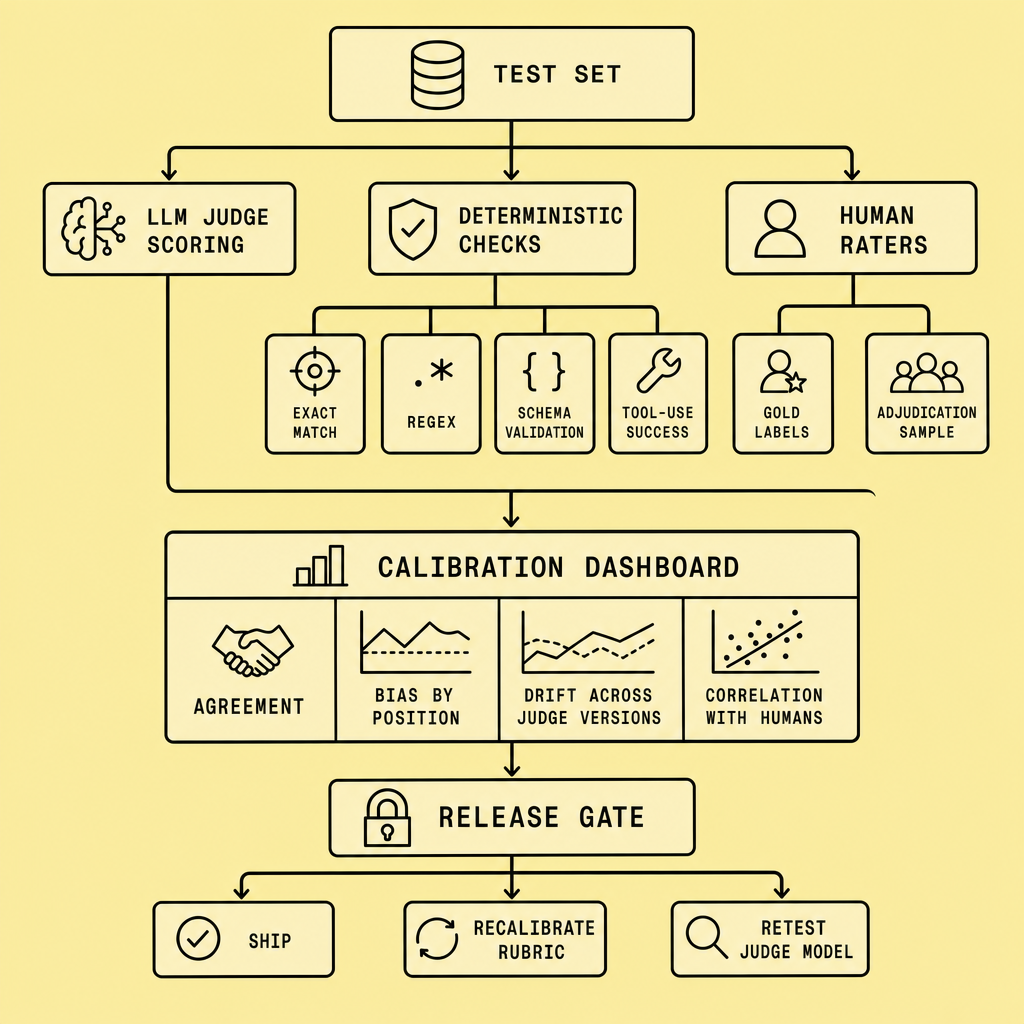
A hybrid pipeline is usually more reliable because deterministic validators catch failures the judge should not debate:
- regex or schema validation for JSON, fields, and format
- policy checks for banned content or missing disclaimers
- grounding checks for required citations or source coverage
- unit tests for code, SQL, or tool outputs
- exact checks for names, dates, totals, or IDs
Compact workflow
- Run deterministic checks first.
- Send only valid outputs to the judge.
- Use pairwise review for preference tasks; scalar scoring for anchored rubric dimensions.
- Sample human review every batch.
- Recalibrate whenever the judge model, prompt, or task changes.
Frequently Asked Questions
What is the biggest mistake teams make with LLM judge evaluation?
The biggest mistake is using LLM judge evaluation as if it were a final authority instead of a measurement tool. It works best as a scalable proxy for human review, but it should not replace explicit rules, audits, or domain experts when the task has legal, financial, or safety consequences.
How does LLM judge evaluation differ from benchmark scoring?
LLM judge evaluation is usually adaptive and semantic, while benchmark scoring is typically fixed and exact. Benchmarks measure performance against predefined answers or tests, whereas an LLM judge can assess qualities like helpfulness, clarity, and tone that are harder to capture with simple match-based metrics.
Why should pairwise judgments sometimes be converted into win rates instead of direct scores?
Win rates often provide a cleaner summary because they preserve the comparative strength of outputs without pretending the distance between quality levels is precise. This makes them especially useful for prompt experiments, model tournaments, and retrieval comparisons where relative ranking matters more than assigning an absolute grade.
When should human reviewers override an automated LLM judge evaluation?
Human reviewers should override automated judgments when the output is novel, ambiguous, high-impact, or outside the rubric's tested scope. Overrides are also appropriate when deterministic checks and judge scores disagree, because that mismatch often signals a hidden requirement, rubric gap, or evaluator bias that needs investigation.
How often should a team recalibrate an LLM judge evaluation system?
A team should recalibrate whenever the judged task changes materially, the judge model or prompt is updated, or score distributions shift unexpectedly. Even without obvious changes, periodic recalibration on fresh samples is necessary because production data drifts over time and can quietly weaken alignment with human standards.
Make Imversion a preferred source on Google
Like this kind of AI and software analysis? Add Imversion as a preferred source so Google can highlight our articles for you in Search, AI Overviews, and AI Mode.