RAG Retrieval Quality: Best Practices for Accurate Context in 2026
Explore the critical aspects of RAG retrieval quality and learn how to measure and improve context relevance for better AI retrieval accuracy.

How To Measure RAG Retrieval Quality in Practice
If your RAG system sounds confident but keeps getting answers wrong, start by checking retrieval. Most teams waste time tweaking prompts when the real problem is simpler: the system is pulling the wrong context, incomplete context, or context ranked too low to help.
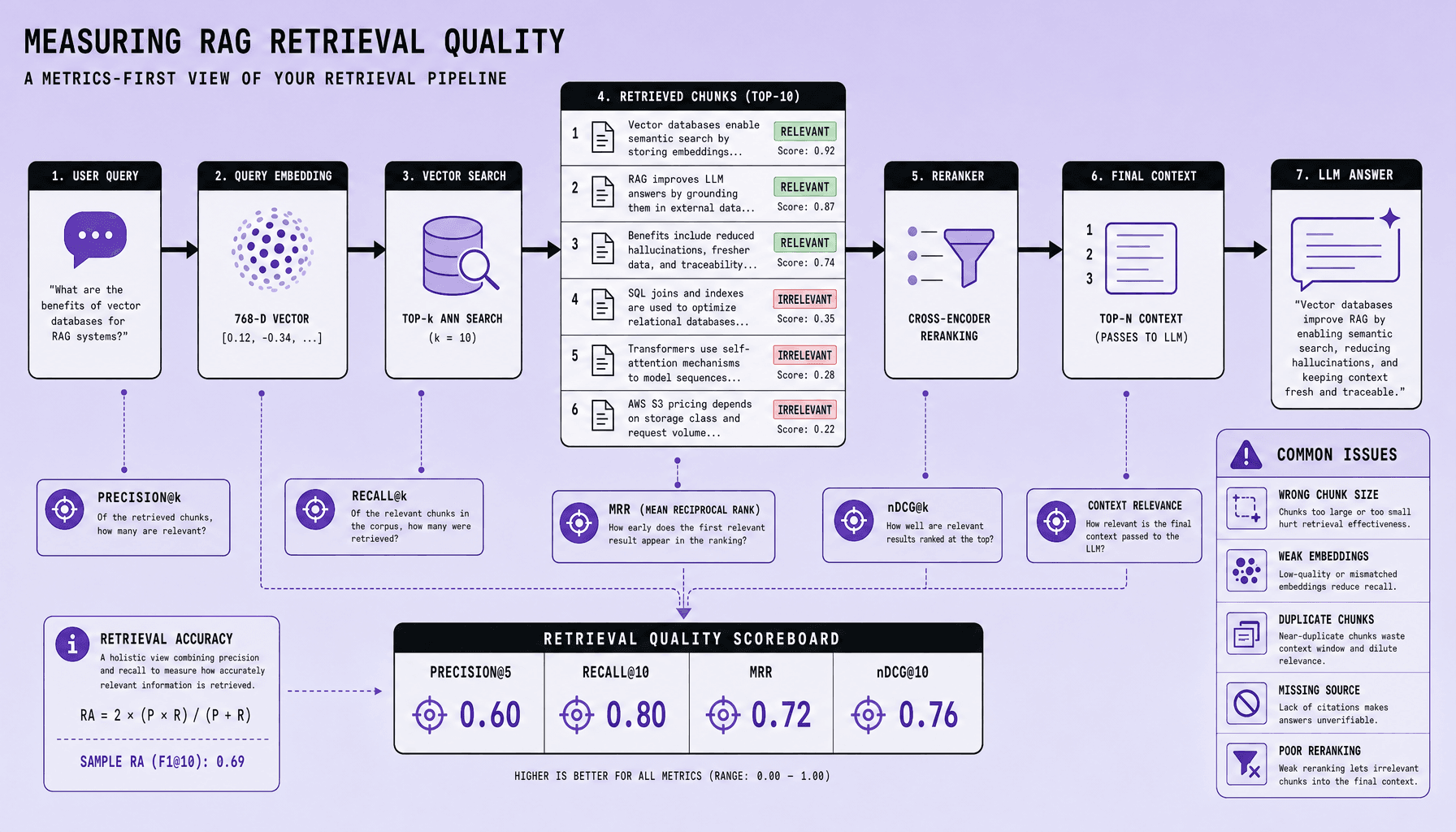
You measure RAG retrieval quality by testing whether your system returns relevant, complete, and correctly ranked context for real queries. In practice, strong RAG evaluation combines Precision@k, Recall@k, MRR, nDCG, and context relevance checks -- because retrieval accuracy is not just about matching words.
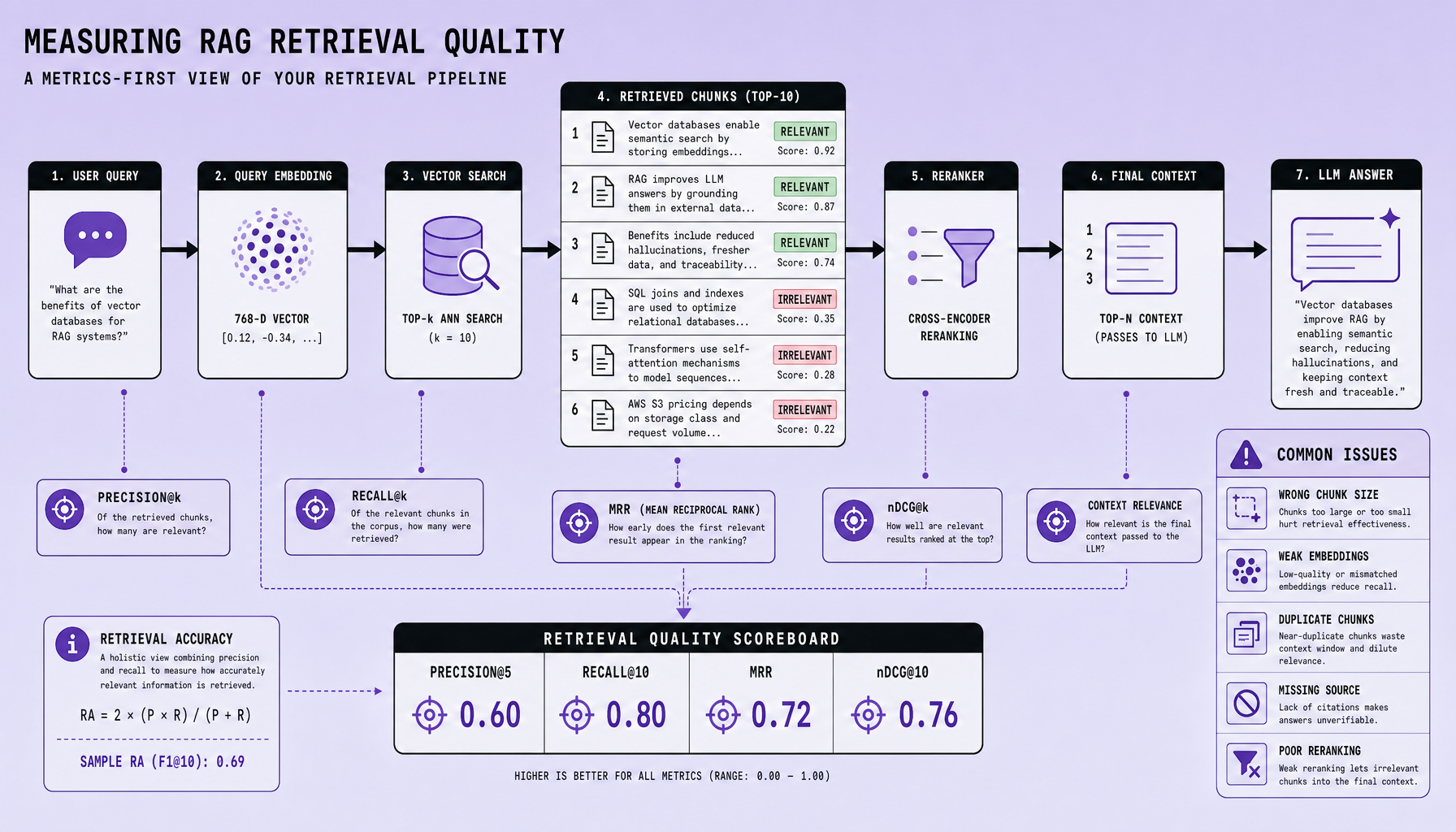
Start with a labeled test set of representative questions and expected passages. Then score top-k results, inspect misses, and compare changes in chunking, embedding models, and rerankers. A practical setup might test 300- to 800-token chunks, small overlap, a vector database, and a cross-encoder reranker. But metrics alone are not enough. Some chunks look relevant and still fail to support the answer. So include human review or LLM-as-judge checks for answer-supporting context. At Imversion Technologies Pvt Ltd, I treat this as an engineering loop: measure offline, validate online, and keep watching production -- because monitoring is as important as deployment.
Key Takeaways for Improving RAG Retrieval Quality
- Treat RAG retrieval quality as an engineering problem, not a prompt tweak. If your RAG systems retrieve the wrong chunks, generation quality will look random and debugging will stay slow.
- Prioritize the metrics that expose retrieval accuracy: Precision@k for relevance, Recall@k for coverage, MRR for first-hit ranking, and nDCG for graded ranking quality in RAG evaluation.
- Don’t confuse keyword overlap with context relevance. A passage can share terms with the query and still miss the user’s intent, omit the needed fact, or provide outdated context.
- The biggest levers are chunking strategy, overlap settings, embedding quality, and reranking. Small chunk sizes can improve precision, but they can also hurt recall if you split critical context too aggressively.
- Keep measuring after launch. Monitoring is as important as deployment -- query drift, content changes, and index updates can quietly degrade AI retrieval long before users report failures.
Why Retrieval Quality Matters in RAG Systems
A fluent answer can hide a broken retrieval pipeline for a long time. That is the danger. Users see polished language and assume the system is grounded, while the model is actually answering from thin or misleading context.
Retrieval quality determines whether a RAG system is trustworthy or merely persuasive. If retrieval returns the wrong context, the model often still produces a fluent answer. That is how hallucinations, unsupported claims, and confident but incorrect guidance appear.
In RAG, generation depends on retrieval. If the system fetches an outdated policy, an incomplete procedure, or a chunk that matches keywords but not meaning, the final answer can sound polished while remaining wrong. Better prompting cannot replace missing evidence, so teams should usually debug retrieval before blaming generation.
Factual accuracy depends on retrieval accuracy
Reliable answers require source material that is relevant, complete, and current. That is why retrieval sits at the center of RAG evaluation. Precision@k helps show whether top results are actually useful. Recall@k helps show whether the system found enough context to answer fully. Ranking metrics such as MRR and nDCG indicate whether the best evidence appears early enough to be used.
High recall alone is not enough. Retrieving many loosely related chunks can dilute context quality and increase the chance that the model relies on the wrong passage.
Explainability depends on grounded context
If you cannot trace an answer back to retrieved chunks, debugging turns into guesswork. Auditability is not a nice extra in RAG systems. It is how you decide whether the issue is retrieval, ranking, chunking, or the generation step itself.
A useful RAG system should let you trace an answer back to retrieved chunks. That makes outputs easier to inspect, test, and improve. When retrieval is weak, that audit trail breaks down.
This is also why chunking, embeddings, and reranking matter. Poor chunk boundaries can split key facts across passages. Weak embeddings can miss semantic matches. Without reranking, plausible but lower-value chunks may stay near the top. Retrieval quality usually improves when these layers are tuned together and checked against real queries.
Risk rises in high-stakes use cases
The cost of weak retrieval changes fast once the answer affects real operations. A bad movie recommendation is noise. A bad policy answer, billing explanation, or compliance instruction is a workflow problem.
In customer support, weak retrieval can produce incorrect policy answers or incomplete troubleshooting steps. In regulated or process-heavy environments, it can surface outdated guidance or omit important constraints. The stakes rise when answers affect policy, finance, healthcare, legal, or security-sensitive workflows.
Monitoring matters too. Retrieval quality can drift as documents change, indexing falls behind, or query patterns shift. When retrieval drifts, answer quality usually drifts with it.
RAG Retrieval Quality Metrics: Precision, Recall, Ranking, and Context Relevance
If your retriever only “sometimes works,” stop changing prompts for a moment and measure what it is actually returning. You need to know three things: did the system find relevant evidence, did it find enough of it, and did it rank the most useful context high enough to matter?
Precision vs. Recall: useful, but incomplete
Precision@k asks: of the top-k retrieved chunks, how many are relevant?
Formula: relevant chunks in top-k / k.
Recall@k asks: of all relevant chunks available, how many did the retriever return in top-k?
Formula: relevant chunks retrieved in top-k / total relevant chunks.
Use Precision@k when you want to reduce noisy retrieval. Use Recall@k when missing one key passage makes the answer incomplete.
These metrics trade off. A retriever can show high precision by returning one strong chunk while still missing another chunk needed for a complete answer. High recall can also look good while sending too much weak or repetitive context into generation.
Ranking metrics: MRR and nDCG
Finding the right chunk is only part of the job. Position matters. A relevant chunk buried at rank 10 is often functionally absent, especially if your generator only sees a small top-k window.
MRR measures how early the first relevant result appears. For each query, calculate 1 / rank of the first relevant result, then average across queries. It is most useful when one highly ranked result often determines success.
nDCG measures ranking quality when relevance is graded instead of binary. It rewards putting highly relevant chunks above partially relevant ones, which makes it useful when several chunks contribute unequally to the answer.
| Metric | Measures | Misses | Best use |
|---|---|---|---|
| Precision@k | Relevance density in top-k | Missing needed context | Reduce noisy retrieval |
| Recall@k | Coverage of relevant context | Excess irrelevant chunks | Multi-step or completeness-sensitive answers |
| MRR / nDCG | Ranking quality and position | Whether chunks support the final answer | Compare retrievers and rerankers |
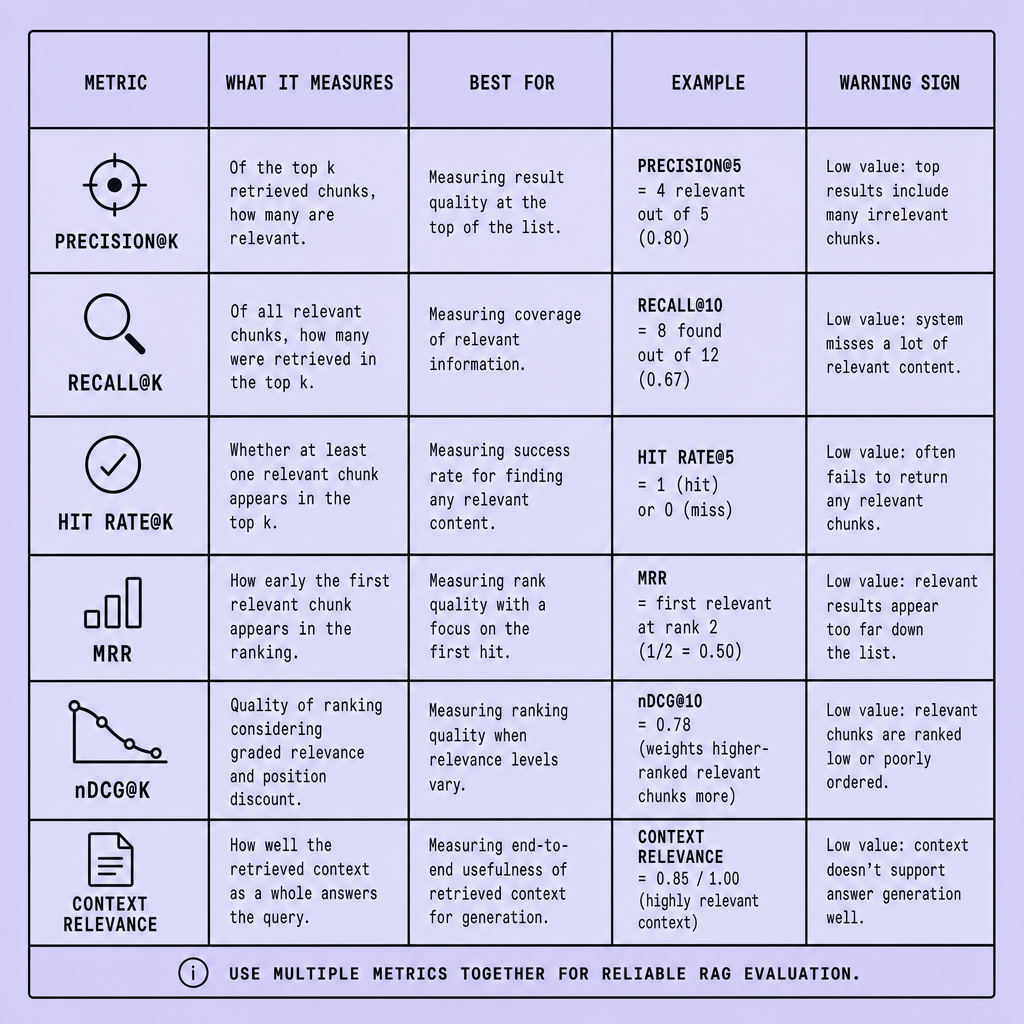
Context relevance checks: the metric behind answer quality
This is where many evaluations fall apart. A chunk can look relevant on paper, score well in retrieval metrics, and still fail to support the final answer.
Ranking relevance is not the same as context relevance. A chunk can overlap with the query’s terms yet still fail the user’s actual intent.
That is why offline metrics should be paired with manual review. A chunk may score as relevant and still be unhelpful for generation. When answers look wrong despite solid metric scores, inspect the retrieved chunks directly.
In practice, track Precision@k, Recall@k, MRR, and nDCG on a labeled test set, then review failure cases. If retrieval quality is weak, investigate chunking, embeddings, and reranking together rather than tuning prompts first.
How Chunking, Embedding Quality, and Reranking Affect RAG Retrieval Quality
If retrieval keeps returning passages that look close but do not actually solve the query, the fix is rarely in prompt wording. Most of the time, the issue starts earlier in the pipeline.
Retrieval accuracy depends more on system design than prompt wording, especially chunking, embeddings, filtering, search strategy, and reranking.
Chunking
Chunking determines what the retriever can find. Small chunks often improve precision because they isolate a single idea, policy rule, or API behavior. Larger chunks can improve completeness when the answer depends on surrounding paragraphs, section headers, tables, or multi-step instructions. The tradeoff is simple: smaller chunks are more specific; larger chunks preserve more context.
Keep document structure where possible. Headings, bullet lists, code blocks, and table boundaries carry meaning. If you split across them blindly, retrieval may return fragments that look relevant but are missing the actual answer. Overlap can help, but too much overlap creates near-duplicates that crowd the top-k.
A practical approach is to test one chunk size and one overlap setting at a time. Changing chunking, embeddings, and reranking together makes it hard to see what actually improved retrieval.
Embeddings
Embeddings decide how well semantic similarity lines up with what the user actually meant. That sounds straightforward until domain language gets involved.
Embedding quality affects how well semantic similarity matches user intent. Strong embeddings usually improve recall for paraphrased queries and reduce reliance on exact keyword matching. But domain mismatch can still hurt retrieval. A general-purpose model may understand broad terms while missing internal product names, legal phrasing, or specialized abbreviations.
Metadata filtering also matters. Filtering by product, language, date, or document type can reduce noise before retrieval and improve precision. Hybrid search can help when exact terms, IDs, part numbers, or acronyms matter alongside semantic similarity.
Consistency between indexing and query pipelines matters too. If text is normalized, tokenized, or filtered differently at index time and query time, retrieval quality can drift in ways that are difficult to debug.
Reranking
Reranking is often where a decent retriever becomes a useful one. It helps most when first-pass retrieval finds several candidates that are close, but not equally useful.
Reranking improves top-k relevance after initial retrieval, especially when first-pass search returns several almost-right chunks. A reranker can compare the query and candidate chunks more precisely than the initial retriever, which often improves ranking quality and answer grounding.
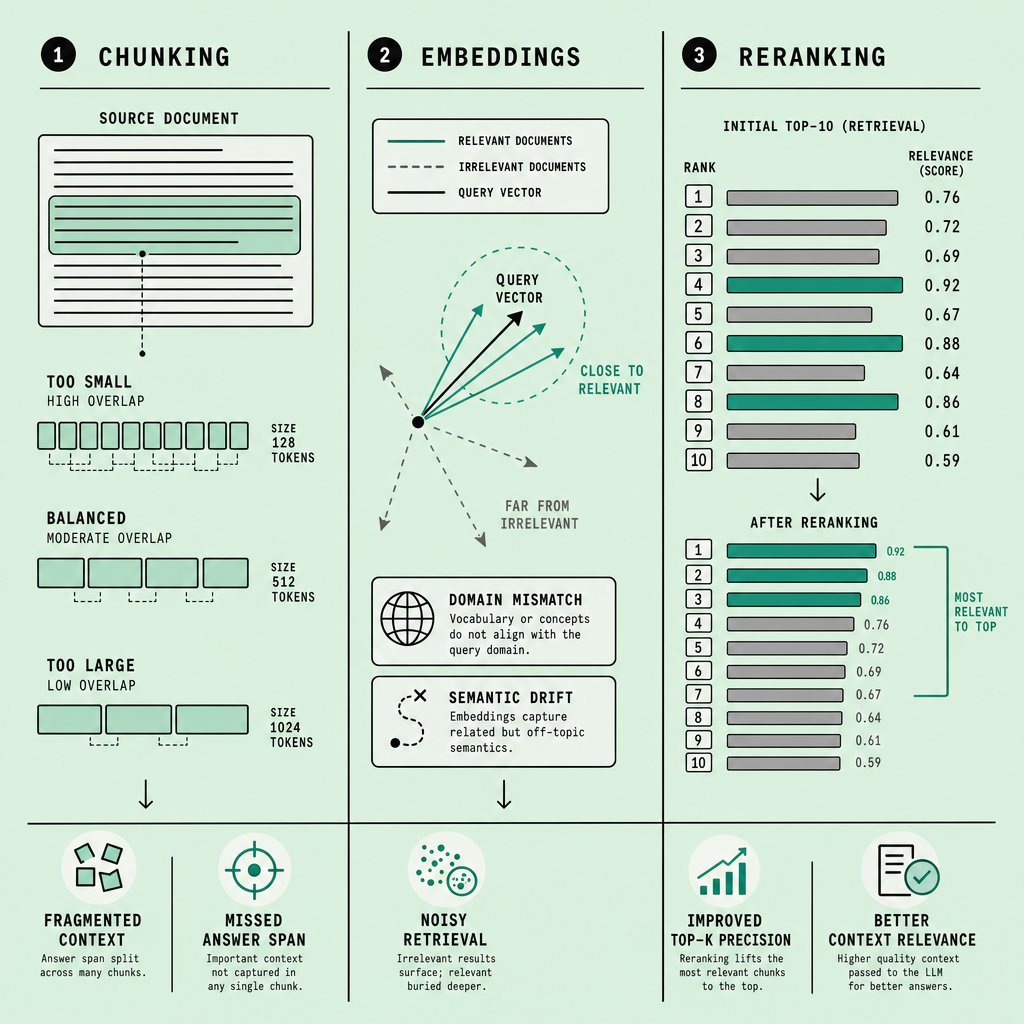
But reranking is not a substitute for recall. If the right chunk never enters the candidate pool, a reranker cannot recover it. In practice, use reranking after your base retrieval is already finding enough relevant candidates.
FAQs
What system choices most affect retrieval accuracy in RAG systems?
Chunking strategy, embedding quality, metadata filtering, hybrid search setup, and reranking usually have the biggest direct effect.
How does chunk size affect context relevance?
Smaller chunks improve specificity, while larger chunks preserve more surrounding context.
Why do embeddings fail in domain-specific AI retrieval?
They often miss specialized terminology, abbreviations, or document conventions.
When should you use hybrid search in RAG systems?
Use it when exact matches matter alongside semantic retrieval.
Does reranking always improve RAG evaluation results?
No. It helps only when relevant chunks are already in the candidate set.
Common Retrieval Issues and Best Practices for Better RAG Evaluation
Most retrieval failures are not mysterious. They follow recognizable patterns, they damage specific metrics, and they can usually be isolated with disciplined testing instead of guesswork.
In practice, better RAG evaluation comes from mapping common failure modes to the metrics they hurt, then testing targeted fixes on realistic queries before changing prompts.
Common retrieval issues
Irrelevant chunks lower Precision@k. They often stem from weak embeddings, overly broad chunks, or no reranking.
Missing context hurts Recall@k. The system finds one useful passage but misses the second chunk needed for a complete answer. Small chunks, low overlap, or overly strict top-k settings often cause this.
Duplicate passages waste result slots and reduce coverage, even when retrieval scores look strong.
Stale content returns valid-looking but outdated material, which leads to unsupported downstream answers unless indexing and version control stay current.
Poor metadata weakens filtering. If version, region, document type, or product tags are inconsistent, filters cannot narrow results reliably.
Lexical mismatch appears when users phrase queries differently from source text. Aliases, abbreviations, and internal jargon are common causes.
Over-retrieval noise happens when top-k is too high or filters are too loose. You may raise recall, but bury the answer in clutter.
Best practices
If you want retrieval improvements you can trust, build the evaluation set first. Otherwise every change will look promising for a week, then fail on real traffic.
Start with a golden dataset built from representative real queries, not only synthetic prompts. Include short queries, messy wording, and multi-step requests. Label chunk relevance explicitly, such as relevant, partially relevant, and not relevant.
Use that dataset for offline RAG evaluation with Precision@k, Recall@k, MRR, and nDCG. Then test retrieval fixes directly:
- Tune chunk size and overlap around complete ideas, not arbitrary token counts.
- Add hybrid retrieval to reduce lexical mismatch.
- Use rerankers to demote plausible but unhelpful chunks.
- Deduplicate near-identical passages before final ranking.
- Enforce metadata standards and document versioning.
- Monitor stale-index rates, duplicate rates, and score shifts over time.
A practical caveat: retrieval improvements usually involve tradeoffs. Raising top-k can improve recall while reducing precision. Smaller chunks can increase matchability while breaking context. Because of that, validate each change against the same labeled dataset instead of assuming a generic “best practice” will transfer cleanly.
FAQs
What are the most common retrieval issues in RAG systems?
Irrelevant chunks, missing context, duplicate passages, stale content, poor metadata, lexical mismatch, and over-retrieval noise.
How do you improve RAG retrieval quality?
Tune chunking, improve embeddings, add reranking, use metadata filters, deduplicate results, and evaluate against a labeled golden dataset.
Which metrics matter most for RAG evaluation?
Precision@k, Recall@k, MRR, nDCG, and human-judged context relevance are the core metrics.
Why do realistic queries matter in RAG evaluation?
Because synthetic tests rarely reflect real query distribution, wording, ambiguity, or business constraints.
How do you detect retrieval drift in AI retrieval?
Track changes in retrieval accuracy, stale content rates, duplicate results, and ranking quality over time.
How To Monitor RAG Retrieval Quality Over Time
A retrieval pipeline can look healthy on launch day and still degrade quietly a month later. New content lands, query patterns shift, indexes lag, and suddenly answer quality drops without any obvious outage.
One-time testing is not enough. If you want stable RAG retrieval quality in production, you need ongoing monitoring that catches drift before users feel it.
Retrieval changes silently. New documents get indexed, chunking rules change, embedding models get swapped, rerankers get tuned, and user queries evolve. Any one of those can shift retrieval accuracy without causing an obvious system error. Your RAG systems may still answer -- just with weaker context.
What to monitor
Start with a baseline offline test set, then track the same signals in production through dashboarding and observability. Useful retrieval metrics include Precision@k, Recall@k, MRR, nDCG, and acceptance signals such as whether users clicked, used, or approved retrieved results. If you log retrieved chunk IDs, scores, query text, and final answer outcomes, you can connect AI retrieval failures back to specific pipeline stages.
But averages can mislead.
Segment monitoring by query type, tenant, language, or business workflow. A support bot, policy assistant, and internal search tool can all show acceptable overall metrics while one high-stakes workflow is failing badly. Query segmentation makes drift detection practical because you see where quality is slipping, not just that it slipped.
Include annotation rates in your annotation workflow too. If reviewers keep flagging missing context, stale chunks, or poor ranking, that is a direct signal that RAG evaluation needs attention.
How often to review
Review dashboards weekly for active systems. Review critical query classes daily if bad retrieval can create legal, financial, or operational risk. Set alert thresholds for drops in Precision@k or spikes in low-confidence retrieval on business-critical queries.
And re-evaluate any time you change the corpus, chunk size, overlap settings, embedding model, metadata filters, or reranking logic.
Because monitoring is as important as deployment, automate metric collection and alerts wherever possible -- automation reduces human error, and manual checks alone will miss slow degradation.
Use automated metrics to catch broad movement, then sample targeted failures for human review.
Production monitoring tells you that retrieval changed. Focused human review tells you whether the retrieved context is actually useful.
Frequently Asked Questions
What is RAG retrieval quality, and how is it different from answer quality?
RAG retrieval quality measures whether the system finds the most relevant, complete, and well-ranked source context before generation begins. Answer quality measures the final output seen by the user. A system can produce fluent answers with poor retrieval, so separating these two signals makes debugging faster and more reliable.
How can I improve RAG retrieval quality without retraining my whole model stack?
You can often improve RAG retrieval quality by changing chunk size, overlap, metadata filters, hybrid search settings, candidate depth, and reranking logic before touching the language model. These retrieval-layer changes usually cost less, deploy faster, and produce more measurable gains than prompt-only adjustments.
Which metric should I trust most in RAG evaluation?
No single metric is sufficient in RAG evaluation because each one captures a different failure mode. Precision@k is best for noise, Recall@k is best for coverage, MRR and nDCG are best for ranking quality, and human or model-based context review is best for checking answer support.
Why should teams monitor retrieval accuracy separately from generation metrics?
Teams should monitor retrieval accuracy separately because generation metrics can hide upstream retrieval failures. If the retriever starts returning stale, duplicated, or weakly relevant context, the generator may still sound correct. Separate monitoring helps detect drift early and identifies whether the real problem is retrieval, ranking, or generation.
How does AI retrieval change when queries are short, ambiguous, or domain-specific?
AI retrieval becomes harder when queries are short, ambiguous, or full of internal terminology because the system has less intent signal to match against documents. In these cases, hybrid retrieval, stronger metadata filters, domain-tuned embeddings, and query segmentation usually improve results more than increasing top-k alone.
Make Imversion a preferred source on Google
Like this kind of AI and software analysis? Add Imversion as a preferred source so Google can highlight our articles for you in Search, AI Overviews, and AI Mode.