RAG TCO Comparison: Build vs Buy in 2026
Uncover the true costs of different production RAG architectures with our comprehensive TCO comparison. Decide wisely between build and buy.

RAG TCO comparison: Which production approach usually costs less over 3 years?
If you only price the first sprint, you will probably pick the wrong RAG architecture.
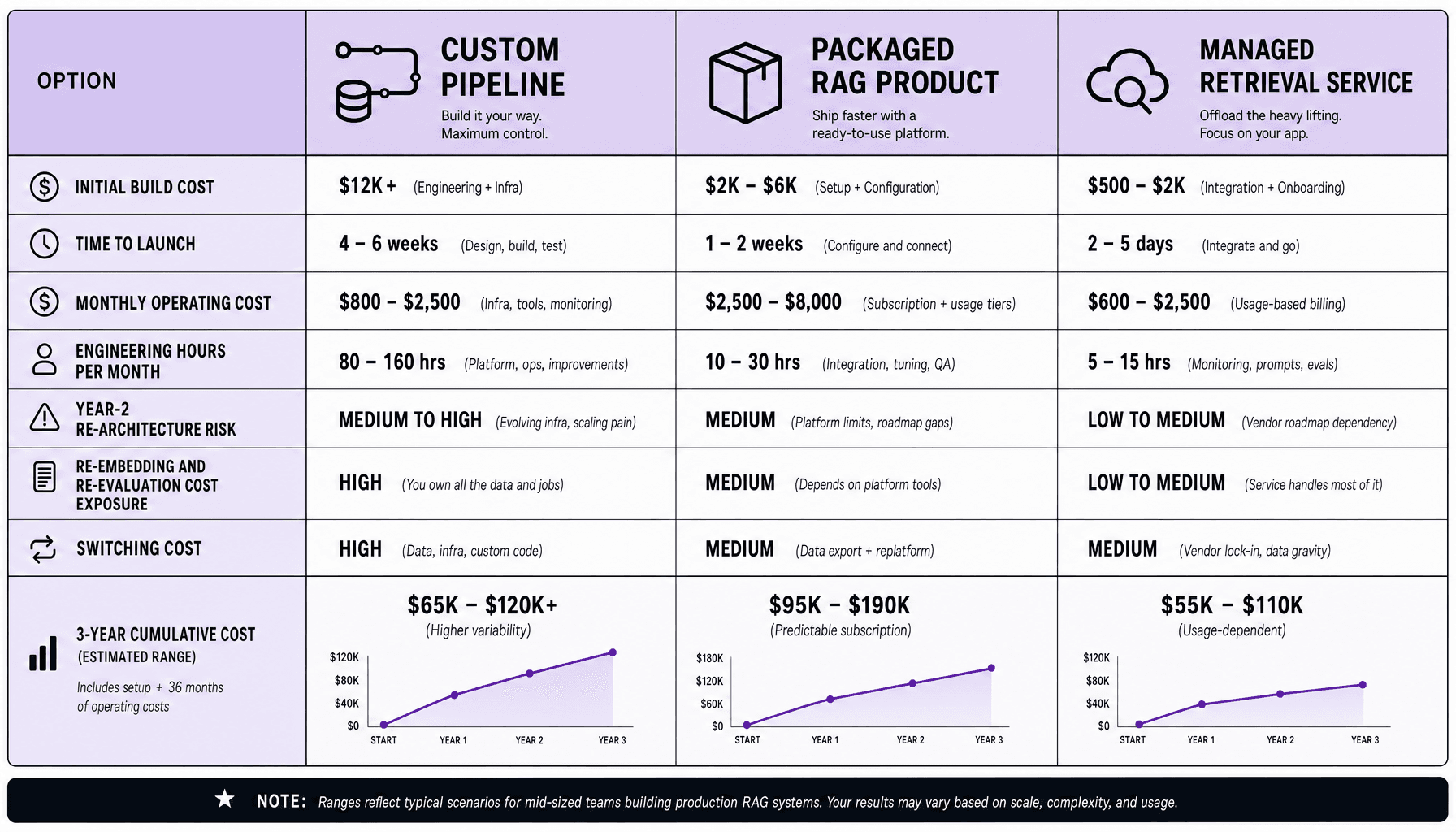
A 3-year RAG TCO comparison rarely has one permanent winner. Custom RAG often costs less for stable, high-control workloads. Packaged RAG usually wins on speed and lower ops burden. A managed retrieval service is often the most efficient path for teams that want fast deployment with minimal infrastructure ownership.12
The real trap is Month 1 thinking. A custom pipeline may start at $12K+ and 4–6 weeks, then grow once ACL-aware retrieval, hybrid search, reranking, refresh jobs, and evaluation work show up as corpus complexity increases.31 Packaged platforms and managed services move more of that spend into subscription fees, but they can cut engineering hours and reduce Year-2 re-architecture risk.41 In practice, the build vs buy RAG decision turns on freshness, compliance, and switching friction -- especially re-embedding, re-indexing, and retrieval re-evaluation after architecture changes.35 We prefer clean code where we own the stack, because it lowers long-term maintenance cost.
Key Takeaways for a 3-Year RAG TCO Comparison
- The cheapest Month-1 option often loses by Year 2. In any serious RAG TCO comparison, ongoing retrieval tuning, corpus refresh, evals, and permissioning usually outweigh the demo-stage build.31
- Custom build vs buy RAG starts with a real baseline: about $12K+ and 4–6 weeks for a production-minded custom pipeline, then scales fast with ACL-aware retrieval, hybrid search, freshness needs, and corpus complexity.31
- Year-2 re-architecture is the big cost inflection point. Teams often add reranking, better chunking, multi-index routing, or tenant isolation later -- and that can trigger re-embedding plus re-evaluation work.35
- Packaged RAG products usually win on speed and lower engineering hours; managed retrieval tends to win for teams that want solid defaults without owning retrieval infrastructure; custom wins when control, compliance, or workload shape justifies higher upfront production RAG cost.412
- Ask four questions: How often does content change? Do we need strict access control? How expensive is lock-in? And can we afford Year-2 redesign without slowing roadmap delivery? If we build, clean code helps over the long run.
How to measure RAG TCO beyond prototype costs
Prototype math breaks down fast in production.
Start with this rule: a prototype is not the economic unit. A fair 3-year total cost of ownership model for production RAG has to price the system you will actually operate -- with monitoring, refresh jobs, ACL-aware retrieval, eval loops, and the engineering time needed after launch.31
For a useful RAG pricing comparison, we model seven buckets across all three paths: Year-1 build or setup cost, monthly infrastructure and API spend, ongoing engineering hours, retrieval quality iteration, corpus freshness operations, Year-2 re-architecture likelihood, and switching cost. Miss any one of those, and the production RAG cost will look artificially low.
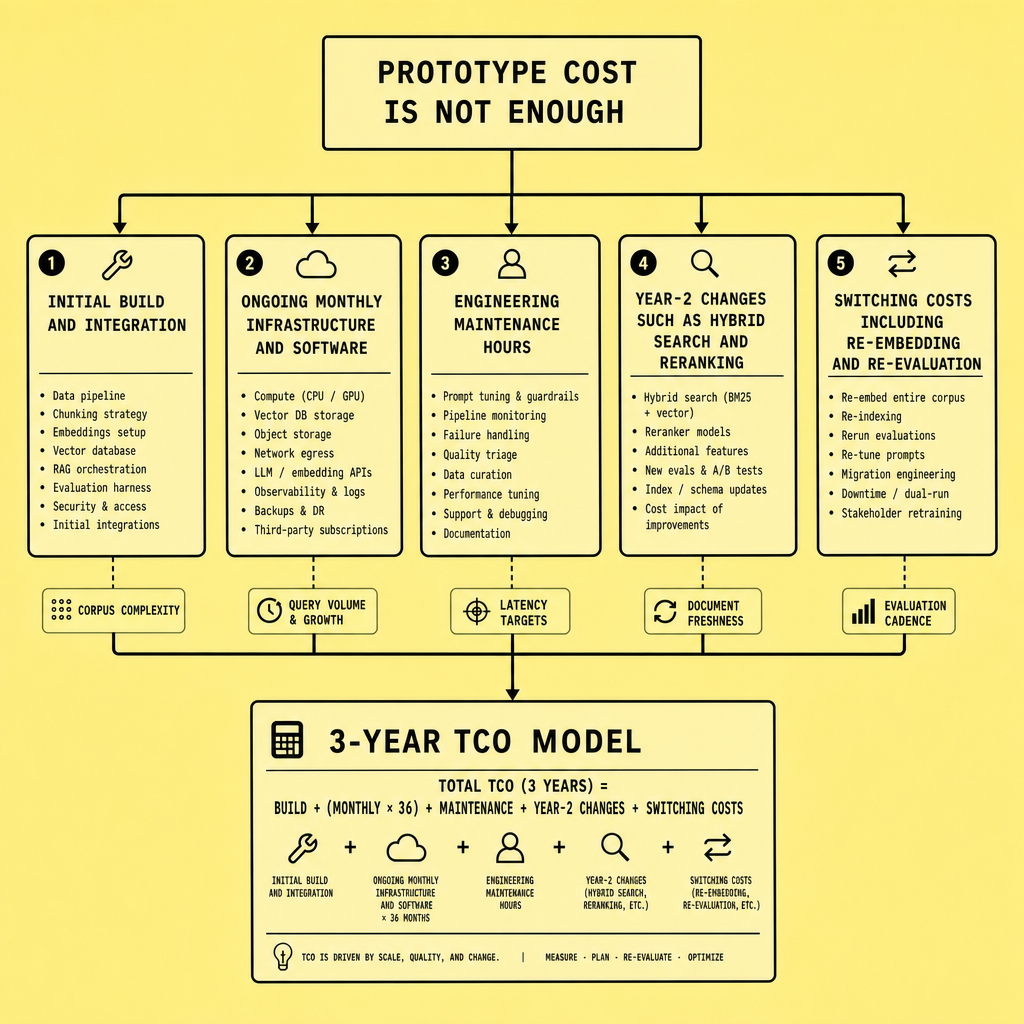
The custom RAG pipeline baseline is a good example. The entry point is often $12K+ and 4-6 weeks, then climbs with corpus complexity, freshness requirements, connector count, hybrid search, reranking, tenant isolation, and permission filters.31 The bigger budgeting mistake usually comes later. Teams launch, then discover chunking is wrong, metadata is weak, recall drops on long-tail queries, or access control breaks human handoff. Then they re-embed, rebuild evaluation sets, and change the retrieval stack in Year 2.52
| Approach | Build/setup | Monthly run cost | Eng. effort | Year-2 re-arch risk | Switching cost |
|---|---|---|---|---|---|
| Custom RAG pipeline | $12K-$60K+; 4-6 weeks | $1K-$8K+ | ~0.1-0.5 FTE | High | Moderate-High |
| Packaged RAG product | Days-2 weeks | $2K-$15K+ | Lower ongoing ops | Medium | Medium-High |
| Managed retrieval service | Fastest setup | Usage-based; can rise with scale | Lowest platform ops | Medium | Medium |
We recommend one comparison worksheet for all options. Include vector database or managed index cost, embeddings, LLM calls, storage, monitoring, refresh pipelines, offline evaluation time, and manual regression testing after schema or chunking changes.64
Switching cost is not just vendor migration. It includes re-embedding the corpus, rerunning relevance evaluations, rebuilding connectors, and retesting ACL behavior.31 That is why build vs buy RAG decisions should be judged over 36 months, not the first demo sprint. At Imversion Technologies Pvt Ltd, we keep seeing the same pattern -- clean code improves long-term productivity, but in RAG, disciplined retrieval operations do too.
3-year RAG TCO comparison by option: custom pipeline vs packaged product vs managed retrieval service
The fastest prototype is rarely the lowest 3-year cost. In a serious RAG TCO comparison, spend shape matters more than Month-1 setup, especially once corpus freshness, ACL-aware retrieval, evaluation, and switching friction show up.31
| Option | Initial setup | Typical monthly cost | Ongoing engineering | Main TCO risk |
|---|---|---|---|---|
| Custom RAG pipeline | 4–6 weeks; $12K–$60K+ | $1K–$8K+ | ~0.1–0.5 FTE | Year-2 re-architecture and switching effort |
| Packaged RAG product | Days to 2 weeks | $2K–$15K+ | Low to moderate | Subscription growth and vendor constraints |
| Managed retrieval service | Low setup friction | Usage- or platform-based | Low | Provider dependency and pricing changes |
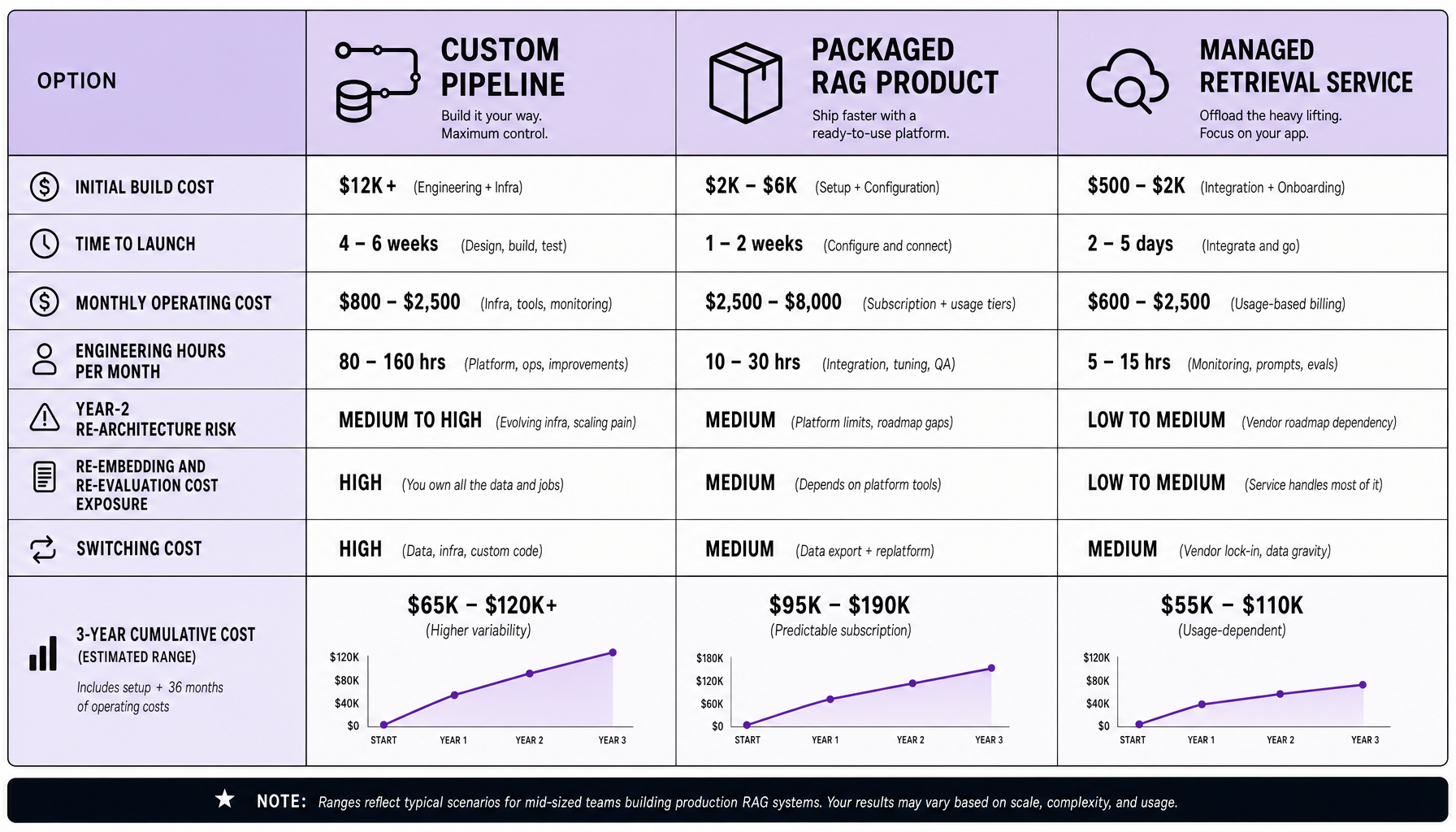
That top-line comparison is useful, but the tradeoffs sharpen once you look at each path separately.
Custom RAG pipeline
A production-ready custom RAG pipeline may start around $12K+ and 4–6 weeks for a straightforward build, then rise toward $30K–$60K+ in regulated, multilingual, connector-heavy, ACL-aware, or near-real-time environments.31 Monthly run cost often lands around $1K–$8K+, covering vector storage, orchestration, embeddings, LLM calls, monitoring, and refresh jobs, with ongoing engineering around 0.1–0.5 FTE.61
The hidden line item is often Year 2. Teams start with basic semantic retrieval, then add hybrid search, reranking, tenant isolation, stricter permission filters, or better chunking. Re-embedding a large corpus and re-running retrieval evaluations adds both cash cost and engineering time.35
Packaged RAG product
A packaged RAG product can compress setup into days or roughly two weeks, with connectors, admin controls, monitoring, and opinionated retrieval workflows already included.41 The tradeoff is lower engineering burden but higher recurring spend. Monthly pricing often falls in the $2K–$15K+ range depending on seats, corpus size, environments, and query volume.41
This option usually makes more sense when launch speed matters, the team lacks dedicated retrieval expertise, or operations need to stay simple. The downside is less flexibility, and switching later may require connector rewrites, re-indexing, and benchmark re-validation.12
Managed retrieval service
A managed retrieval service has the lowest setup friction. You bring content and application logic; the provider operates most indexing and retrieval infrastructure. Pricing is usually usage-based or platform-based and varies with corpus size, query volume, freshness requirements, and provider packaging.41
This can be a practical path for small teams because less infrastructure ownership usually means fewer ops hours. The tradeoff is dependency on provider capabilities, pricing changes, and limits around orchestration, permissioning, or custom ranking logic.41
Decision framework: Do we need deep control over retrieval logic? How fast must we launch? How often will corpus freshness, connectors, or ACL rules change? If we switch in Year 2, who pays for re-embedding, re-evaluation, and integration rework?
Year-2 re-architecture, re-embedding, and switching costs that change the RAG TCO comparison
Year 2 is where the nice-looking spreadsheet usually breaks.
Most teams can get a prototype live fast. Production RAG cost changes once real users expose failure modes: lexical misses that need hybrid search, weak ranking that needs reranking, bloated prompts caused by poor chunking strategy, or ACL leaks that force stricter permission filtering and tenant isolation.31 For custom stacks, this re-architecture risk is high because the first version is often optimized for launch speed, not long-term retrieval operations.35
And the changes are rarely isolated.
A move from single-index vector search to hybrid search plus reranking often touches ingestion, metadata, evaluation, latency budgets, and caching. Faster refresh requirements can force event-driven indexing instead of nightly batches. Multi-index routing shows up once one corpus becomes several -- product docs, tickets, policies, and customer-specific content each with different freshness and access rules.51 This is why build vs buy RAG decisions that looked clear in Month 1 can reverse by Year 2.
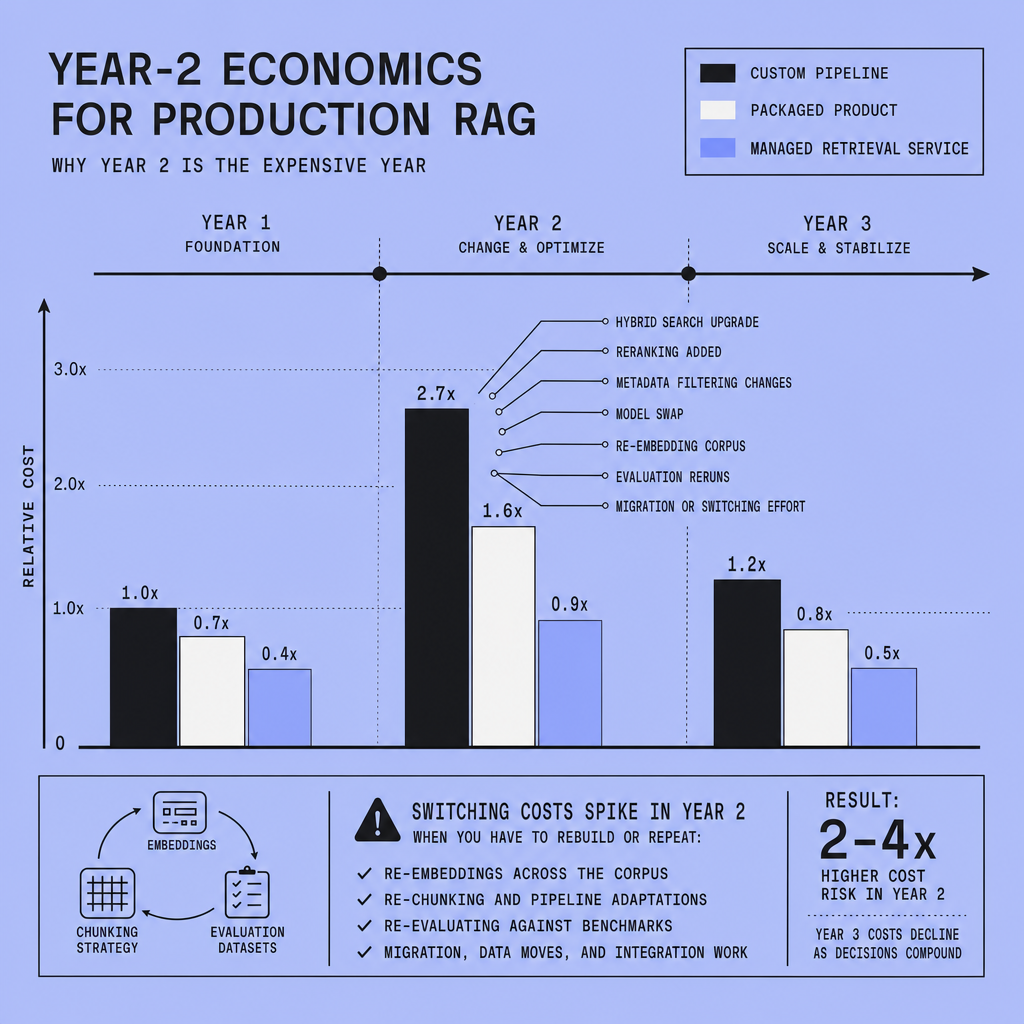
Re-embedding is the cost many teams miss. If you change chunk size, overlap rules, embedding model, metadata schema, or provider, you may need to recompute vectors for the full corpus, rebuild indexes, and rerun retrieval evaluation before trusting output quality again.31 The direct bill may be manageable for a small corpus. The labor is not. Teams have to re-baseline recall, ranking quality, latency, and permission behavior -- and after any major retrieval shift, they also have to rebuild stakeholder trust in answer quality.
A practical caveat: do not budget only for vector recompute; budget for evaluation resets, connector fixes, and rollout verification.
Switching costs differ by path, but none are trivial:
- Custom to platform: moderate to high, because custom ingestion logic, metadata assumptions, and admin workflows rarely map cleanly.1
- Platform to custom: often high, especially if proprietary connectors, internal relevance tuning, or UI workflows are hard to reproduce.12
- Managed retrieval service to another stack: moderate to high, with hidden effort in auth models, permission filtering, refresh semantics, and eval parity.41
We take a firm view here: in production RAG, clean retrieval contracts matter just as much as clean code. They reduce Year-2 rewrite pain -- and that can swing the entire build vs buy RAG outcome over a 3-year horizon.
When building vs buying wins in production RAG TCO comparison
The right answer in build vs buy RAG depends less on ideology and more on how much your retrieval architecture will change after launch.
Choose a custom RAG pipeline when retrieval quality is part of the product, not just plumbing. If you need ACL-aware retrieval, hybrid search, tenant isolation, custom reranking, or strict compliance controls, the upfront $12K+ and 4–6 weeks can be justified -- especially if the corpus is stable enough that you will not keep rebuilding ingestion and indexing logic every quarter.31 The tradeoff is obvious: higher Year-2 re-architecture risk, plus re-embedding and evaluation costs when chunking, metadata strategy, or model choices shift.35 A practical fit: an internal knowledge system for regulated documents with strict permissioning.
If the bigger risk is delay, a packaged RAG product usually looks stronger. Fast setup, connectors, admin tooling, and built-in monitoring reduce engineering drag.12 But you pay for that convenience in recurring spend, platform constraints, and sometimes shallow control over retrieval internals. Example: a support assistant that needs solid search quality fast, with business users managing content through vendor tooling.
A managed retrieval service is often the best economic middle path when the team wants predictable deployment effort and minimal infrastructure ownership.41 But provider limits -- indexing patterns, region availability, permission models, export friction -- can raise switching costs later. Example: a small product team shipping RAG on a modest corpus with a moderate freshness SLA.
Use this decision filter:
- Will retrieval logic create competitive advantage?
- How often will corpus complexity or freshness requirements change?
- Do compliance and permissioning force architectural control?
- Can the team absorb ongoing production RAG cost in engineering hours, not just cloud spend?
A 4-question decision framework for your RAG TCO comparison
The cheapest kickoff quote can be misleading. What usually hurts later is operational drag.
Use this filter: choose the option with the lowest 3-year operational drag, not the lowest kickoff quote, because production RAG costs usually shift from setup into maintenance, change management, and retrieval quality work over time.31
- How messy is the corpus? If you need ACL-aware retrieval, hybrid search, tenant isolation, many connectors, or complex document cleanup, a custom stack or stronger packaged platform may beat a basic managed retrieval service. Those requirements tend to create Year-2 redesign, permissioning, and ingestion costs if the first architecture is too simple.12
- How fresh must answers stay? Daily or near-real-time updates increase spend through re-indexing, re-embedding, pipeline monitoring, and recurring evaluation work.35 A good caveat: do not estimate refresh cost from a static prototype. Pilot with a small but representative corpus and real update frequency.
- How much custom logic do we need? If retrieval policy, ranking, compliance rules, or workflow orchestration are part of the product itself, the build-vs-buy decision often tilts toward custom. If those needs are modest, packaged RAG can reduce engineering burden even if list pricing looks higher at first.41
- What is our tolerance for engineering bandwidth and switching cost? Price initial build, monthly vendor spend, internal engineering hours, Year-2 re-architecture, and exit friction together.41
Grounded recommendation: score each option against these four questions before comparing price lines. The cheapest choice on paper can lose if your team cannot operate it, adapt it, or leave it without major rework.
References
- The hidden cost of your first RAG pipeline | by Vlad Koval - Medium
- RAG vs Fine-Tuning TCO Calculator: Comparison 2026 - Digital Applied
- Production RAG Architecture Nobody Teaches (2026) - YouTube
- The TCO, Risk & Speed Case for Agentic RAG-as-a-Service - YouTube
- Build vs. Buy RAG Infrastructure: Raw Cloud vs. Unified Platform - Render
- Dear IT Departments, Please Stop Trying To Build Your Own RAG
- I made 60K+ building RAG projects in 3 months. Here's exactly how I did it ...
- RAG vs Fine-Tuning 2026: Cost Comparison and When to Use
Footnotes
-
Build vs. Buy RAG Infrastructure: Raw Cloud vs. Unified Platform - Render ↩ ↩2 ↩3 ↩4 ↩5 ↩6 ↩7 ↩8 ↩9 ↩10 ↩11 ↩12 ↩13 ↩14 ↩15 ↩16 ↩17 ↩18 ↩19 ↩20 ↩21 ↩22 ↩23 ↩24 ↩25 ↩26 ↩27 ↩28 ↩29 ↩30
-
Dear IT Departments, Please Stop Trying To Build Your Own RAG ↩ ↩2 ↩3 ↩4 ↩5 ↩6 ↩7
-
The hidden cost of your first RAG pipeline | by Vlad Koval - Medium ↩ ↩2 ↩3 ↩4 ↩5 ↩6 ↩7 ↩8 ↩9 ↩10 ↩11 ↩12 ↩13 ↩14 ↩15 ↩16 ↩17 ↩18
-
The TCO, Risk & Speed Case for Agentic RAG-as-a-Service - YouTube ↩ ↩2 ↩3 ↩4 ↩5 ↩6 ↩7 ↩8 ↩9 ↩10 ↩11
-
Production RAG Architecture Nobody Teaches (2026) - YouTube ↩ ↩2 ↩3 ↩4 ↩5 ↩6 ↩7 ↩8
-
RAG vs Fine-Tuning TCO Calculator: Comparison 2026 - Digital Applied ↩ ↩2
Frequently Asked Questions
What is the biggest hidden variable in a RAG TCO comparison?
The biggest hidden variable is usually the cost of retrieval change, not initial setup. When chunking strategy, metadata design, permissions, or ranking logic evolves, teams often must re-index, re-embed, rebuild evaluation sets, and spend engineering time validating quality again, which can outweigh early savings from a cheap prototype.[^1][^7]
How does a RAG TCO comparison change for small corpora versus large, fast-changing corpora?
Small, stable corpora usually make managed or packaged options look better because infrastructure and refresh operations stay simple. Large or frequently updated corpora shift the economics toward whichever option handles ingestion automation, permissioning, and evaluation with the least manual work, because operational complexity compounds faster than raw storage cost.
Why should a RAG TCO comparison include people costs separately from cloud costs?
A RAG TCO comparison should separate people costs because cloud invoices rarely capture the time spent on evaluation design, relevance debugging, connector maintenance, incident response, and compliance reviews. In production, those labor costs often determine whether a system is truly economical, especially once retrieval quality becomes a recurring operational responsibility.[^1][^6]
When does buying usually beat building for production RAG?
Buying usually wins when time-to-launch matters more than retrieval differentiation, and when the team cannot justify dedicated retrieval engineering capacity. Packaged or managed offerings often reduce setup risk, shorten deployment cycles, and provide built-in operational controls that would otherwise take weeks or months to reproduce internally.[^7][^8]
How should teams estimate exit cost before choosing a RAG vendor?
Teams should estimate exit cost by listing every artifact tied to the current stack: embeddings, indexes, connectors, ACL logic, test datasets, dashboards, and workflow assumptions. A realistic exit estimate includes both migration work and the validation cycle required to prove the new stack matches prior relevance, latency, and permission behavior.
Make Imversion a preferred source on Google
Like this kind of AI and software analysis? Add Imversion as a preferred source so Google can highlight our articles for you in Search, AI Overviews, and AI Mode.