Agentic AI due diligence: Expert Questions for 2026
Unlock effective agentic AI due diligence with our essential checklist and 22 focused questions to assess potential firms thoroughly.

Agentic AI Due Diligence: What to Check Before You Hire a Firm
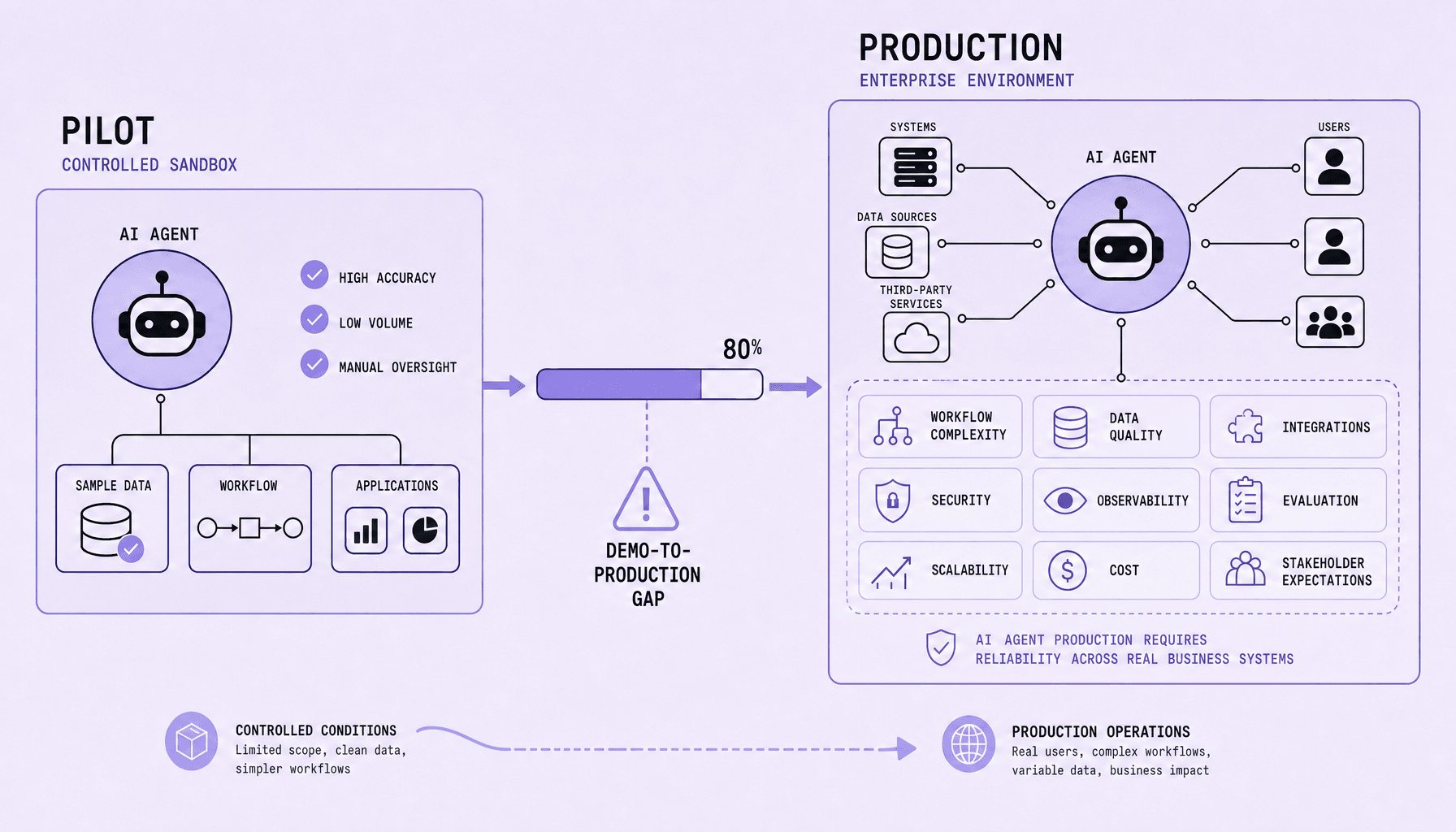
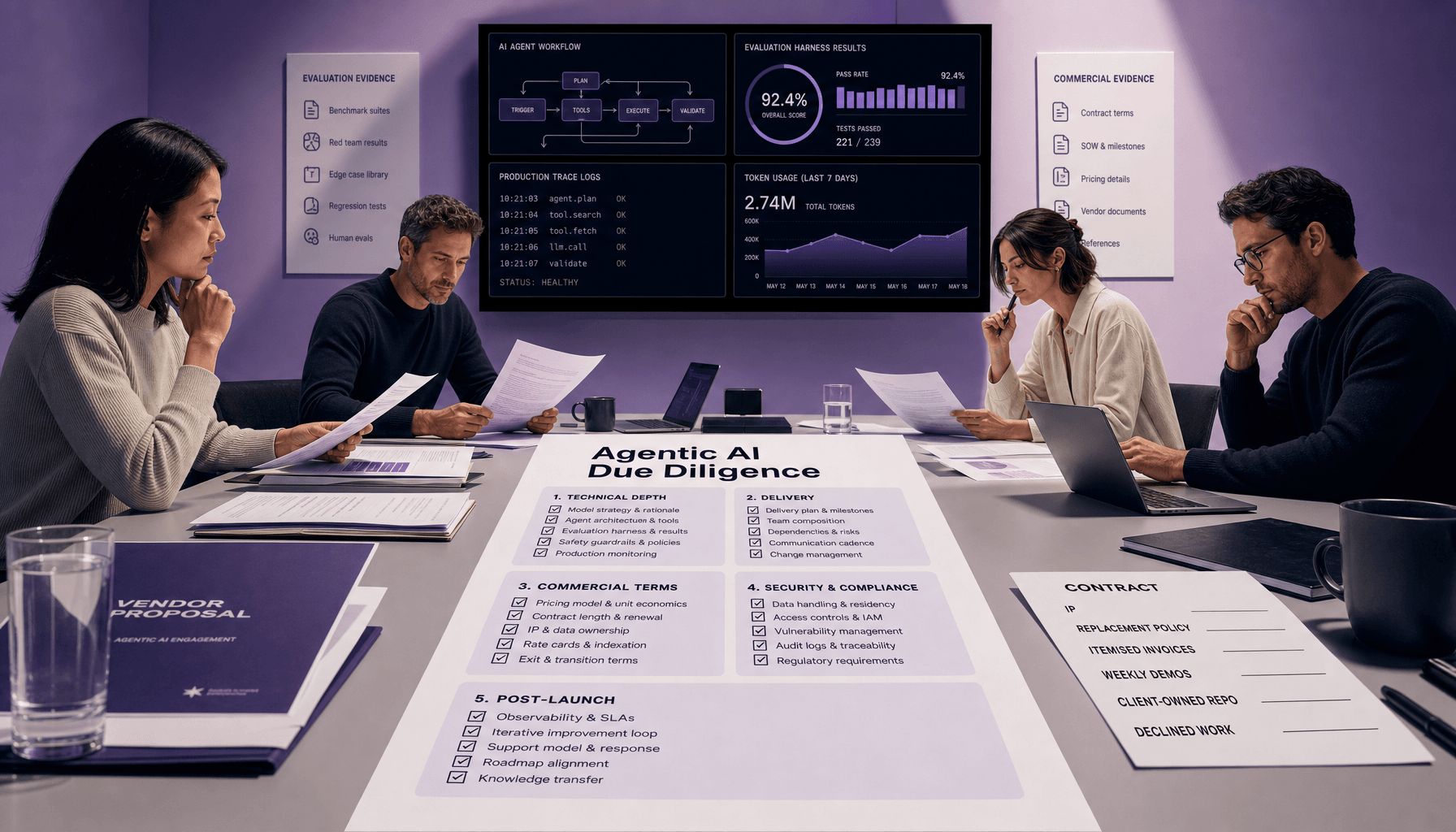
A polished demo can hide expensive problems. If a team plans to hire agentic AI firm support, it needs proof across technical depth, delivery, commercial terms, security/compliance, and post-launch operations -- because agent behavior, token spend, and failure modes are operational risks, not slide-deck problems.123
This guide gives 22 buyer questions, shows strong vs weak answer patterns, and ends with a one-page checklist for practical AI vendor due diligence. Expect specifics: named coders, evaluation harnesses, redacted production traces, token scaling, IP terms, replacement policy, and when an AI agent development company should decline the work.145
One bias, stated plainly: decisions should be backed by data. So the strongest firms -- including the standard Imversion Technologies Pvt Ltd states openly -- show senior developers, client-owned repo access, weekly demos, itemised invoices, IP transfer on final payment, and a 15-day replacement policy instead of hiding behind generic promises.26
Key Takeaways
- Start with evidence, not demos. Strong AI vendor due diligence means asking 22 focused questions across technical depth, delivery, commercial terms, security, and post-launch support -- the kind of agentic AI RFP questions that expose how a firm actually works, not how well it sells.14
- If a team wants to hire agentic AI firm support safely, it should ask for named coders, evaluation harnesses, and redacted production traces. Those three items reveal real engineering depth fast.16
- Cost discipline matters early. Ask for token scaling forecasts, model routing logic, caching plans, and retrieval metrics before signing with any AI agent development company -- because clarity is better than complexity.
- Contract terms need to be explicit: IP ownership on final payment, replacement policy, itemised invoices, weekly demos, declined-work boundaries, client-owned GitHub or GitLab repo, and clear AI implementation contract terms.24
- A one-page agentic AI due diligence checklist beats a polished sales deck. Buyers should leave the process with operational proof, commercial clarity, and fewer surprises after launch.53
Why Agentic AI Due Diligence Matters and How to Use This Guide
The hard part is not getting impressed. The hard part is spotting whether the team behind the demo can keep an agent reliable once it touches real workflows.
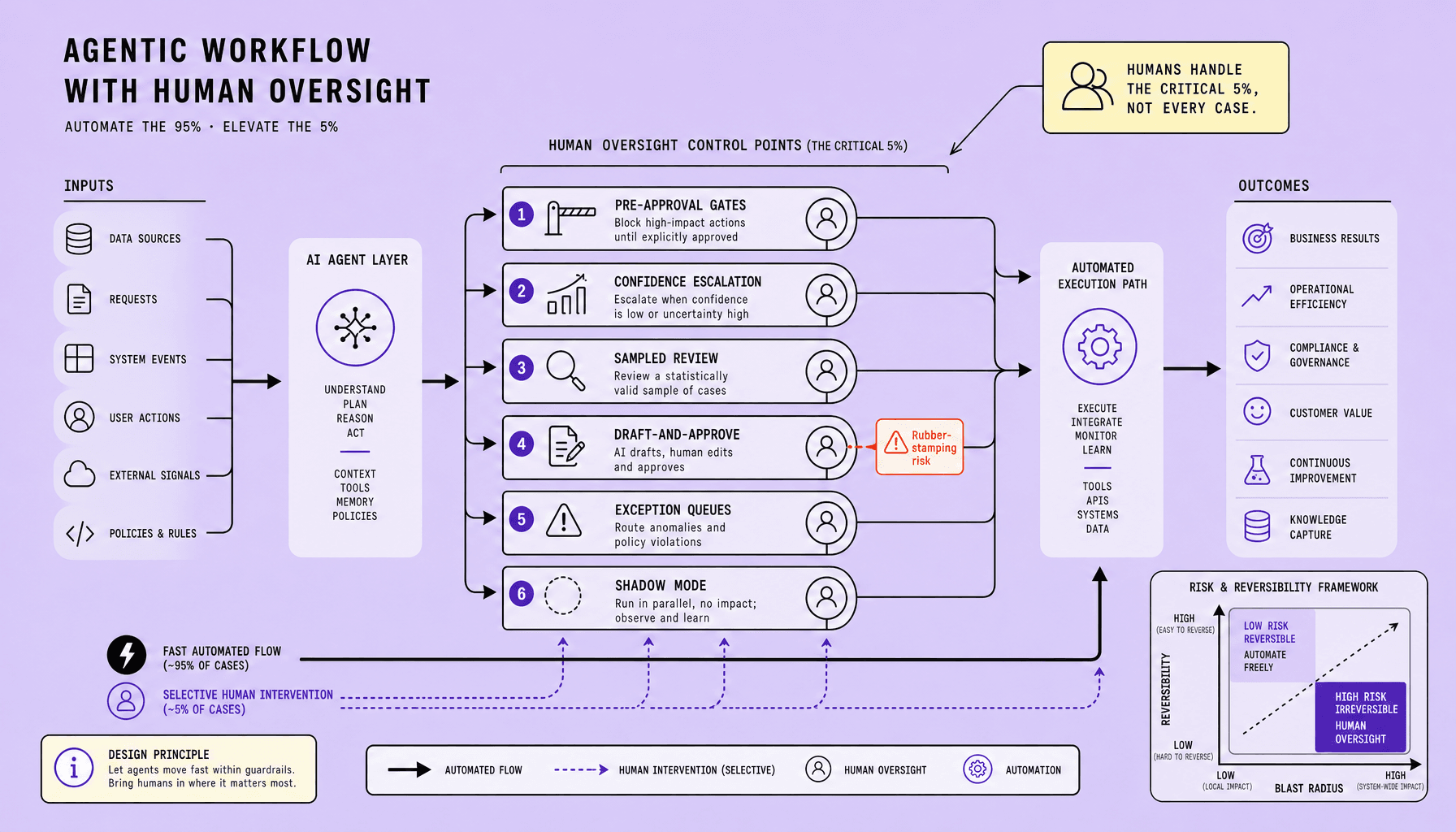
Buying agentic AI is different from buying standard software services. The buyer is not just judging whether a team can code features. The buyer is judging how that team makes decisions under uncertainty: model choice, tool permissions, fallback logic, evaluation design, token control, memory use, and the point where automation should stop and a human should step in.12
That difference shows up fast in delivery. An agent may look capable in a scripted walkthrough and still fail on reliability, access control, escalation rules, or evaluation coverage once it faces live conditions.153
So if a team wants to hire agentic AI firm support, AI vendor due diligence has to center on evidence buyers can inspect, compare, and write into procurement notes. Use this guide in three passes:
- Shortlist calls: ask the 22 questions quickly and score each answer 0, 1, or 2.
- Proposal review: check whether claims are backed by named builders, evaluation harnesses, redacted production traces, security controls, and clear commercial terms.45
- Final contract negotiation: turn good answers into statement of work language, including IP transfer, replacement policy, client-owned repo, invoicing detail, demo cadence, acceptance criteria, post-launch obligations, and AI implementation contract terms.2
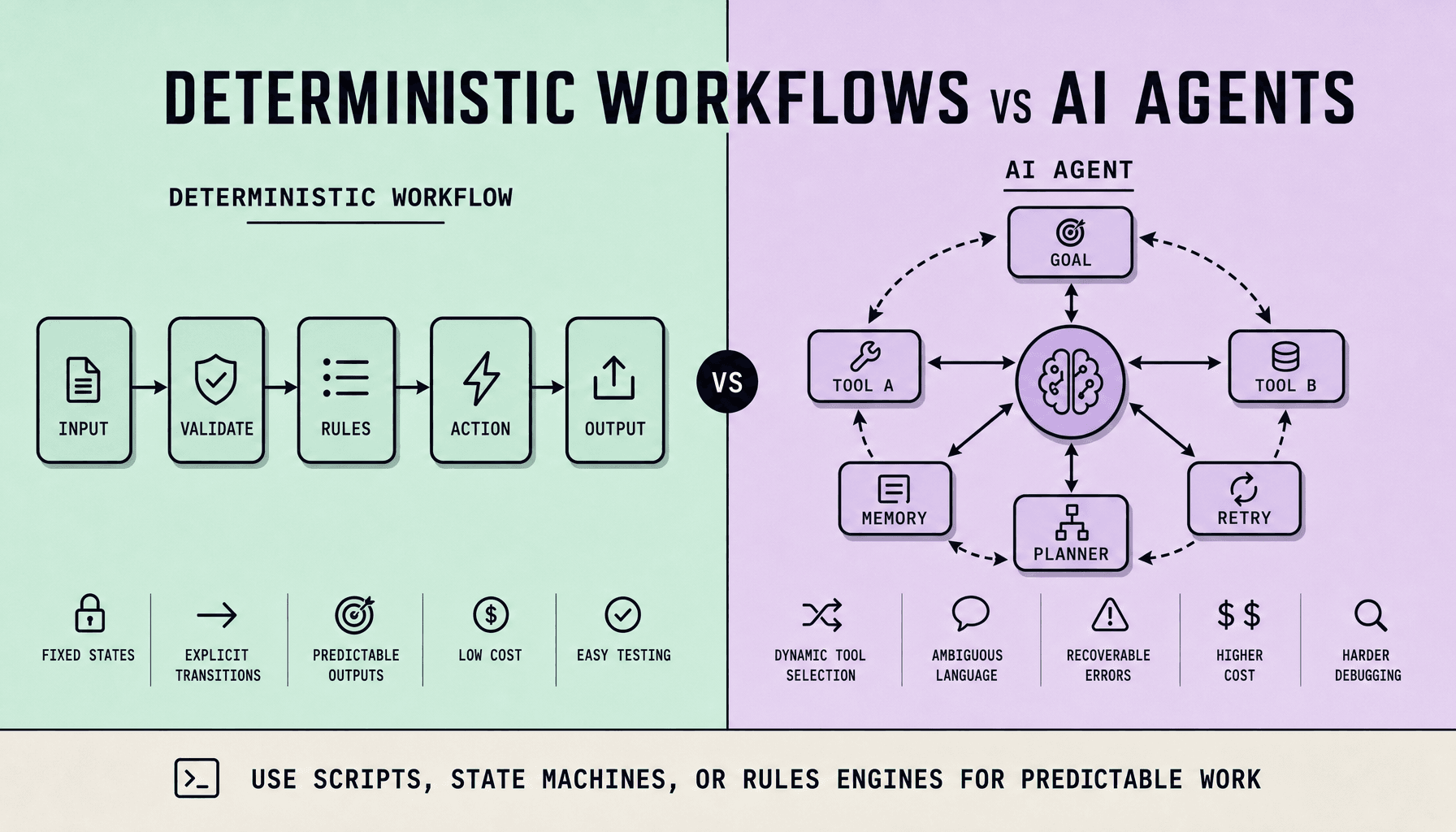
A practical rule helps here: strong answers are specific, testable, and evidenced. Weak answers lean on buzzwords, polished slides, or “we’ll define that later.” If a vendor cannot explain how it measures agent quality, limits permissions, monitors failures, or hands control back to humans, that gap should affect scoring.137
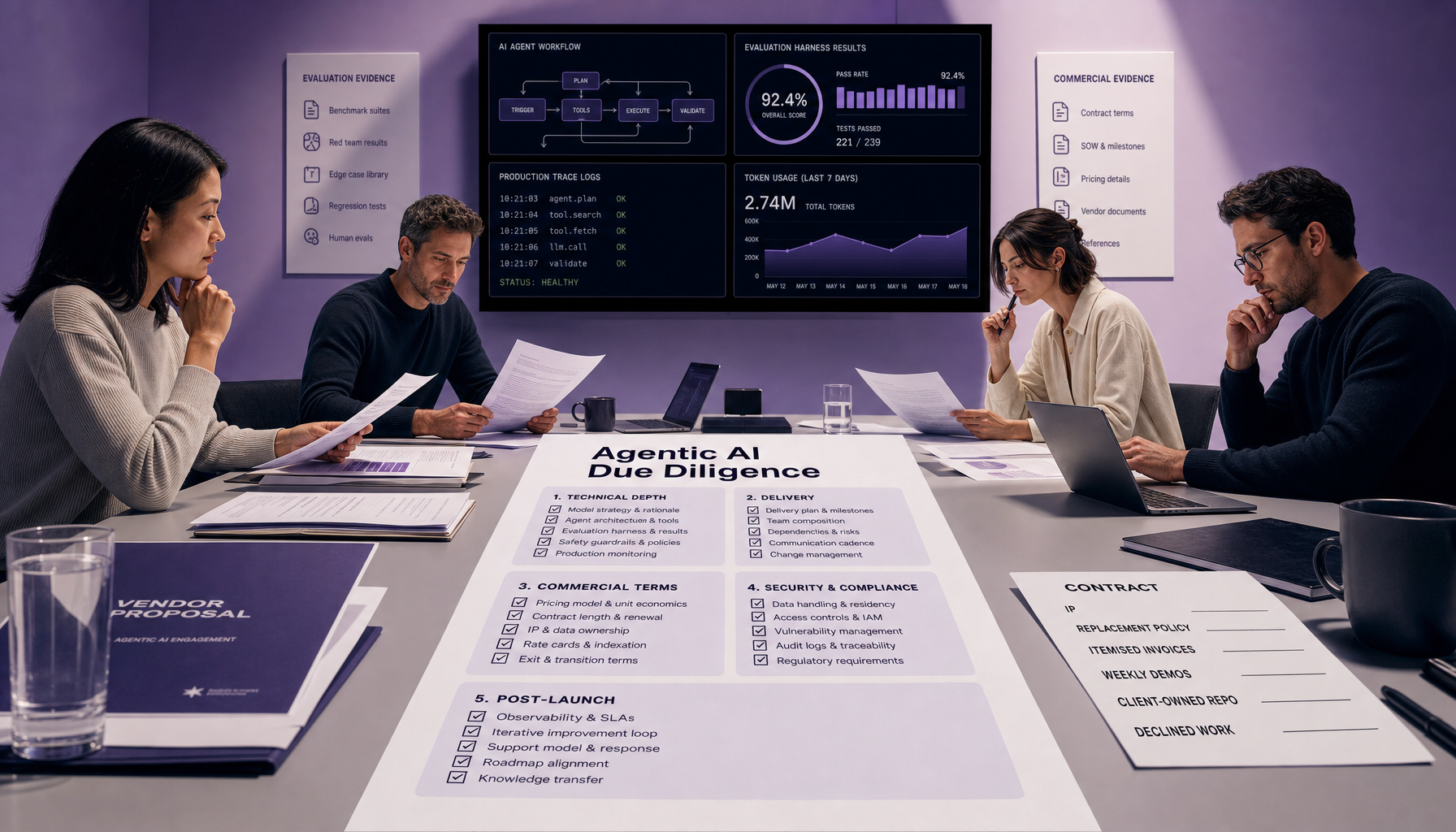
And there is one uncomfortable but useful signal. The best AI agent development company will sometimes recommend narrower scope or decline work that should not be automated. That is often a good sign.37
12 Agentic AI RFP Questions on Technical Depth and Delivery
Most bad vendor decisions happen because buyers accept presentation quality as delivery evidence. That is the trap this section is meant to avoid.
The fastest way to separate a credible AI agent development company from a polished sales team is to ask for operating evidence. Demos can impress, but traces, evals, and named ownership show whether a firm can ship reliable systems. If a vendor will not show redacted traces, named staffing, or evaluation methods, treat that as procurement risk.14
Technical depth
-
Who are the named coders and technical leads?
Strong: named senior developers, clear roles, relevant shipped systems, and identified architecture reviewers. Weak: “we have a strong bench.” -
Why this model, framework, and orchestration approach?
Strong: explains tradeoffs across latency, accuracy, tool use, lock-in, and fallback paths. Weak: buzzwords without reasons. -
Do you use an evaluation harness before release and after changes?
Strong: task checks, tool-call verification, regression suites, transcript review, and outcome scoring.1 Weak: manual prompt testing only. -
Can you show redacted production traces or run logs?
Strong: traces with latency, retries, failures, tool decisions, and cost per run.1 Weak: output screenshots only. -
How do you design context, memory, and RAG?
Strong: chunking rules, retrieval thresholds, reranking, memory limits, and fallback behavior when retrieval confidence is low. Weak: “we do RAG.” -
How does token usage scale with traffic and longer tasks?
Strong: token budgets, caching, batching, model routing, context limits, and forecast cost curves. Weak: “token costs should stay low.”84
Delivery
The next set of questions shifts from architecture to execution. Good technical choices still fail if ownership, milestones, and scope control are vague.
-
What delivery process do you follow each week?
Strong: weekly demos, visible backlog, client-owned GitHub or GitLab repo, and itemized invoices. Weak: opaque progress updates. -
How are milestones defined?
Strong: milestones tied to working behaviors, eval targets, and acceptance criteria—not vague phases like “AI integration complete.” Weak: activity-based milestones only.4 -
Who owns code, environments, and deployment assets?
Strong: client-owned repo, environment access, and clear IP transfer terms on final payment. Weak: code exists only in the vendor account.2 -
What are the escalation paths if delivery slips or quality drops?
Strong: named escalation contacts, response times, and replacement policy. Weak: “contact your account manager.” -
How do you handle scope change without losing control?
Strong: documented change requests, cost/timeline impact, and re-baselined evals. Weak: informal Slack approvals. -
What work do you decline?
Strong: explicit no-go areas such as unsafe autonomy, weak data access, missing human review, or unrealistic timelines. Weak: “we can build anything.”53
A practical caveat: not every vendor can share full production traces because of client confidentiality or security limits. If so, ask for redacted examples, synthetic runs, or a live walkthrough of the evaluation process instead. Mature firms should still be able to show how they test, monitor, and constrain agent behavior.13
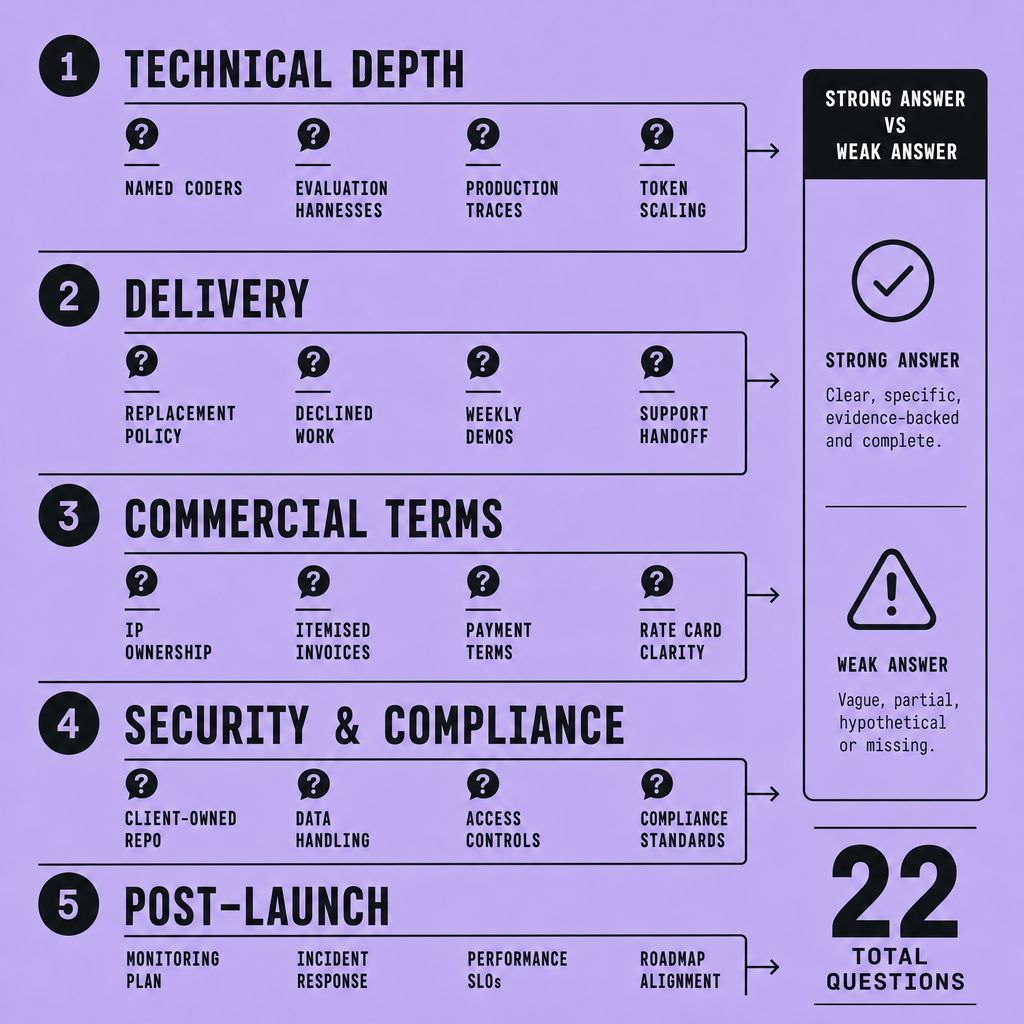
Buyers that want to hire agentic AI firm support should prefer firms that explain constraints as clearly as capabilities.
10 Questions on Commercial Terms, Security, Compliance, and Post-Launch Support for Agentic AI Due Diligence
This is where many deals get messy. The demo is over, the enthusiasm is high, and vague promises start turning into scope fights, token-cost surprises, or ownership disputes.
Good AI vendor due diligence checks the MSA, SOW, security controls, and operating model with the same rigor used for evals and traces.24
Commercial terms
13. When does IP assignment happen?
Strong: the contract states clear IP assignment on final payment, with code, prompts, configs, and documentation included; third-party exclusions are named in the SOW.2 Weak: “you’ll own the solution” with no timing, carve-outs, or repo access.
14. Who are the named developers, and what is the replacement policy?
Strong: named senior developers and a written replacement process if fit or performance fails. Weak: interchangeable staffing language.
15. Are invoices itemised?
Strong: line items for build work, model/API usage, tools, and maintenance hours. Weak: one monthly lump sum. Itemisation adds admin overhead, but it makes overruns easier to spot early.
16. What work will the firm decline?
Strong: the AI agent development company can say no to unsafe automations, poor data practices, or impossible timelines.45 Weak: “we can do anything.”
Security and compliance
Commercial clarity is only half the job. If the security model is weak, a good prototype can still become a bad production decision.
17. How is client data handled?
Strong: data-flow clarity, redaction rules, retention limits, and whether training on client data is prohibited by default.53 Weak: “data is secure.”
18. What access control model is used?
Strong: least-privilege access control, SSO, role-based permissions, secret management, and audit logs.37 Weak: shared accounts or ad hoc credentials.
19. What is the compliance posture?
Strong: honest mapping to SOC 2, ISO 27001, GDPR, or customer-specific controls, plus clear gaps. Weak: logo-dropping without scope.57
Post-launch operations
Launch is not the finish line. It is where weak ownership becomes visible.
20. Who owns monitoring and incident response?
Strong: defined owners, alert thresholds, production traces, SLA targets, and incident steps.13 Weak: “we’ll keep an eye on it.”
21. What are the maintenance windows and support cadence?
Strong: scheduled releases, client-owned GitHub or GitLab repo, and support hours in writing. Weak: support “as needed.”
22. How will post-launch optimisation work?
Strong: a plan for eval regressions, token budgets, model routing, RAG metrics, and periodic review of failures.1 Weak: “we’ll tune it later.” A practical caveat: not every pilot needs a full 24/7 support model, but every launch needs clear ownership and an escalation path.
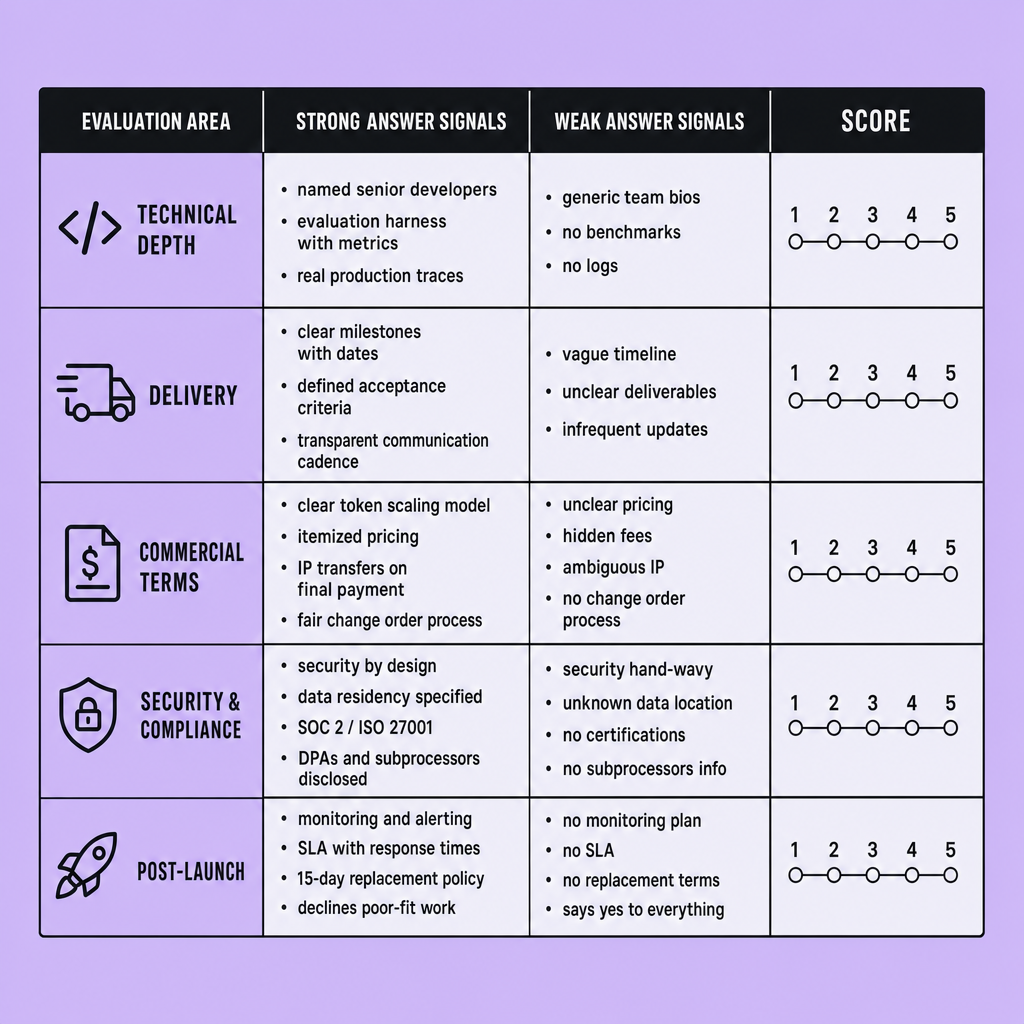
How to Compare Strong vs Weak Vendor Answers at a Glance
Once the answers start piling up, memory becomes unreliable. Use a scorecard.
In AI vendor due diligence, score the evidence behind each answer -- named owners, artifacts, examples, metrics, and decision logic -- because the most polished demo is not always the safest shortlist choice.14
| Area | Strong answer | Weak answer |
|---|---|---|
| Technical depth | Named senior builders, eval harness, redacted traces, token budgets, model-routing logic, and clear fallback rules | “We use the best models” with no logs, tests, cost math, or explanation of failure handling |
| Delivery & commercials | Weekly demos, client-owned repo, itemized invoices, clear IP terms, change-control process, replacement expectations, and AI implementation contract terms | Vague updates, platform lock-in, bundled billing, fuzzy ownership, and unclear scope boundaries |
| Security & post-launch | Specific controls, incident path, human handoff, monitoring, access limits, and declined-work criteria | “We take security seriously” and “support is available if needed,” without controls, escalation, or support model detail |
Score each row 0, 1, or 2: 0 if the answer is mostly claims, 1 if some proof exists but operating detail is thin, 2 if the vendor shows evidence and can explain tradeoffs. Red flags include no artifacts, no named owners, no refusal criteria, or no explanation of how the team handles bad outputs, outages, or cost spikes. Yellow flags include partial proof, but weak ownership or vague post-launch support.
One caveat: a concise answer is not automatically weak. Some teams protect client confidentiality and cannot share raw traces or contracts. That is reasonable if they can still provide redacted examples, sample documentation, or a clear explanation of their process. The goal is not maximum detail; it is enough evidence to judge whether the vendor has repeatable engineering and operating discipline.2537
Imversion’s Verifiable Terms and a One-Page Agentic AI Due Diligence Checklist
By this stage, buyers should be checking written terms against actual evidence. Sales language is easy to promise. Contract language is what survives later.
For teams looking to hire agentic AI firm support, Imversion publicly states several checkable delivery and commercial terms: senior developers, IP on final payment, a 15-day replacement policy, itemised invoices, weekly demos, and a client-owned repo. Those points are useful only if they appear in the proposal, SOW, or MSA in wording you can review later.26
Imversion’s verifiable terms
- Senior developers
- IP on final payment
- 15-day replacement
- Itemised invoices
- Weekly demos
- Client-owned repo
One-page checklist for AI vendor due diligence
Copy this into an RFP or review sheet for any AI agent development company:
- Named coders and delivery owner listed
- Evaluation harness documented1
- Redacted production traces or run logs shared
- Token budgets, routing, and scaling assumptions explained
- Security controls, data handling, and access model defined53
- IP ownership and repository ownership confirmed2
- Replacement policy stated in writing
- Weekly demo cadence agreed
- Invoice format itemised
- Declined-work policy documented -- what the firm will refuse to automate, and why
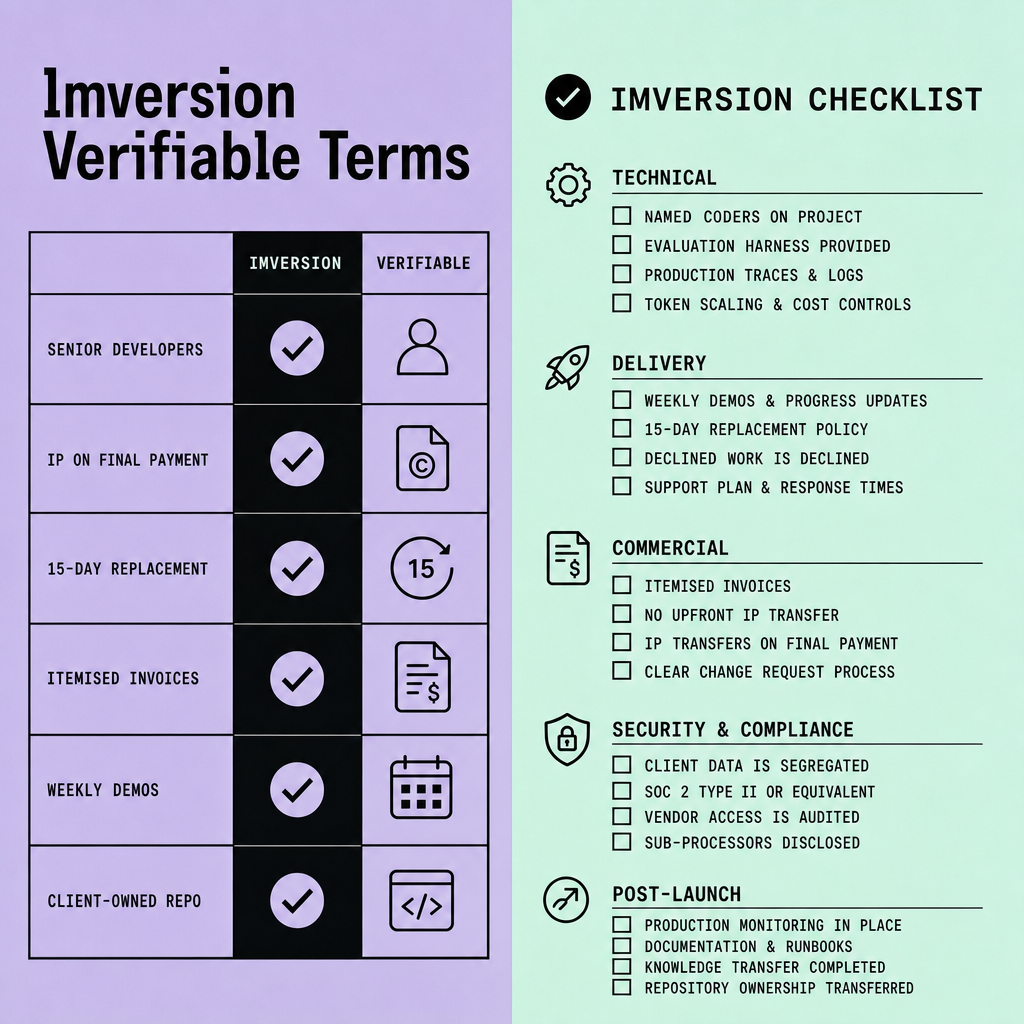
A practical caveat: good terms reduce ambiguity, but they do not prove execution quality. A vendor can offer clean commercial language and still lack eval discipline, security maturity, or post-launch support. Use this checklist as a minimum screen, then compare answers against artifacts, named owners, and examples from the earlier scorecard sections.157
Clarity beats complexity here. The goal is not a perfect procurement document; it is a short list of promises you can test in writing before work starts.
References
- How to Build & Sell AI Agents: Ultimate Beginner's Guide
- Demystifying evals for AI agents
- Key Contract Issues in Agentic AI Implementation and ...
- Agentic AI RFP Template: 30 Vendor Questions for 2026
- How to Choose an AI Agent Development Company (2026)
- Agentic AI Risk Assessment: 10 Questions IT Leaders ...
- Agentic AI Security: A Guide to Securing AI Agents in 2026
- AI Agent Security Best Practices for Enterprise Trust | Arthur
Footnotes
-
https://www.anthropic.com/engineering/demystifying-evals-for-ai-agents ↩ ↩2 ↩3 ↩4 ↩5 ↩6 ↩7 ↩8 ↩9 ↩10 ↩11 ↩12 ↩13 ↩14 ↩15 ↩16
-
https://www.mayerbrown.com/en/insights/publications/2026/06/key-contract-issues-in-agentic-ai-implementation-and-integration-deals ↩ ↩2 ↩3 ↩4 ↩5 ↩6 ↩7 ↩8 ↩9 ↩10 ↩11
-
https://www.sysdig.com/learn-cloud-native/agentic-ai-security ↩ ↩2 ↩3 ↩4 ↩5 ↩6 ↩7 ↩8 ↩9 ↩10 ↩11 ↩12
-
https://www.kognitos.com/blog/agentic-ai-rfp-template-2026-vendor-questions/ ↩ ↩2 ↩3 ↩4 ↩5 ↩6 ↩7 ↩8 ↩9 ↩10
-
https://blog.cyberadvisors.com/agentic-ai-risk-assessment-10-questions-it-leaders-should-ask-before-deployment ↩ ↩2 ↩3 ↩4 ↩5 ↩6 ↩7 ↩8 ↩9 ↩10 ↩11
-
https://synchronizedcodelab.com/blogs/how-to-choose-ai-agent-development-company ↩ ↩2 ↩3
-
https://www.arthur.ai/column/ai-agent-security-best-practices-enterprise ↩ ↩2 ↩3 ↩4 ↩5 ↩6
Frequently Asked Questions
What is agentic AI due diligence, and how is it different from normal software vendor review?
Agentic AI due diligence is a procurement review focused on how an AI system behaves in production, not just how software is delivered. It examines evaluation methods, autonomy limits, tool permissions, runtime monitoring, and failure recovery because agent risks are operational and probabilistic rather than purely feature-based.[^2][^7]
How does agentic AI due diligence reduce the risk of budget overruns?
Agentic AI due diligence reduces budget risk by forcing vendors to quantify token consumption, model-routing logic, retry behavior, and support expectations before delivery begins. That discipline exposes hidden cost drivers early, which is especially important when inference usage can scale nonlinearly with traffic, longer contexts, and multi-step workflows.[^2][^4]
Why should a buyer ask for a declined-work policy from an AI firm?
A declined-work policy shows whether the vendor has judgment, not just enthusiasm. Firms that clearly refuse unsafe autonomy, poor data conditions, or weak human-review setups are more likely to protect the client from preventable failures, regulatory issues, and brittle deployments that should never have been approved.
What documents should be saved during vendor review for future contract disputes?
Buyers should retain proposal versions, SOW drafts, staffing commitments, sample invoices, security responses, demo notes, and any written statements about IP, support, or replacement. Those records create an evidence trail that helps resolve disputes about scope, ownership, acceptance criteria, and post-launch obligations if delivery quality later drops.[^3]
How often should agentic AI due diligence be revisited after launch?
Agentic AI due diligence should be revisited whenever the model, tools, permissions, workflows, or traffic profile materially change. A vendor that passed review during a pilot may need renewed scrutiny after new integrations, broader autonomy, or heavier production use because the operating risk profile can change faster than the contract does.[^2][^8]
Make Imversion a preferred source on Google
Like this kind of AI and software analysis? Add Imversion as a preferred source so Google can highlight our articles for you in Search, AI Overviews, and AI Mode.