Agentic CRM: Transforming Workflows with AI Sales Agents
Unleash the potential of Agentic CRM with AI-driven sales agents that enhance workflows and boost productivity. Learn more about its transformative benefits.

Agentic CRM Turns Customer Data Into Action
Most CRM pain has nothing to do with missing fields or dashboards. It shows up when leads wait too long for a reply, handoffs slip, notes sit stale, and reps spend more time updating records than acting on what customers just did.
Agentic CRM Key Takeaways
- Agentic CRM shifts a CRM from passive storage to action, using AI CRM workflows to score leads, draft follow-ups, update records, and trigger next steps automatically.
- It helps most where teams struggle with stale data, missed outreach, slow response times, and repetitive CRM automation tasks inside platforms like Salesforce, HubSpot, or Microsoft Dynamics.
- Strong AI customer relationship management depends on boundaries -- define which actions AI sales agents can take alone and which need human approval.
- Start small: automate one workflow, track response time and conversion impact, then expand. At Imversion Technologies Pvt Ltd, we see clean code improve long-term productivity because it makes AI-driven workflow changes safer to maintain.
What Agentic CRM Actually Does Inside Modern CRM Systems
Most CRM problems are not storage problems. They are execution problems -- stale records, missed follow-ups, slow handoffs, and too much admin work sitting between signal and action.
From passive record-keeping to active workflow execution
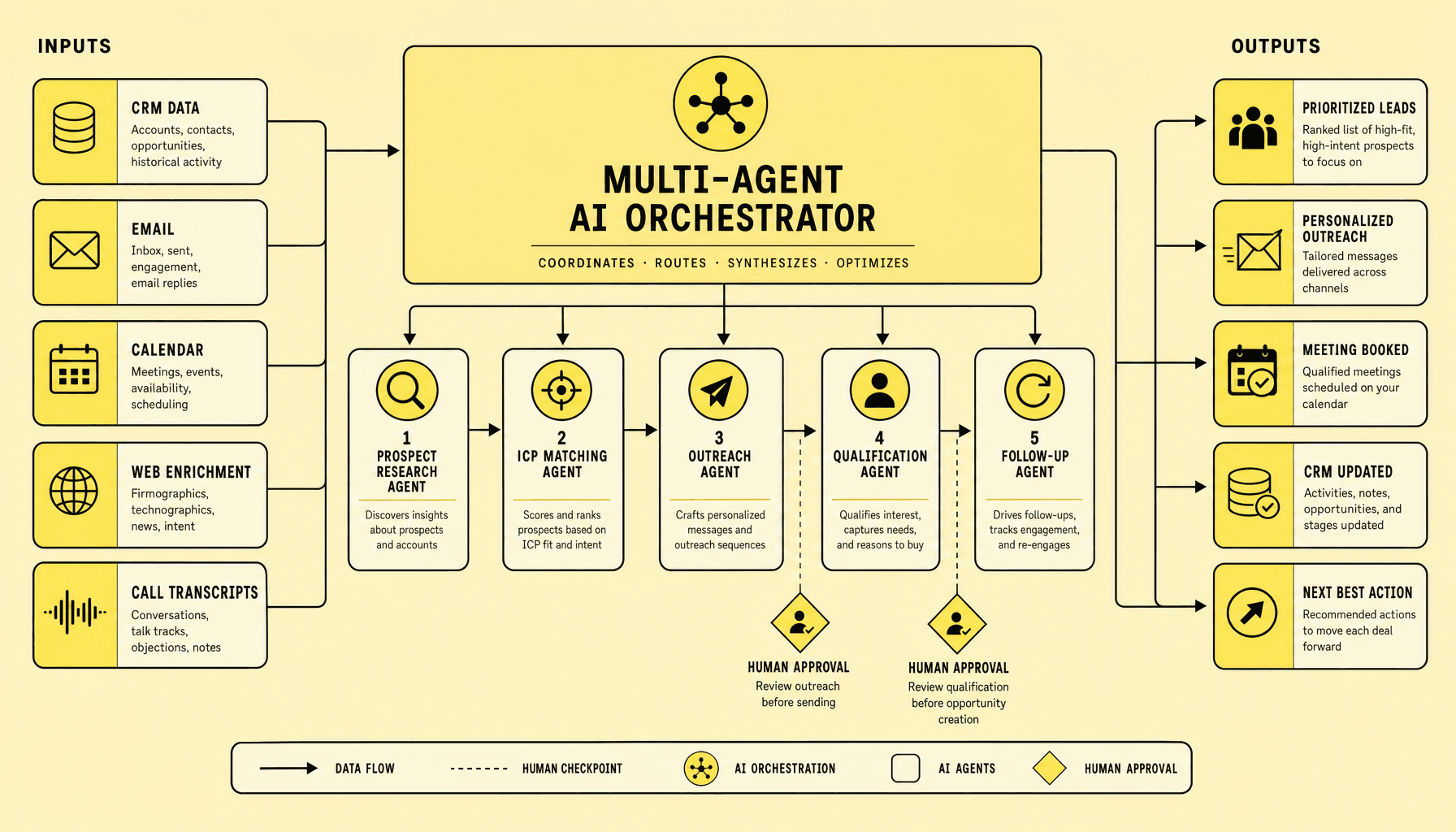
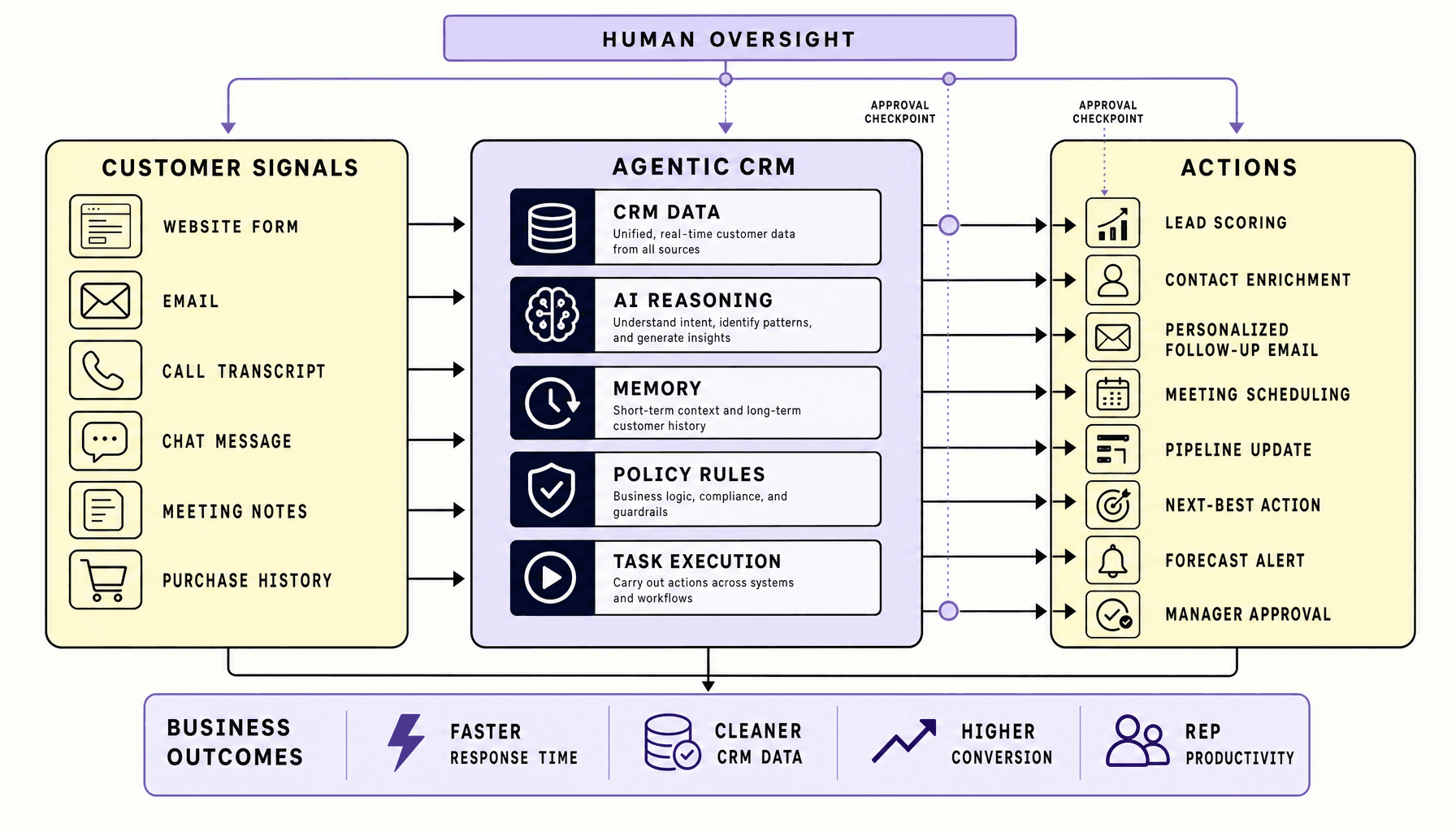
This is where the shift becomes concrete. Agentic CRM turns a CRM into a working layer, not just a database. In practical terms, it combines CRM data, AI reasoning, and task execution so the system can decide what should happen next and then do part of that work inside tools like Salesforce, HubSpot, or Microsoft Dynamics.
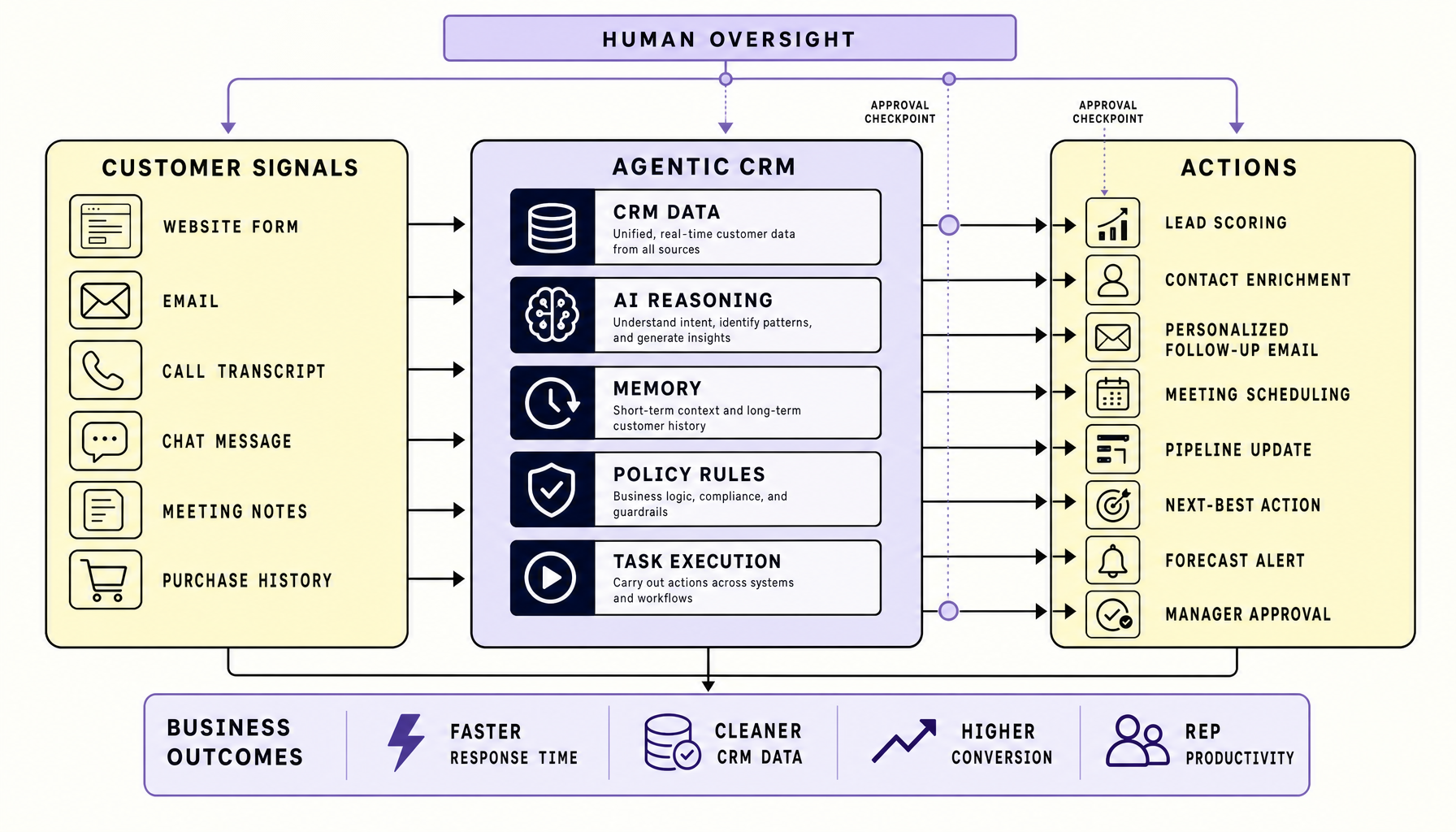
A traditional CRM stores contacts, activities, pipeline stages, and reports. Basic CRM automation adds if-this-then-that rules: send email X after form submission Y. Useful, but rigid. It breaks when the context changes.
Agentic CRM is different because the agent evaluates more than one signal at once. It can look at lead source, product interest, email engagement, meeting notes, account history, and pipeline status, then choose an action within defined limits. That is closer to workflow orchestration than simple trigger-based automation.
How an AI CRM agent operates in a real workflow
A simple example:
A prospect downloads a pricing guide, returns to the site, books a demo, and replies with a budget question. An intelligent CRM agent can:
- update the contact and account record
- raise lead scoring based on combined intent signals
- summarize the reply and meeting context
- draft a follow-up for the rep
- create a task with a time-to-response target
- move the opportunity to the correct stage if rules allow
- alert a human if the message suggests risk, urgency, or procurement involvement
That is AI customer relationship management in action. Not just recommendations. Execution.
Agentic CRM works best when it is allowed to act inside clear boundaries; without that design, it becomes one more layer on top of a cluttered CRM.
Where human oversight still matters
Of course, not every action should be handed over. Pricing exceptions, sensitive customer communications, stage changes tied to forecast commitments, and compliance-heavy workflows still need human approval. User experience is as important as functionality, so teams should design review points where trust matters most.
A practical starting point is lead management, follow-ups, meeting summaries, and record updates -- high-volume tasks with low downside and clear ROI.
How AI Sales Agents Transform Lead Management, Follow-Ups, and Pipeline Work
The operational shift is the interesting part. Agentic CRM closes the gap between customer signals and sales action. Teams no longer need to rely on reps to notice every form fill, update every record, or remember every follow-up. Instead, AI sales agents handle repetitive, time-sensitive work inside the CRM while humans stay focused on judgment, deal strategy, and relationships.
Lead management
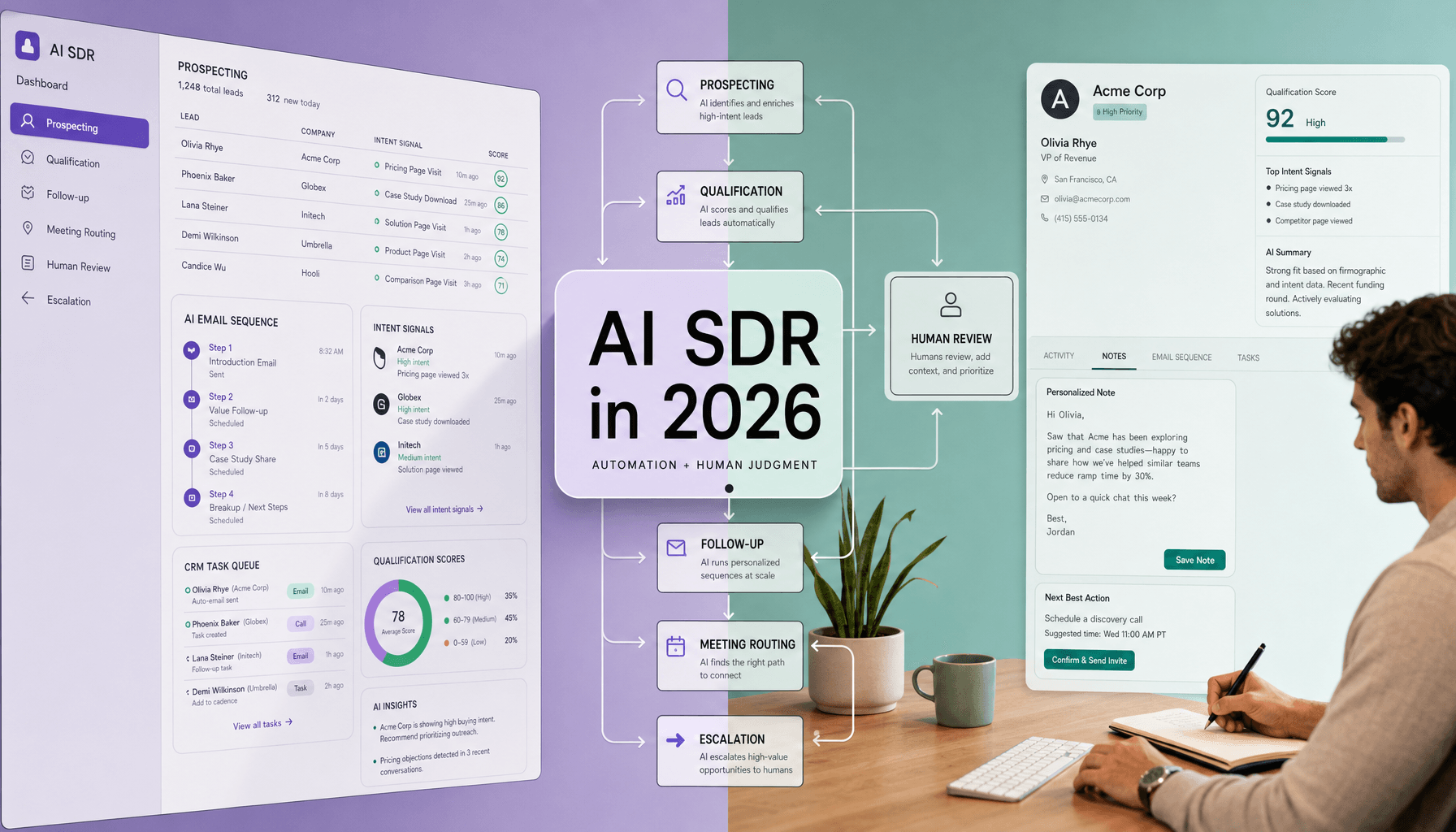
Lead capture often breaks at the first step: slow response, incomplete records, and weak prioritization. Agentic CRM improves this by pulling leads from forms, chat, email, and campaign tools, then triggering enrichment, deduplication, and qualification workflows automatically. In a Salesforce, HubSpot, or Microsoft Dynamics setup, that can mean matching company data, applying lead scoring, assigning ownership, and routing high-intent leads in minutes instead of waiting for manual triage.
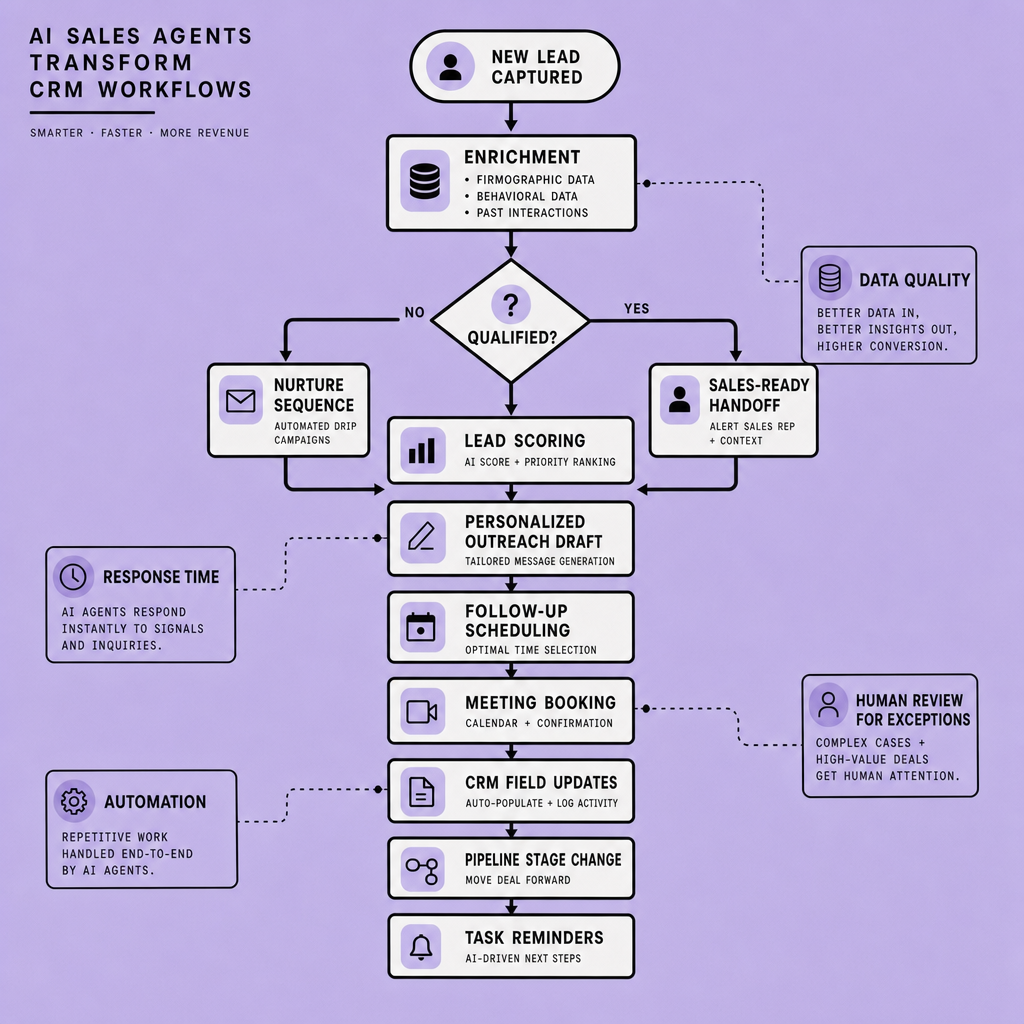
This is where CRM automation becomes practical, not cosmetic.
If a prospect requests pricing, visits product pages, and replies to a chatbot, the system can raise priority, create a task, and suggest the next-best action before the record goes stale. That matters most at the top of funnel, where delays can reduce response quality and consistency.
Follow-ups
Follow-up consistency is where many pipelines leak momentum. AI sales agents can draft outreach based on source, persona, prior activity, and CRM history, then place prospects into email sequences with guardrails for timing and tone. They can also generate meeting summaries after calls, extract action items, and update opportunity notes without forcing reps to do end-of-day admin work.
Still, automation should support execution, not replace relationship-building in complex sales. For high-value deals, reps need to review sensitive emails, pricing language, and negotiation context.
Insights and pipeline automation
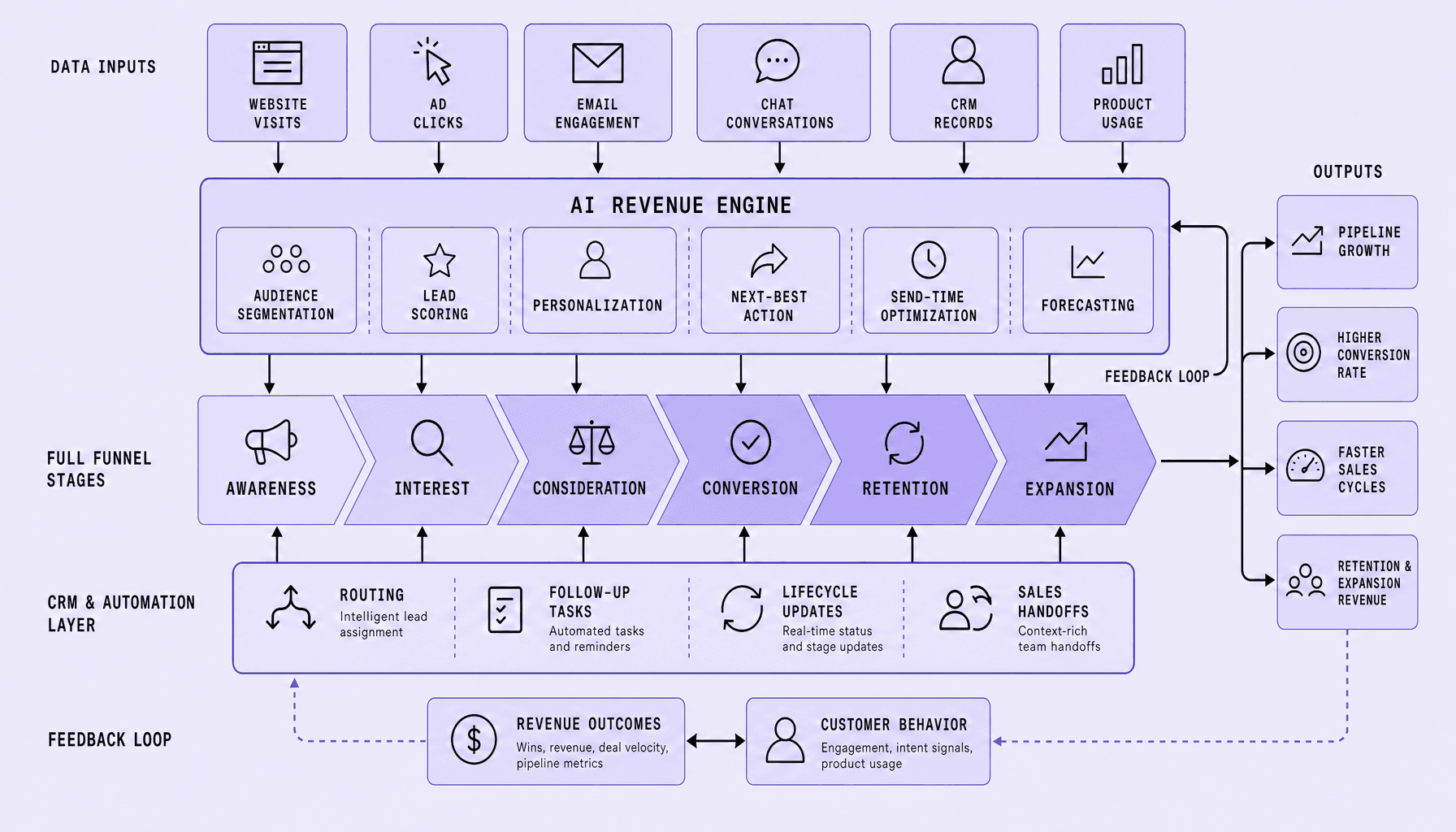
Once lead handling improves, pipeline work gets cleaner too. Pipeline management improves when the CRM can act on signals, not just display them. Agentic CRM can recommend next-best actions, flag inactive deals, suggest stage changes, surface missing fields, and update records after emails or meetings. That improves pipeline visibility because fewer opportunities sit in the wrong stage with outdated notes.
A grounded rollout works best: automate lead routing, record updates, and meeting summaries first; keep stage movement, forecasting, and escalation decisions under human oversight until data quality is stable.
User experience matters as much as functionality. If sellers do not trust the recommendations or cannot verify changes quickly, even well-designed AI CRM workflows will be ignored.
The Real Benefits of Agentic CRM and Why Human Oversight Still Matters
Speed is useful only if teams stay in control. Agentic CRM delivers its biggest benefit when it speeds execution without removing control. Teams can respond faster, keep records cleaner, and reduce the manual gaps that cause missed follow-ups, stale pipeline stages, and inconsistent handoffs.
In practical AI customer relationship management workflows, AI agents can draft follow-ups right after a demo, update Salesforce or HubSpot from a meeting summary, and route leads into the right sequence based on intent signals. That shortens time-to-response, reduces record decay, and gives reps more time for selling instead of admin work. A useful intelligent CRM should lower friction, not add another confusing layer of automation.
But autonomy has limits.
AI CRM systems can misread incomplete data, recommend the wrong next step, or generate outreach that sounds off-brand, too aggressive, or poorly timed. In regulated or customer-sensitive workflows, compliance and data governance are design constraints, not afterthoughts. A bad sync, weak lead scoring logic, or unchecked email sequence can create risk quickly.
The strongest Agentic CRM setups use human-in-the-loop controls at high-risk or customer-sensitive decision points.
That usually means approval workflows for outbound messaging, audit trails for record changes, exception handling for unusual cases, and clear thresholds for what the system can do on its own. The tradeoff is straightforward: more automation can increase speed, but the best AI customer relationship management systems keep humans responsible for decisions where judgment, brand context, or customer trust matter most.
How to Implement Agentic CRM Without Creating Workflow Chaos
A broad rollout sounds efficient. In practice, it usually creates noise first.
Start narrow. That is the safest way to make Agentic CRM useful without turning CRM automation into a governance problem.
Choose one or two high-frequency, low-risk workflows for a pilot, such as lead routing, meeting summaries, record enrichment, or internal follow-up task creation in Salesforce, HubSpot, or Microsoft Dynamics. Avoid starting with broad, cross-functional automation. A small pilot makes it easier to see where the agent helps, where it creates noise, and where people still need to make the final call.
Before rollout, audit data hygiene. If contact fields are inconsistent, ownership rules are unclear, or activity data is missing, the agent will produce uneven results. Define permissions precisely: what it can read, write, trigger, recommend, and escalate. That boundary is what keeps helpful automation from becoming uncontrolled workflow sprawl.
Connect core systems next -- CRM, email, calendar, forms, and call notes -- but test outputs in a sandbox before going live. Add human review for sensitive actions such as changing pipeline stages, sending customer-facing messages, or reassigning accounts.
Track a short list of operating metrics from day one: response time, admin time reduced, follow-up completion, and conversion between key stages. One useful tradeoff to plan for: stricter approvals reduce risk, but they also slow execution. Start with more oversight, then relax controls only where the agent proves reliable.
Common Agentic CRM Mistakes, ROI Metrics, and Future Trends to Watch
Most teams do not fail because the idea is wrong. They fail because they automate a bad process, trust incomplete CRM data, remove human review too early, or try to launch too many use cases at once.
Another common mistake is using agents for decisions that need clear policy, such as lead ownership, pricing exceptions, or customer messaging, before rules and approvals are defined. The safer path is narrower: start with one bounded workflow, such as lead routing, follow-up sequencing, or record enrichment inside Salesforce, HubSpot, or Dynamics, then add controls for approval, logging, and exception handling.
Measure ROI in layers so you do not expect revenue impact before execution quality improves. Start with operational metrics: time saved per rep, lead response speed, activity logging coverage, SLA adherence, and CRM data completeness. Then track workflow quality metrics, such as fewer stale opportunities, more consistent stage updates, cleaner handoffs, and reduced manual rework. Only after that should you judge commercial impact through conversion rate, pipeline velocity, meeting-booked rate, and stage progression consistency. In many teams, the first visible return is greater consistency, not immediate closed-won growth.
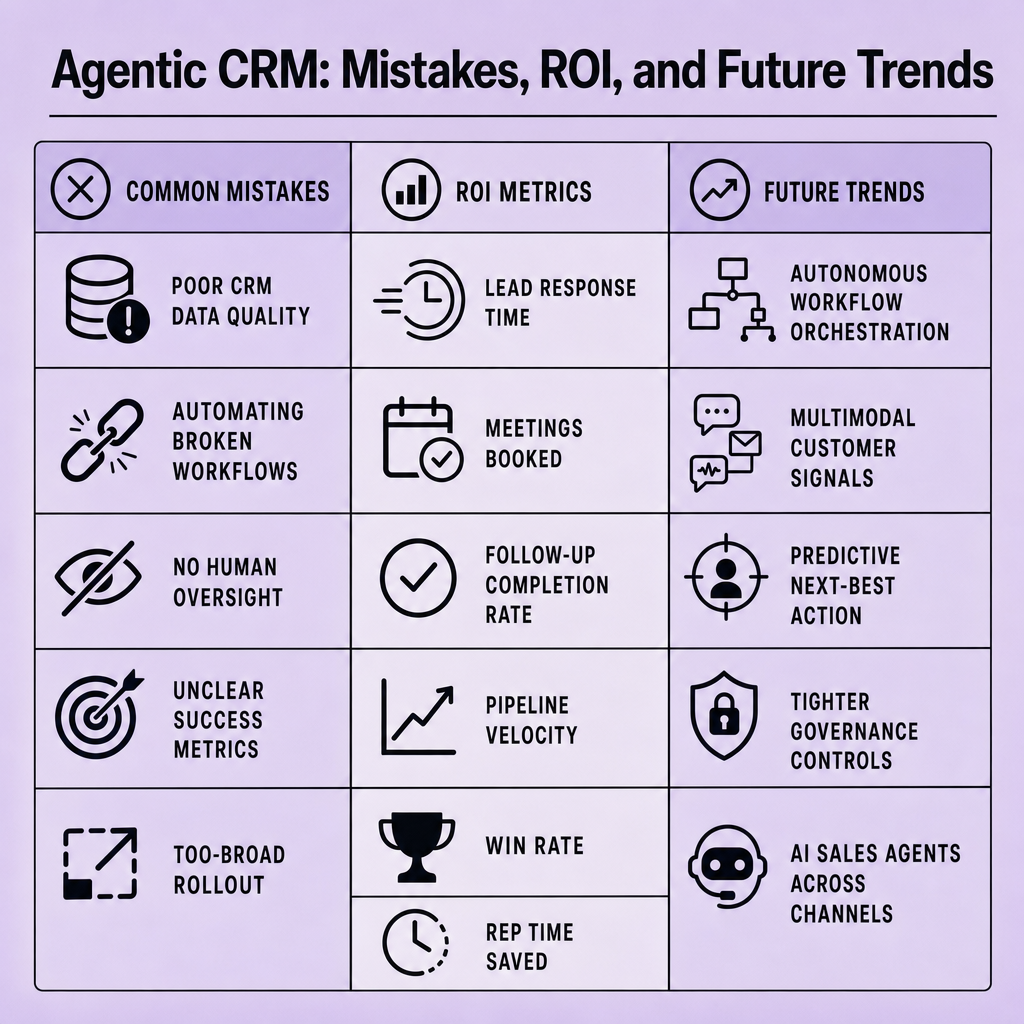
Future trends are less about replacing teams and more about better orchestration. Expect agents that work across email, calls, calendar, tickets, and CRM records; more role-specific copilots for sales, success, and RevOps; and tighter governance features, including permissions, audit trails, and escalation logic. The practical question to watch is not whether CRM becomes more autonomous, but where autonomy is useful, reviewable, and safe.
Frequently Asked Questions
What is the difference between Agentic CRM and traditional CRM automation?
Traditional CRM automation follows predefined rules, such as sending a message after a form submission. Agentic CRM evaluates multiple signals at once, applies reasoning within set limits, and can choose from several approved actions. That makes it better suited for changing customer context, not just repetitive triggers.
How does Agentic CRM affect sales rep productivity day to day?
Agentic CRM reduces the hidden workload around selling by handling record updates, meeting summaries, task creation, and follow-up preparation in real time. Reps spend less time on after-call administration and manual CRM cleanup, which helps them focus more on conversations, qualification, and account strategy.
Why should companies keep human review in AI customer relationship management?
Human review protects brand quality, compliance, and customer trust in situations where data may be incomplete or context is subtle. Approval checkpoints are especially important for pricing language, sensitive outreach, account reassignment, and forecast-related stage changes, where a fast automated action can still be the wrong one.
How long does it take to see ROI from AI CRM tools?
Most teams see early ROI from process consistency before they see direct revenue lift. Within the first few months, improvements usually appear in response times, logging accuracy, follow-up completion, and reduced admin effort. Revenue impact tends to show later, once cleaner execution improves conversion rates and pipeline movement.
Can AI sales agents work in regulated industries or complex B2B sales?
AI sales agents can work in regulated or complex environments if they operate within strict permissions, approval workflows, and audit trails. The safest model is to let agents handle preparation and low-risk execution while humans retain authority over customer-facing commitments, compliance-sensitive messaging, and exceptions that require business judgment.
Make Imversion a preferred source on Google
Like this kind of AI and software analysis? Add Imversion as a preferred source so Google can highlight our articles for you in Search, AI Overviews, and AI Mode.