AI Revenue Engine: Unlocking the Future of Sales Automation 2026
Learn how the AI revenue engine can streamline your sales funnel, improve lead scoring, and automate revenue generation. Unlock your business's potential!

What an AI revenue engine is and why it matters now
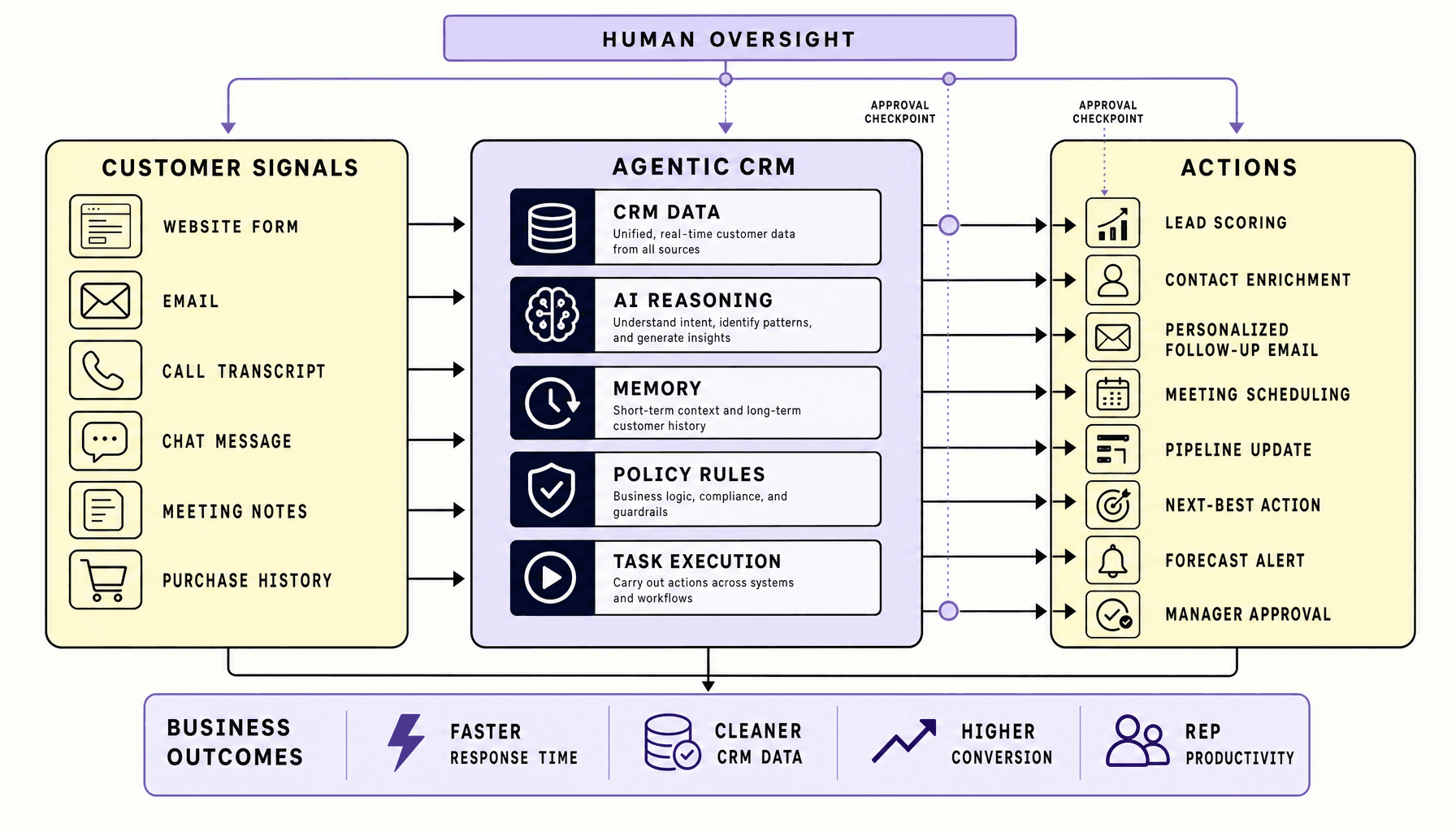
If your team already has HubSpot, Salesforce, email automation, and chatbots in place, but follow-up is still slow, lead scoring still feels weak, personalization is still fragmented, and attribution is still unclear, the issue usually is not missing tools. It is that the system is disconnected.
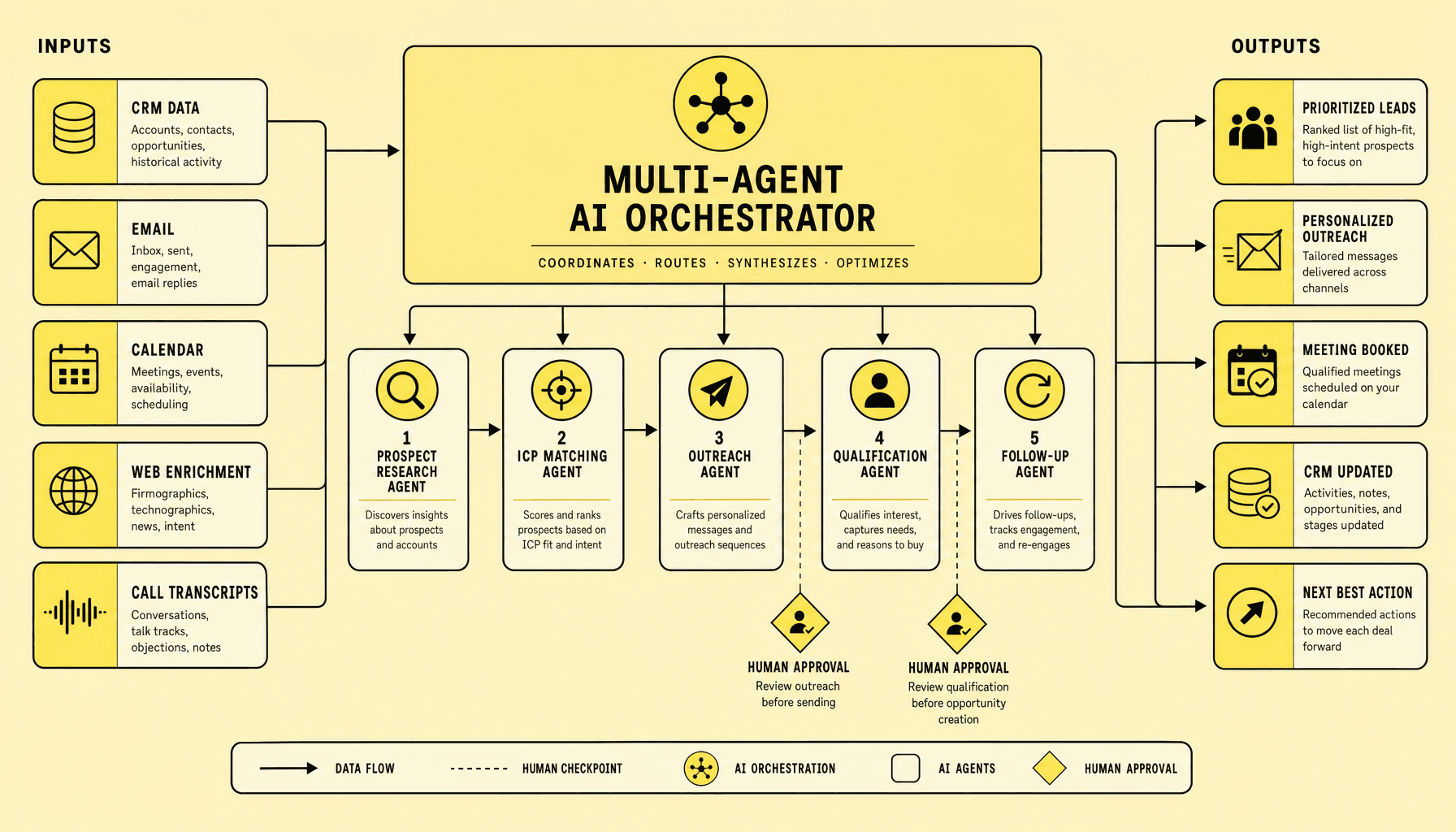
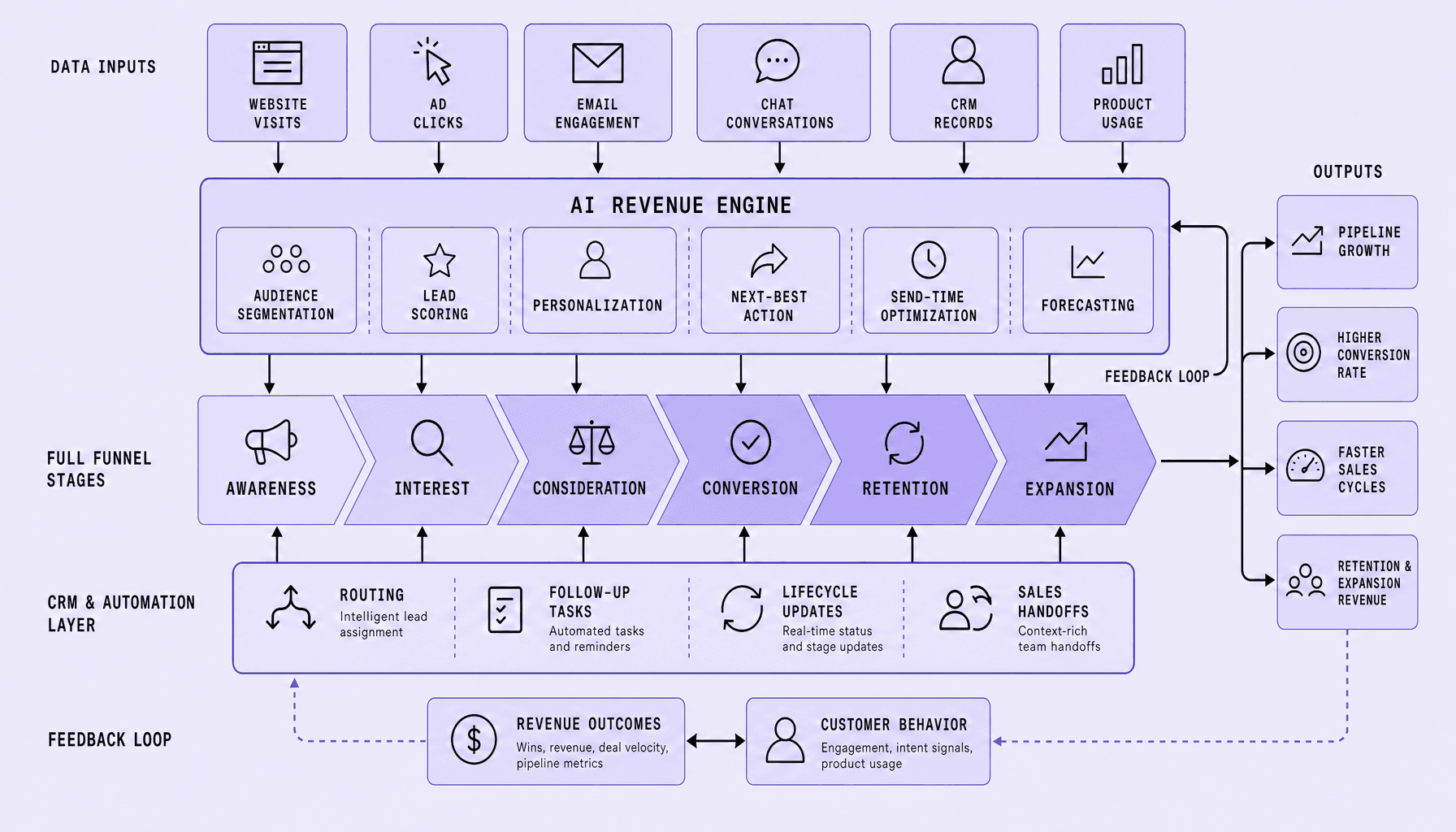
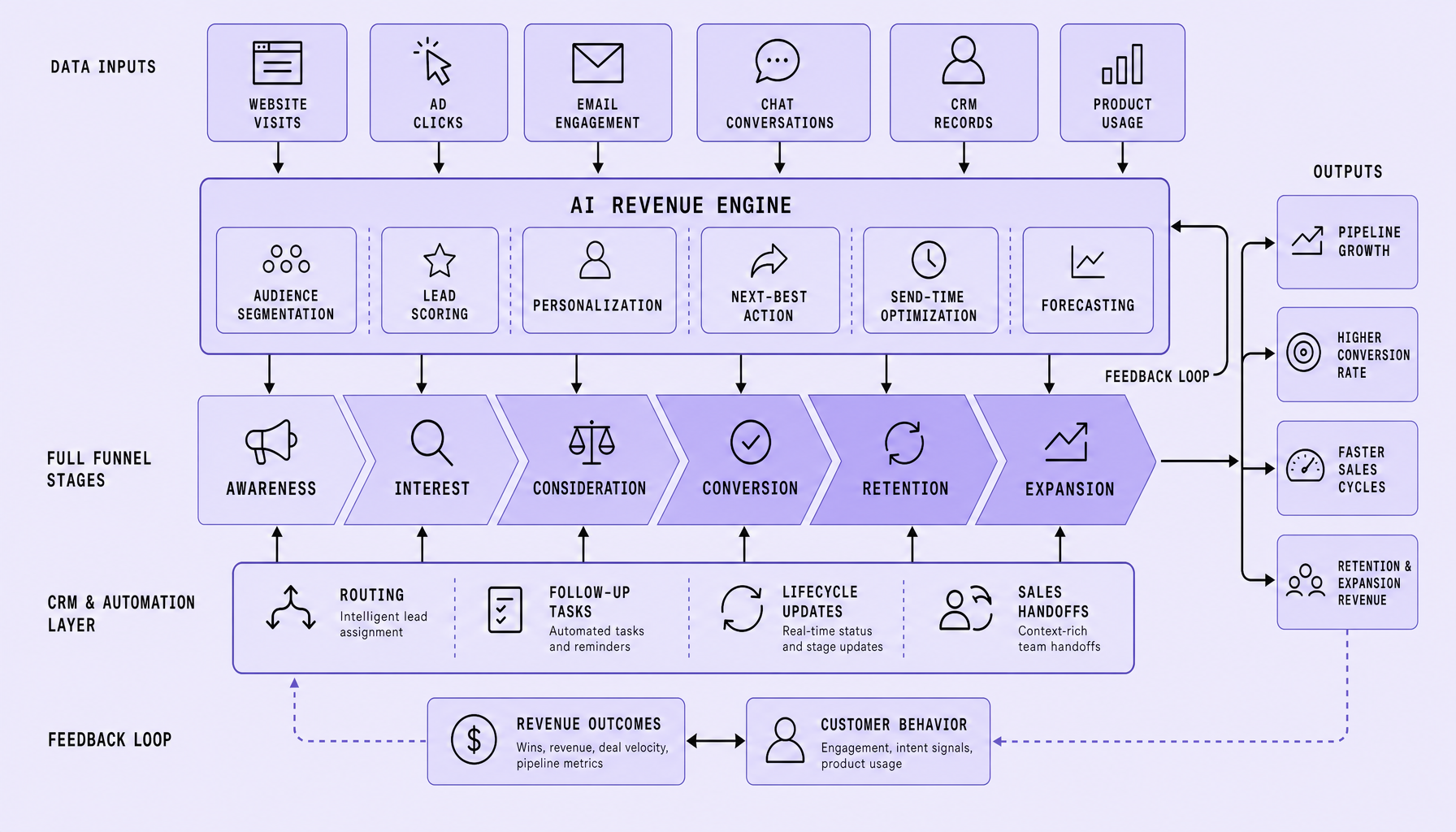
An AI revenue engine is a connected system that uses data, automation, and machine learning to improve lead capture, qualification, nurturing, conversion, and retention across the funnel. Unlike a basic AI sales funnel, a self-optimizing sales funnel keeps learning from behavior, CRM activity, and campaign results to improve the next action.
Why now? Because many teams already run those systems and still struggle to turn them into one measurable revenue automation model. An AI revenue engine can do that, but only if the data is clean and the rules are visible. We see this often in full-stack delivery at Imversion Technologies Pvt Ltd: user experience is as important as functionality, so automation must stay accurate, explainable, and useful for sales teams.
Key Takeaways for Building an AI Revenue Engine
- An AI revenue engine works best as a connected operating model -- not a pile of separate tools. It links CRM data, marketing automation, lead scoring, personalization, and sales workflows into one measurable system.
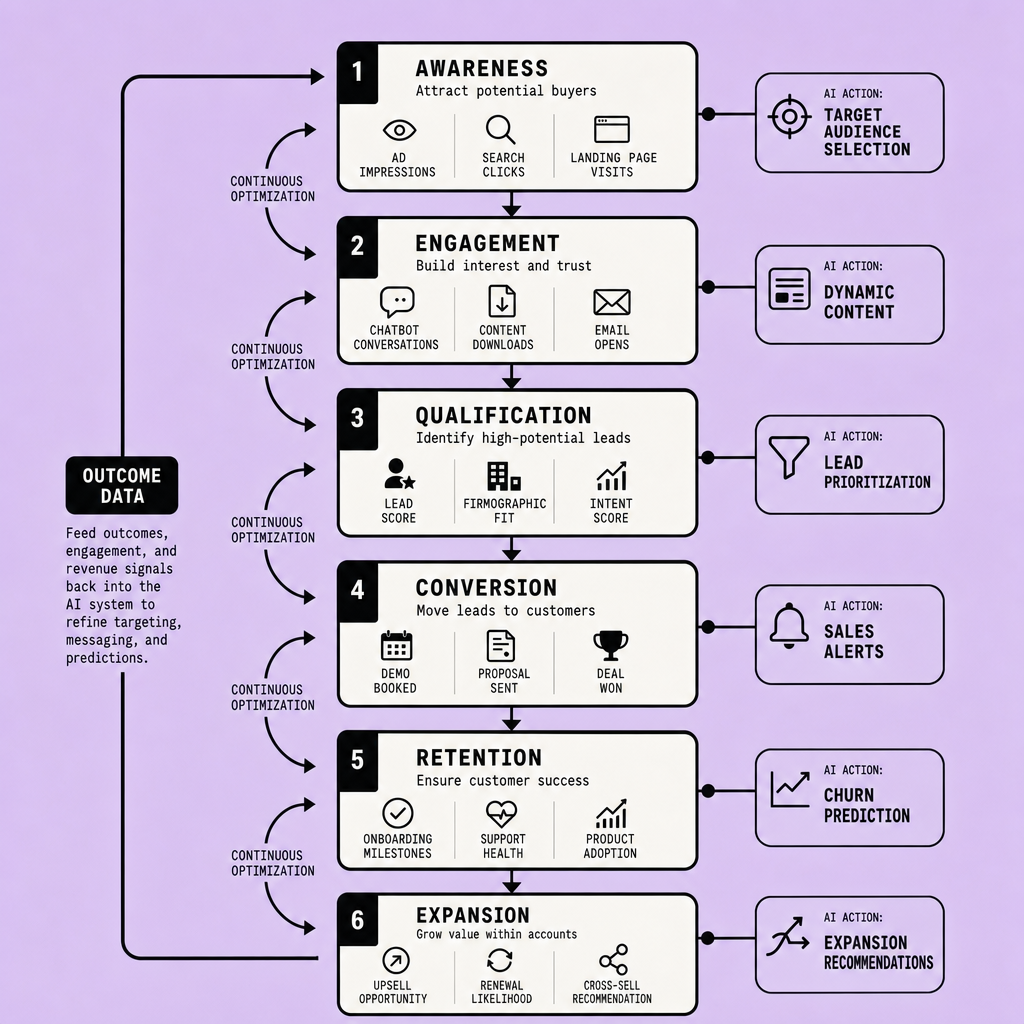
- A strong AI sales funnel optimizes each stage: targeting at awareness, tailored content during interest, lead scoring in consideration, and next-best-action recommendations at conversion. That is how a self-optimizing sales funnel improves over time.
- Feedback loops matter. Without CRM automation, closed-loop reporting, and clean stage data, AI sales automation becomes noisy and hard to trust.
- Start with one constrained use case -- like inbound lead qualification or follow-up sequencing. Messy integrations slow revenue automation and make optimization harder.
- Adopt it when volume, response-time pressure, and funnel complexity exceed what manual processes can handle reliably.
The AI sales funnel stages that power a self-optimizing sales funnel
A self-optimizing sales funnel sounds efficient until the stage definitions are fuzzy. Then AI just automates confusion.
It only works if the stages are explicit. If awareness, qualification, handoff, and post-sale ownership are unclear, the system cannot make better pipeline decisions. In practice, teams need clear lifecycle definitions, conversion events, and CRM ownership before an AI revenue engine can improve anything.
Awareness
At the top of the funnel, the problem is not traffic alone. It is getting the right buyers into the system.
The job of the awareness stage is reach -- getting the right buyers into the top of the AI sales funnel. This is where AI improves audience targeting, channel selection, SEO content recommendations, and paid campaign segmentation using firmographic and behavioral signals.
But reach alone is a vanity metric. A self-optimizing sales funnel tracks which traffic sources create qualified downstream activity, not just clicks. That stage-level visibility helps teams stop overfunding channels that fill dashboards but not pipeline.
Interest
Interest is where attention either sharpens or drops off. If the experience feels generic, most visitors keep moving.
Interest turns anonymous attention into identifiable engagement. The goal is simple: keep relevant visitors moving. AI supports this with chatbots, dynamic landing pages, email automation, and content personalization based on source, industry, device, or prior page views.
Because user experience is as important as functionality, personalization has to feel useful, not invasive. If every visitor sees a different experience but the logic is unclear, optimization becomes a black box fast.
Consideration
This is where teams start burning sales time if the funnel is sloppy.
Consideration is where buyers evaluate fit. This stage should answer one question: which leads deserve sales time now? AI-driven lead scoring models use signals such as demo requests, pricing-page visits, email engagement, form depth, and CRM fit data in HubSpot, Salesforce, or Marketo.
And this is where many funnels break. Teams score leads, but they do not define score thresholds, sales acceptance criteria, or re-nurture rules.
AI cannot optimize a stage your team has not operationalized.
Conversion
By the time a lead reaches conversion, timing matters more than theory.
Conversion moves qualified demand into revenue. Here, AI sales automation can recommend next-best actions, outreach timing, follow-up sequences, and CRM workflows that reduce response-time gaps and improve pipeline velocity.
The tradeoff is straightforward: automation should guide reps, not replace judgment in complex deals.
Retention/Expansion
Winning the deal is only one part of the system. If retention is weak, the engine is incomplete.
Retention and expansion protect revenue after the first win. AI can monitor product usage, support signals, renewal risk, and upsell triggers to prompt account outreach. This closes the feedback loop -- conversion data improves targeting, retention data sharpens scoring, and the full AI revenue engine gets smarter over time.
How an AI revenue engine optimizes targeting, timing, and next-best actions
Most teams do not have an automation problem. They have a coordination problem.
Separate tools can send emails, score forms, and trigger CRM tasks, but an AI revenue engine improves funnel performance by connecting those actions to live behavior, conversion outcomes, and feedback loops across the full AI sales funnel.
Start with targeting. AI uses segmentation built from firmographic data, page visits, email engagement, product interest, and CRM history. Instead of one nurture track per persona, teams can serve dynamic landing pages, personalized email automation, and chatbot flows that adjust to source, industry, or stage. Rules-based automation can route a lead by country or company size. Machine learning starts where patterns become too complex for static rules -- such as predicting which combination of intent signals actually correlates with pipeline quality.
Then there is timing, which is often where AI sales automation creates immediate lift. A standard workflow might send the same follow-up cadence to every lead. A stronger system predicts response windows, flags high-intent prospects after pricing-page visits or repeat sessions, and triggers rep outreach while interest is still high. We should treat this as decision support, not full autonomy. User experience is as important as functionality, and poorly timed automation can feel invasive fast.
Next-best action sits on top of that foundation. The engine combines predictive analytics, lead scoring models, and CRM workflows to recommend what should happen now: book a demo, send a case-study email, trigger retargeting, assign SDR follow-up, or pause outreach. In HubSpot, Salesforce, or Marketo, that usually means syncing scoring, lifecycle stage updates, and task creation into one revenue automation loop.
Start with one narrow use case -- like inbound lead prioritization plus automated follow-up timing -- before expanding to every funnel stage.
The difference is practical. Traditional automation executes prewritten steps. An AI revenue engine learns which steps improve conversion rates, response times, pipeline velocity, and win rates, then adjusts the system over time. But sales teams still need visibility into why a recommendation was made, or the funnel becomes a black box instead of a self-optimizing sales funnel.
Feedback loops, lead scoring, and personalization that keep the funnel learning
A funnel does not become self-optimizing just because automation exists. It becomes self-optimizing when outcomes feed back into the system and change what happens next.
Basic automation can send emails, assign tasks, or trigger chatbots. An AI revenue engine should go further -- it should update prioritization and messaging from real conversion results.
In practice, lead scoring starts with shared signals across the AI sales funnel: behavioral data such as pricing-page visits, demo requests, repeat sessions, email clicks, form depth, and chatbot interactions; firmographic data such as industry, company size, region, and role; and CRM fit signals such as pipeline stage, account status, and historical win patterns. Predictive scoring uses those inputs to rank who should get faster follow-up, heavier nurturing, or direct sales outreach.
But scoring only improves if the model sees closed-won and closed-lost data. Without closed-loop reporting, the system learns activity, not revenue. That creates noisy scores and weak handoffs.
The same logic applies to personalization. A prospect from paid search in SaaS should not receive the same sequence as a returning enterprise visitor from organic search who has viewed integration docs and pricing. Source, industry, engagement level, and CRM fit should shape copy, offers, channel, and timing.
Personalization works best when it is relevant and restrained -- weak signals can make automated outreach feel invasive.
Our view is simple: user experience is as important as functionality. Here, that means personalization should feel helpful, not over-engineered.
CRM automation, key metrics, and ROI measurement for revenue automation
Most teams do not need more alerts. They need tighter CRM workflows tied to revenue outcomes.
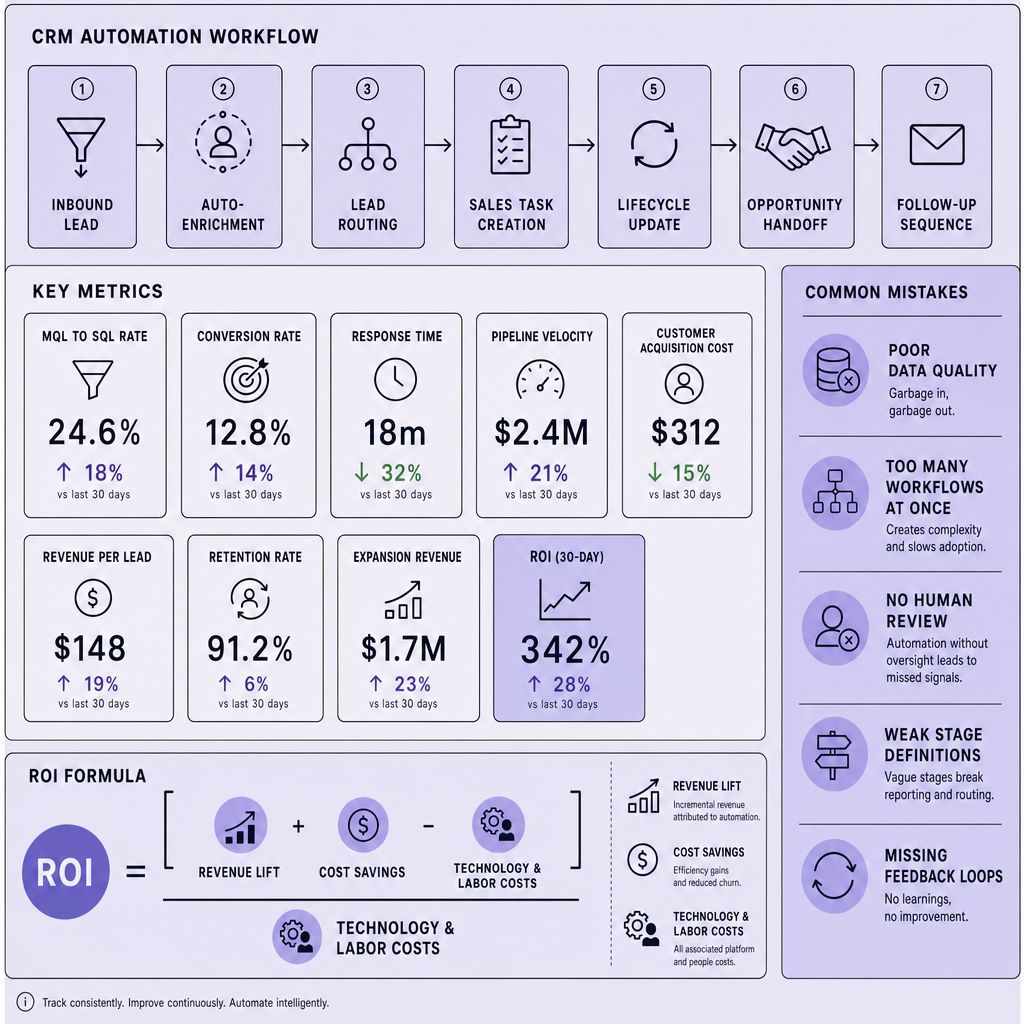
In an AI revenue engine, CRM automation should handle four jobs well: route leads by territory, fit, or intent score; create follow-up tasks with clear SLAs; update lifecycle stages from MQL to SQL to opportunity; and control handoffs between marketing and sales inside tools like HubSpot or Salesforce. If those rules are messy, the AI sales funnel becomes noisy fast. Revenue automation then starts amplifying bad process instead of fixing it.
Which CRM automations matter most
The first wins usually come from removing delay and ambiguity.
Start with the workflows that do that. Auto-assignment, meeting reminders, stale-lead reactivation, enrichment-based routing, and lifecycle updates usually create the first operational lift. But use guardrails -- sales should be able to override routing or score exceptions when context changes.
Because user experience is as important as functionality, we should treat follow-up timing and message continuity as part of system design, not just sales ops.
Metrics that prove ROI
Track the metrics that connect workflow speed to pipeline quality:
- MQL-to-SQL conversion: how many qualified marketing leads become accepted sales leads
- Speed-to-lead: time from inquiry to first meaningful sales action
- Meeting booked rate: leads that turn into scheduled conversations
- Pipeline velocity:
(qualified opportunities × average deal value × win rate) / sales cycle length - Win rate
- CAC
- Retention
- Revenue influenced
Do not declare ROI from opens, clicks, or chatbot chats alone.
A practical ROI model for a self-optimizing sales funnel is: incremental gross profit from higher conversion, faster pipeline movement, and better retention, plus labor saved from automation, minus tooling and implementation cost. That is how CRM automation proves business value.
How to implement an AI revenue engine without the common mistakes
This is where teams usually go wrong: they try to automate everything before the inputs, ownership, and workflow logic are stable.
Start small, wire it properly, and force every automation to earn its place. That is how we implement an AI revenue engine without turning the funnel into a black box.
First, audit your inputs. Pull CRM records, form data, email engagement, website events, call outcomes, and lifecycle statuses into one map. If contact fields are inconsistent, duplicate-heavy, or missing stage definitions, AI sales automation will amplify bad decisions. Data hygiene comes first. Always.
Next, define the funnel in operational terms: inquiry, MQL, SQL, opportunity, customer, expansion -- or your equivalent. Then assign owners, entry criteria, exit criteria, and handoff rules. Weak definitions break revenue automation long before any model fails.
After that, pick one high-impact use case. Not five. A pilot program around lead routing, follow-up timing, or lead scoring usually creates the fastest learning loop. Smaller pilots expose data gaps early -- before complexity compounds across the full AI sales funnel.
Then connect the stack. In practice, that means CRM integration between platforms like HubSpot or Salesforce and your marketing automation layer, whether that is Marketo, email automation, chatbots, or workflow automation in the CRM itself. Sync fields, timestamps, activity history, and status changes. If systems disagree on source of truth, stop and fix that first.
Set lead scoring logic with both fit and behavior signals. Firmographics alone miss urgency. Clicks alone miss account quality. Use both, review the score distribution, and test whether sales actually trusts the output.
Launch limited workflows.
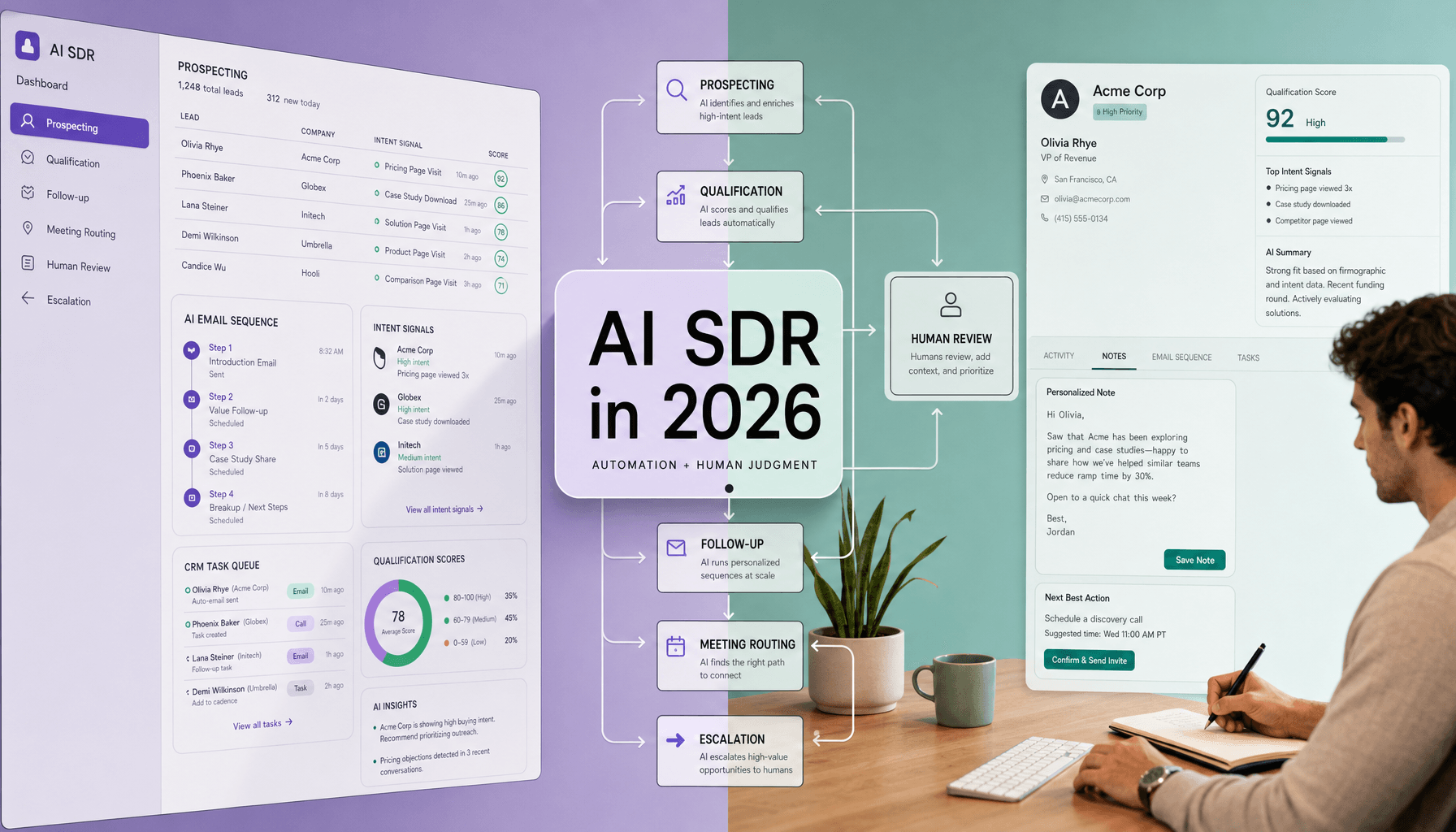
For example, route high-intent leads faster, trigger tailored nurture based on page behavior, and create CRM tasks for stalled opportunities. But keep a human review path. Over-automation causes irrelevant outreach, bad timing, and brittle personalization.
The common mistakes are predictable: poor data hygiene, unclear ownership, weak sales-marketing handoffs, and adopting AI before the process is mature enough to automate. If the funnel is inconsistent today, AI will scale the inconsistency tomorrow.
Review metrics weekly: response times, MQL-to-SQL conversion, pipeline velocity, win rates, and workflow completion errors. Then iterate.
Adopt an AI revenue engine when lead volume is high enough to create prioritization pain, the sales cycle has enough complexity to benefit from scoring and orchestration, and the team is ready for change management -- not just new tools.
Frequently Asked Questions
What is the difference between an AI revenue engine and traditional marketing automation?
Traditional marketing automation follows fixed rules and predefined sequences, while an AI revenue engine adjusts decisions based on outcomes, behavior patterns, and sales results. The difference is that it can improve routing, timing, and prioritization over time instead of only executing static workflows.
How long does it usually take to see results from an AI sales funnel?
Most teams see early operational gains within 30 to 90 days if they start with one use case such as lead routing or speed-to-lead improvement. Larger revenue impact usually takes longer because the system needs enough conversion and pipeline data to refine scoring and recommendations.
Why does an AI revenue engine fail even when the tools are good?
An AI revenue engine usually fails because of broken process design, not weak software. Inconsistent lifecycle stages, low-quality CRM data, poor sales-marketing alignment, and unclear ownership prevent the system from learning accurately and make automated recommendations hard to trust.
How should small and mid-sized businesses approach revenue automation?
Small and mid-sized businesses should begin with narrow, high-friction problems rather than full-funnel transformation. The best starting points are missed follow-up, inconsistent qualification, or manual CRM updates. That approach lowers implementation risk and creates measurable proof before expanding the automation layer.
What metrics should executives watch to evaluate a self-optimizing sales funnel?
Executives should watch a mix of efficiency and revenue metrics, including speed-to-lead, stage conversion rates, pipeline velocity, win rate, retention, and revenue per sales rep. Those measures show whether the system is improving both operational execution and actual commercial performance.
Make Imversion a preferred source on Google
Like this kind of AI and software analysis? Add Imversion as a preferred source so Google can highlight our articles for you in Search, AI Overviews, and AI Mode.