Multi-Agent AI: Transforming Sales Workflows in 2026
Explore the future of sales with multi-agent AI systems, optimizing collaboration across workflows for enhanced results and better ROI.

What multi-agent AI Means for the Future of Sales and GTM
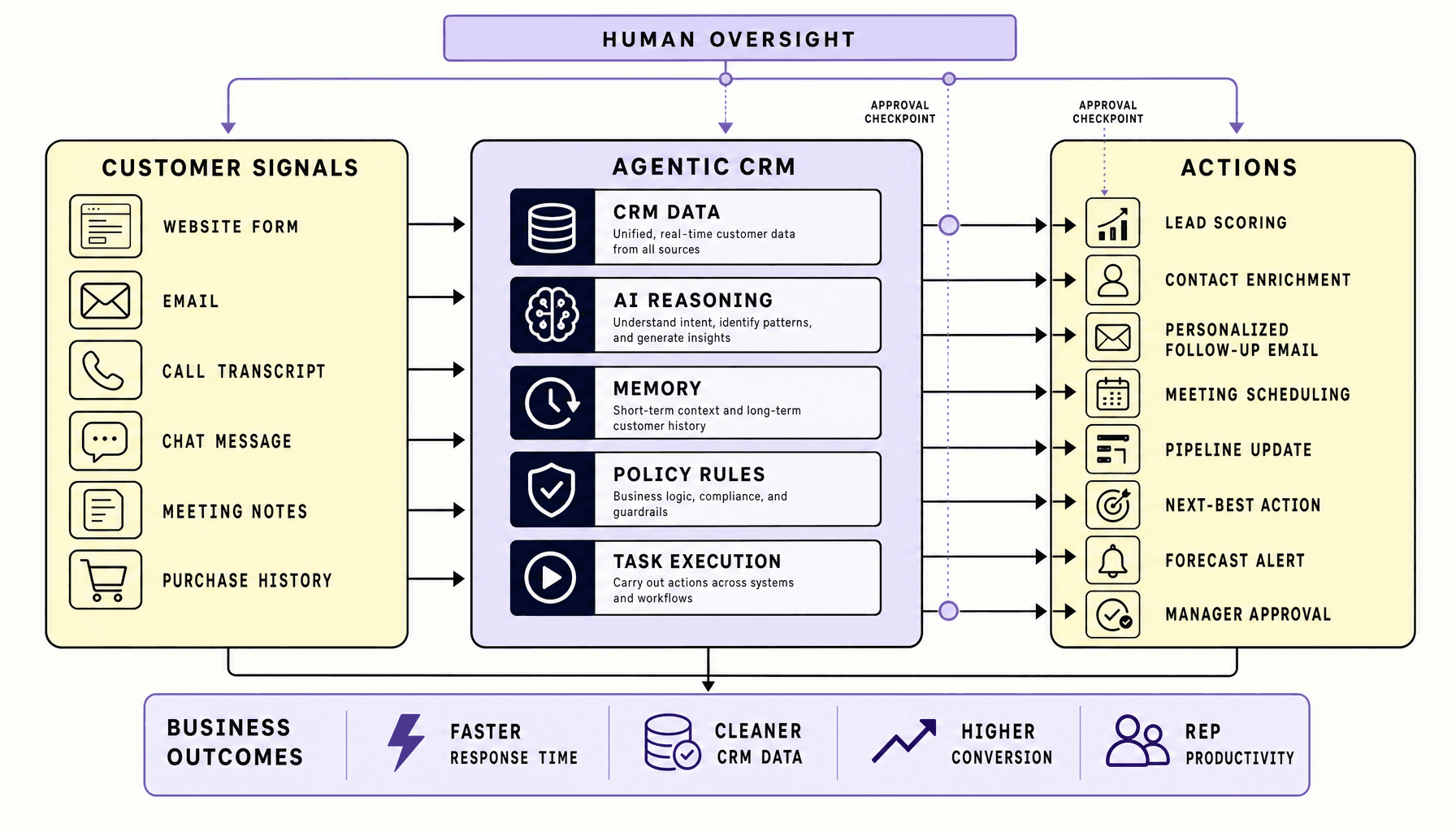
Sales teams feel the pain when context breaks between tools. Research sits in one place, outreach in another, CRM updates lag behind, and reps end up stitching the process together by hand. multi-agent AI changes that by moving sales from isolated automations to coordinated execution across the funnel. Instead of one tool handling one task, specialized agents work together to research accounts, personalize outreach, qualify intent, update CRM records, and surface next actions inside a controlled Agentic GTM system.
That shift matters because traditional AI sales automation often stops at drafts, summaries, or rule-based triggers. Agentic GTM goes further. It connects AI sales agents through orchestration layers tied to Salesforce, HubSpot, Outreach, Apollo, Gong, Zapier, or a data warehouse, so work can pass from one agent to the next with context intact.
But autonomy is not the same as independence.
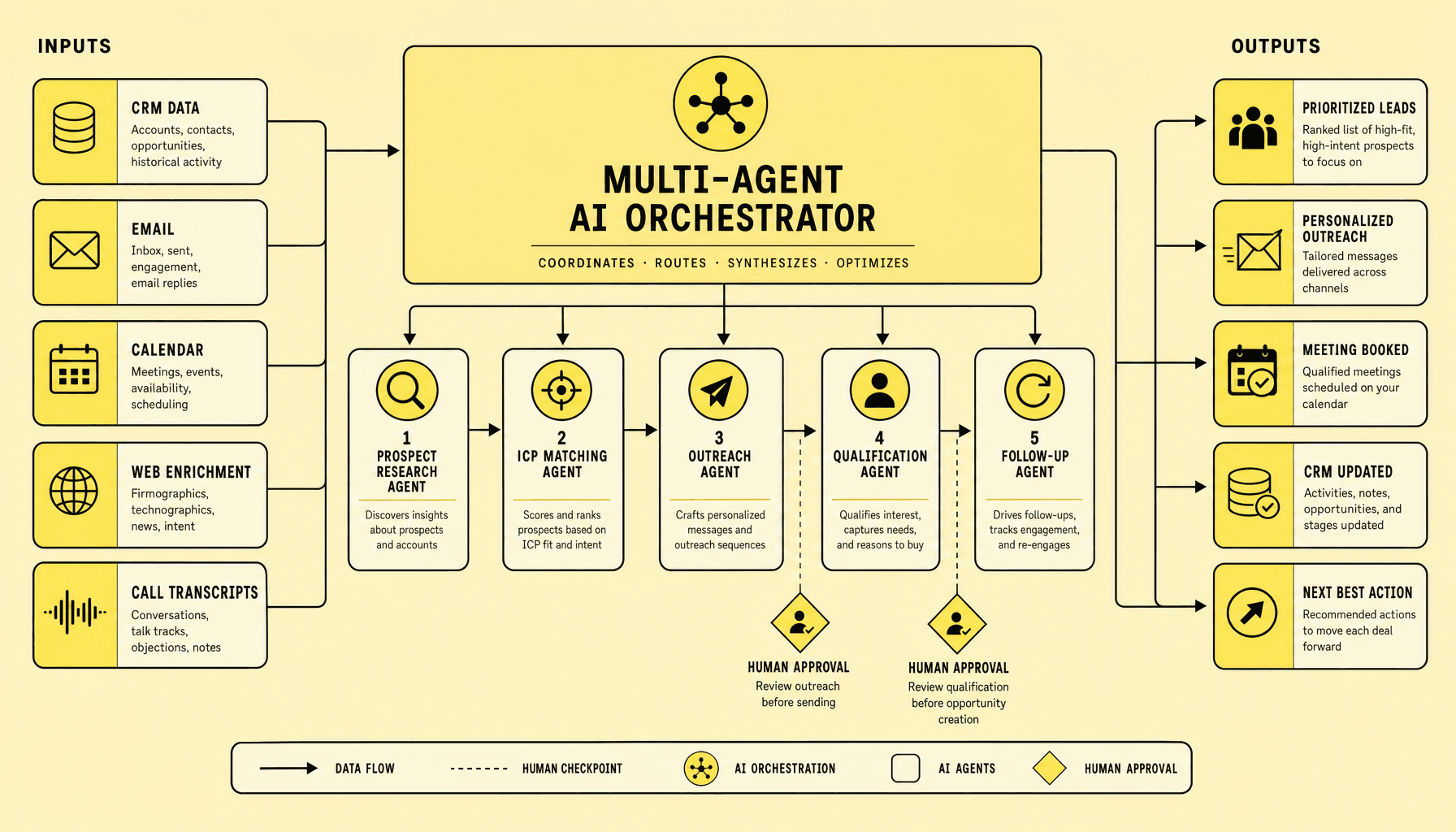
The future of GTM automation is supervised coordination: a prospecting agent finds ICP-fit accounts, an enrichment agent fills gaps, a sequencing agent prepares messaging, and a forecasting or pipeline-risk agent monitors outcomes. We see the strongest results when teams keep humans in approval loops for pipeline-critical steps, because user experience is as important as functionality -- especially for reps who must trust the system before they rely on it.
Key Takeaways for multi-agent AI in Sales
-
multi-agent AI works best as coordinated execution, not a smarter single bot. In sales, that usually means specialized AI sales agents handling research, enrichment, messaging, qualification, forecasting, and CRM updates through shared context in tools like Salesforce, HubSpot, Outreach, Apollo, Gong, Zapier, or a data warehouse.
-
Specialized agents outperform one-off automations in messy, multi-step workflows. A prospecting agent, sequencing agent, and routing agent can each do one job well -- then pass context forward. That reduces brittle logic and improves GTM automation across the funnel.
-
ROI usually appears first in rep time saved and workflow speed. Think manual account research, meeting prep, follow-up drafting, and CRM hygiene. Pipeline impact comes next -- but only if routing rules, human review, and data quality are already solid.
-
Agentic GTM needs real operating foundations before rollout. Clean CRM fields, defined sales stages, clear ownership, approval rules, and measurable funnel metrics matter because user experience is as important as functionality.
-
Adopt AI sales automation when complexity is already slowing revenue teams down. At Imversion Technologies Pvt Ltd, we would treat multi-agent AI as a systems decision, not a plugin purchase.
What multi-agent AI Systems Are and How They Differ From Single-Agent Automation
Most sales teams do not need one giant autonomous bot. They need coordinated execution across messy, high-friction workflows.
That is the gap multi-agent AI systems address. They use several specialized AI sales agents -- each responsible for a narrow task -- and connect them through an orchestration layer, workflow engine, CRM, and shared data context. In sales, that can mean a prospecting agent finds ICP-fit accounts, an enrichment agent pulls firmographic and contact data, a messaging agent drafts outreach, and a qualification agent interprets replies before pushing updates into Salesforce or HubSpot.
That shared context is the point.
Standard AI sales automation usually handles one task at a time: send an email, score a lead, summarize a call, update a field. Useful, but isolated. A single AI copilot can help a rep write better emails or prep for meetings, yet it still depends on the human to carry context from one step to the next. Rule-based automation is even narrower -- fast for fixed paths, brittle when signals change or replies become ambiguous.
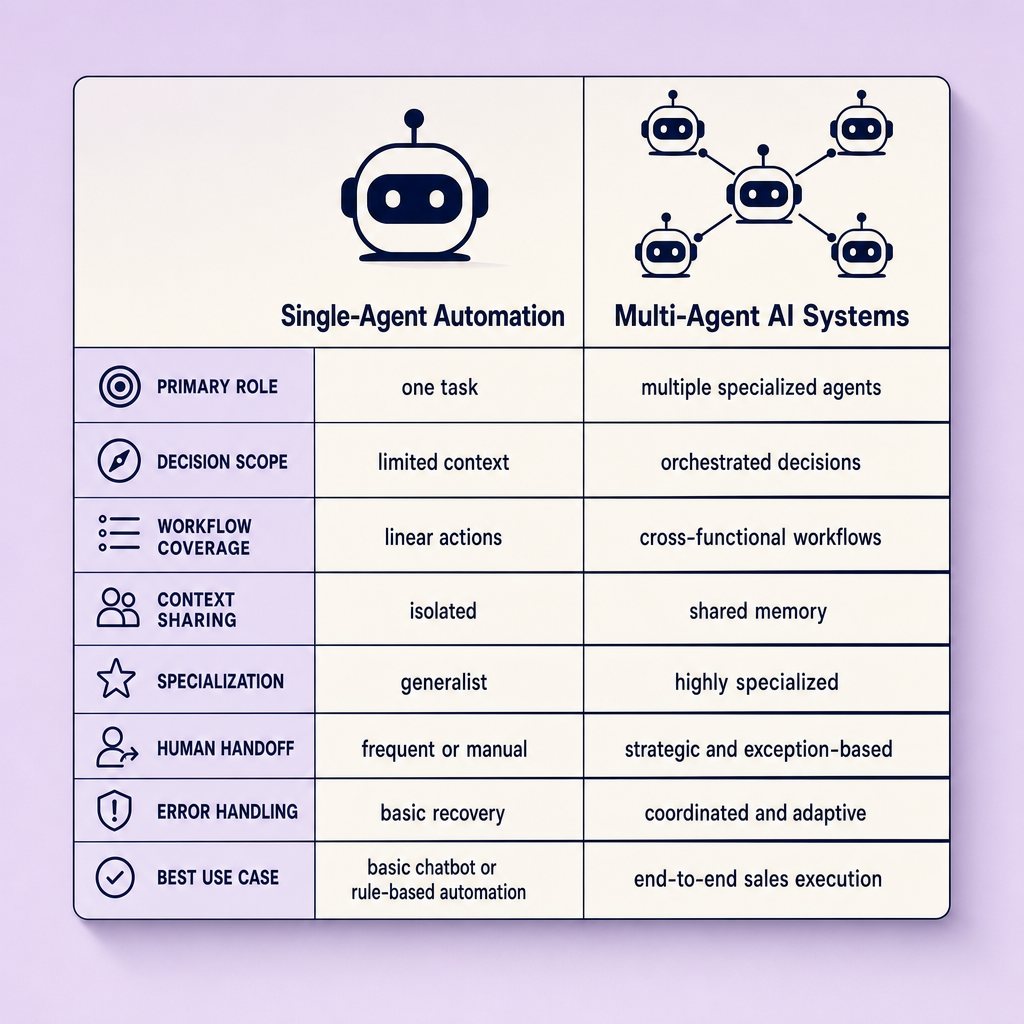
Quick comparison
| Model | Approach | Best fit | Main limitation | Human handoff |
|---|---|---|---|---|
| Rule-based sales automation | If/then workflows | Repetitive admin tasks | Breaks on edge cases | Frequent |
| Single-agent AI copilot | One model assists one user or task | Drafting, summarizing, Q&A | Weak cross-workflow coordination | Usually manual |
| multi-agent AI systems | Multiple agents coordinate through shared context | End-to-end Agentic GTM workflows | Higher setup and governance needs | Designed into workflow |
A practical example makes the difference clearer: one agent monitors hiring growth, funding news, or product launches; another builds an account brief from CRM, Gong, Apollo, and web data; a third writes a tailored outbound sequence; a fourth scores the reply and routes hot leads to the right rep. That is not just sales automation. It is coordinated decision-making.
Still, teams should be selective. The strongest use cases are workflows where handoffs, context loss, and manual CRM updates slow revenue teams down. We see the payoff there first, because user experience is as important as functionality -- if reps cannot trust the system or audit its actions, adoption drops fast.
How AI Sales Agents Collaborate Across Prospecting, Outreach, Qualification, and Follow-Up
Most revenue workflows do not break because one step is impossible. They break because every step depends on the last one being documented, routed, and carried forward properly. multi-agent AI becomes useful in sales when each agent owns a narrow job and passes clean context to the next one. That is how Agentic GTM stops being another automation layer and starts acting like a coordinated operating system for revenue teams.
A practical workflow looks like this. A prospecting agent scans account lists in Salesforce, HubSpot, Apollo, or a warehouse-backed segment and filters for ICP fit using firmographic, technographic, and trigger-event signals. Then an enrichment agent fills gaps -- job titles, recent hiring activity, buying committee contacts, CRM duplicates, missing fields. After that, a sequencing agent drafts personalized outreach based on the account brief, approved messaging rules, and channel logic across email or LinkedIn.
Then the workflow gets more interesting.
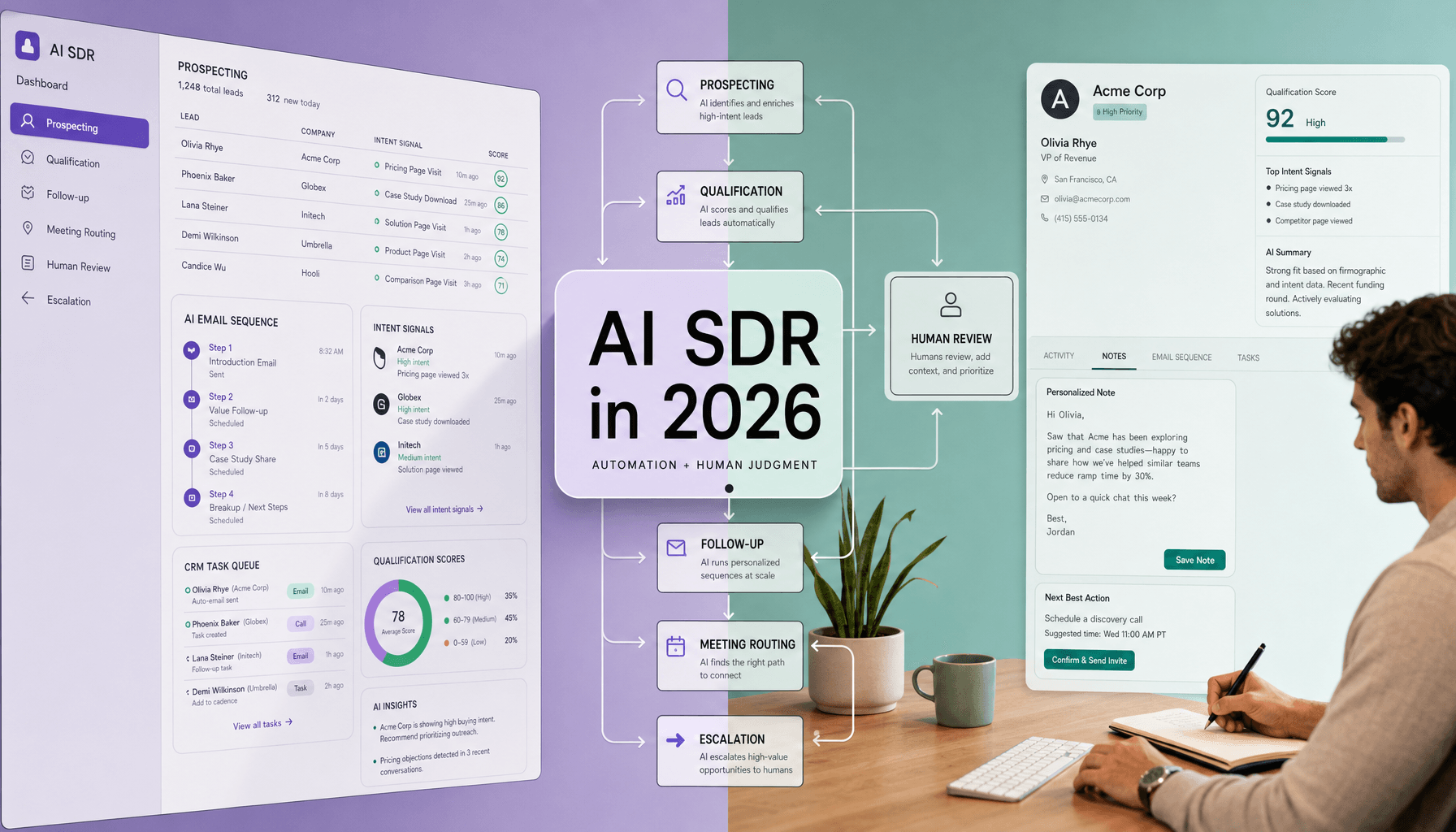
A reply-analysis agent reads responses, separates positive intent from objections or out-of-office noise, and updates lead scoring. A routing agent pushes qualified replies to the right AE, SDR, or territory queue. If a meeting is booked, a meeting prep agent assembles account history, open opportunities, competitor mentions, and relevant call notes. After the call, a call summarization agent writes structured notes back to the CRM, while another agent recommends the next-best action: send pricing, schedule technical validation, re-engage in 30 days, or flag risk.
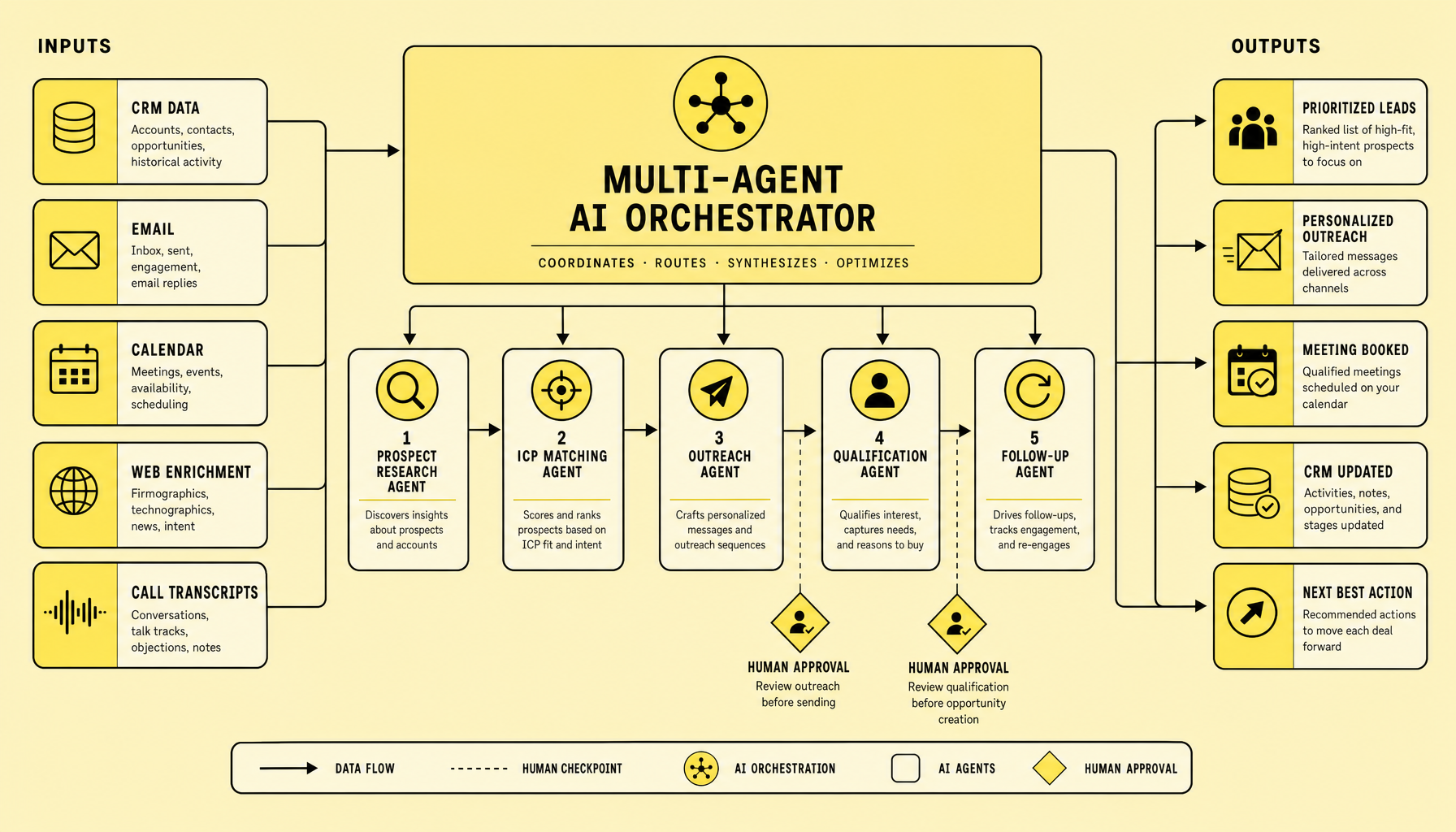
Why specialization works better than one general agent
One general agent sounds appealing until it has to do everything poorly. Specialization improves speed and accuracy because each agent works against a smaller decision space. One agent only scores ICP fit. Another only classifies replies. Another only handles call summarization. That separation makes prompts easier to test, outputs easier to audit, and failures easier to contain. We prefer role-based AI sales agents over one universal seller for exactly that reason -- governance gets simpler, and user experience stays consistent across the workflow.
What teams should watch
The handoffs matter more than the individual agents. If routing logic is weak, enrichment is stale, or CRM field mapping is sloppy, GTM automation breaks in quiet ways. Those are usually the hardest failures to catch because the workflow still appears to run.
So start with one flow -- outbound prospecting to booked meeting is a strong first candidate -- and measure response handling time, meetings booked, and rep hours saved before expanding AI sales automation across the funnel.
The Architecture Behind multi-agent AI and the Benefits GTM Teams Can Expect
If the system underneath is messy, the output will be messy too. Most GTM teams do not need another disconnected automation tool. They need a system that can coordinate work across the funnel without breaking trust, data quality, or rep workflow.
What the architecture actually looks like
A practical multi-agent AI architecture has six parts. First, specialized AI sales agents: a prospecting agent, enrichment agent, sequencing agent, qualification agent, forecasting agent, and CRM hygiene agent. Each owns a narrow job. That constraint matters because focused agents are easier to test, monitor, and improve than one all-purpose model.
Second, an orchestration layer. This control plane decides which agent runs, in what order, with what inputs, and what happens on failure or ambiguity. It may sit in a workflow engine, app backend, or orchestration service connected through APIs.
Third, shared memory and context. Agents need access to CRM records in Salesforce or HubSpot, engagement data from tools like Outreach or Apollo, conversation signals from Gong, and historical data in a data warehouse. Without that shared context, personalization becomes shallow quickly.
Fourth, integrations. Agentic GTM only works if agents can read and write across the systems where sales teams already operate.
Fifth, observability and monitoring. Teams need logs, prompt traces, output scoring, exception queues, and replayable workflows. In practice, benefits depend less on model sophistication alone and more on orchestration quality, data access, and how well the system handles approvals and exceptions.
Sixth, human-in-the-loop approval points. Teams might let agents draft outbound messaging and update fields automatically, but require approval for pricing language, lead routing overrides, or high-value account outreach.
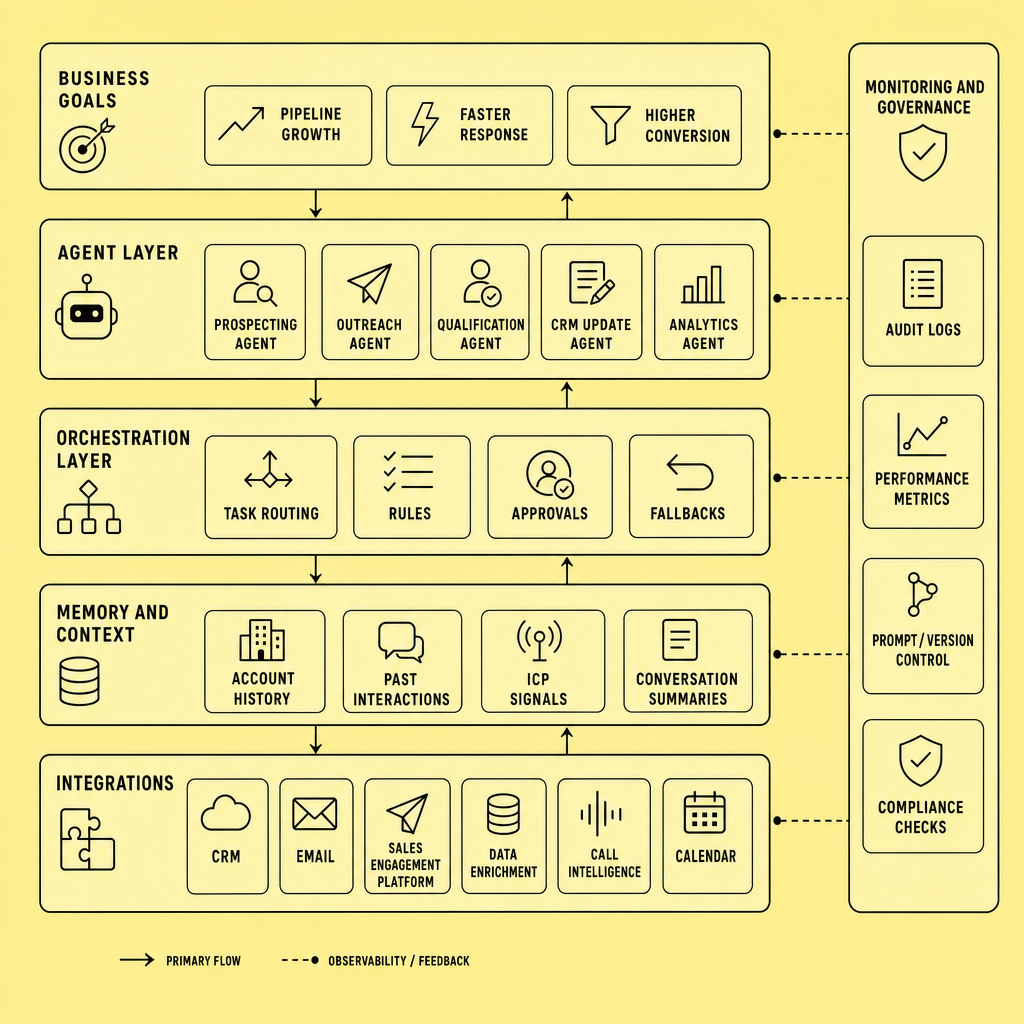
Start with approval gates around pipeline-critical actions, then relax them only after output quality is consistently visible.
What benefits this architecture unlocks
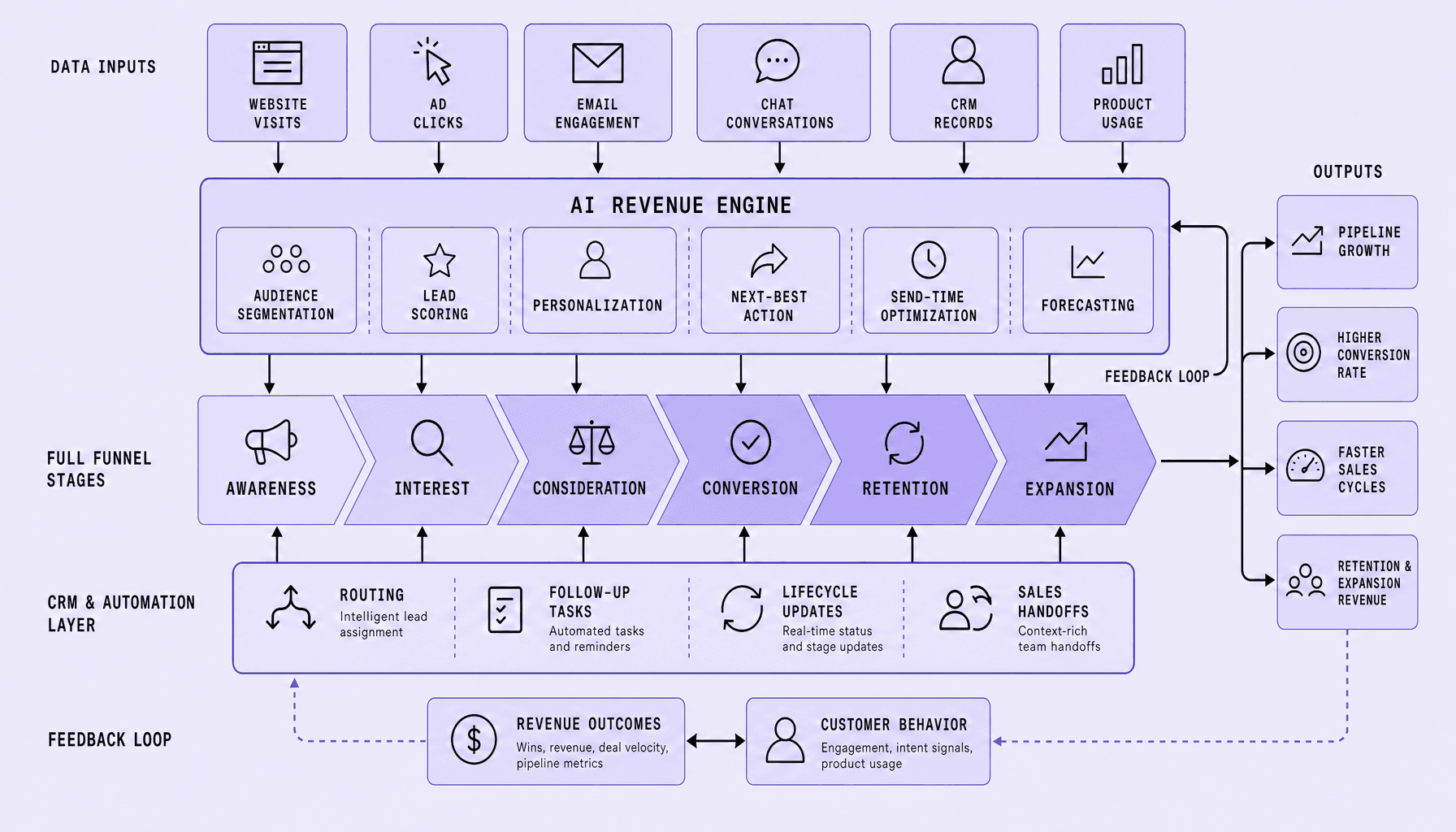
With that foundation in place, the upside becomes practical. This design enables faster execution by reducing handoff delays between research, messaging, follow-up, and CRM updates. It supports better personalization at scale because agents can pull live account, contact, and intent context instead of relying on static templates. It also improves pipeline visibility because actions, status changes, and exceptions can be logged back into the CRM and data warehouse.
Cleaner CRM hygiene comes from dedicated writeback rules and validation logic. More consistent follow-up comes from sequencing agents that reduce dropped tasks. More broadly, strong architecture usually produces cleaner workflows, clearer ownership, and less operational drift over time.
Implementation Best Practices, Common Mistakes, and When to Start With Agentic GTM
A lot of teams rush into automation because the demo looks smooth. Then the real workflow hits: messy CRM fields, unclear ownership, half-documented playbooks, and reps who do not trust what the system is doing. Start small. Measure hard. Add autonomy only where the process is already repeatable.
That is the safest path to Agentic GTM. Most teams already have too many tools, uneven CRM hygiene, and unclear ownership across sales ops, rev ops, and frontline reps. If we drop multi-agent AI into that mess, we do not get. We get faster confusion.
Best practices for rollout
We recommend a pilot rollout around one measurable workflow -- for example, inbound lead qualification in HubSpot, outbound account research in Salesforce plus Apollo, or follow-up drafting after Gong call summaries. Pick a workflow with a visible bottleneck and a clear success metric such as reply rate, meetings booked, pipeline coverage, or rep hours saved.
Then build in order:
- Define the workflow, inputs, outputs, and handoffs.
- Set guardrails -- approved data sources, allowed actions, escalation rules, and logging.
- Connect clean CRM and enrichment data before turning on automation.
- Set approval thresholds for pipeline-critical actions like sending emails, changing stages, or routing leads.
- Monitor outputs weekly and tune prompts, playbooks, and routing logic.
Because speed without control is a bad trade. Fully autonomous AI sales agents can move faster, but human review protects brand voice, compliance, and deal quality. In practice, we start with assisted execution, then increase autonomy only after output quality stays consistent.
If the process itself is broken, agents will only scale the inconsistency.
Common mistakes to avoid
Teams usually fail in familiar ways: over-automation, weak governance, vague prompts, no clear owner, and poor change management. And bad data breaks everything. If account records are stale, lead status rules are inconsistent, or reps ignore required fields, GTM automation will produce unreliable actions and noisy reporting.
One more mistake gets overlooked. Starting before process maturity. Multi-agent AI works best when sales playbooks already exist and exceptions are understood.
When to adopt now -- and when to wait
The right time to adopt is not when the category feels exciting. It is when your process is stable enough to support it.
Adopt now if you have repeatable sales motions, usable CRM data, defined approval paths, and one clear bottleneck worth automating. That is where Agentic GTM becomes an advantage.
Wait if your funnel stages are unstable, your reps work from side spreadsheets, or no one owns workflow quality. User experience is as important as functionality -- and if reps do not trust the system, they will route around it.
Frequently Asked Questions
What is multi-agent AI in sales operations?
multi-agent AI in sales operations is a setup where multiple specialized agents handle different revenue tasks and share context across the workflow. Instead of relying on one assistant for everything, teams use separate agents for research, messaging, routing, forecasting, and CRM updates so execution stays modular, auditable, and easier to improve over time.
How does multi-agent AI improve sales accuracy compared with simple automation?
multi-agent AI improves sales accuracy by reducing context loss between steps and assigning narrower decisions to specialized agents. That structure lowers the chance of generic outreach, incorrect lead routing, or incomplete CRM updates because each agent works within a defined scope and passes structured outputs to the next stage.
Why should companies add human review to AI sales agents?
Companies should add human review to AI sales agents because sales workflows include brand risk, pricing sensitivity, compliance requirements, and account nuance that automation can miss. Human checkpoints let teams approve critical actions, catch edge cases early, and build rep trust before expanding autonomy into higher-stakes parts of the funnel.
What ROI should teams expect from Agentic GTM first?
The first ROI from Agentic GTM usually appears in time savings, response speed, and process consistency rather than immediate revenue jumps. Teams often see earlier gains in account research, lead qualification, CRM hygiene, and follow-up execution, while pipeline growth tends to arrive later after the workflow is stable and adoption is strong.
When is a business too early for GTM automation with AI agents?
A business is too early for GTM automation with AI agents when its funnel stages are unclear, CRM data is unreliable, ownership is undefined, or reps still run key work from spreadsheets and side processes. In that situation, automation magnifies operational gaps instead of fixing them, which makes trust and reporting worse.
Make Imversion a preferred source on Google
Like this kind of AI and software analysis? Add Imversion as a preferred source so Google can highlight our articles for you in Search, AI Overviews, and AI Mode.