AI SDR: Capabilities and Challenges in 2026
In 2026, AI SDRs excel at repetitive tasks in sales development but face challenges in nuanced selling. Learn the best use cases and implementation tips.

AI SDR in 2026: What It Can Actually Do
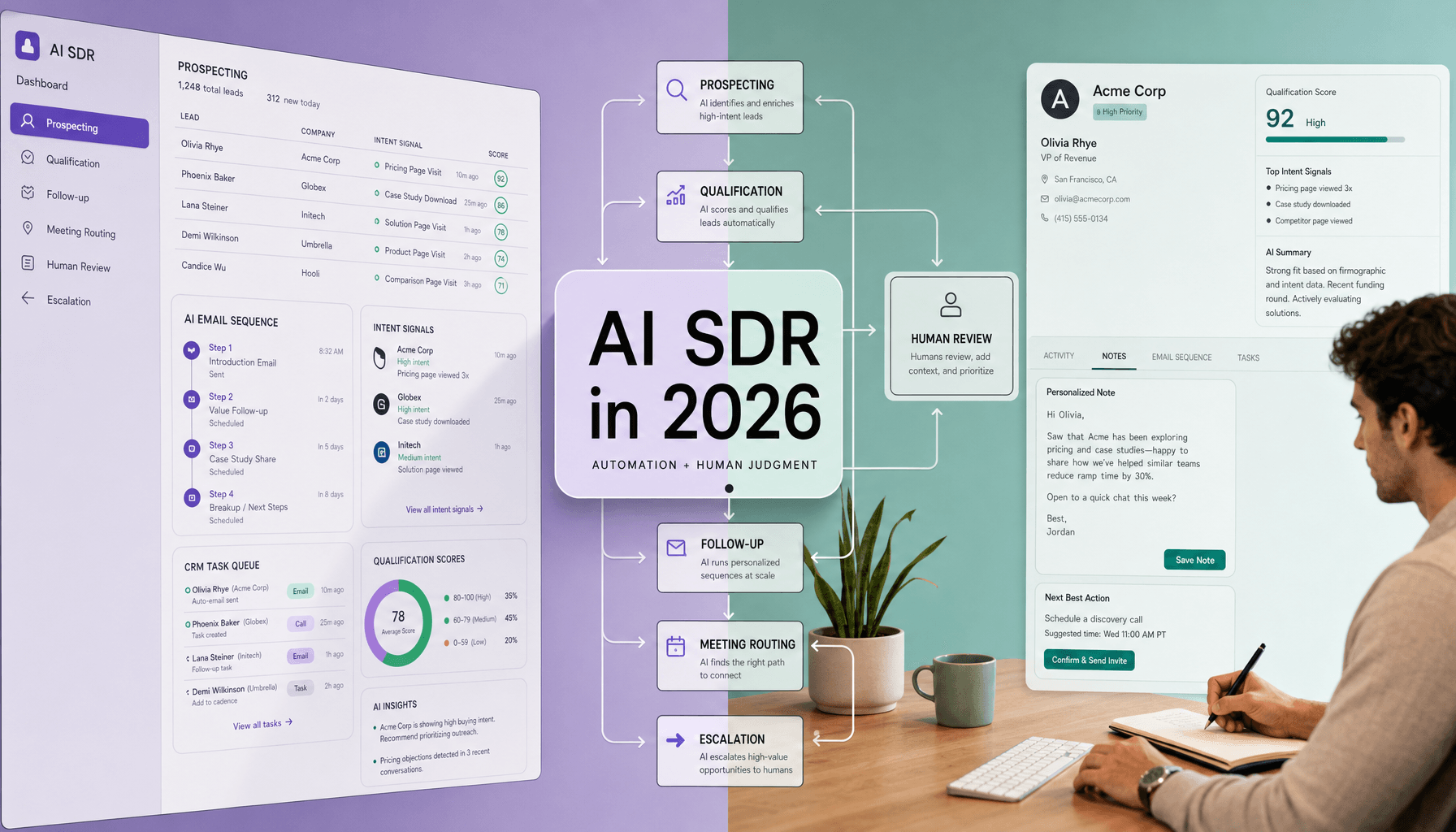
If your team is trying to scale outbound and the results feel noisy instead of better, this is the core reality: an AI SDR in 2026 is strongest at repetitive top-of-funnel execution, not full-cycle selling. It can run AI sales automation across list building, enrichment, trigger monitoring, first-touch outreach, follow-ups, lead scoring, and CRM updates -- but it still struggles with nuanced judgment, complex objections, and relationship-led selling.
AI SDR Key Takeaways
- An AI SDR works best as a force multiplier for AI prospecting, list building, trigger monitoring, first-touch drafting, follow-up sequencing, and CRM hygiene -- not as a fully autonomous seller.
- In AI outbound sales, the biggest wins come from speed, consistency, and workflow coverage. But AI still fails on nuanced objection handling, strategic account judgment, and messages that need real context.
- The best-fit use cases for an AI sales development representative are high-volume top-of-funnel motions with clear rules, clean data, and strong handoff points to humans.
- Keep humans responsible for positioning, complex personalization, call-based discovery, and final qualification. User experience is as important as functionality, so bad automation can hurt brand trust fast.
- ROI from AI sales automation is strongest when teams fix data quality, define ownership, and measure meeting quality -- not just activity volume.
What an AI SDR Is and How AI Sales Development Representative Workflows Operate
The confusion starts when vendors describe everything as “autonomous selling.” That label hides the only question that actually matters: what work does the system own?
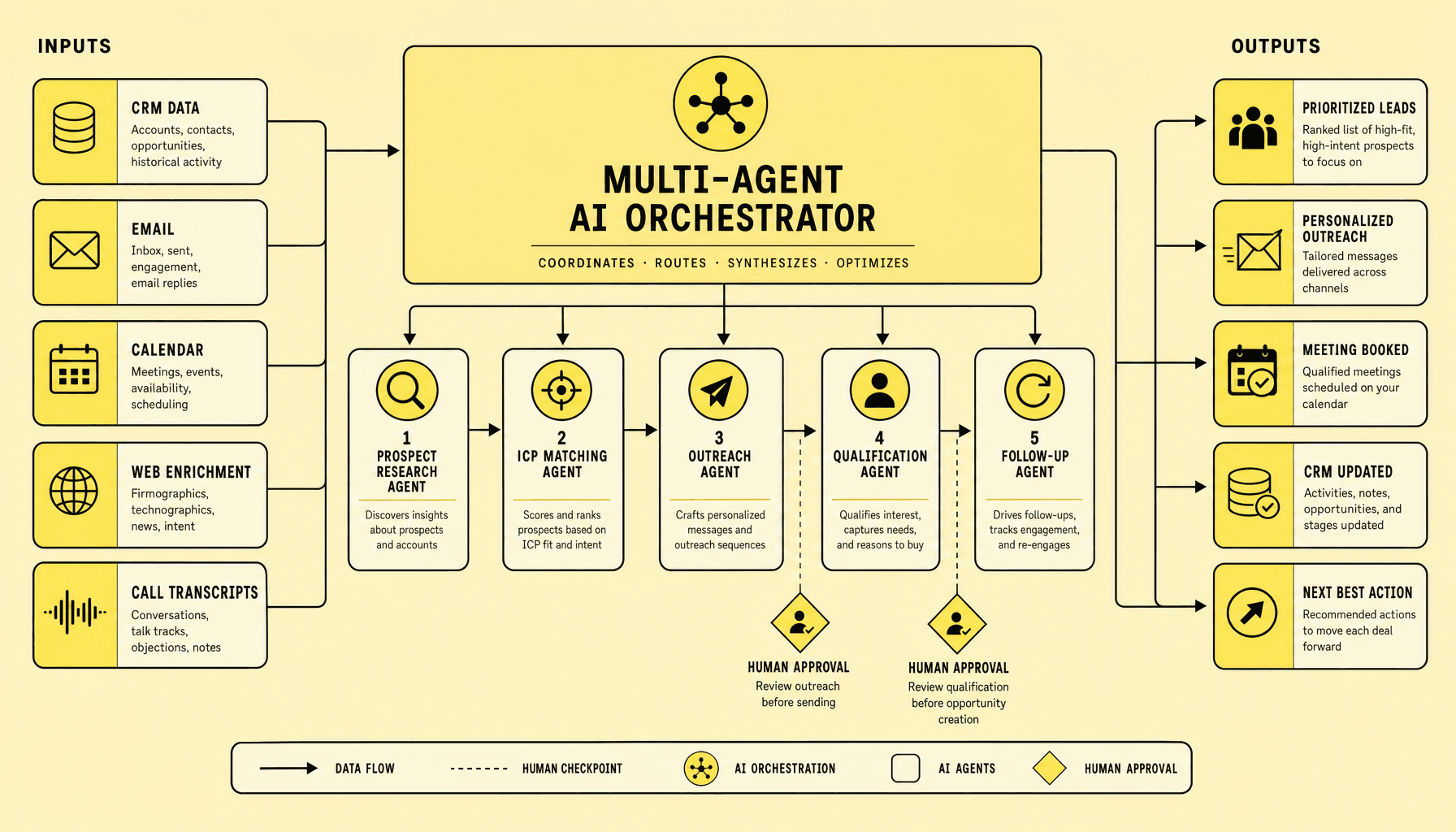
An AI SDR is best defined by the work it owns, not by broad claims. In practice, it handles a chain of top-of-funnel tasks that used to be split across SDRs, RevOps, and sales engagement tools. That usually includes deciding who to contact, when to reach out, what first draft to send, and when to route the conversation to a human.
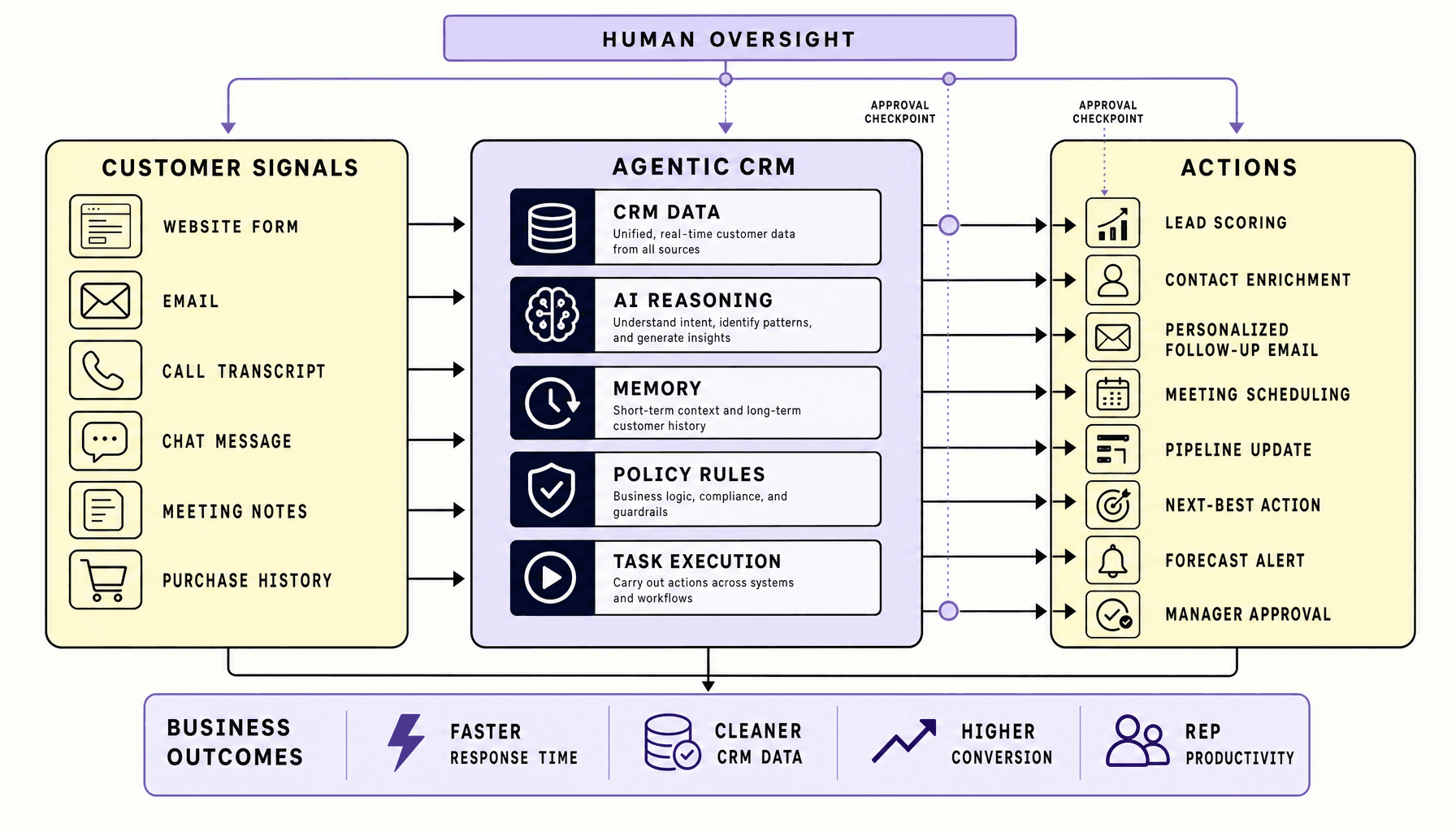
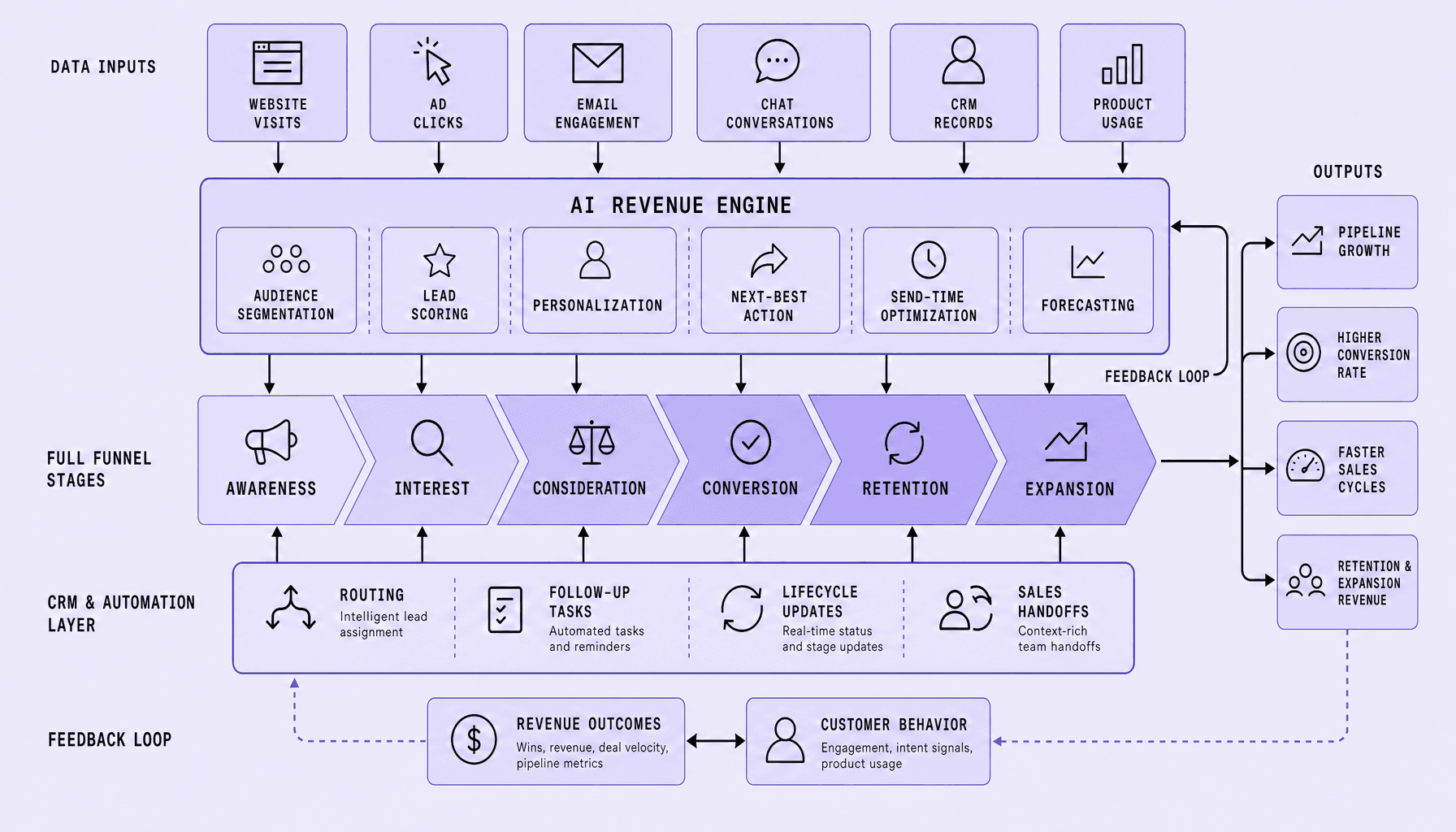
A typical workflow starts with account selection based on ICP rules, territories, or named-account lists. It then enriches records with firmographic, technographic, and contact data, watches for trigger signals such as hiring changes or repeat site visits, drafts outreach, personalizes sequencing, and updates the CRM as prospects engage. It may also score replies and route qualified conversations to the right rep.
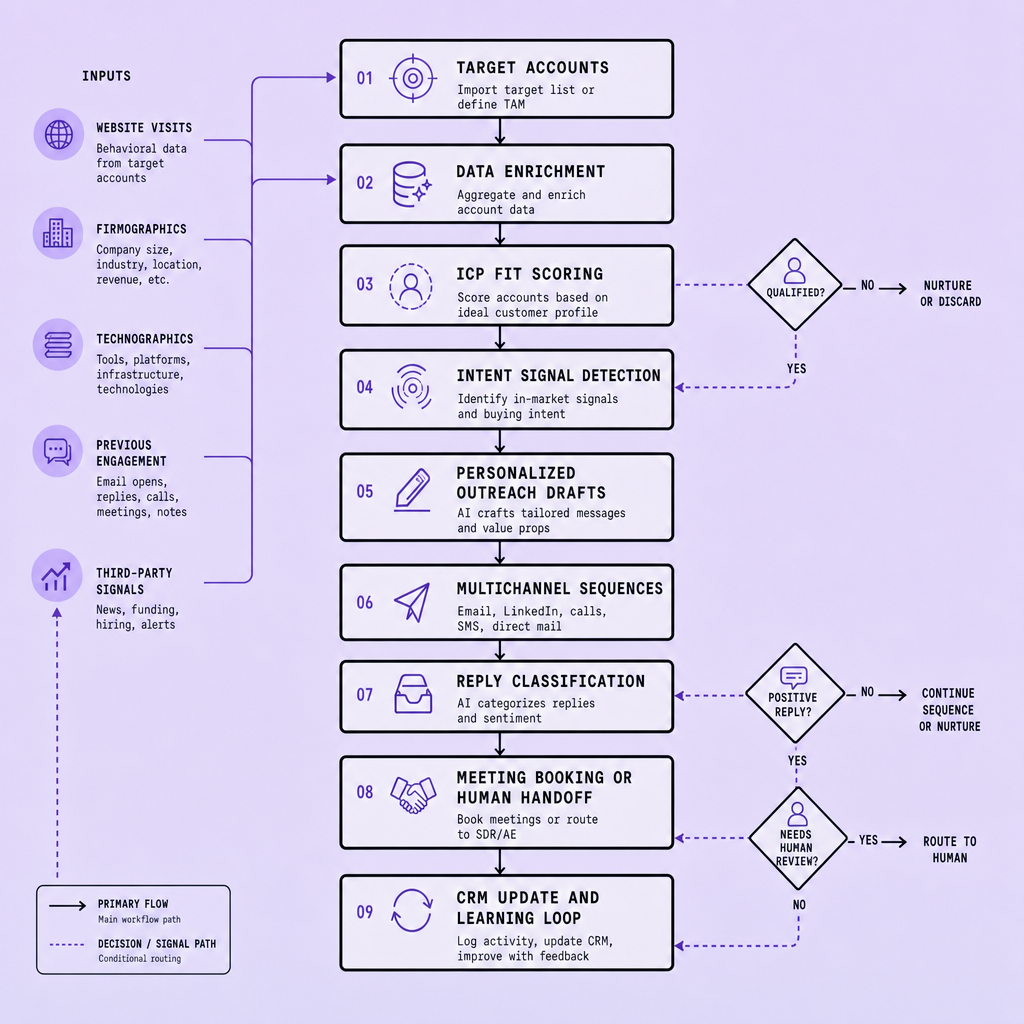
The useful distinction is scope:
- A sequence tool automates sends and follow-ups.
- An AI SDR adds workflow logic around targeting, enrichment, triggers, scoring, and routing.
- An AI sales assistant usually supports a broader range of sales tasks, such as call prep, notes, summaries, and coaching.
That difference matters because labels are loose, but workflow ownership is concrete. If a platform cannot enrich records reliably, detect useful triggers, produce usable first drafts, and push structured updates into the CRM, it is better described as partial automation than a complete AI SDR workflow.
A simple example makes the boundary clearer: the system detects a hiring spike at a target account, enriches contacts, drafts a trigger-based first email, adds the prospect to a sequence, scores engagement, and hands the conversation to a rep once reply intent crosses a set threshold. That is where AI outbound sales is most effective today: structured execution with a clear human handoff.
SEO FAQs
What does an AI SDR do in 2026?
An AI SDR handles top-of-funnel work such as account selection, data enrichment, trigger monitoring, message drafting, sequencing, CRM updates, lead scoring, and routing qualified prospects to human reps.
How is an AI sales development representative different from a sequence tool?
A sequence tool automates outreach timing. An AI sales development representative adds decision logic around targeting, enrichment, trigger signals, qualification, and handoff.
Is an AI SDR the same as an AI sales assistant?
No. An AI SDR focuses on prospecting and outbound workflow execution. An AI sales assistant usually supports a wider set of sales tasks, including call prep, note-taking, summaries, and coaching.
Where AI SDR Platforms Perform Well and Where They Still Fail
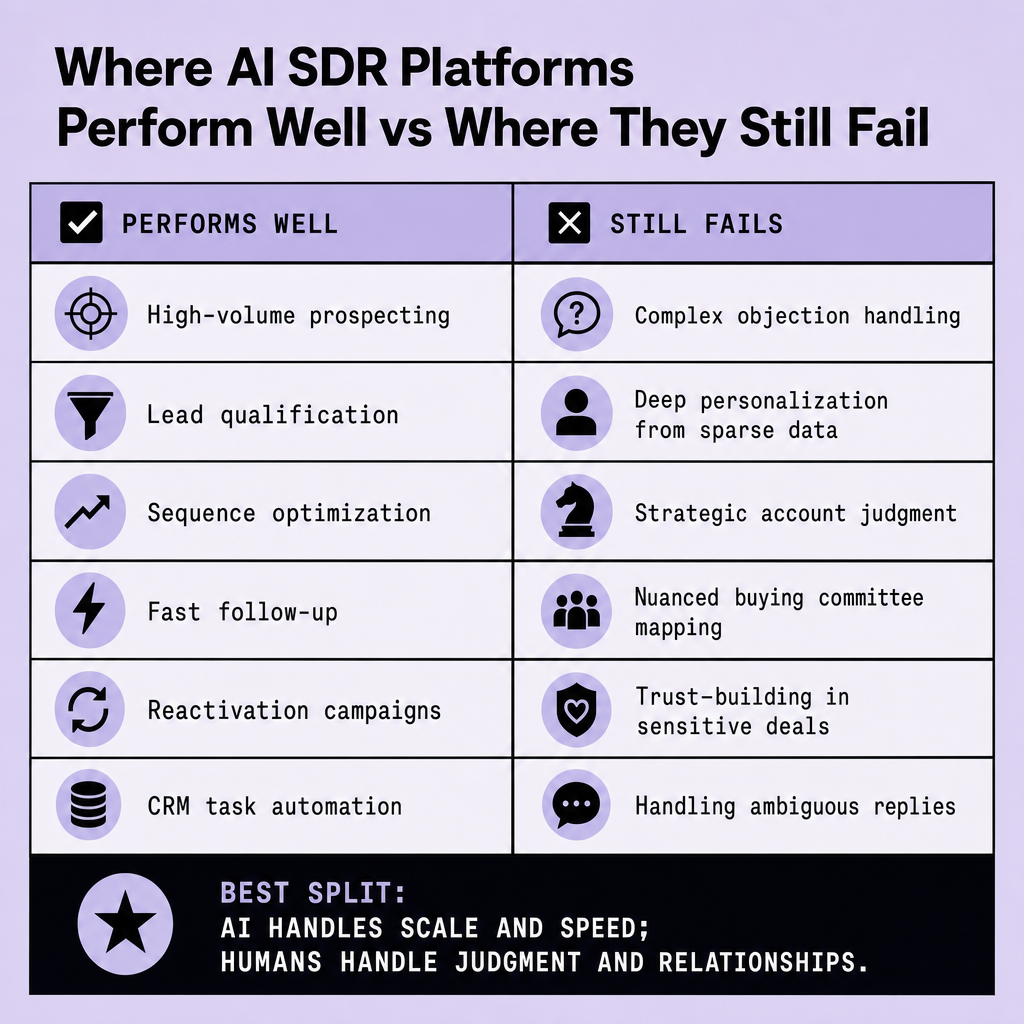
This is where teams usually get overconfident. An AI SDR is reliable for structured, repetitive outbound work. It still struggles with judgment-heavy sales development. Teams win when they automate execution, not when they hand over the whole conversation.
Where AI SDR platforms perform well
AI sales automation performs best where inputs are clear and actions are repeatable. That includes list building from ICP filters, contact enrichment, and signal detection across funding rounds, hiring spikes, website visits, and tech-stack changes. A strong AI sales development representative can watch those buying signals, push qualified accounts into sequences, and keep CRM fields, tasks, and routing rules updated without human follow-through gaps.
It also handles personalization at scale -- within limits. For example, AI prospecting systems can draft hundreds of first-touch emails using role, industry, recent trigger events, and account-level pain hypotheses. They can test send times, rotate follow-up steps, and maintain sequence discipline far better than a tired SDR team working manually.
Administrative automation is another clear win.
Logging activity, summarizing replies, creating next steps, deduplicating records, and assigning leads are low-value human tasks. Offloading them gives reps more time for qualification and live conversations. At Imversion Technologies Pvt Ltd, we see this as the right boundary: user experience is as important as functionality, and that applies internally too -- seller workflows need to stay fast, clean, and usable.
Message volume is not proof of pipeline quality; judge AI outbound sales by qualified meetings and downstream conversion, not activity counts.
Where AI SDR platforms still fail
The failure modes are consistent, and most of them are easy to recognize once you see them in production. Shallow personalization comes first. AI can reference a prospect’s company news, but it often misses relevance, priority, or tone. So the message looks personalized while feeling generic.
Hallucination is still a real risk. A system may infer the wrong use case, invent context from weak data, or misread a job change as a buying trigger. Weak objection handling follows from the same problem: AI can respond to common replies, but nuanced budget, timing, stakeholder, or competitor objections still need a human.
Channel fatigue is another tradeoff. More automation can mean more touchpoints, but over-automation hurts deliverability, response quality, and brand trust. AI SDR tools are also a poor fit for complex sales with multi-threaded discovery, long evaluation cycles, or heavy compliance requirements. In those motions, human judgment is not optional.
Best AI SDR Use Cases and the Right Split Between Human and AI Responsibilities
The temptation is to give AI more ownership just because it can move fast. That is usually where teams start creating new problems.
An AI SDR adds the most value where volume, speed, and consistency matter more than persuasion depth. That makes it a strong fit for repetitive top-of-funnel work -- and a weak fit for nuanced selling.
The best use cases are practical. High-volume AI outbound sales is first: list building, account research, enrichment, sequence enrollment, and follow-up timing. Then inbound lead qualification, where an AI sales assistant can score form fills, check firmographic fit, route by territory, and trigger the right sequence fast. Reactivation is another strong lane because old leads, closed-lost accounts, and dormant contacts usually need disciplined follow-up, not bespoke account strategy.
Two more fit well: territory planning and account research. Trigger-based outreach fits too. If a target account raises funding, adds headcount, visits pricing pages, or changes tech stack, an AI sales development representative can detect the signal and tee up outreach quickly.
But teams overreach when they let automation own the whole conversation.
For complex or enterprise sales cycles, human SDRs and AEs should still control messaging strategy, multi-threading, objection handling, and discovery. User experience is as important as functionality, and outbound is part of brand experience. If the message feels synthetic or tone-deaf, conversion quality drops even if activity volume rises.
Recommended hybrid workflow
Use AI for research-heavy, rules-driven execution. Keep humans on judgment-heavy work.
| Responsibility | Best Owner | Handoff Rule |
|---|---|---|
| Account research, enrichment, trigger monitoring | AI | Human reviews priority accounts before launch |
| Inbound lead qualification and routing | AI + Human | AI scores and routes; human confirms edge cases |
| First-draft outreach and follow-up sequencing | AI + Human | Human approves messaging strategy and edits key accounts |
| Discovery, complex qualification, negotiation cues | Human | Keep human-led from first meaningful reply |
| Enterprise account strategy and multi-threading | Human | AI supports with notes, signals, and CRM updates |
Practical implementation tip
Do not start everywhere at once. Start with one motion -- usually inbound qualification or trigger-based outbound -- and define a strict sales handoff. For example: AI handles research, drafting, CRM updates, and sequencing until a prospect replies with buying intent, complexity, or objections. Then a human takes over. That hybrid workflow is where AI prospecting improves throughput without hurting trust.
How to Implement an AI SDR Without Common Mistakes—and What ROI to Expect Next
Most rollout problems have nothing to do with model quality. They come from weak process, vague ownership, and bad data hitting automation at scale.
Start narrow. That is the safest and fastest way to make an AI SDR useful without turning your outbound engine into a noisy experiment.
Most teams fail at rollout because they try to automate the whole funnel at once. We should do the opposite. Pick one segment, one offer, and one workflow first. For example: inbound demo follow-up for mid-market SaaS leads, or AI outbound sales into a tightly defined ICP triggered by hiring spikes or funding rounds. Pilot there, learn fast, then expand.
Rollout discipline first, automation second
A responsible implementation usually follows six steps:
- Define a narrow use case with clear ownership. Decide whether the AI sales development representative will handle prospect research, first-touch drafting, follow-ups, routing, or CRM updates.
- Clean the data. If titles, firmographics, account ownership, and stage definitions are messy, AI prospecting quality will collapse. Bad CRM hygiene gets amplified.
- Set guardrails. Put approval rules around message claims, send limits, domain usage, escalation triggers, and who can edit sequences.
- Align CRM ownership. Every task needs a source of truth -- contact status, sequence state, disposition, and meeting outcomes should not live in scattered tools.
- Review messaging weekly. AI sales automation can keep output high while quality quietly drifts.
- Track funnel metrics, not just activity counts.
Pilot AI SDR workflows in one segment first and judge success by qualified pipeline progression, not just volume or even raw meetings booked.
The mistakes that hurt teams most
The biggest mistake is automating bad targeting. If the ICP is vague, the system just scales irrelevance.
Generic personalization is another trap. Inserting a company name, funding event, or tech-stack mention is not the same as relevance. Prospects notice the difference fast. Deliverability gets ignored far too often too. If your domain setup, sending reputation, and list quality are weak, more automation simply means more email going nowhere.
Then there is measurement. Teams love dashboards full of sends, opens, and tasks completed. But output volume is a weak success metric. We should care more about meeting-booked rate, speed-to-lead, pipeline conversion, no-show rate, opportunity creation, and whether sourced pipeline actually progresses.
A realistic ROI framework
The cleanest ROI model combines labor savings with funnel impact. Measure:
- Hours saved on list building, enrichment, sequencing, and CRM updates
- Faster speed-to-lead for inbound or trigger-based outbound
- Meeting-booked rate by segment
- Qualified pipeline created, not just meetings booked
- Pipeline quality through stage progression and conversion
User experience is as important as functionality, so we should count brand risk too. If reply quality drops or unsubscribe rates climb, apparent efficiency may hide pipeline damage.
What improves next
The next gains are easy to picture. By 2026 and beyond, AI SDR tools should get better at context assembly, multichannel orchestration, and trigger-based timing. They will likely improve at deciding when to reach out and which signals matter most. But we should not expect reliable autonomous persuasion in complex sales. Human reps will still own nuanced discovery, objection handling, and deal judgment.
The practical future is clear: better AI prospecting, better workflow execution, tighter governance -- not hands-off selling.
Frequently Asked Questions
How long does it usually take to see ROI from an AI SDR?
Most teams can see early operational ROI from an AI SDR within one to three months if they start with a narrow workflow, clean data, and clear handoff rules. Revenue ROI usually takes longer because meeting quality, pipeline progression, and close rates need time to stabilize across a full sales cycle.
Can an AI SDR work for small businesses, or is it mainly for larger sales teams?
An AI SDR can work well for small businesses when the sales motion is simple, the offer is clear, and prospect volume is high enough to justify automation. Smaller teams often benefit most from reduced admin work and faster follow-up, but they still need human oversight to protect messaging quality.
What data does an AI sales development representative need to perform well?
An AI sales development representative needs accurate ICP criteria, clean CRM records, reliable contact data, account ownership rules, and usable intent or trigger signals. Without those inputs, the system cannot prioritize accounts properly, personalize outreach credibly, or route leads with enough confidence to improve pipeline quality.
How does AI outbound sales affect email deliverability?
AI outbound sales can improve consistency, but it can also hurt deliverability if automation increases send volume faster than domain health, list quality, and reply relevance can support. Strong deliverability requires warm domains, suppression rules, list validation, and close monitoring of bounce, unsubscribe, and spam complaint rates.
Should sales teams let AI SDR tools handle multilingual outreach?
Sales teams should use AI SDR tools for multilingual outreach only when they review tone, market context, and compliance requirements for each language. Translation quality may be acceptable, but localized persuasion often fails without human editing because regional buying cues, etiquette, and terminology vary more than the system assumes.
Make Imversion a preferred source on Google
Like this kind of AI and software analysis? Add Imversion as a preferred source so Google can highlight our articles for you in Search, AI Overviews, and AI Mode.