Agentic GTM: Transforming Revenue Teams with AI Automation
Learn about Agentic GTM and how AI revenue agents are transforming modern revenue teams through improved workflows and automation.

Agentic GTM Explained in Plain Terms
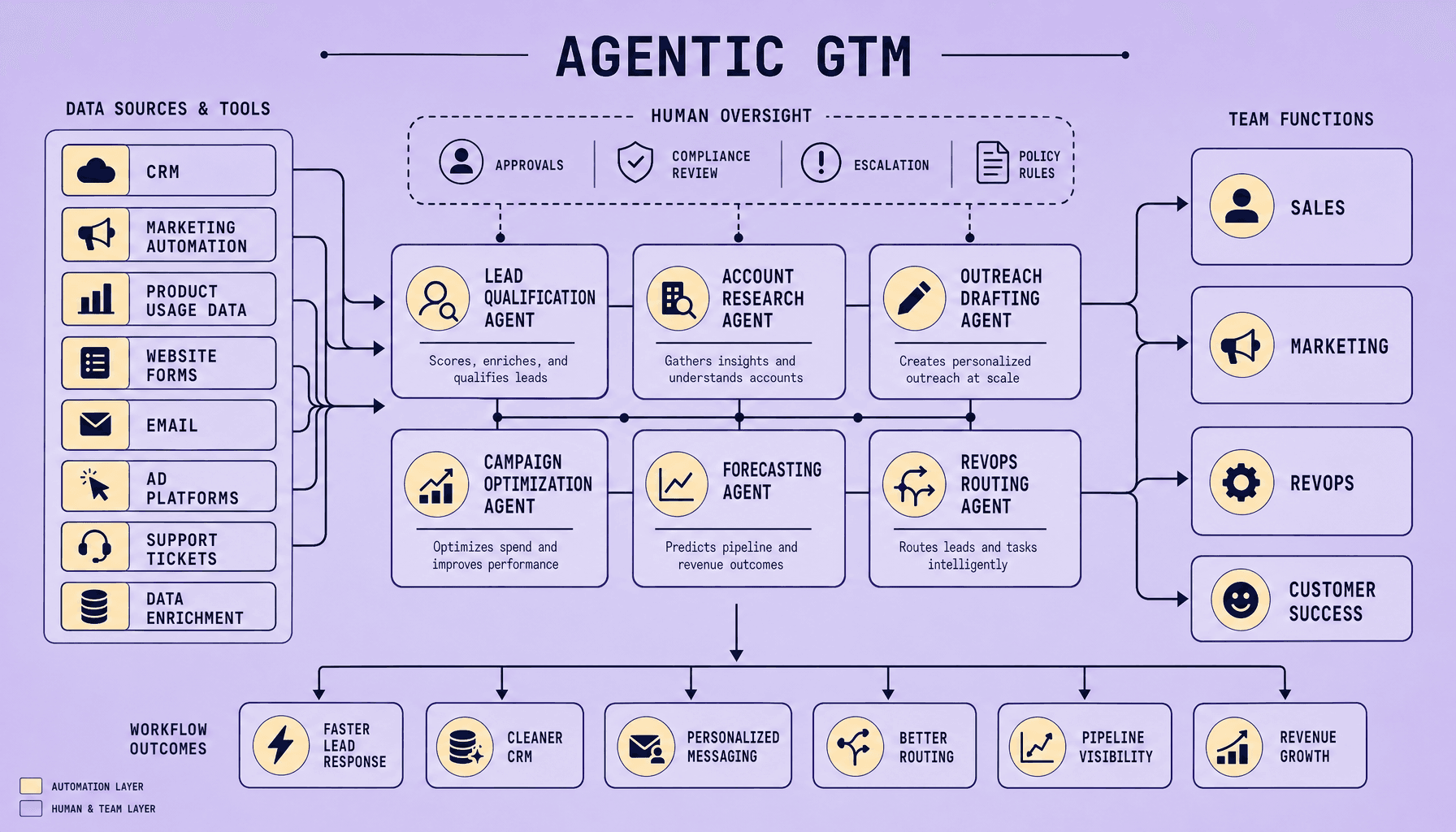
Revenue teams do not usually break because strategy is weak. They break because follow-up slows down, CRM data gets messy, lead routing turns inconsistent, and too much work sits between disconnected tools. Agentic GTM is about fixing that operational gap with AI agents that do real go-to-market work -- not just trigger rules, but interpret context, decide within guardrails, and act across systems.
Agentic GTM Key Takeaways
-
Agentic GTM moves revenue work from simple rule-based automation to supervised AI action across CRM, email platforms, ad platforms, and analytics dashboards. In practice, AI revenue agents do not just notify teams -- they qualify, route, enrich, draft, update, and escalate within guardrails.
-
The biggest wins show up where repetitive coordination slows growth: AI sales agents for lead follow-up and meeting scheduling, marketing agents for audience segmentation and campaign optimization, and RevOps-driven revenue team automation for pipeline hygiene, forecasting support, and quote-to-cash monitoring.
-
GTM automation increases speed and consistency. But risk comes with it. Bad CRM data, weak permission controls, and unclear escalation rules can produce wrong outreach, messy attribution, or silent process failures.
-
Human oversight stays non-negotiable. We treat user experience as equal to functionality, so teams should review agent prompts, approval thresholds, fallback paths, and customer-facing tone before scaling live workflows.
-
Businesses usually need Agentic GTM when lead volume rises, tool sprawl creates delays, CRM quality drops, or leaders need faster response times without adding headcount immediately. Start with one contained workflow first.
Why Agentic GTM Is Rising Now Across Revenue Teams
Revenue teams are paying attention now because many of them have hit the same execution wall. The stack keeps expanding -- CRM, marketing automation, ad platforms, enrichment tools, analytics dashboards, meeting schedulers -- but the work between those systems is still messy, manual, and slow.
Salesforce has reported that sellers spend a large share of their time on non-selling work, often close to 70%. That gap hurts. If reps are buried in CRM updates, lead routing checks, follow-up drafting, and pipeline hygiene, leadership does not get faster pipeline growth -- it gets more operational drag.
Buyer expectations have shifted too. Prospects expect relevant outreach and quick responses, not a delayed handoff between forms, inboxes, and spreadsheets. Traditional workflow automation helped for a while. But older GTM automation mostly follows fixed if/then logic: assign a lead, send an email, create a task. Useful, yes. Adaptive, no.
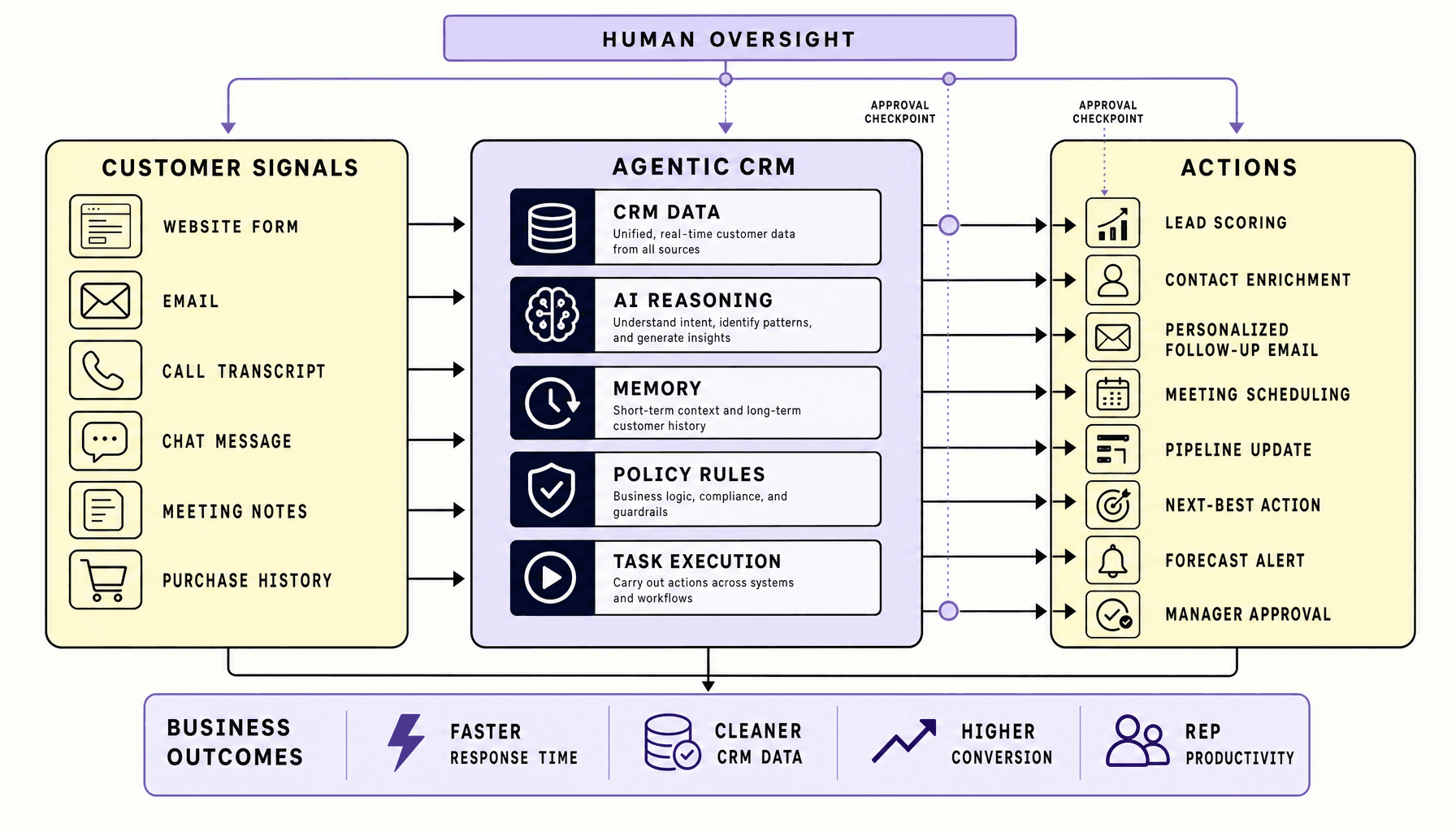
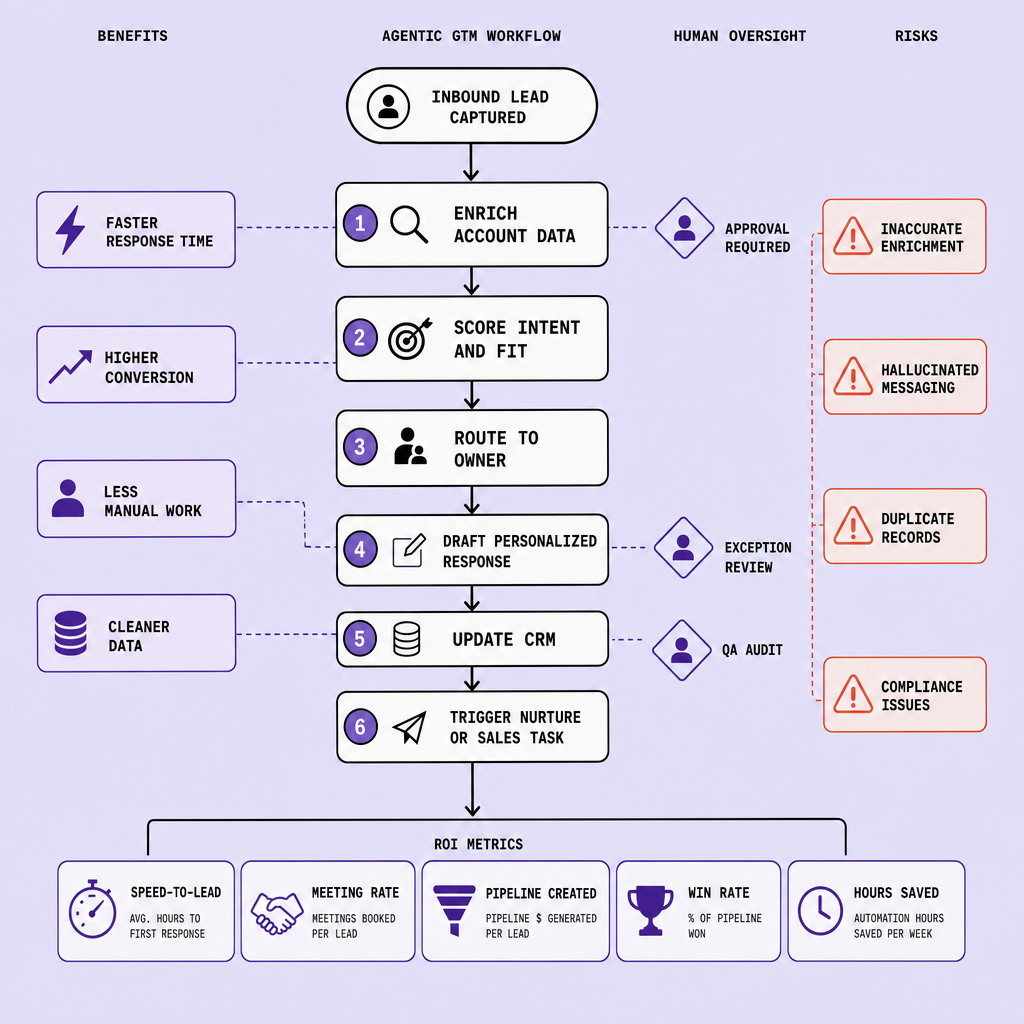
That is where the current rise in Agentic GTM starts to make sense. The newer generation of AI agents can work across tools with context. They do not just trigger workflow automation. They can interpret intent signals, check account history in the CRM, decide whether a lead fits routing rules, draft a tailored response, and escalate to a human when confidence is low. For AI for go-to-market teams, that is a real shift.
There is another reason, and it is less glamorous.
Tool sprawl and poor data quality break revenue execution long before strategy fails. If lifecycle stages are inconsistent, contact records are stale, or attribution data is fragmented, teams lose trust in automation. We see the best results when AI revenue agents are used to reduce coordination overhead first -- lead triage, meeting scheduling, record updates, basic research, and follow-up orchestration -- not to replace strategy or headcount planning.
Position Agentic GTM as a response to execution bottlenecks, not as a substitute for human judgment.
The technology improved. The pressure increased. And the old automation model stopped covering the gaps. User experience is as important as functionality -- and for revenue teams, internal user experience means faster systems, cleaner handoffs, and less manual friction.
How Agentic GTM and AI Revenue Agents Support Sales, Marketing, and RevOps
Most revenue teams do not struggle because people are not working hard enough. The struggle is coordination. Sales, marketing, and RevOps are often updating the same customer journey through different systems, with delays and mismatched context in between. AI revenue agents help by taking on narrow, repeatable work that usually falls through those cracks.
Sales: faster follow-up, less admin
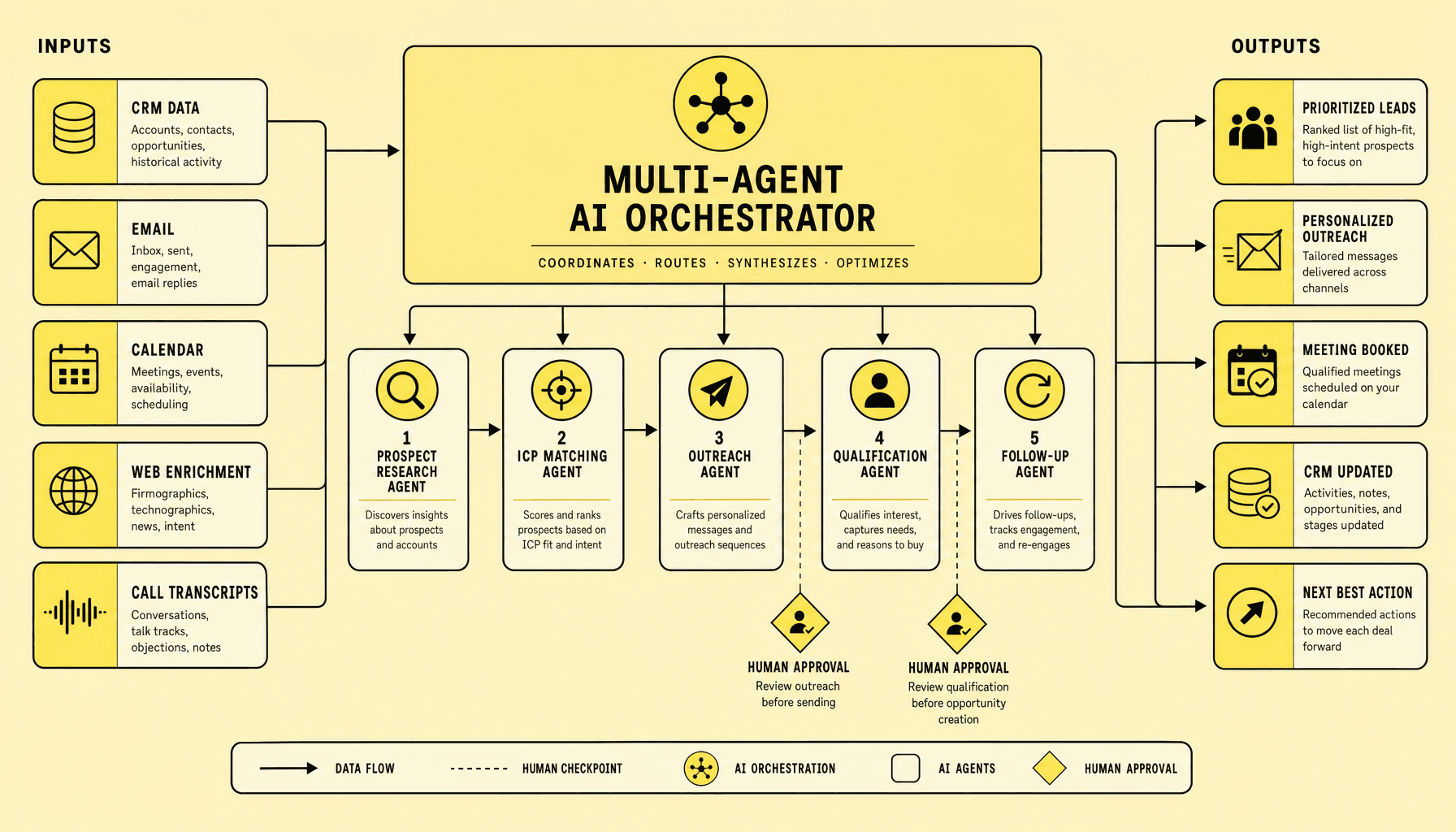
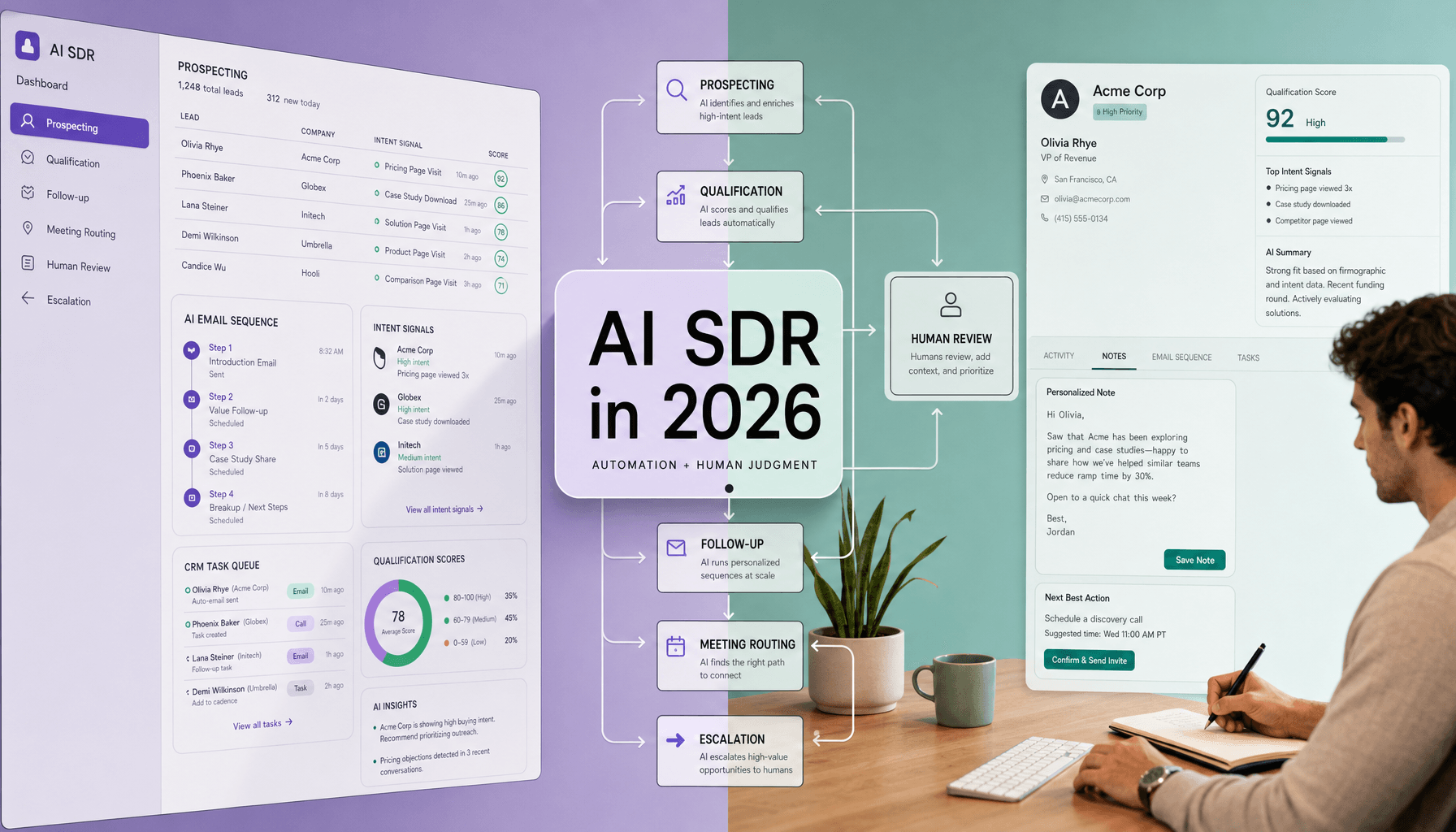
For sales, AI sales agents work best on tasks that drain rep time but follow clear patterns. They can qualify inbound leads against ICP criteria, run CRM enrichment from firmographic and behavioral signals, draft personalized outreach based on account activity, schedule meetings, update opportunity fields, and surface next-best-action recommendations.
A common example: a high-intent form fill or website visit triggers an agent to check account fit, enrich contact data, log activity in the CRM, draft an email sequence, and alert the account owner. All within one workflow. Human reps should still approve messaging for strategic accounts, pricing discussions, and sensitive objections.
Marketing: better execution across the funnel
Marketing teams use AI for go-to-market teams to reduce lag between signal and action. Agents can build segments from CRM and product data, generate content variations for email or paid campaigns, monitor campaign performance across ad platforms and analytics dashboards, route MQLs by rules and score thresholds, and flag funnel drop-off points that need investigation.
That sounds efficient, but efficiency alone is not the goal. Because user experience is as important as functionality, agents should not optimize only for clicks or volume. Poor routing, weak message quality, or over-automation can hurt conversion even when activity looks busy on paper.
RevOps: cleaner systems, stronger coordination
RevOps gets the most benefit from agents that support forecasting, territory planning inputs, pipeline hygiene, quote-to-cash checks, and reporting coordination. For example, an agent can detect stale opportunities, missing close dates, inconsistent stage definitions, or approval gaps before those issues distort forecasting. It can also sync updates across CRM, billing, and analytics dashboards.
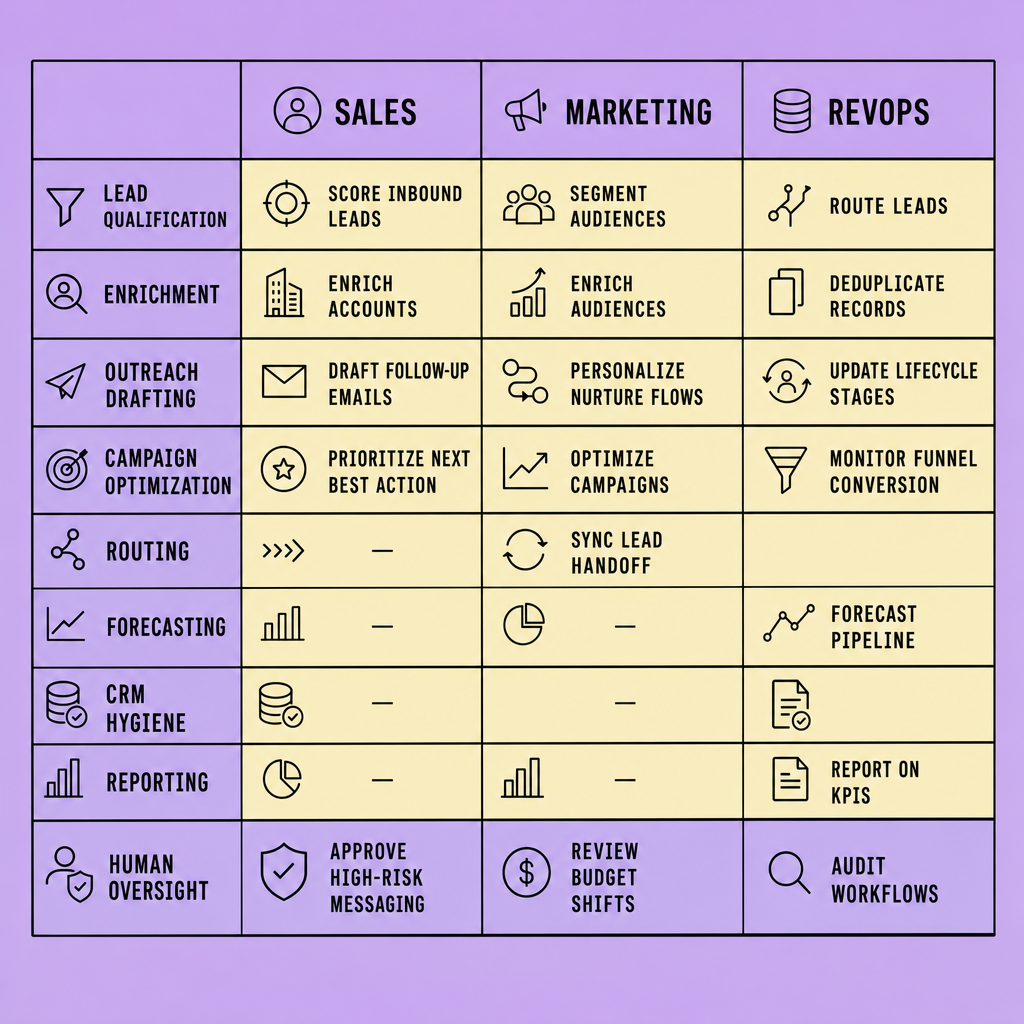
The strongest use cases for revenue team automation are supervised workflows with clear rules, defined handoffs, and measurable outcomes.
That boundary matters. Open-ended strategy stays human. Execution-heavy coordination does not need to.
High-Impact Agentic GTM Workflows and Their Benefits
The quickest wins usually do not come from ambitious automation. They come from workflows that are repetitive, time-sensitive, and already measured. Start there. If a team can see current response times, conversion rates, SLA misses, or CRM completion rates, it can prove impact faster and adjust guardrails before expanding into more complex decisions.
Inbound lead triage and routing
Inbound is often the first workflow to automate because delay kills momentum. AI sales agents can monitor form fills, chat conversations, and product-signup events, apply lead scoring, enrich records with firmographic data, check intent data, and route the lead to the right rep or sequence in the CRM. That cuts response lag and reduces manual queue management.
The benefit is practical: faster speed-to-lead, better SLA compliance, and fewer high-intent leads sitting untouched because routing rules were too rigid or incomplete.
Account research and personalized follow-up
Reps lose hours pulling company context, recent signals, and contact details from scattered tools. AI revenue agents can assemble account briefs, surface buying signals, draft outreach tied to role or industry, and trigger meeting scheduling after engagement. Good personalization improves conversion efficiency because reps start from relevant context instead of blank-page writing.
Still, we would not automate final messaging for every segment. Enterprise outreach, sensitive accounts, and late-stage deals still need human review.
Lifecycle campaign optimization
Marketing teams can use GTM automation to watch audience performance, identify funnel drop-off, refresh variants, and adjust campaign logic across email platforms and ad platforms. This is where revenue team automation helps beyond top-of-funnel volume -- it improves handoff quality and reduces wasted spend on low-fit segments.
Pipeline hygiene and forecasting support
RevOps teams get measurable value from agents that flag missing fields, duplicate accounts, stale opportunities, inconsistent stage movement, and weak next-step data. Better pipeline hygiene improves forecast confidence because leadership is not making decisions from incomplete CRM records. Forecasting support can also summarize deal risk, stage aging, and rep activity patterns for managers.
Start where the workflow is high-volume, repetitive, and tracked with baseline metrics. That makes ROI easier to prove -- and mistakes easier to catch.
One opinion we hold strongly: clean process design in GTM works like clean code in software. If the underlying workflow is messy, Agentic GTM will scale the mess faster.
The Risks of Agentic GTM Automation and Why Human Oversight Still Matters
Fast execution sounds great until the wrong action spreads everywhere at once. Agentic GTM can remove manual bottlenecks, but poorly governed GTM automation can spread bad decisions across CRM, email platforms, ad platforms, and forecasting workflows faster than a human team ever could.
The first failure point is data quality. If enrichment is wrong, AI revenue agents will segment the wrong accounts, route leads to the wrong reps, and personalize outreach with false details. Bad inputs cascade. Fast. Teams often blame the model, but the root problem is stale CRM fields, weak identity resolution, and inconsistent account mapping across tools.
Then comes messaging risk. AI sales agents can draft useful outreach, but they can also hallucinate product claims, use the wrong tone, or produce copy that does not match brand safety standards. Once that copy is connected to sequences or ad variants, revenue team automation can amplify the mistake at scale. User experience matters as much as functionality -- especially in outbound communication, where one inaccurate email can damage trust.
Where human-in-the-loop review is non-negotiable
Some decisions should never be fully autonomous:
- external messaging approvals for outbound email, paid ad copy, and pricing-sensitive responses
- escalation logic for urgent accounts, legal objections, and negative sentiment signals
- account prioritization rules, especially for strategic segments or named accounts
- revenue forecasting decisions, pipeline stage changes, and forecast-impacting adjustments
A practical governance model is simple: let agents act on low-risk operational tasks, but require approval workflows for external messaging, compliance-sensitive actions, and changes that affect forecast accuracy.
Common risks teams underestimate
Over-automation is one of the biggest ones. Teams automate lead routing, meeting scheduling, follow-up, and pipeline hygiene -- but weak handoffs between tools create duplicate records, missed SLAs, and conflicting task ownership. Compliance is another sharp edge. Automated outreach, consent handling, retention policies, and audit trails need explicit governance, not assumptions.
Bias is harder to spot. If historical conversion data favored certain industries, company sizes, or geographies, AI revenue agents may keep prioritizing those patterns and under-serve good-fit accounts outside them.
So yes, use Agentic GTM aggressively, but with boundaries. Humans should stay firmly in control of judgment-heavy decisions. That is how teams get speed without losing accuracy, trust, or accountability.
How to Implement Agentic GTM, Measure ROI, and Know When Your Business Needs It
The biggest mistake is trying to automate everything at once. That usually creates a new layer of operational mess on top of the old one. The more practical path is smaller: start with one workflow, instrument it properly, and keep humans in control.
How to implement Agentic GTM without overcomplicating it
Most teams should not begin with a fully autonomous revenue engine. They should begin with one or two narrow workflows that already sit across clear systems -- usually CRM, email, meeting scheduling, lead routing, or pipeline hygiene. The goal is to prove that AI revenue agents can take useful action inside guardrails, not just generate suggestions no one uses.
A workable rollout usually looks like this:
-
Map one painful workflow end to end.
Pick a process with visible friction: slow inbound follow-up, stale CRM fields, missed routing rules, delayed meeting scheduling, or weak handoff between marketing and sales. -
Define the decision boundary.
Decide what the agent can do alone, what needs approval, and what it must never do. For example, an agent may enrich a lead, assign ownership, draft outreach, and create tasks -- but not change pricing, alter territory logic, or send high-stakes customer communication without review. -
Connect the operating systems.
In practice, that means CRM, marketing automation, email platform, calendar, analytics dashboard, and sometimes quoting or billing workflows. If the systems are disconnected, GTM automation will inherit that fragmentation. -
Set success metrics before launch.
Use existing baselines such as response time, lead-to-meeting conversion, CRM field completeness, routing accuracy, pipeline coverage, or time spent per rep on admin work. -
Launch in supervised mode first.
Review agent actions, spot failure patterns, and tighten prompts, permissions, and fallback rules before expanding scope.
Internal usability matters here too. If reps, marketers, or RevOps managers cannot understand what the system did and why, adoption will stall even if the workflow is technically sound.
How to measure ROI from AI sales agents and revenue team automation
ROI should be tied to operational changes the team can already observe. Keep it concrete. If AI sales agents reduce lead response time, improve routing accuracy, or raise CRM completion rates, those changes can be measured directly. If an agent supports quote-to-cash monitoring or pipeline hygiene, look at fewer exceptions, cleaner records, and less manual correction work.
A useful measurement model usually tracks three layers:
- Efficiency: admin hours saved, fewer manual updates, lower queue backlog, faster lead handling
- Revenue impact: more meetings booked, better conversion between funnel stages, improved follow-up consistency
- Operational quality: cleaner CRM data, fewer attribution gaps, fewer SLA misses, stronger forecast inputs
Teams often make one mistake -- they try to prove value only through closed revenue. That is too late for early-stage evaluation. Start with process metrics that move faster, then connect them to pipeline and forecasting once the workflow is stable.
If a workflow cannot be measured before automation, it is usually not the right first candidate for Agentic GTM.
When your business actually needs Agentic GTM
Not every business needs it immediately. The strongest signal is not company size. It is workflow strain.
Your business likely needs Agentic GTM if revenue teams are dealing with repeated follow-up delays, fragmented tool handoffs, stale CRM records, inconsistent lead routing, poor pipeline hygiene, or heavy RevOps cleanup work at the end of each reporting cycle. Those are clear signs that manual coordination is breaking down.
There is another signal. Leadership wants faster execution and better attribution, but the team keeps adding tools without reducing effort. That usually means the stack has grown, yet work still depends on people pushing data from one system to another.
A simple rule helps: if repetitive GTM decisions happen at high volume and under time pressure, supervised agents are worth evaluating. If the work is low-volume, highly strategic, or extremely sensitive, human-led execution should still dominate.
Tradeoffs to accept before scaling
Scaling Agentic GTM is not a one-time switch. It is an operating model. The tradeoff is straightforward: more speed and coverage in exchange for more attention to permissions, workflow design, exception handling, and review loops.
The same logic developers apply to software systems applies here too. If workflow logic is messy, ownership is unclear, or field structure in the CRM is inconsistent, AI revenue agents will expose those problems fast. Sometimes that is useful. Sometimes it is painful.
Both.
Frequently Asked Questions
What is the difference between Agentic GTM and traditional marketing and sales automation?
Agentic GTM uses AI agents that can interpret context, choose from multiple actions, and adapt within guardrails, while traditional automation mainly follows fixed rules and predefined triggers. The difference matters because agentic systems can handle exceptions, prioritize work dynamically, and coordinate across tools without needing every path hardcoded in advance.
How does Agentic GTM affect SDR and AE roles in practice?
Agentic GTM usually changes SDR and AE work by removing repetitive admin, early research, and first-pass follow-up tasks so reps can spend more time on discovery, qualification, and deal progression. In practice, strong teams redesign roles around higher-value conversations rather than simply layering AI on top of existing manual workflows.
When should a company invest in AI revenue agents instead of hiring more reps?
A company should invest in AI revenue agents when demand volume is rising but execution delays come mostly from manual coordination, inconsistent routing, and CRM cleanup rather than a lack of selling talent. If the bottleneck is operational throughput, agents often improve speed and coverage faster than adding headcount alone.
Can Agentic GTM work for mid-market and smaller businesses, or is it only for enterprise teams?
Agentic GTM can work for mid-market and smaller businesses if they already have repeatable lead flow, a usable CRM, and at least one measurable workflow worth improving. Smaller teams often benefit quickly because even modest gains in response time, data quality, or meeting conversion can have an outsized effect on revenue capacity.
What metrics best show whether revenue team automation is actually working?
The best metrics combine speed, quality, and business impact: response time, routing accuracy, CRM completeness, meeting conversion, SLA adherence, and pipeline created per rep or per channel. Those indicators reveal whether revenue team automation is improving execution quality, not just increasing automated activity that looks productive on the surface.
Make Imversion a preferred source on Google
Like this kind of AI and software analysis? Add Imversion as a preferred source so Google can highlight our articles for you in Search, AI Overviews, and AI Mode.