AI Agent Identity: Essential Autonomy for Enterprise Security
Explore the importance of AI agent identity in enterprises. Learn how robust identity management improves security, accountability, and governance.

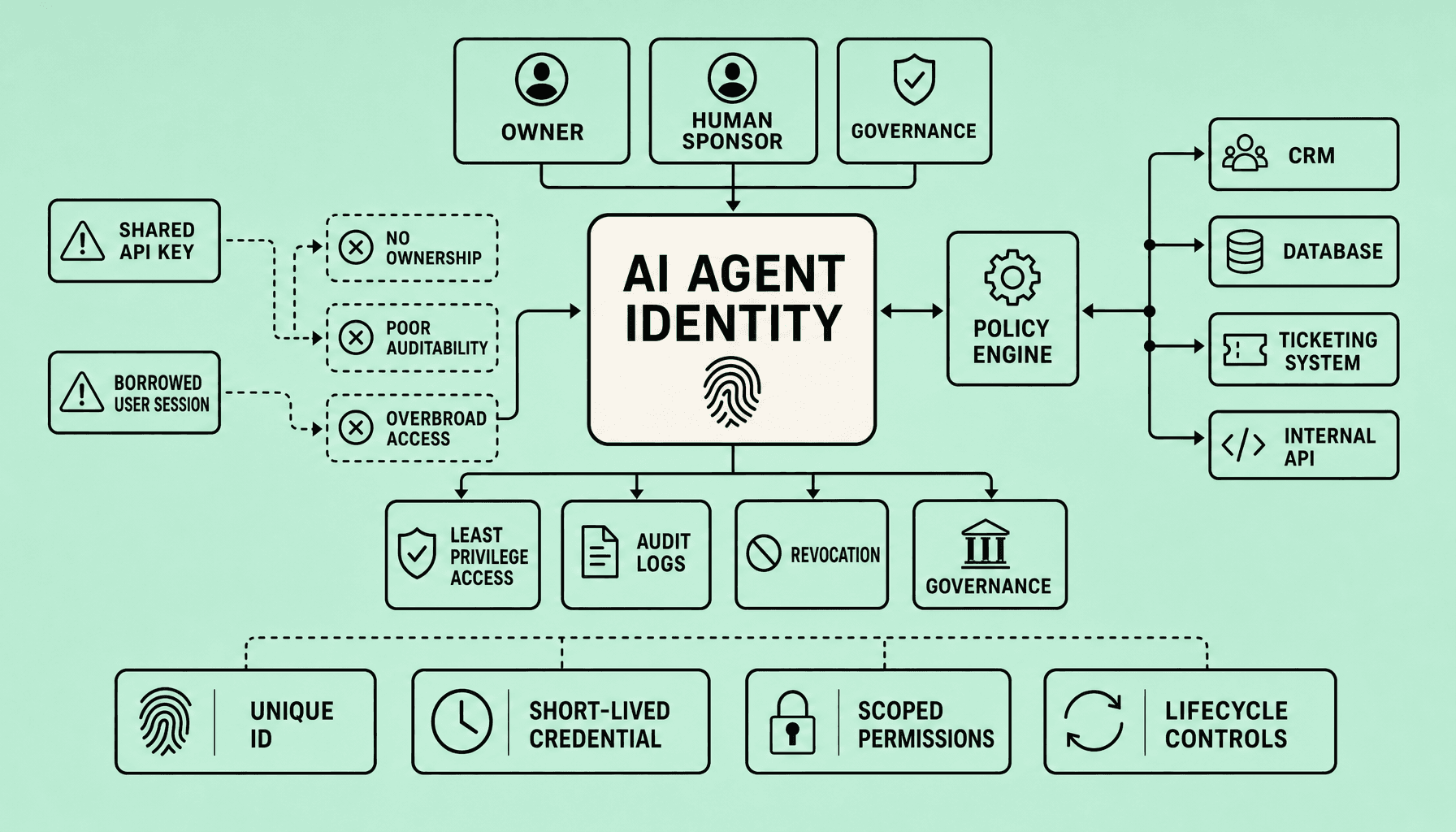
AI agent identity is the foundation for safe enterprise autonomy
The shortcut usually feels harmless at first. One shared API key. One reused service account. Maybe even a borrowed user session to get an agent into production quickly. Then the agent starts reading documents, calling internal APIs, or submitting workflow approvals across systems, and the whole setup turns into a liability. Ownership gets muddy. Least-privilege boundaries disappear. Audit trails stop being useful.
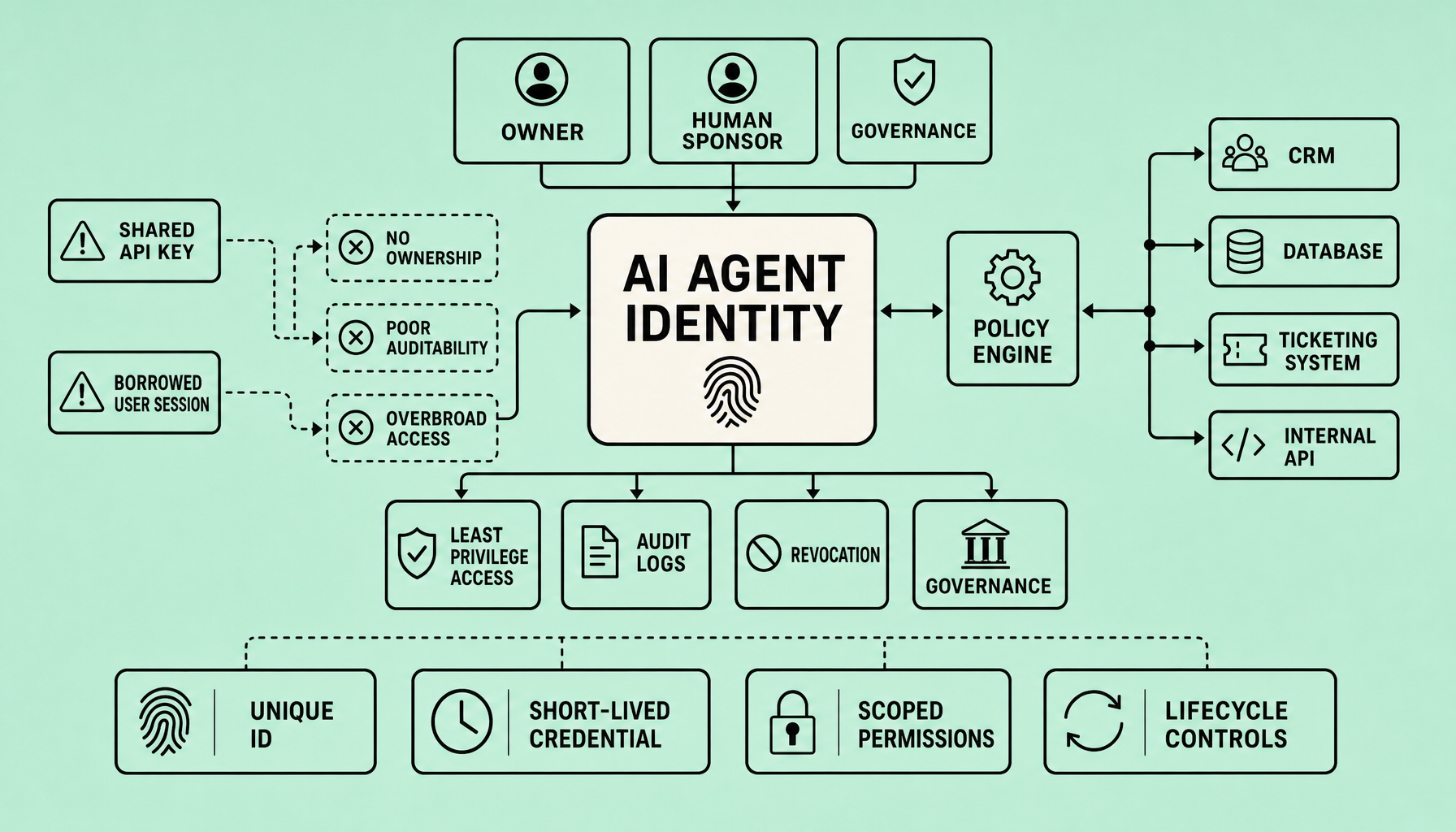
Autonomous systems need AI agent identity as a first-class control, not a shortcut built on shared API keys or borrowed user sessions. Each agent should have its own enterprise identity so access, actions, ownership, and revocation can be managed separately from humans and other non-human identities.
Teams often start with whatever works fastest. Shared credentials. A reused service account. But that breaks the moment an agent reads documents, calls internal APIs, or submits workflow approvals across systems. You lose clear ownership, least-privilege boundaries, and reliable audit trails.
A better model is enterprise AI identity tied to a lifecycle: creation, sponsor approval, scoped access, token-based authentication, rotation, suspension, and retirement. In practice, that means workload identity for AI agents through OIDC, cloud IAM roles, service accounts, or SPIFFE/SPIRE -- plus short-lived tokens and system-specific scopes. At Imversion Technologies Pvt Ltd, we treat enterprise AI identity as an accountability layer, because user experience is as important as functionality, and unsafe identity design creates friction for both security teams and builders.
Key Takeaways for AI agent identity
-
Treat every autonomous agent as a distinct enterprise AI identity. Shared API keys and borrowed user sessions collapse ownership, blur accountability, and make audits weak the moment one agent reads documents, triggers workflows, or calls production APIs.
-
Build AI agent identity around lifecycle controls from day one: create, approve, scope, rotate, suspend, and delete. In practice, SCIM-style records, named owners, sponsor fields, and ticket-linked approvals make AI agent governance workable under real operational pressure.
-
Use modern authentication -- OAuth 2.0, OIDC, cloud IAM roles, service accounts, or SPIFFE/SPIRE-based workload identity for AI agents -- with short-lived tokens. But avoid broad static secrets. User experience is as important as functionality, so secure access should not force unsafe shortcuts.
-
Assign least privilege to non-human identities with narrow scopes tied to specific tasks, such as document retrieval, API writes, or workflow submission. Separate human sponsors from agent runtime permissions.
-
Design revocation and auditability before deployment. Security teams need to disable one agent fast, trace every action to that identity, and prove who owned it, who approved it, and what it could access.
Why AI agent identity works better than shared API keys or borrowed user sessions
Once an agent touches production systems, shared credentials stop being a convenience and start being a governance problem.
Enterprises should give each autonomous agent its own identity. Not later. From the moment that agent reads internal documents, triggers workflow approvals, or calls production APIs.
Teams often start with shared API keys because they are fast. But that speed creates governance debt almost immediately, especially once one agent spans Slack, Jira, cloud storage, and internal services. A proper AI agent identity gives the system a named owner, explicit scopes, lifecycle controls, and audit logs that show what the agent did, not what some generic key or employee session appeared to do.
Shared credentials break attribution. One API key can back several agents, scripts, and environments, so audit logs collapse into a single actor. Borrowed user sessions are worse in a different way: the agent may inherit broad human access through OAuth 2.0, OIDC, or SAML-backed sessions, and its actions can look indistinguishable from the employee’s own activity. That blurs accountability and makes least privilege hard to enforce.
Practical comparison
| Approach | Ownership | Authentication | Least privilege | Auditability | Blast radius |
|---|---|---|---|---|---|
| Shared API key | Usually unclear or team-owned | Static secret | Often broad, reused scopes | Weak; actions collapse into one identity | High if key leaks or must be revoked |
| Borrowed user session | Tied to a human sponsor | Human login/session reuse | Often inherits excess user access | Mixed; human and agent actions blur | High; user compromise affects agent |
| First-class agent identity | Named agent with sponsor and lifecycle | Agent authentication via workload identity, short-lived tokens, service account, SPIFFE/SPIRE, or cloud IAM role | Scoped per agent and task | Strong; logs map actions to one non-human identity | Lower; revoke one agent without breaking others |
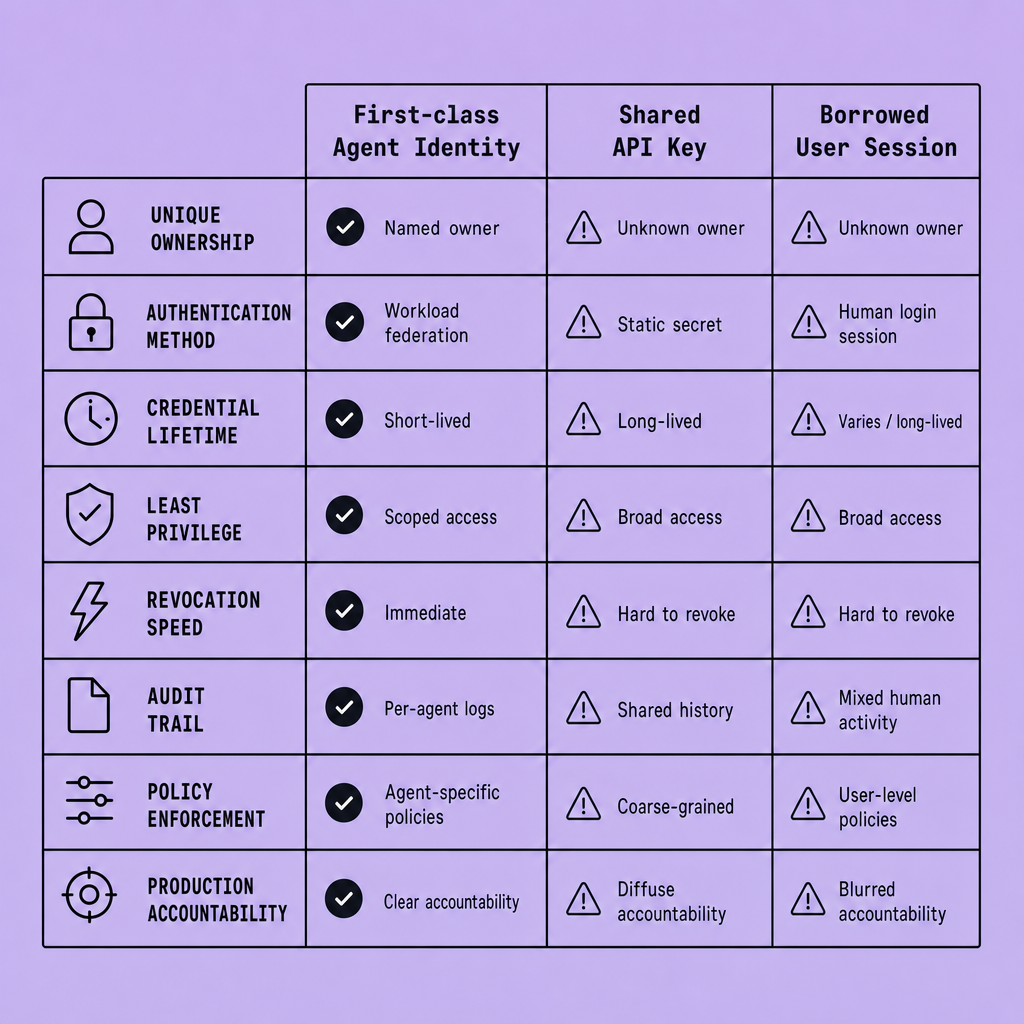
A first-class enterprise AI identity also supports lifecycle management. We can create the agent through an approval workflow, assign a human or team sponsor, issue short-lived credentials, review scopes, and revoke access cleanly when the agent is retired or its function changes. That is harder with long-lived API keys. Messier too.
One caveat: first-class identities add setup work. More objects to manage. More policy decisions. But the tradeoff is still easy to defend. Clean identity design reduces incident response time, simplifies revocation, and makes non-human identities governable in production.
So the choice is simple: convenience now versus control later. For production agents, control wins.
Build an AI agent identity lifecycle with ownership, sponsors, and revocation from day one
Most identity problems do not begin with authentication technology. They begin with missing ownership and a weak lifecycle.
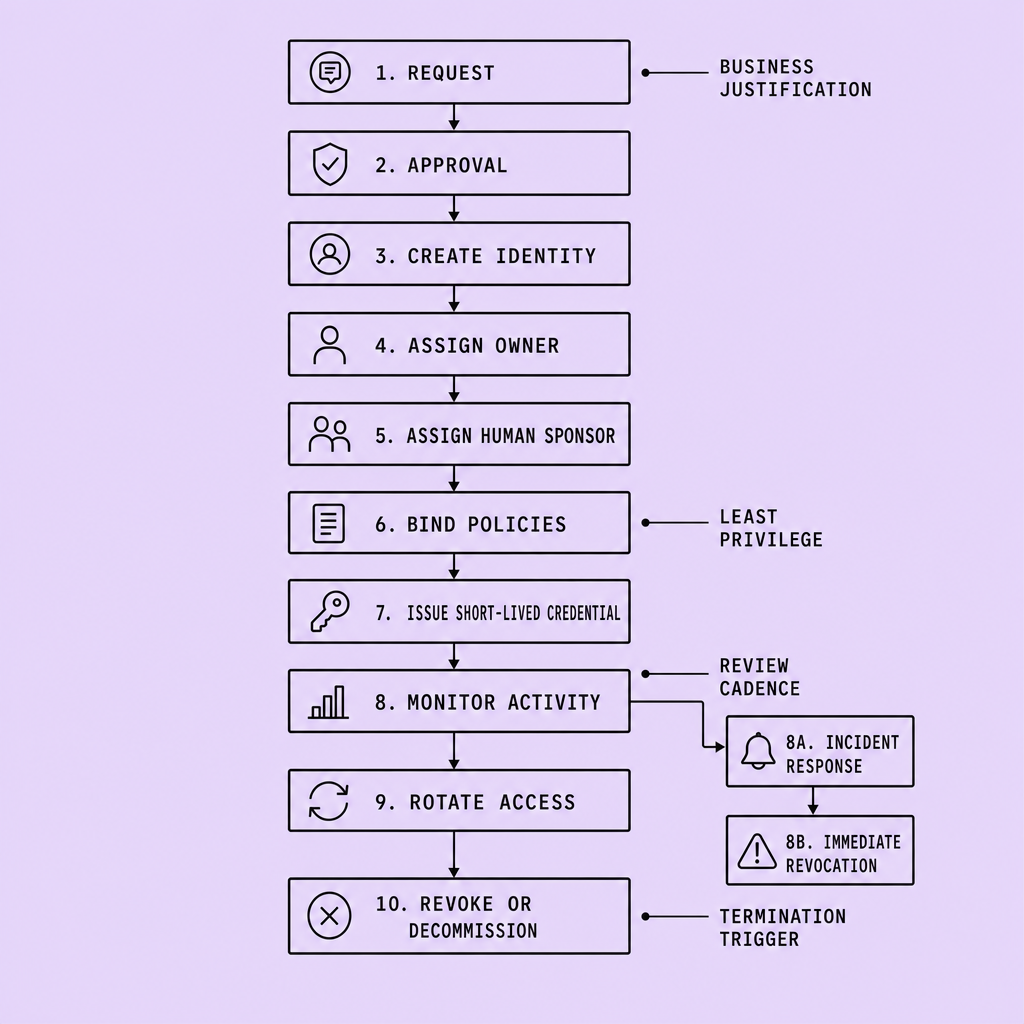
A secure lifecycle for an autonomous agent should look a lot like application onboarding or privileged access onboarding: no agent reaches production without a named owner, a defined purpose, an approval workflow, and a clean deprovisioning path.
Shared secrets break this model fast.
For enterprise AI identity, treat agents as managed non-human identities with joiner-mover-leaver style controls from the start. That means request, approval, creation, policy binding, credential issuance, monitoring, rotation, suspension, and deprovisioning are designed up front, not patched in after the first audit finding.
Request, approval, and identity creation
The easiest place to lose control is right at provisioning. If an agent appears in production before anyone captures its purpose, systems touched, or data sensitivity, the cleanup later is always harder.
Start with a request record in the same system used for access governance or ticketing. Capture the agent name, business purpose, data sensitivity, systems it will touch, and whether it will read documents, call APIs, or trigger workflow approvals. Then require approval before provisioning.
Creation should produce a unique identity -- service account, cloud workload identity, or SPIFFE/SPIRE workload identity -- mapped to the agent itself, not to a developer or shared bot account. Bind least-privilege access at creation time using scoped OAuth 2.0 permissions, cloud IAM roles, or application-specific RBAC groups.
Keep the process strict but usable. If onboarding is clumsy, teams will bypass it with API keys.
Ownership, sponsor model, and policy accountability
Identity without ownership is just a record no one trusts during an incident.
Every agent needs two human links: a business owner and a human sponsor.
The business owner is accountable for why the agent exists, what outcome it supports, and whether its access still matches its purpose. The human sponsor is the operational backstop -- usually the manager, platform lead, or system custodian who can approve creation, respond to incidents, and authorize suspension or revocation.
These roles can differ. A finance operations lead may own a reconciliation agent, while an identity or platform engineer sponsors the production deployment.
If no one can answer “who owns this agent?” and “who can shut it off today?”, the identity is not production-ready.
Monitoring, rotation, suspension, and deprovisioning
Strong creation controls are not enough if the runtime side is weak.
Issue short-lived tokens where possible through OIDC, cloud IAM, or workload federation. Avoid long-lived API keys unless a legacy system leaves no alternative, and document that exception. Monitor authentication events, access scope changes, failed token exchanges, and high-risk actions in audit logs.
Rotate credentials on a schedule and on change events. Suspend first when behavior is suspicious. Deprovision when the agent is retired, replaced, or loses sponsorship. Good AI agent governance depends on fast revocation, current ownership metadata, and reviewable audit trails for non-human identities.
Use workload identity and least privilege for agent authentication and authorization
A lot of teams solve the first mile of agent access and ignore the rest. The agent authenticates somehow, the calls work, and the rollout moves on. That is usually where trouble starts.
Enterprise agents should authenticate as workloads, not as people and not with embedded secrets. Shared API keys feel fast at setup time. But they age badly -- no clear owner, weak revocation, and poor audit trails across multiple systems.
Strong agent authentication is only half the job.
Plenty of failures come from valid identities with far too much access, so authorization design has to be just as deliberate as authentication. For enterprise AI identity, we separate the two on purpose: first prove what the agent is, then decide exactly what it may do.
Workload identity for AI agents
The safest default is workload identity for AI agents built on short-lived credentials. Use OIDC federation, cloud IAM roles, managed identity, or attested runtime identity such as SPIFFE issued through SPIRE. Those patterns let a running workload obtain tokens at execution time instead of carrying a static secret in code, env vars, or config files.
Short-lived tokens reduce blast radius because they expire quickly and can be reissued under current policy. Long-lived secrets do the opposite. Once copied into logs, CI variables, laptops, or support scripts, they tend to spread.
A practical model for non-human identities looks like this: the agent runs in a trusted environment, the platform attests that workload, and an identity provider issues an OAuth 2.0 or OIDC token bound to that workload identity.
Token design: prove identity, not broad entitlement
Bad token design quietly creates oversized trust boundaries.
Keep tokens narrow. Include a stable agent ID, issuer, audience, expiry, and maybe environment or workload attributes. Avoid packing broad authorization decisions into the token itself unless they are short-lived and specific.
Because authentication and authorization are different controls, a valid token should not imply blanket access. It should only establish identity and context for downstream policy checks.
Good token design makes revocation, rotation, and audit review far simpler than chasing static API keys across repositories and runtime configs.
Access scoping with roles, attributes, and policy engines
This is where least privilege either becomes real or stays theoretical.
Authorize agents with RBAC, ABAC, resource policies, and a policy engine. Give the agent permission to read one document store, create tickets in one project, or call one internal API route -- not “access the knowledge platform” in the abstract.
We prefer scopes tied to real tasks. User experience is as important as functionality, and over-restricting agents can break useful workflows. Broad permissions are worse. Start tight, inspect logs, then expand with evidence. That is how enterprise AI identity stays governable in production.
AI agent identity improves auditability, governance, and production accountability
An agent that cannot be traced is not ready for production. It is an automation blind spot with a nicer interface.
If a team cannot prove which agent did what, under which approval, and with which scope, it does not have a production-ready agent. It has an automation blind spot.
Unique AI agent identity fixes that. Each agent becomes a distinct actor in logs, policy engines, access reviews, and incident timelines. Shared keys collapse all of that into one noisy record. Borrowed user sessions are worse because they make agent activity look human, which weakens traceability and complicates incident response.
What strong identity changes in practice
Once identity is modeled correctly, governance stops being guesswork.
With first-class enterprise AI identity, every action can be tied to a specific non-human identity, its owner, its sponsor, and its approved purpose. That supports a control security teams already expect: traceable access with separation of duties. The agent requests access. A human owner approves. A separate control path such as IAM, workflow policy, or change review enforces it.
That structure is what lets teams grant more autonomy over time without losing accountability.
In practice, logs should show at least: agent ID, workload credential used, token issue time, system accessed, scope granted, approving authority, and resulting action. For OAuth 2.0 or OIDC flows, preserve the client or workload identity in downstream audit logs, not just the API call result. For workload identities such as SPIFFE/SPIRE, cloud IAM roles, or service accounts with short-lived tokens, map runtime identity back to a named agent record.
Example: one agent, separate scopes
The point is not to make agents weak. The point is to keep permissions precise.
Consider an agent that reads policy documents, opens service tickets, and triggers an internal workflow.
- Document access: read-only scope to a specific repository path
- Ticketing access: create-ticket scope, no delete or admin rights
- Workflow access: trigger-only permission for one approved workflow
- Approval step: human sponsor required for workflow runs above a defined risk threshold
The same agent can operate across systems without carrying one oversized credential. If scopes are too coarse, teams are more likely to bypass controls.
What auditors and security teams should be able to see
- Named owner and business purpose
- Separate non-human identities per agent or per environment
- Access reviews and policy exceptions with expiry
- Revocation path that disables tokens, roles, and workflow rights
- Logs that support incident reconstruction end to end
Implementation checklist
- Create a unique AI agent identity for each production agent
- Use workload authentication, not shared API keys
- Bind scopes to specific tasks and systems
- Record sponsor, owner, and approval history
- Time-limit exceptions and review them regularly
- Test revocation before production deployment
Frequently Asked Questions
What is AI agent identity in an enterprise setting?
AI agent identity is a dedicated, managed identity assigned to an autonomous system so the enterprise can authenticate it, authorize it, monitor it, and revoke it independently. It gives the agent its own ownership record, policy boundaries, and audit footprint instead of hiding activity behind a shared secret or a human session.
Why should AI agent identity be separated from a human sponsor?
A human sponsor provides accountability and approval authority, but should not be the runtime identity the agent uses to act. Separating the two prevents permission inheritance, preserves clear attribution, and allows the organization to disable the agent without disrupting the sponsor’s own access or work.
How does AI agent identity affect incident response?
AI agent identity shortens incident response because security teams can isolate one agent, inspect its scopes, review its recent actions, and revoke its credentials without taking down unrelated automations. It also improves forensics by making timelines, approvals, and system access records attributable to a single non-human actor.
What should happen to an agent identity when the underlying model or workflow changes?
A material change to the model, orchestration logic, connected systems, or decision authority should trigger identity review, not just application deployment. The enterprise should reassess scopes, risk classification, approvals, and monitoring rules so the identity still matches the agent’s current behavior and business purpose.
How can enterprises measure whether their AI agent identity design is mature?
A mature design shows up in operational evidence: every production agent has an owner, sponsor, unique identity, scoped access, short-lived credentials, and tested revocation. Teams should also be able to produce clean audit records, complete access reviews on schedule, and decommission agents without leaving orphaned permissions behind.
Make Imversion a preferred source on Google
Like this kind of AI and software analysis? Add Imversion as a preferred source so Google can highlight our articles for you in Search, AI Overviews, and AI Mode.