AI ROI Metrics: Prioritizing Hours Returned for Impactful Insights
Discover why net hours returned is a more valuable AI ROI metric than vague efficiency claims. Uncover measurable insights for better decision-making.

On this page
AI ROI Metrics Should Start With Hours Returned, Not Efficiency
Most AI ROI discussions go off track in the first five minutes. Someone says a workflow is “30% more efficient,” everyone nods, and the room moves on without answering the only question that affects staffing, budgets, or delivery: did the team actually get usable time back?
AI ROI metrics should start with hours returned, because that is the only measure directly tied to recoverable human capacity. Generic efficiency claims sound good in meetings. But they are too vague to manage, budget, or staff against.
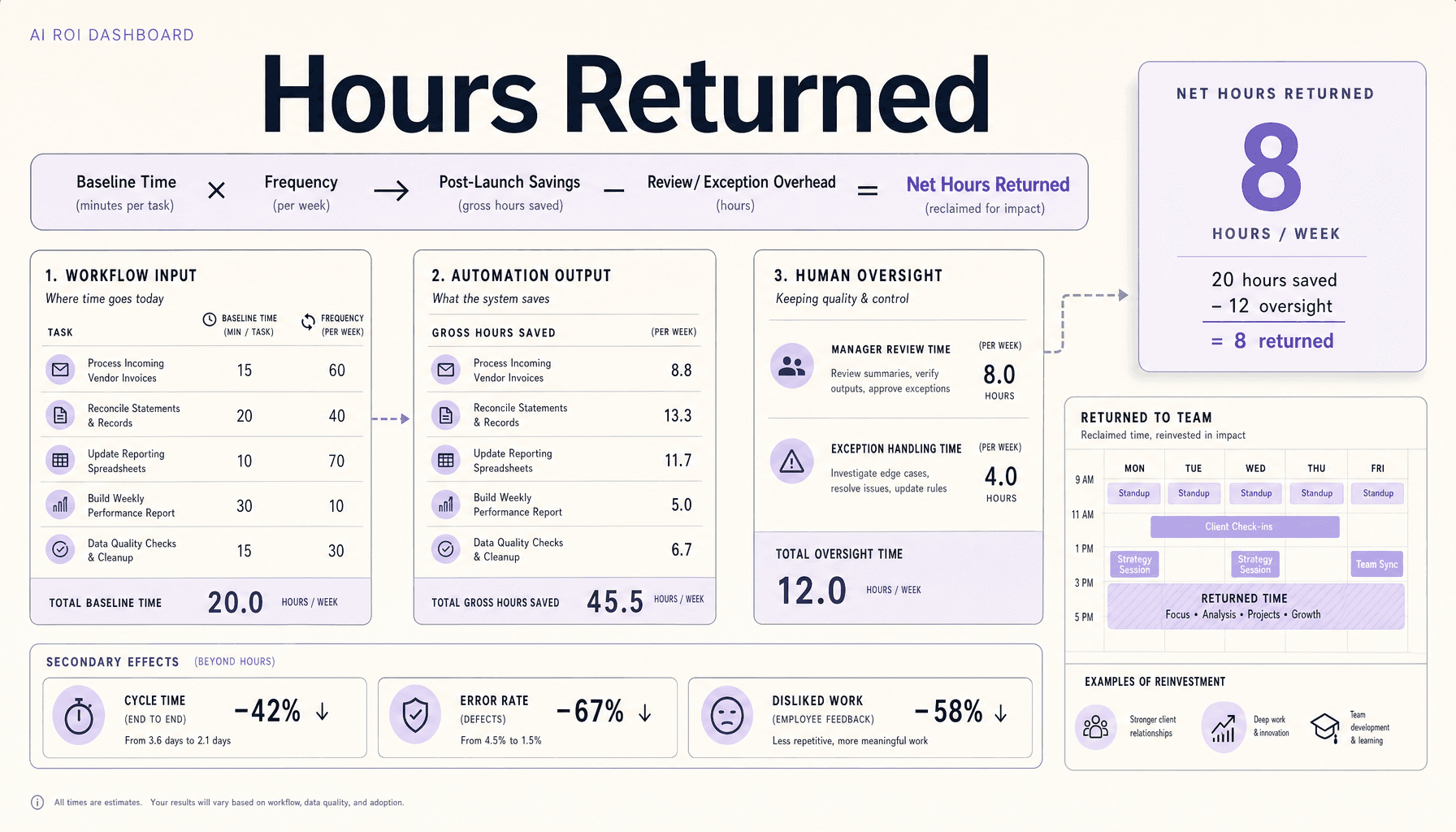
For automation ROI, we use a simple test: baseline time per task × frequency = gross savings; then subtract review, exception handling, QA sampling, and rework to get net hours returned. Example: a workflow saves 20 hours per month on paper, but needs 12 hours of oversight after launch. Net result: 8 hours returned.
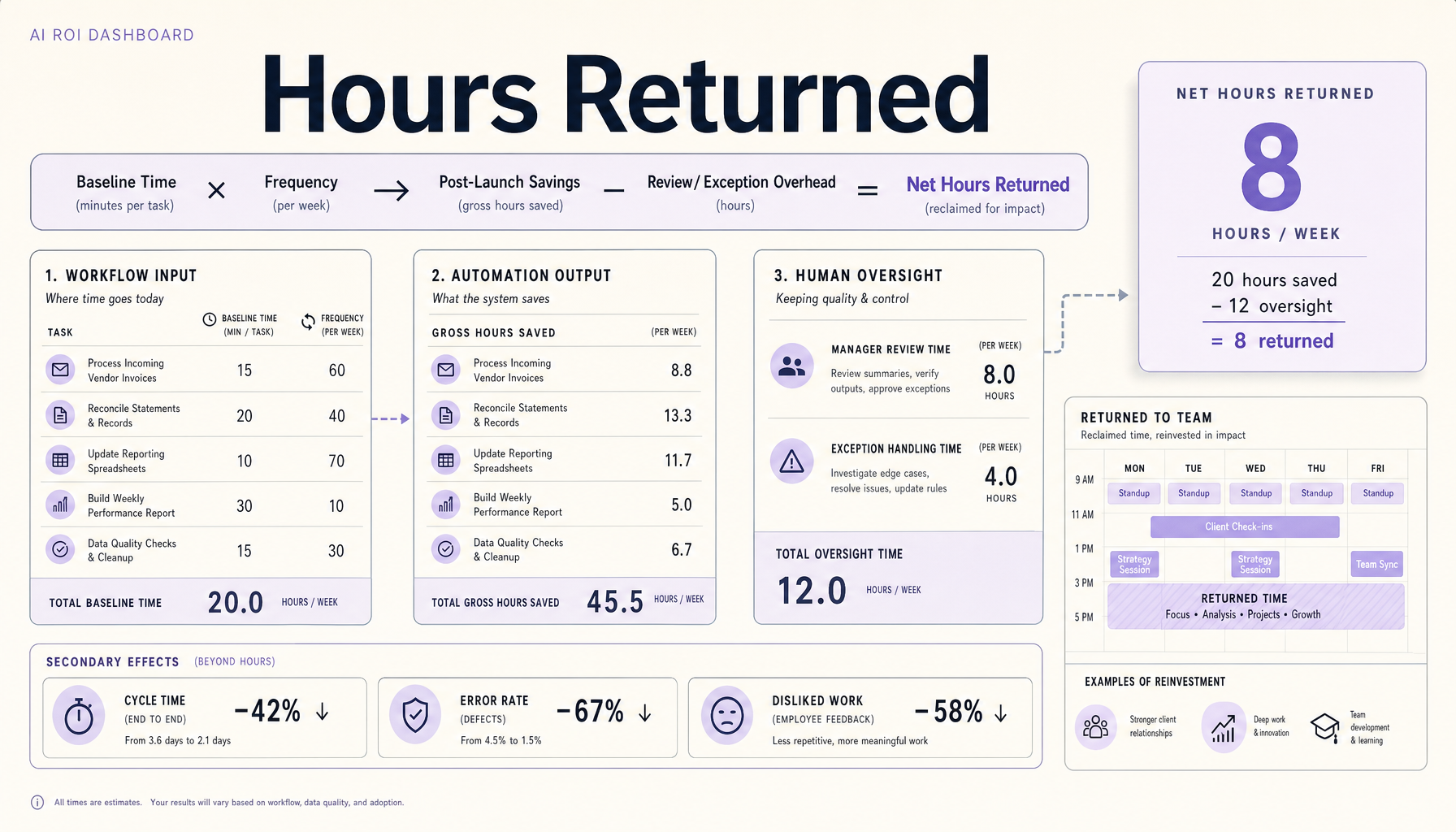
That framing is stricter -- and better. Time is human. If teams cannot show where labor was actually released, “efficiency” is just a narrative. At Imversion Technologies Pvt Ltd, we prefer measurable operating math because clean code improves long-term productivity only if the system reduces real work, not if it shifts effort into downstream review. Cycle time, error rates, and disliked work still matter. They are secondary effects, useful for diagnosing quality and adoption, but they should not replace hours returned as the primary AI ROI metrics baseline.
Key Takeaways on AI ROI Metrics
-
Use hours returned as the primary AI ROI metrics standard. Time is human -- finite, scheduled, and budgeted. If an AI workflow does not return usable capacity, the automation ROI claim is weak.
-
Vague AI efficiency measurement falls apart under basic scrutiny: faster for whom, how often, and with what added review, QA sampling, exception handling, or rework? “Efficiency” without operating detail is just a story.
-
Measure it directly: baseline time per task × task frequency = gross time savings; gross time savings − review, exception, and oversight overhead = net hours saved. We prefer this because clean code improves long-term productivity, but clean measurement determines whether the gain is real.
-
Example: 20 hours saved − 12 hours of oversight = 8 hours returned. That is the number leaders can plan around.
-
Track cycle time, errors, and disliked work too. But treat them as secondary effects, not primary ROI claims, unless they clearly convert into measurable net hours saved.
Why Vague Efficiency Claims Fail as AI ROI Metrics
The fastest way to weaken an AI proposal is to describe it with phrases like “30% faster” or “productivity uplift” and stop there. Those phrases sound positive. They do not prove automation ROI. If the claim cannot show who got time back, how often the workflow runs, and what new oversight was introduced, it is not an operating metric. It is marketing.
The discipline is simple:
baseline time × frequency = gross savings; gross savings − review, exception, and oversight overhead = net hours returned
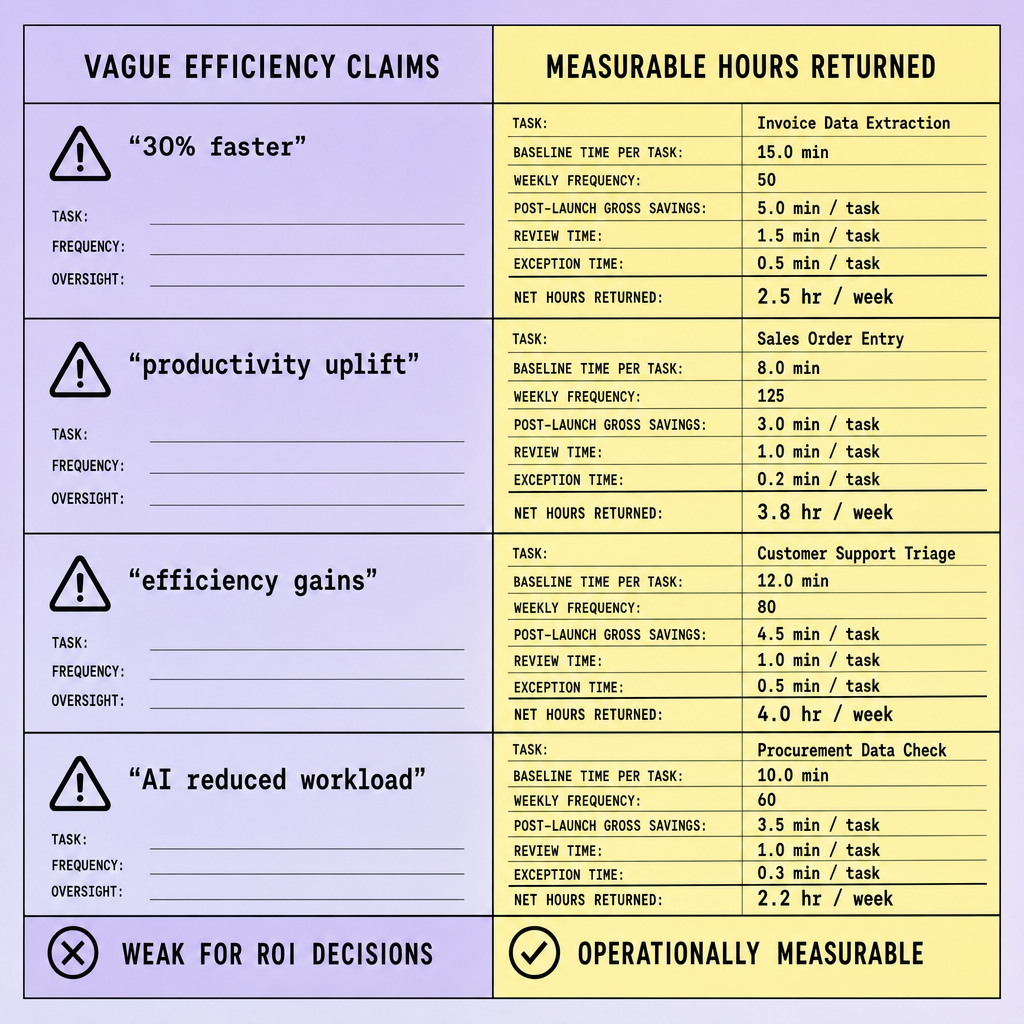
That is the standard we should use for AI ROI metrics because time is human. Hours sit on calendars, staffing plans, SLAs, and budgets. Percentages do not.
Unclear actor means unclear value
“Faster” for whom? An analyst, a manager, a QA reviewer, or a downstream operations team?
This is where weak AI efficiency measurement breaks first. A workflow can be faster for the person clicking the button while creating more work for someone else in approval, audit, or reconciliation. User experience matters as much as functionality here -- if people do not trust the output, they add manual checks, and the claimed time savings ROI shrinks fast.
Unclear frequency makes percentages meaningless
A 30% improvement on a task done once a quarter is minor. A 10-minute reduction on a task done 500 times a month is material.
So frequency has to sit next to baseline time. Without both, “efficiency” cannot be converted into usable capacity. Leaders need monthly or quarterly hours returned, not abstract uplift.
Review burden and exception handling erase gross savings
This is the hidden tax. Teams often measure the automated happy path and ignore QA sampling, rework, exception handling, and escalations.
Take a simple example: a workflow appears to save 20 hours per month. But post-launch, managers spend 12 hours reviewing outputs and resolving edge cases. Net hours returned: 8. Still valuable, maybe. But now it is real.
Downstream work shifts can fake ROI
Some automations reduce touch time upfront while pushing cleanup into finance, support, compliance, or reporting. Cycle time may improve. Error rates may fall. Disliked work may decline. Good outcomes. But they are secondary effects unless they translate into measurable hours returned or another defined business result.
That is why measurement has to follow the full workflow, not just the first visible step. Clean code improves long-term productivity, and so does clean measurement. We should not criticize automation for needing oversight. We should criticize weak measurement for hiding it.
Why Hours Returned Is the Primary Automation ROI Metric
Most teams do not struggle to describe benefits. They struggle to describe capacity. That gap is exactly why hours returned should be the primary automation ROI metric.
It ties automation to the one constrained input every operating model depends on: human time. Broad efficiency language sounds strategic, but it rarely answers the questions that matter: where time was saved, where work moved, and what new oversight was introduced.
The practical formula is simple:
baseline time per task × frequency = gross time saved; gross time saved − review, exception, and oversight effort = net hours saved
This is the discipline many AI proposals avoid.
A workflow can look faster in a demo and still fail to return usable capacity. If a team saves 20 hours of manual effort each month but spends 12 hours reviewing outputs, handling exceptions, and fixing edge cases, the business did not get 20 hours back. It got 8. Those 8 returned hours are the number leaders can actually plan around.
Managerial reason: it supports real capacity planning
Operating models are built from finite labor hours, scheduled roles, handoffs, and service levels. Hours returned gives managers a usable planning unit. They can decide whether to redeploy capacity into backlog reduction, customer response, revenue-supporting work, or risk controls. “Productivity uplift” cannot do that.
The math also scales cleanly. Measure baseline time, run frequency, exception rate, QA sampling, and rework time by week or month. Then compare initiatives on the same basis.
Financial reason: it improves investment comparison
Teams often compare automation ideas with a mix of excitement, demo quality, and rough benefit language. That makes prioritization messy.
Automation ROI gets stronger when teams compare options using net hours saved instead of narrative wins. A reporting bot, a support triage flow, and a document extraction pipeline may solve different problems. But all three either consume or return labor capacity. Hours returned creates comparability across initiatives and gives finance a more credible base for labor utilization decisions.
Leaders do not need a layoff story to justify that metric. They only need to show recoverable capacity with believable assumptions.
Workforce reason: it reflects how work actually changes
This is also closer to how teams experience the change. Returned time means fewer repetitive touches, fewer manual checks, and fewer interruptions. Cycle time, error rates, and work quality still matter, but they are secondary signals. They help validate the change. They do not replace ROI measurement.
Faster cycle time does not always mean returned capacity. Fewer errors do not always offset heavy oversight. Start with hours returned, then treat quality and speed gains as supporting evidence.
AI ROI Metrics Formula: Baseline Time × Frequency − Oversight = Net Hours Returned
If leaders want defensible AI ROI metrics, measure hours returned, not abstract efficiency. The formula is simple, auditable, and harder to game:
Baseline time per task × task frequency = current workload
Current workload − post-launch human time − oversight overhead = net hours returned
Now break that into parts. Each one affects whether the ROI claim survives contact with real operations.
Baseline time per task
Start with the task as it exists today. Measure the average human time required to complete one unit of work before automation. Use actual workflow steps, not optimistic estimates: open the ticket, gather inputs, validate fields, correct issues, submit, and confirm completion.
This is the baseline. Without it, AI ROI becomes storytelling.
Task frequency
Next, measure how often the task occurs in a week, month, or quarter. A five-minute saving on a daily workflow can matter. A two-hour saving on a quarterly task may not. Frequency turns anecdotal savings into operating load.
Baseline time × task frequency gives the total current load.
Post-launch human touch time
Now measure the human time still required after launch. This includes prompting, setup, approval, spot checks, and any manual completion work when the system only handles part of the flow.
This is where teams often inflate value. Machine speed is not the ROI. Reduced human touch is.
Oversight overhead
Subtract every new cost created by the automated process:
QA review
Sampling outputs, checking accuracy, and validating edge cases.
Exception rate
Work items the system cannot handle and routes back to people.
Escalation
Cases that require a supervisor, specialist, or secondary review.
Rework
Fixes caused by incorrect outputs, formatting failures, or downstream cleanup.
Gross savings vs. net hours returned
This is where the argument becomes real. Use the logic chain in order. If a workflow previously took 2 hours per run and occurred 10 times per month, the baseline load is 20 hours. If post-launch oversight, review, and exception handling consume 12 hours, then the business did not get 20 hours saved. It got 8 net hours returned.
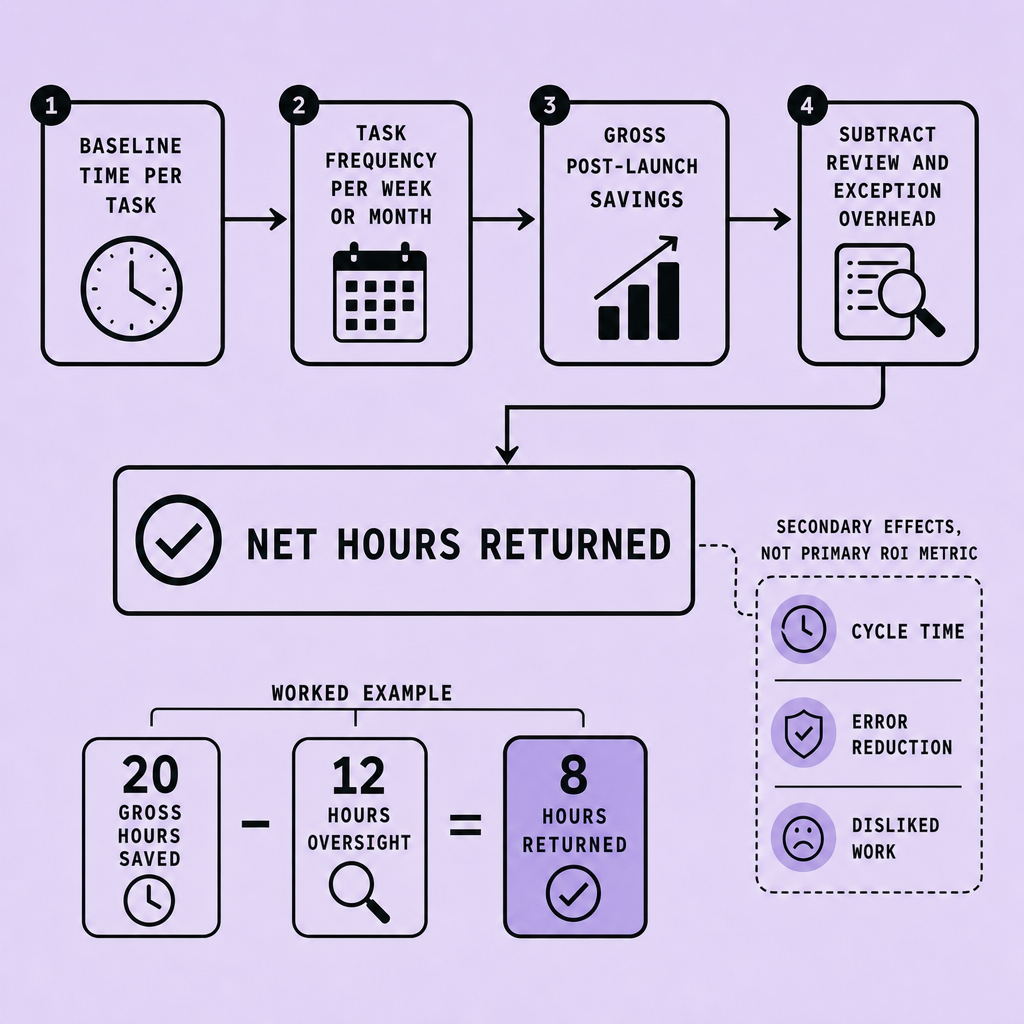
The caveat is practical: not every saved hour becomes usable capacity. If work is fragmented across many people or saved in tiny increments, the organization may not be able to redeploy it cleanly. That does not make the metric useless. It means leaders should start with workflows that are frequent, standardized, and concentrated enough for recovered time to be scheduled, reassigned, or removed from backlog. Start with one workflow. Measure weekly or monthly. Build the scorecard after the audit discipline exists.
The 20 Saved Minus 12 Oversight Example Shows Real Net Hours Saved
This is where inflated ROI claims usually collapse. Gross savings sounds impressive. Net savings survives review.
A realistic automation ROI calculation includes the drag, not just the speedup. If a workflow saves 20 gross hours but requires 12 hours of review, exception handling, and oversight overhead, the business did not get 20 hours returned. It got 8.
Here is the clean math:
- Baseline work: 2 hours per run
- Frequency: 10 runs per month
- Gross savings: 2 × 10 = 20 hours
- Post-launch overhead:
- QA sampling and review: 6 hours
- Exception review: 4 hours
- Escalations or cleanup: 2 hours
- Net hours returned: 20 − 12 = 8 hours
That number is smaller. It is also stronger.
Leaders can actually use it. Eight recurring hours returned per month may still justify the initiative if those hours come from a constrained team and remove manual load that people actively avoid. User experience is as important as functionality -- and bad review design can erase claimed savings fast.
This is why net hours saved beats vague efficiency language. Gross savings tells us the automation can perform work. Net hours returned tells us whether the operating model improved after human judgment, exception review, and control steps were counted. Cycle time may improve. Errors may drop. Disliked work may shrink. Good outcomes. But we should treat those as secondary effects unless they clearly return usable human time.
Time is human. Count the time that came back, not the time the demo appeared to save.
Cycle Time, Error Reduction, and Disliked Work Matter, but They Are Secondary AI ROI Metrics
These metrics are useful. They are just easy to misuse.
Leaders should treat cycle time, error rate, and employee experience as supporting indicators: useful, sometimes strategically important, but not standalone proof of automation ROI.
The mistake is common. A team shows that a workflow finishes faster, produces fewer mistakes, or removes repetitive work people dislike. Those are real benefits. But if none of them converts into measurable capacity, the business case is still incomplete. A report that reaches a manager in 10 minutes instead of 2 hours may matter operationally. But unless you can show what human effort was actually removed, what review was added, and whether exceptions created rework, you have not yet proven time savings ROI.
Use these metrics to support the case, not replace it.
Cycle time can justify urgency. Lower error rates can reduce downstream cleanup. Less repetitive work can improve employee experience and make roles easier to sustain. But these gains create a tradeoff: they are easy to celebrate and hard to overstate-check. Review queues, QA sampling, approval steps, and manual exception handling often absorb part of the apparent benefit.
A grounded recommendation is to translate each secondary metric into one of two outcomes: hours returned or dollars avoided. If you cannot do that yet, present the result as a strategic benefit, not a quantified ROI claim.
Say “supporting indicators,” not ROI, unless the effect is translated into hours or financial impact.
Start with hours returned. Then use cycle time, error reduction, and disliked-work reduction to explain why the change also improves service, quality, or sustainability. That framing is more credible because it separates measured capacity from plausible upside.
Frequently Asked Questions
What makes hours returned better than other AI ROI metrics?
Hours returned is the strongest primary metric because it shows whether automation created recoverable human capacity that managers can actually reassign, schedule, or remove from backlog. Other AI ROI metrics may describe improvement, but they often fail to show whether labor demand truly declined after review, exception handling, and control work were counted.
How should teams audit AI ROI metrics after launch?
Teams should run a post-launch audit using real operating data, not pilot assumptions. Measure task volume, residual human touch time, review hours, exception rates, rework, and escalation effort for at least one full reporting cycle. The result should be a monthly or quarterly net-hours-returned figure that can be compared against the original business case.
Why do AI ROI metrics often get overstated in executive reviews?
AI ROI metrics are often overstated because teams present technical speed, user satisfaction, or demo performance as if those outcomes automatically reduce labor demand. In practice, hidden review work, fragmented savings across roles, and new compliance checks absorb part of the gain. ROI becomes credible only when the full workflow is measured end to end.
How does fragmented time savings affect planning?
Fragmented savings matter because ten minutes saved across many people is not the same as one concentrated block of recoverable time. If the time cannot be bundled into a shift change, backlog reduction, or role redesign, the operational value is lower than the gross estimate suggests. Leaders should distinguish theoretical savings from schedulable capacity.
When should cycle time or error reduction lead the business case instead of hours returned?
Cycle time or error reduction should lead only when the primary objective is service-level performance, risk reduction, or compliance rather than labor recovery. In those cases, the organization should state that the project is being justified on speed, quality, or control outcomes, and avoid presenting the result as labor ROI unless returned hours are also proven.
Make Imversion a preferred source on Google
Like this kind of AI and software analysis? Add Imversion as a preferred source so Google can highlight our articles for you in Search, AI Overviews, and AI Mode.