UK vs India engineering costs: Candid Comparison for 2026
Uncover the truth about UK vs India engineering costs. We break down hiring rates and reveal when UK talent is worth the investment.

On this page
UK vs India engineering costs: the candid short answer
If you budget UK vs India engineering costs by comparing a UK salary with an offshore hourly rate, you will almost certainly misread the decision. The real comparison is fully loaded UK employment cost versus India partner spend. On that basis, India usually wins on senior execution capacity, but not always on strategic or highly specialised roles.
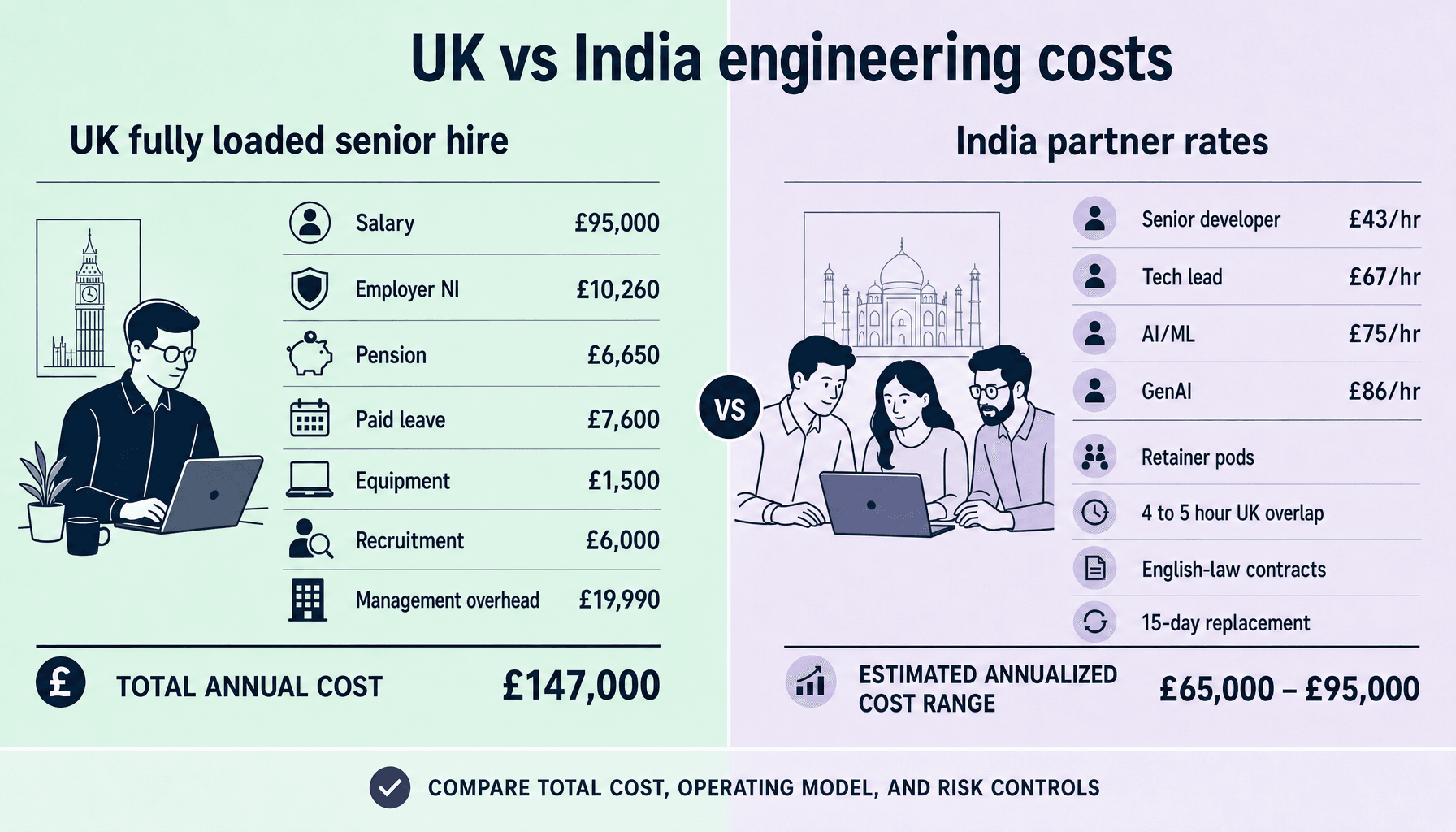
A fair software development cost comparison UK India uses total employer cost: salary, NI, pension, paid leave, equipment, software, recruitment, and ramp-up. On that basis, a UK senior hire often lands around £110k–£140k+, while India partner pricing is clearer: £43/hr senior dev, £67 tech lead, £75 AI/ML, £86 GenAI -- roughly £72k, £113k, £126k, and £144k a year at 1,680 productive hours.
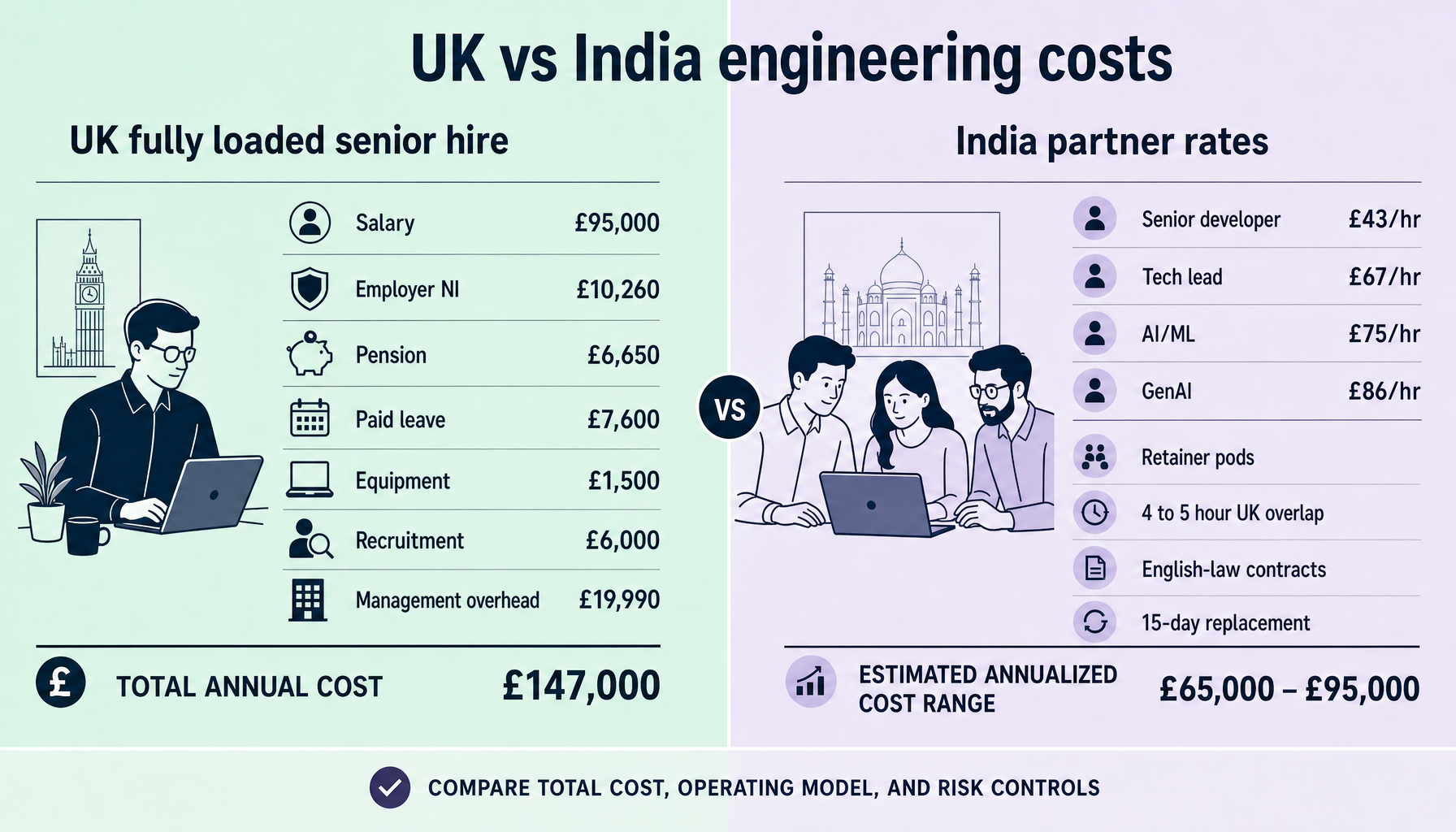
Still, UK vs India developer costs are not just maths. UK hiring wins where product discovery, stakeholder access, regulated context, or deep domain leadership outweigh the rate advantage. A good India partner -- with overlap hours, English-law/IP terms, low churn, and 15-day replacement -- can remove much of the delivery risk. At Imversion Technologies Pvt Ltd, we keep seeing the same thing: the cheaper model only works if engineering quality stays high.
Key Takeaways
-
Start with the right comparison: in UK vs India engineering costs, salary versus hourly rate is misleading. The useful lens is offshore engineering total cost versus fully loaded UK employment cost -- including NI, pension, paid leave, equipment, software, recruitment, ramp-up, and management time.
-
India shows the clearest savings on senior execution work. At £43/hr, a senior developer lands at roughly ~£72k/year versus £110k–£140k for a UK senior hire. That is the biggest gap in this software development cost comparison UK India.
-
The gap narrows fast for leadership and specialist roles: £67/hr tech leads, £75/hr AI/ML, £86/hr GenAI. UK vs India developer costs still favor India, but less dramatically.
-
UK hiring wins when you need deep product context, tight stakeholder access, and faster decision loops. If communication overhead is high, savings erode quickly -- user experience is as important as functionality, so misalignment can get expensive.
-
Good India partners reduce risk with English-law/IP contracts, usable UK overlap, retainer pods, and 15-day replacement terms. But do not buy on rate alone.
UK vs India engineering costs table: fully loaded hires vs partner rates
Most teams do not need another abstract debate here. They need a like-for-like budgeting view: fully loaded UK employment cost against India developer partner rates, using roughly 1,680 productive hours per year. Not salary versus hourly rate. That shortcut breaks budgets.
| Role | UK fully loaded annual cost | India partner rate | Approx. India annual cost |
|---|---|---|---|
| Senior developer | £110k–£140k | £43/hr | ~£72k |
| Tech lead | £130k–£170k | £67/hr | ~£113k |
| AI/ML engineer | £140k–£180k+ | £75/hr | ~£126k |
| GenAI engineer | £150k–£200k+ | £86/hr | ~£144k |
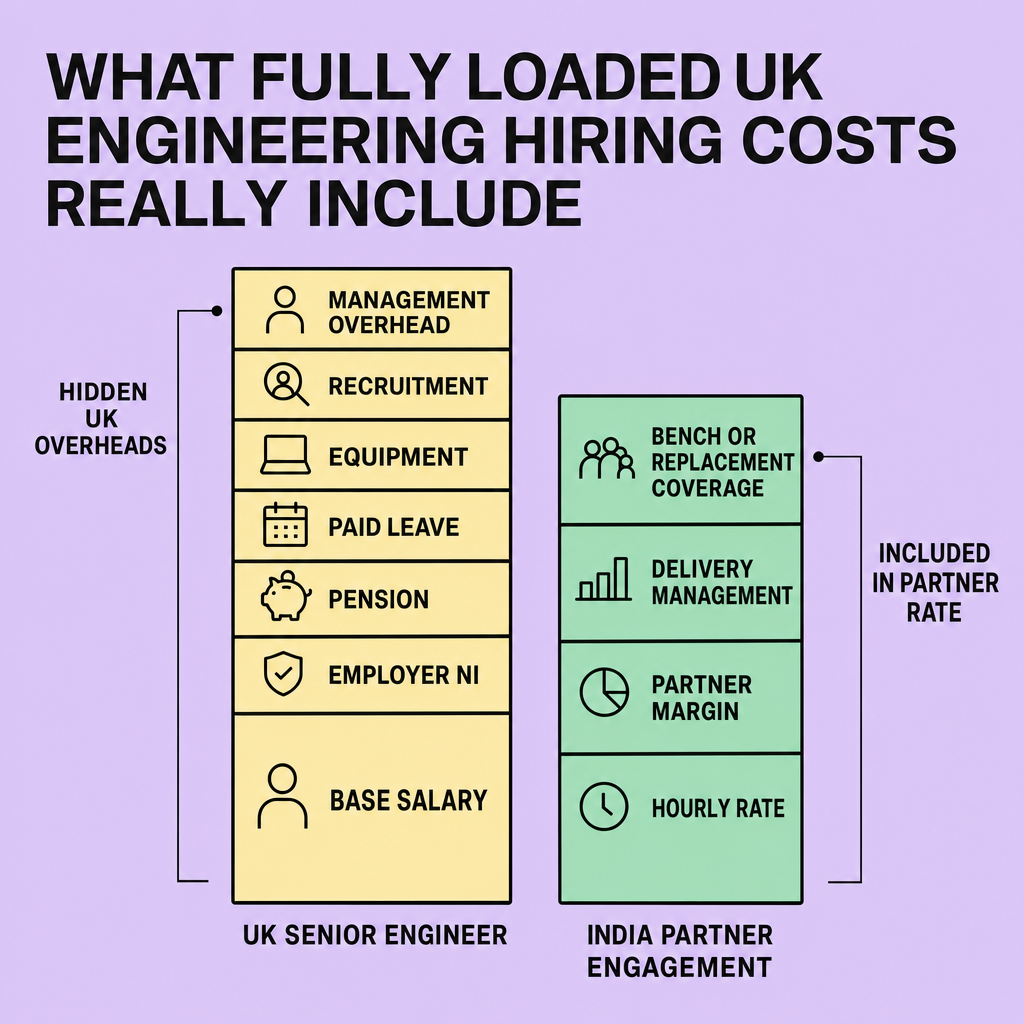
This is the core software development cost comparison UK India buyers should use. A UK engineer hiring cost model includes more than base pay: Employer National Insurance, pension, paid leave, equipment, software licences, recruitment fees, management overhead, and ramp-up time. Ignore those and the comparison gets distorted fast.
The table points in a clear direction. Senior execution capacity is where UK vs India developer costs often diverge most sharply. A senior developer at ~£72k annual partner spend versus £110k–£140k fully loaded in the UK is a meaningful gap. But the spread narrows for a tech lead, an AI/ML engineer, and especially a GenAI engineer. Specialist partner talent is still premium talent.
That is why this table is useful for budgeting, not for automatic decision-making.
It does not prove team fit, delivery quality, architecture judgment, stakeholder handling, or whether the partner can work cleanly inside your product cadence. That boundary matters because user experience is as important as functionality -- a cheaper build that creates rework, vague ownership, or poor product decisions can wipe out the paper savings.
There is also an operating detail buyers sometimes skip. Partner pricing may look simpler than employment cost, but you still need to check terms. Timezone overlap with India is often workable for UK teams -- usually enough for daily standups, reviews, and unblock sessions -- yet you should still define handoff windows, escalation routes, IP assignment, and English-law contracts before work starts.
So if you want a planning baseline, these India partner rates are credible. If you want a hiring verdict, they are only the first filter.
What fully loaded UK engineering hiring costs really include
The number on the job spec is rarely the number that hits the budget. A UK senior hire costs far more than salary because payroll is only one line item.
This is where weak software development cost comparison UK India pieces usually fall apart. They compare a UK salary to an offshore day rate, then skip everything the employer carries around that salary. Those costs are not deceptive or “hidden”. They are just routinely left out.
A realistic UK engineer hiring cost view usually includes:
- base salary
- Employer National Insurance
- auto-enrolment pension
- paid leave and public holidays
- laptop, peripherals, and replacement cycle
- software licences, cloud access, security tools, and collaboration tools
- recruitment fee for senior tech roles or internal talent acquisition time
- manager and team interview time
- onboarding time
- ramp-up time before the hire is fully productive
The expensive part is not only tax and benefits. It is time.
Finance leaders often model the obvious items, then miss the internal drag: senior engineers spending hours interviewing, an engineering manager writing scorecards, DevOps setting up access, product people transferring context, and a new hire operating below full speed for the first months. Because user experience is as important as functionality, strong teams also spend real time helping new engineers learn product behaviour, customer edge cases, and release expectations -- not just the codebase.
That is how an £85k-£100k salary for a generic senior UK engineer turns into roughly £110k-£140k+ fully loaded annual cost. A tech lead often lands around £130k-£170k. AI/ML and GenAI roles can move higher again.
The honest comparison in UK vs India developer costs is not payroll versus partner invoice. It is fully loaded employment cost versus total partner spend.
From there, the decision gets more practical. UK hiring still wins in some cases: highly ambiguous product leadership, heavy stakeholder management, sensitive domain work, or roles where daily in-person collaboration changes speed and quality. But for pure execution capacity, UK vs India developer costs usually look very different once annual partner pricing is compared against the full employment budget, not salary alone.
India partner rates, retainer pods, and what you actually buy
A low hourly number looks attractive right up until delivery starts wobbling. That is the trap. India partner pricing can lower offshore engineering total cost, but only if we read the rate card properly. A cheap-looking hourly line means very little on its own.
Using the rates in this software development cost comparison UK India, we should expect roughly this level of capability: £43/hr for a senior developer, £67/hr for a tech lead, £75/hr for AI/ML, and £86/hr for GenAI. Annualised across 1,680 productive hours, that works out to about £72k, £113k, £126k, and £144k respectively. So yes, on paper, the India side often undercuts UK engineer hiring cost. But paper is the easy part.
What we actually buy varies by model.
Hourly rates: capacity first, outcomes second
With straightforward India developer partner rates, we are usually buying named capacity -- a person or set of hours with a defined skill level. That can work well for backlog execution, feature delivery, test automation, API work, data pipelines, and maintenance.
The catch is ownership. Who reviews architecture? Who writes acceptance criteria? Who owns release quality? Who absorbs slippage if estimates fail? If the partner only supplies hands, we still carry delivery ownership.
That is why premium offshore rates can still be good value if they come with strong technical leadership, QA discipline, and usable overlap with UK working hours -- often enough for stand-ups, reviews, and unblock sessions. Usually, we can expect a practical overlap window of several hours each day. Often enough. Not always.
Retainer pods: steadier budget, better continuity, less flexibility
A retainer pod changes the model. Instead of buying ad hoc hours, we reserve a small, stable unit -- for example a senior developer plus part-time tech lead, QA, or project coordination. Budgeting gets easier. Team continuity usually improves. So does context retention.
A good pod is not just staffing. It is a delivery structure.
The tradeoff is commitment. Pods reduce churn and often include replacement terms -- such as a 15-day replacement if someone exits -- but they also need clearer scope boundaries, cadence, and governance. We should insist on IP assignment, confidentiality, and English-law contracts if we are a UK buyer.
Our view is simple: clean code improves long-term productivity, so we should pay for seniority and review standards, not just lower hourly cost. In UK vs India developer costs, the best buy is rarely the lowest rate.
UK vs India engineering costs: timezone overlap, communication, contracts, churn, and the real risk controls
Most offshore failures do not start with rates. They start with operating sloppiness. The delivery risk in a software development cost comparison UK India is rarely “India” by itself. It is weak operating discipline.
UK-India timezone overlap is workable, but it needs design. Depending on the UK season, teams usually get roughly half a working day of shared time. That is enough for stand-ups, backlog refinement, architecture reviews, and blocker clearing. Not enough for constant ad hoc interruptions. So teams need written specs, recorded walkthroughs, clear acceptance criteria, and decision logs. User experience is as important as functionality -- and vague requirements usually damage both.
Communication quality affects offshore engineering total cost more than most rate cards admit. If the UK side relies on verbal instructions and scattered Slack messages, rework climbs fast. If the partner works from structured tickets, defined ownership, and weekly demos, delivery becomes far more predictable.
The legal layer matters too, but it is not the whole story. A proper service agreement under English law, with clear intellectual property assignment, confidentiality, security obligations, and defined acceptance terms, reduces ambiguity before problems become expensive. Legal comfort helps. Operational clarity helps more.
Then there is churn.
Attrition is normal in any engineering market. The question is not whether it exists, but how fast the supplier restores capacity and context. A 15-day replacement SLA matters because it limits idle sprint time, protects roadmap continuity, and caps hidden management drag. In UK vs India developer costs, that control can save more money than a slightly lower hourly rate. For specialist work -- especially lead, AI/ML, or GenAI roles -- replacement speed and handover quality should be checked before price.
When UK hiring genuinely wins: a practical decision framework
The cheapest delivery model is not always the cheapest decision. Pay the UK premium when the work is dominated by ambiguity, organisational context, and fast decisions, not just code production.
In practical terms, UK hiring tends to win when the engineer must sit close to product, commercial, compliance, or operations leaders and keep reinterpreting the problem as new information arrives. That usually includes product discovery, undefined early-stage platform work, regulated or trust-sensitive systems, senior engineering management, and roles that require frequent workshops, trade-off calls, or same-day stakeholder decisions. In those cases, the extra UK engineer hiring cost may buy speed of alignment, lower decision friction, and clearer accountability.
India usually wins when the delivery model is more legible. Think mature backlogs, scoped migrations, well-defined features, QA-heavy throughput, or specialist capacity added to an existing team. It can also be the stronger choice when you need targeted expertise without taking on the full annual cost of a UK hire.

A simple decision test:
- Choose UK hires when ambiguity is high, priorities change often, and the role depends on deep organisational embedding.
- Choose an India partner when scope is clearer, acceptance criteria can be written down, and the main goal is reliable execution at lower total spend.
- Choose a hybrid model when UK product or engineering leads define priorities and architecture, while India handles build capacity, testing, or specialist streams.
The useful question is not “Which country is better?” It is “Where will this role create the least coordination drag for the budget available?” That is the practical way to judge UK vs India engineering costs.
Frequently Asked Questions
What is the biggest mistake people make in UK vs India engineering costs?
The biggest mistake is comparing UK salary alone with an India hourly rate. A valid comparison must include employer on-costs, paid non-productive time, recruitment effort, tooling, management overhead, and ramp-up. Without that, the UK option appears artificially cheaper and the India option appears artificially simpler than either really is.
How does timezone overlap affect UK vs India engineering costs in practice?
Timezone overlap affects cost through decision speed and rework, not just calendar hours. If teams have enough shared time for planning, reviews, and blocker removal, offshore delivery can run efficiently. If they depend on constant instant responses, delays multiply and the lower rate can be offset by missed context, duplicated effort, and slower releases.
Why should I care about contract terms if the India partner rate already looks competitive?
Contract terms determine whether a lower rate stays low when something goes wrong. Clear IP assignment, confidentiality clauses, acceptance criteria, security duties, governing law, and replacement commitments reduce legal and operational ambiguity. Strong terms do not guarantee good delivery, but they sharply reduce the cost of disputes, attrition, and unclear ownership.
When is a hybrid UK-and-India model better than choosing one side only?
A hybrid model works best when product judgment and stakeholder management need to stay close to the business, but execution capacity or specialist skills can be distributed. UK leads can own priorities, architecture, and sensitive conversations while India engineers handle implementation, testing, and focused technical streams with clearer requirements.
Are retainer pods better than hiring freelancers for ongoing engineering work?
Retainer pods are usually better for ongoing work when continuity, shared context, and predictable cadence matter more than maximum flexibility. A pod gives a stable unit that can retain domain knowledge across sprints, while freelance setups often require more coordination and are more vulnerable to fragmented accountability between delivery, QA, and technical leadership.
Make Imversion a preferred source on Google
Like this kind of AI and software analysis? Add Imversion as a preferred source so Google can highlight our articles for you in Search, AI Overviews, and AI Mode.