US India engineering contracts: Structured Approaches for 2026
Explore effective strategies for US India engineering contracts, including MSA/SOW structure, NDAs, and more for successful collaboration.

On this page
How to Structure US India engineering contracts from Day One
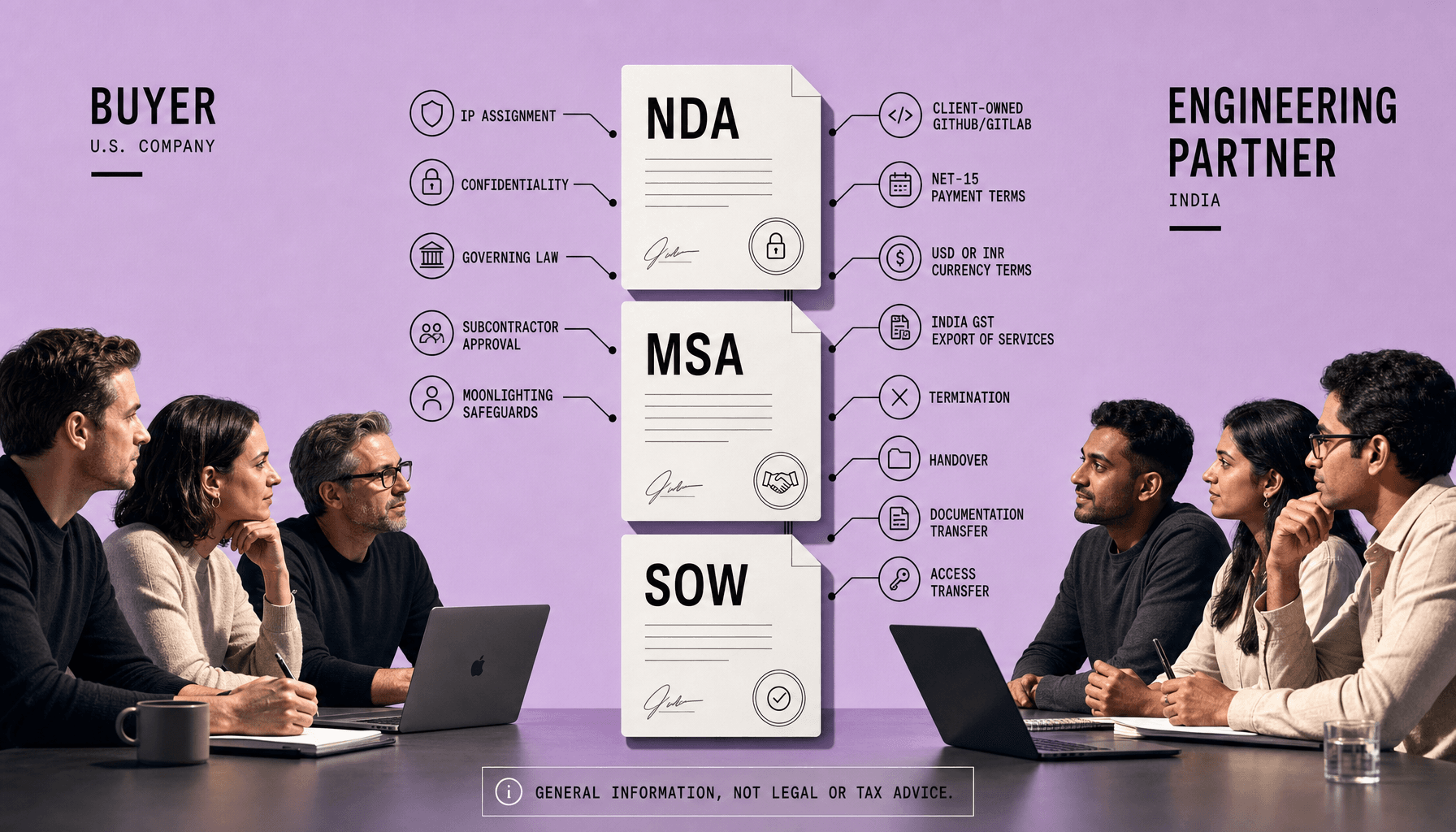
Cross-border engineering work breaks down fast when the contract tries to do everything at once. For US India engineering contracts, we recommend a simple baseline from day one: sign the NDA first, put reusable legal terms in one MSA, and issue a separate SOW for each project.123 That gives a US company hiring Indian developers speed without leaving IP, payment, or exit terms vague. This is general information, not legal or tax advice.
In practice, this MSA SOW NDA for outsourcing structure works better than a single catch-all contract because each document does one job well -- confidentiality first, durable commercial rules next, project specifics last.456 For a software outsourcing contract India teams can actually operate from, the MSA should lock core terms like IP assignment, subcontracting consent, governing law, invoicing currency, and termination mechanics, while each SOW defines scope, acceptance, repos, documentation, and handover.27 We prefer this split because it cuts down the disputes that usually show up later.
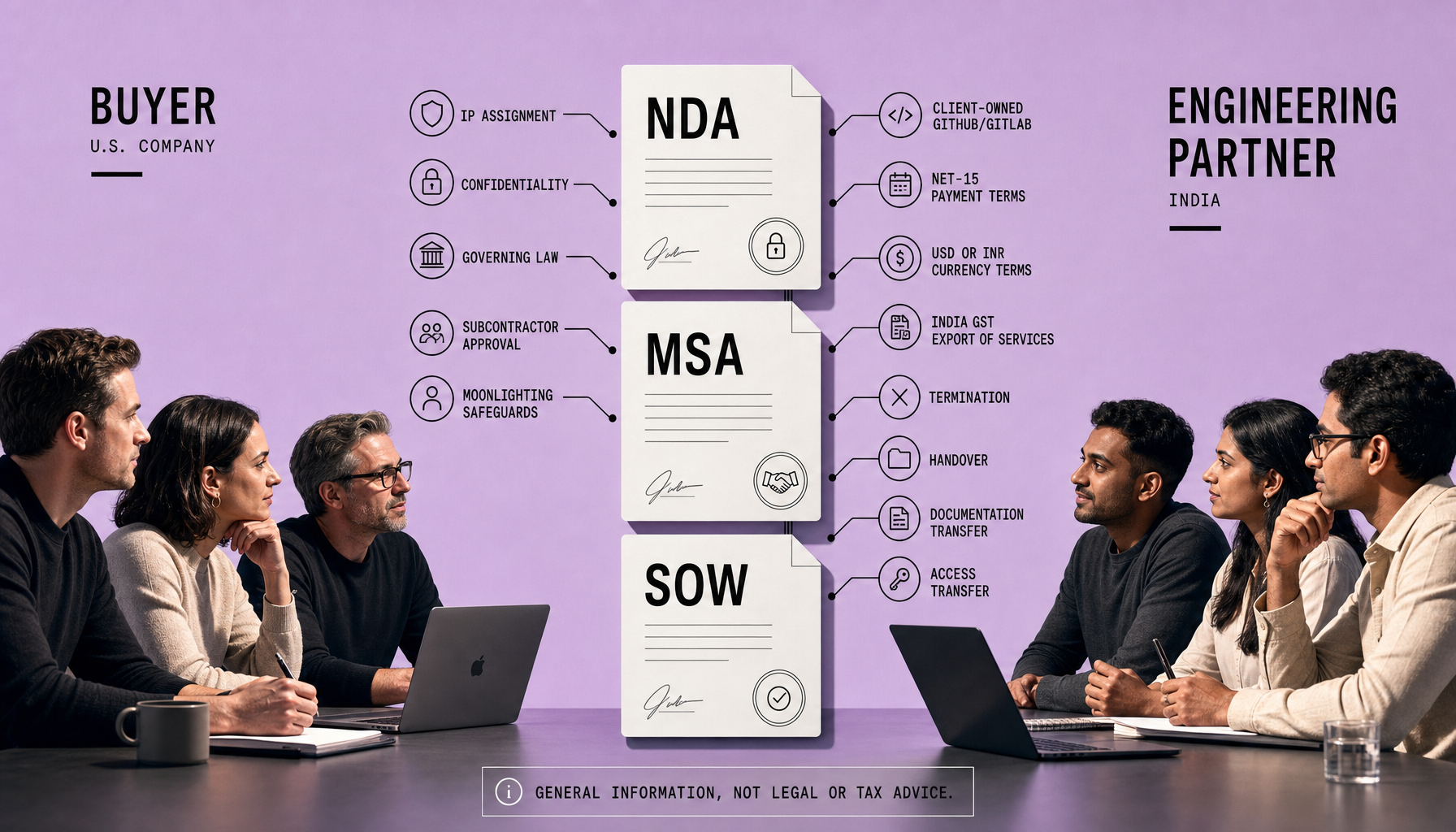
Key Takeaways for US India engineering contracts
- For US India engineering contracts, the safest baseline is the MSA SOW NDA for outsourcing stack: NDA for diligence, one MSA for reusable legal terms, and one SOW per project; add a DPA if personal data is in scope.123
- In any software outsourcing contract India setup, US buyers should require buyer-owned IP assignment, client-owned GitHub/GitLab orgs, admin-controlled access, subcontracting consent, and clear moonlighting restrictions.
- For a US company hiring Indian developers, set invoice currency, Net-15 wording, tax allocation, acceptance criteria, and transition deliverables up front.
- Distinguish legal/tax facts from market practice: GST export treatment, governing law, and IP language need legal-tax review; repo controls and handover checklists are commercial discipline, not a substitute for advice.27
General information only -- not legal or tax advice.
MSA vs SOW vs NDA: the contract stack US buyers should require
US teams often try to force everything into one outsourcing agreement. We would not. For a US company hiring Indian developers, the cleaner structure is NDA first, one MSA for the relationship, and one SOW for each project or workstream.123 That separation reduces ambiguity, speeds change control, and makes the software outsourcing contract India workflow far easier to manage across procurement, legal, engineering, and finance.
Vague SOWs create disputes faster than imperfect pricing does.
If the team cannot tell what was promised, what was accepted, and what is out of scope, delivery friction starts immediately. Reusable legal terms belong in the MSA, while project-specific facts belong in the statement of work.246 The same preference for structure that helps engineering teams also helps here.
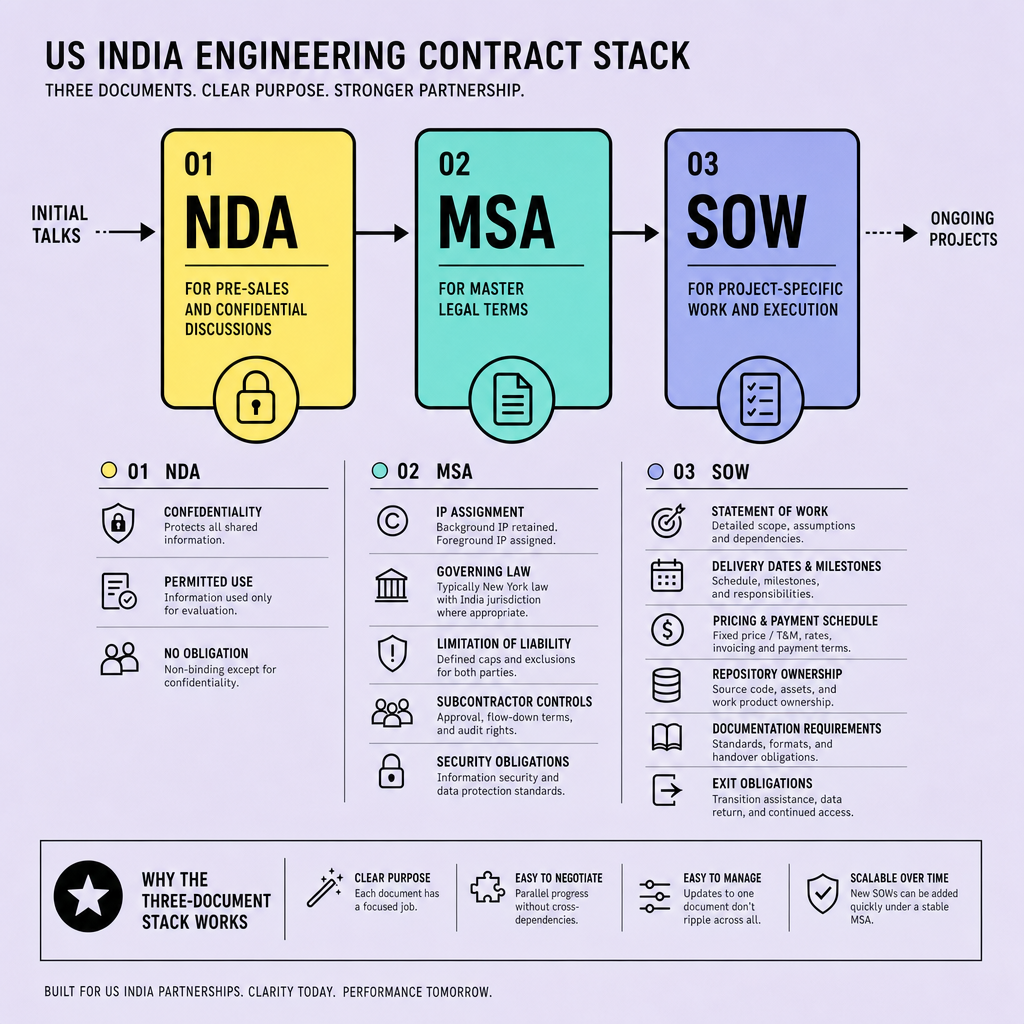
| Document | Purpose | When used | Typical clauses |
|---|---|---|---|
| NDA | Protect confidential information during evaluation and early discussions | Before diligence, demos, access, or code review | Confidentiality, permitted use, exclusions, compelled disclosure, return/destruction |
| MSA | Set reusable legal and commercial rules for the overall relationship | Once, before or alongside first project | IP assignment, payment terms, warranties, liability caps, governing law, subcontracting, termination |
| SOW | Define the actual project being bought | Per project, phase, or change order | Scope, deliverables, milestones, staffing, acceptance criteria, repo/access model, handover duties |
The practical difference is simple. The NDA protects information before trust is fully established.53 The MSA governs the relationship once both sides decide to work together. The SOW governs execution -- what gets built, by when, in which repositories, with what documentation, and how acceptance works.14
That separation also makes it easier to spot missing controls. If the Indian partner will process personal data, add a DPA. This is often required to allocate privacy and security duties in cross-border delivery.27
Our recommendation for any MSA SOW NDA for outsourcing stack: keep the MSA stable, keep SOWs precise, and resist stuffing project detail into the master agreement. That approach scales better for change requests, renewals, and handoffs. At Imversion Technologies Pvt Ltd, we see the operational value clearly -- fewer surprises, cleaner exits, better control.
General information only -- not legal or tax advice.
Clause checklist for US India engineering contracts: IP assignment, confidentiality, governing law, and subcontractor controls
The time to get ownership and risk terms right is before the first commit, invoice, or production credential. In cross-border work, vague drafting causes avoidable fights over who owns code, scripts, documentation, test assets, and deployment artifacts. For a US company hiring Indian developers, the MSA should carry the core risk terms, while the SOW ties them to actual delivery mechanics.237
IP assignment and ownership language
For IP assignment offshore development, we want present-tense assignment wording, not a promise to assign later. Drafting like “hereby assigns” is stronger than “will assign,” because loose future-tense language can create ownership ambiguity if the relationship ends badly or paperwork is never refreshed.27 Cover all work product -- source code, infrastructure code, designs, docs, data models, test cases, and derivative works. If local law allows residual author claims, add a moral rights waiver, or at minimum an irrevocable consent not to assert those rights where waiver is limited.7
Then connect the legal clause to daily operations. Client-owned GitHub or GitLab organizations, branch protections, PR history, and admin access transfer in the SOW reduce the gap between what the contract says and what the tooling shows day to day.
Confidentiality, contractor status, and risk allocation
The MSA SOW NDA for outsourcing should define confidential information broadly, limit use to service delivery, require return or deletion at exit, and bind personnel on a need-to-know basis.15 We also recommend express independent-contractor language, no authority to bind the client, service warranties tied to the SOW, and clear indemnity and limitation of liability clauses.23 But balance matters. Aggressive liability language that no serious engineering partner will sign often slows procurement without improving real protection.
This is general information, not legal or tax advice.
Governing law, disputes, subcontracting, and moonlighting
Dispute clauses deserve deliberate choices, not boilerplate. Cross-border services contracts commonly use either courts or arbitration; arbitration is often chosen for enforceability across jurisdictions, but cost and process design still need lawyer review.47 Restrict subcontracting without prior written consent, require flow-down confidentiality and IP terms, and disclose all approved subcontractors.237 Then address moonlighting operationally: no competing engagements, no code reuse from other clients, conflict disclosures, and documented time-allocation controls. Unclear staffing and ownership rules turn routine delivery into expensive cleanup.
US India engineering contracts: Client-owned GitHub/GitLab, Net-15 payments, currency terms, and India GST export treatment
Contract language alone will not save delivery if the buyer does not control the systems where the work actually happens. If a US company hiring Indian developers wants real control, the contract should be matched by operational ownership from day one. A client-owned GitHub or GitLab organization is one of the clearest ways to preserve continuity if the relationship ends.
Put code, identity, and logs under client control
We recommend that the buyer own the GitHub/GitLab org, keep top-level admin rights, and enforce SSO for vendor users. The software outsourcing contract India stack should then reflect that setup in the MSA and SOW: named users, role-based access, least privilege, branch protections, required reviews, secrets stored in the client’s vault or CI/CD secret store, and access-log retention.27 Do not limit this to repo access. Cover issue trackers, package registries, deployment pipelines, cloud consoles, and domain or certificate access as well.
A practical clause set for MSA SOW NDA for outsourcing work includes no shared accounts, client-controlled admin transfer at all times, immediate revocation on personnel change, and return or deletion of local copies on exit.37
Make billing terms unambiguous
Money disputes are usually drafting failures, not accounting mysteries. State invoice currency, bank wire details, who bears transfer fees, due date, and any late-fee wording in the MSA, then let each SOW specify milestone or time-and-material billing.24 For a US company hiring Indian developers, USD invoicing with clear FX responsibility can reduce disputes. If billing is acceptance-linked, define acceptance criteria and a deemed-acceptance fallback so approvals do not stall indefinitely.27
Net-15 can work. Ambiguity does not.
Explain India GST plainly
For India GST export services, zero-rated treatment may apply only if export-of-services conditions are met under Indian GST rules; if those conditions are not met, GST exposure may change. Buyers often ask the vendor to state on the invoice whether the supply is being treated as export of services and on what basis. This is general information, not legal or tax advice.7
Termination, handover, documentation transfer, and what is legal fact vs commercial practice
Most outsourcing exits do not fail on the headline clause. They fail on the missing operational details. In US India engineering contracts, termination language is not boilerplate; it is continuity control. The MSA should cover termination for convenience, termination for cause, notice mechanics, payment for accepted work through the termination date, return or deletion of confidential information, and a defined cure period for remediable breaches, with the SOW spelling out what happens operationally at exit.237
Do not rely on “all code will be delivered.” That phrase is too vague to protect continuity. Teams often discover too late that the missing items were the runbook, architecture notes, deployment steps, third-party license inventory, CI/CD access, infrastructure account inventory, secrets rotation steps, and GitHub or GitLab admin access transfer. So write in transition assistance: repository ownership confirmation, branch protection/admin transfer, credential handover, environment inventory, open defect list, backup locations, and scheduled knowledge transfer sessions. A practical recommendation is to attach a handover checklist as an SOW exhibit so exit duties are measurable rather than argued later.26
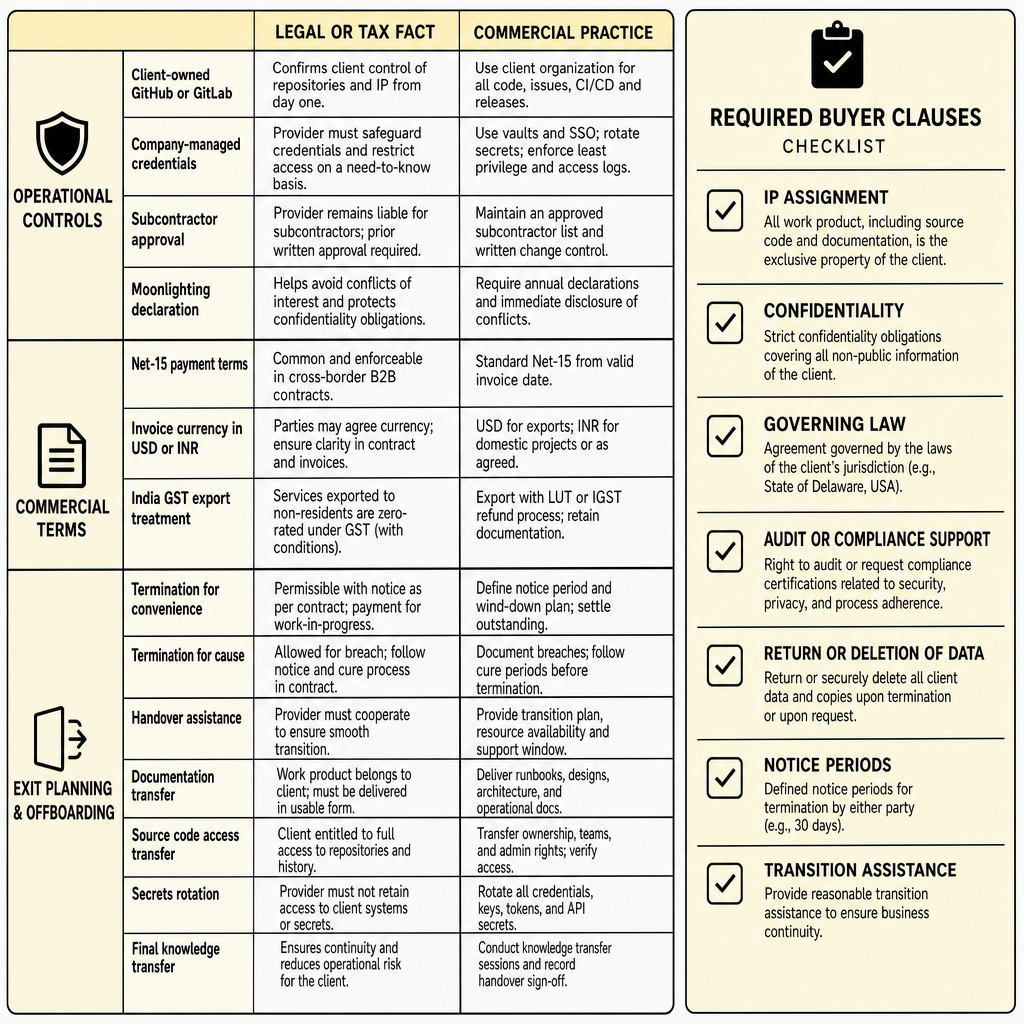
There is a tradeoff. A deeper handover package and post-termination support window reduce operational risk, but they can increase price and extend the vendor’s obligations after notice. That is usually a commercial negotiation, not an automatic legal entitlement.
Legally, enforceability comes from the signed MSA/SOW/NDA stack and the exact termination, IP, confidentiality, and assistance language used.127 Commercially, notice periods, handover depth, and post-termination support are often negotiated norms, not fixed legal defaults. Tax treatment, including India GST export positions, is fact-specific and document-driven. This is general information, not legal or tax advice; a software outsourcing contract India and related tax position should be reviewed by qualified counsel and tax advisers.7
References
- SOW vs MSA vs NDA: Which Contract You Need | Omnivoo
- Software Outsourcing Contracts: MSA, SOW & IP Guide
- Mastering Consulting Contracts: NDAs, MSAs, SOWs & Agreements In 2025
- MSA vs NDA: Key Differences Explained for Businesses - Sirion
- Essential software development contracts: NDA, MSA, and SOW ...
- IT Services Contracts 101: NDA, MSA, SoW Explained - Edvantis
- Software Development Agreement With an Indian Company - JuriGram
- NDA MSA SOW Legal Documents Explained | RA Advisory ... - LinkedIn
Footnotes
-
SOW vs MSA vs NDA: Which Contract You Need | Omnivoo ↩ ↩2 ↩3 ↩4 ↩5 ↩6
-
Software Outsourcing Contracts: MSA, SOW & IP Guide ↩ ↩2 ↩3 ↩4 ↩5 ↩6 ↩7 ↩8 ↩9 ↩10 ↩11 ↩12 ↩13 ↩14 ↩15 ↩16 ↩17
-
IT Services Contracts 101: NDA, MSA, SoW Explained - Edvantis ↩ ↩2 ↩3 ↩4 ↩5 ↩6 ↩7 ↩8 ↩9
-
Mastering Consulting Contracts: NDAs, MSAs, SOWs & Agreements In 2025 ↩ ↩2 ↩3 ↩4 ↩5
-
MSA vs NDA: Key Differences Explained for Businesses - Sirion ↩ ↩2 ↩3
-
Essential software development contracts: NDA, MSA, and SOW ... ↩ ↩2 ↩3
-
Software Development Agreement With an Indian Company - JuriGram ↩ ↩2 ↩3 ↩4 ↩5 ↩6 ↩7 ↩8 ↩9 ↩10 ↩11 ↩12 ↩13 ↩14 ↩15
Frequently Asked Questions
How do US India engineering contracts usually handle open-source compliance?
US buyers should require an open-source policy that obligates the vendor to identify third-party components, preserve license notices, avoid copyleft use without approval, and provide a software bill of materials at handover. This closes a common gap between code delivery and legal compliance, especially when multiple contractors contribute to the same repository.
What approval workflow should US India engineering contracts use for change requests?
US India engineering contracts work best when the SOW defines who can approve scope changes, the required turnaround time, and whether work may begin before written approval. A disciplined change-order process keeps engineering velocity high while preventing later disputes over out-of-scope effort, pricing, or delayed milestones.[^2][^3]
Why should US buyers require a personnel replacement clause in US India engineering contracts?
A personnel replacement clause gives the buyer a clear path if a key engineer underperforms, becomes unavailable, or creates a security concern. The clause should require comparable replacement talent, knowledge-transfer overlap, and no additional ramp-up billing for transition caused by the vendor.
How does invoice support usually work in a software outsourcing contract with an Indian partner?
The cleanest practice is to require each invoice to reference the exact SOW, milestone or time period, approved timesheets if relevant, and any acceptance sign-off. That documentation creates an audit trail for finance teams and reduces payment delays caused by missing backup or mismatched project codes.
What is the difference between legal defaults and negotiated business terms in US India engineering contracts?
Legal defaults come from the signed documents and applicable law, while business terms are the operating choices the parties negotiate, such as response times, overlap hours, transition support length, or reporting cadence. Contract frameworks commonly separate reusable legal rules in the MSA from project execution details in the SOW for exactly this reason.[^1][^7]
Make Imversion a preferred source on Google
Like this kind of AI and software analysis? Add Imversion as a preferred source so Google can highlight our articles for you in Search, AI Overviews, and AI Mode.