AI Development Timeline: Realistic Phases for 2026
Discover a comprehensive AI development timeline that details project phases, risks, and integration considerations for founders and engineering leaders.
On this page
AI Development Timeline: What Founders and Engineering Leaders Should Expect
If your AI demo worked in a few days, that does not mean the product is a few days from launch. This is where many teams misread the schedule. A realistic AI development timeline ranges from weeks to months. Simple AI initiatives can ship fast, but agentic and enterprise systems take longer because evaluation, integration, governance, and compliance usually consume more time than prompt setup or model wiring.
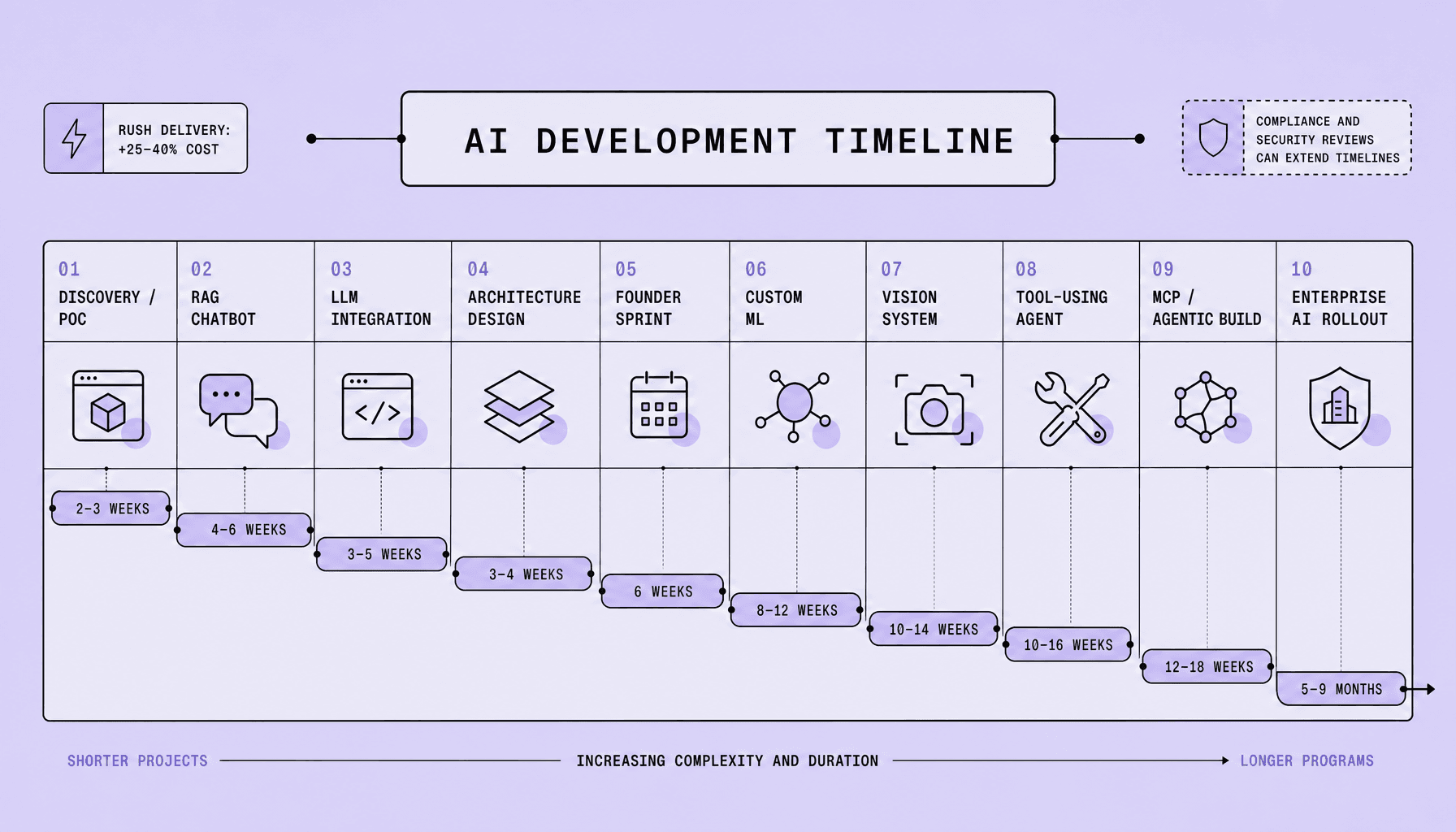
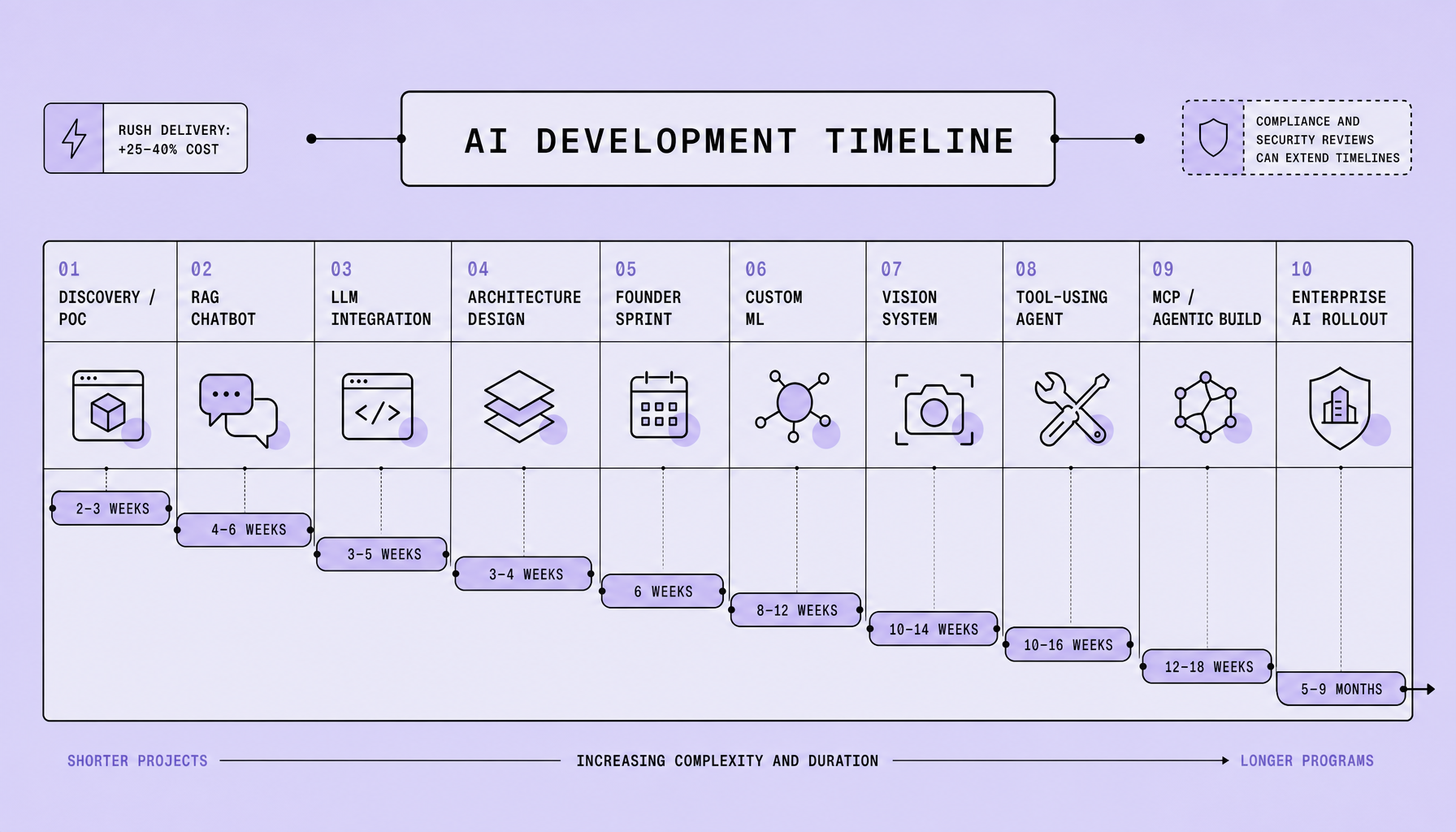
As a planning baseline, an AI project timeline often looks like this: discovery/PoC 2–3 weeks, architecture design 3–4 weeks, LLM integration 3–5 weeks, RAG chatbot 4–6 weeks, founder sprint 6 weeks, custom ML 8–12 weeks, vision 10–14 weeks, tool-using agent 10–16 weeks, MCP or agentic build 12–18 weeks, and enterprise AI 5–9 months. For a 12-week agent build, teams often spend 2 weeks on scope and tool design, 3 on agent logic, 4 on evaluation and workflow integration, and 3 on security, observability, and human review. Clarity is better than complexity. Rush delivery can compress an AI implementation timeline, but expect a 25–40% premium and more risk, especially if SSO, legal review, or compliance gates appear late.
Key Takeaways
- Most AI timelines are set by scope, integrations, and review cycles -- not just model wiring. A practical AI development timeline starts at 2–3 weeks for discovery/PoC, 3–5 weeks for LLM integration, and 4–6 weeks for a RAG chatbot.
- Advanced systems take longer fast: custom ML 8–12 weeks, vision 10–14 weeks, tool-using agents 10–16 weeks, MCP/agentic builds 12–18 weeks, and enterprise AI 5–9 months once SSO, security, legal, observability, and approvals enter the picture.
- For a 12-week AI agent development timeline, teams should phase it roughly as: 1–2 weeks scoping and architecture, 2–3 weeks tool and workflow logic, 3–4 weeks evaluation and guardrails, then 3–4 weeks integration, permissions, and rollout.
- Evaluation and integration often outlast agent logic. Because reliable systems matter most, rushed delivery usually creates rework later.
- Teams can compress an AI project timeline or AI implementation timeline, but expect a 25–40% rush premium -- plus higher risk, thinner testing, and more compliance delays.
AI Development Timeline by Project Type: From PoC to Enterprise Rollout
Most teams miss the same thing: the AI project timeline is rarely set by model selection alone. It moves with data readiness, workflow change, review cycles, and integration depth. Two projects using the same model can land weeks apart because one needs only an API call, while the other needs retrieval checks, SSO, observability, and legal review.
That difference is where planning either gets realistic or stays superficial.
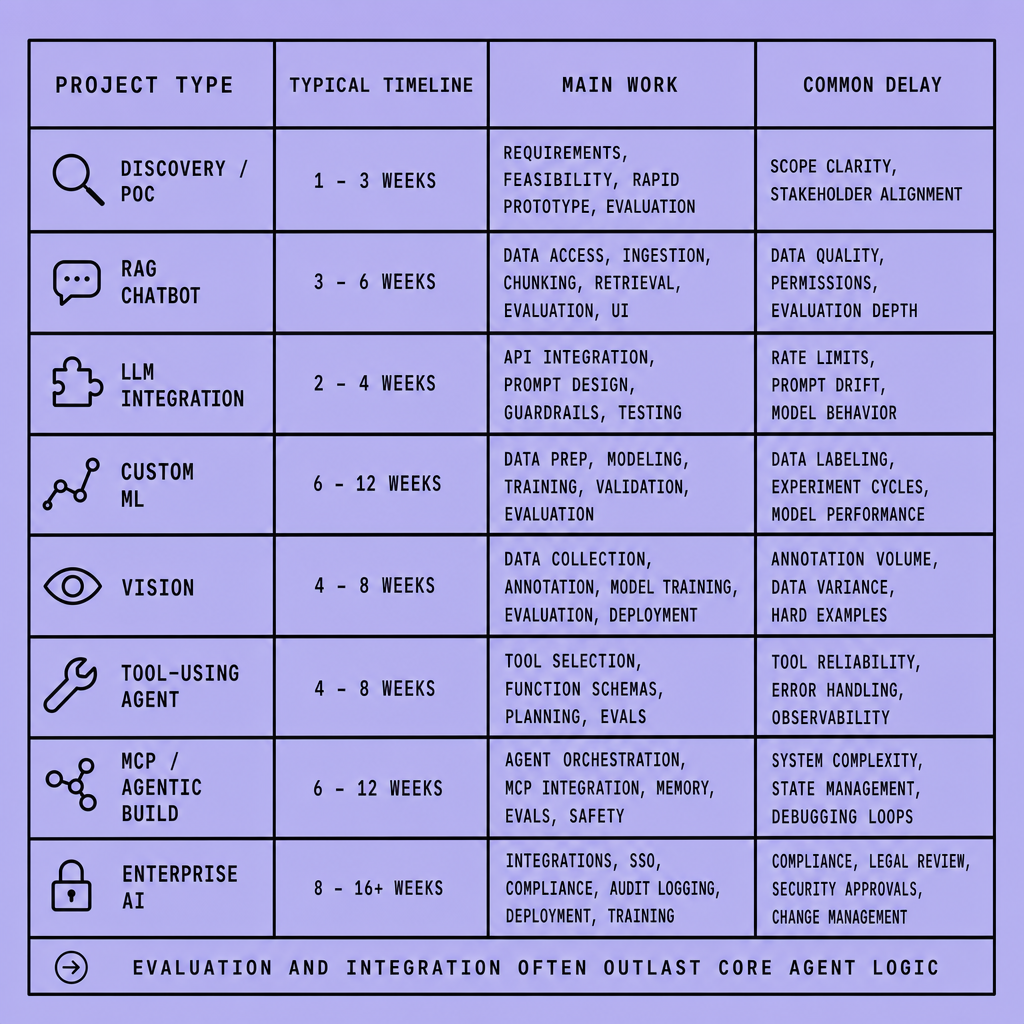
Typical timeline ranges across common AI projects
| Project type | Typical timeline | Main schedule drivers |
|---|---|---|
| Discovery / PoC | 2–3 weeks | use-case definition, data audit, success metrics, risk review |
| Architecture design | 3–4 weeks | system design, vendor choices, security constraints, rollout plan |
| LLM integration | 3–5 weeks | API wiring, prompt design, guardrails, UI/API changes |
| RAG chatbot | 4–6 weeks | ingestion, chunking, retrieval tuning, citations, feedback loop |
| Founder sprint | 6 weeks | rapid validation, prototype build, decision checkpoints |
| Custom ML | 8–12 weeks | labeling, training or fine-tuning, offline evaluation, deployment |
| Vision AI | 10–14 weeks | annotation, image/video pipelines, edge-case testing |
| Tool-using agent | 10–16 weeks | orchestration, tool reliability, permissions, human handoff |
| MCP / agentic build | 12–18 weeks | state, memory, multi-tool coordination, access control |
| Enterprise AI platform | 5–9 months | SSO, governance, observability, security, legal, change management |
What is hidden inside each estimate
A 2–3 week discovery phase is not just planning. It usually includes use-case selection, data access checks, failure-mode mapping, and a go/no-go decision on whether the idea merits a build.
RAG chatbot development time often expands because ingestion is real engineering work. Parsing files, chunking documents, tuning retrieval, and testing answer quality take longer than a demo suggests. By contrast, LLM integration can stay in the 3–5 week range when workflow changes are limited.
Agent timelines usually stretch fastest. A practical 12-week tool-using agent plan often looks like this:
- Weeks 1–2: scope, tools, permissions, evaluation design
- Weeks 3–5: agent logic, orchestration, prompt and tool calling
- Weeks 6–8: system integration and human handoff
- Weeks 9–12: evaluation, hardening, observability, rollout prep
The middle often moves faster than the end.
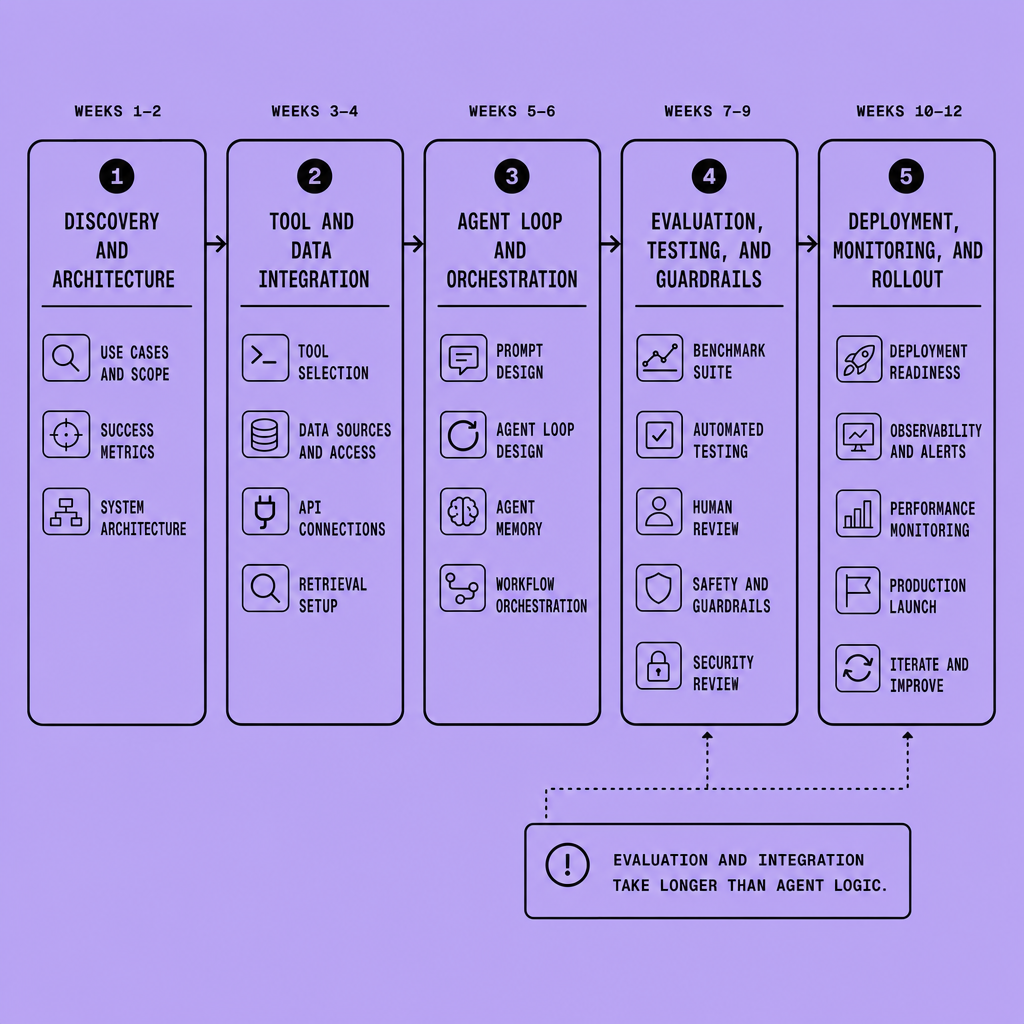
Evaluation and integration usually take longer than agent logic.
How teams compress an AI development timeline — and where it gets risky
Teams can shorten an AI implementation timeline by reducing integrations, narrowing user roles, reusing existing data pipelines, and postponing noncritical UI polish.
The tradeoff is straightforward: less scope can mean faster delivery, but aggressive compression usually increases rework risk. Review-heavy steps such as security checks, legal approval, and human-in-the-loop design often do not shrink much.
This is why a strong enterprise AI roadmap starts with constraints, not optimism.
A 12-Week AI Agent Development Timeline Broken Into Real Delivery Phases
A realistic 12-week build is not 12 weeks of agent logic. The schedule is usually shaped by scope, permissions, evaluation, integration, and launch controls. Teams often mistake an early sandbox demo for proof of readiness, then discover the harder work starts at the system boundary.
That makes the phase breakdown more than a project plan. It is a way to avoid false confidence.
Weeks 1–2: Discovery, architecture, and success criteria
Start by narrowing the job: what the agent should do, which systems it can touch, and where a human must stay in the loop.
In a compressed 12-week build, architecture work is usually scoped just enough to move forward. Useful outputs here include use-case boundaries, failure tolerance, data access assumptions, security constraints, and an initial evaluation plan. If the workflow is still vague, orchestration should wait.
Weeks 3–4: Tool contracts, permissions, and sandbox setup
Define tool contracts early: inputs, outputs, authentication, rate limits, retry behavior, and escalation rules.
Real agents often fail at handoffs between systems, not just in prompts. This phase also includes sandbox setup and permission mapping across internal APIs, SaaS tools, and user roles. Even a narrow first release can slow down here if access and approvals are unclear.
Weeks 5–6: Core orchestration and prototype loop design
Only now should teams build orchestration: planning logic, tool selection, memory or state handling, fallback behavior, and response formatting.
A prototype may look convincing quickly, but prototype-ready is not production-ready. Expected outputs in this phase include basic task execution, guardrails, logging, and a visible human-in-the-loop path.
Weeks 7–8: Evaluation harness and failure analysis
This phase is commonly underestimated.
Build the evaluation harness, define test sets, review failure modes, and check tool reliability, refusal behavior, retrieval quality, and multi-step breakdowns. This is often where schedules slip, because weak edge-case coverage creates rework later.
If a demo succeeds but retries, fallback paths, and user-facing controls are missing, the agent is not ready.
Weeks 9–10: Product integration and observability
Integrate with the real product: UI, queues, APIs, notifications, audit logs, and observability.
Here the schedule often grows. SSO, event handling, analytics, and rollback paths can add meaningful engineering work before launch.
Weeks 11–12: Security review, UAT, and launch readiness
Finish with UAT, security review, prompt and policy hardening, runbooks, and rollout controls. Start with a limited, monitored release before expanding.
Need it faster? Compression is possible, but it usually trades time savings for higher delivery risk and less room for testing, approvals, or remediation. Compliance and access reviews can still delay launch even when the core build is done.
Why Evaluation and Integration Usually Take Longer Than Agent Logic
The short answer: a prototype proves possibility, not reliability. That is why an AI development timeline often stretches after the agent first appears to work.
Getting an agent loop running can be fast. A model calls tools, reads context, returns an answer. Fine. But production work starts right after that moment -- and that work is usually larger than teams expect. Test set creation alone takes time because someone has to define what “good” means across real tasks, edge cases, bad inputs, missing data, and ambiguous requests. If the test set is weak, the whole AI project timeline becomes guesswork.
This is usually the point where optimism meets reality.
Teams often discover failure modes only after they run the system against live workflows: poor retrieval tuning, wrong document chunks, unsafe actions, brittle prompts, missing business rules, and inconsistent tool outputs. A prototype may succeed in a sandbox with clean inputs. A real product has messy permissions, stale records, partial API responses, and users who do not follow the happy path.
Integration slows things down for the same reason. The agent is not operating alone. It has to respect role-based access control, map to internal data models, handle API reliability issues, log every action, retry safely, expose observability, and trigger fallback design when confidence is low. Then human review steps get layered in -- approval queues, exception handling, and guardrails around sensitive actions.
Because reliable systems matter most, this is not “extra” work. It is the work.
A useful planning rule for any AI implementation timeline: expect prompt and orchestration logic to be a minority of effort once the build touches real systems. At Imversion Technologies Pvt Ltd, that execution pattern is the practical lens founders and engineering leaders should use. Not as a complaint. As a scheduling advantage.
So if a demo took days, production readiness may still take weeks. That is why a 10–16 week tool-using agent or a 12–18 week MCP/agentic build is driven less by agent logic than by evaluation depth, integration risk, compliance review, and operational hardening.
How to Compress an AI Development Timeline Without Breaking Quality
Yes, teams can shorten an AI project timeline. But the safe way is to compress scope before compressing validation.
That distinction matters.
A realistic AI implementation timeline gets shorter when the team reduces the MVP scope, not when it skips the hard parts. Narrow the use case. Cut the integration surface area. Reuse existing data pipelines instead of building new ingestion flows. Limit the first release to one department, one workflow, or one model-backed action. A staged rollout is usually faster than trying to launch full autonomy on day one.
For example, if a tool-using build normally fits a 10–16 week AI agent development timeline, a team may pull it closer to the low end by removing secondary tools, keeping approvals human-in-the-loop, and delaying cross-system write actions. But if the same team cuts evaluation coverage, security review, or permission design, the calendar may look better for a week or two -- then rework shows up.
This is where rushed AI schedules usually break.
Rush projects often carry a 25–40% premium. Not because vendors like urgency, but because compression creates real costs: parallel staffing, tighter coordination, faster review cycles, and more change churn. And the tradeoffs are predictable -- more rework, weaker test depth, coordination strain across product, engineering, security, and legal, plus deferred hardening around observability, fallback behavior, and auditability.
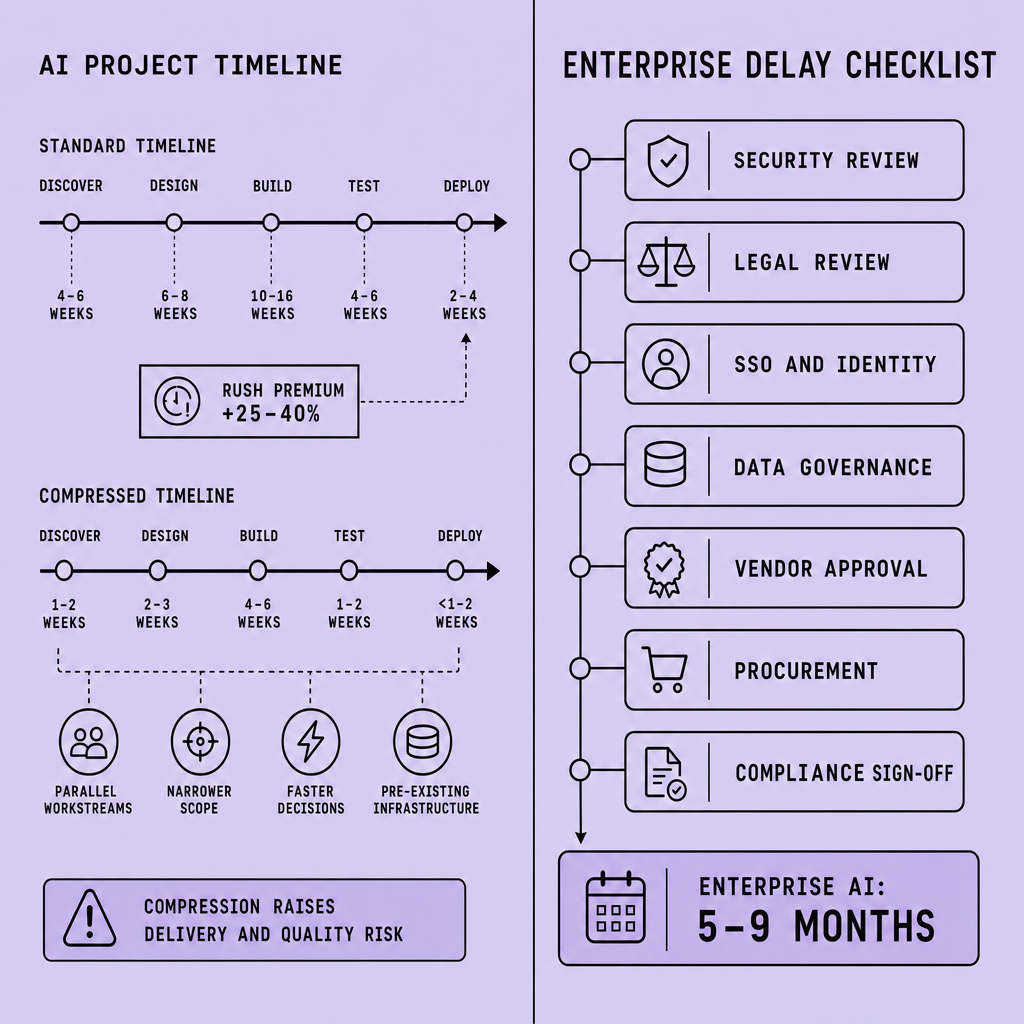
One rule holds across almost every AI development timeline: compress discovery breadth, rollout breadth, or autonomy first. Do not compress evaluation or security-critical review.
A smaller, reliable launch ships faster than an over-scoped AI project timeline that slips anyway.
Compliance, Security Review, and Enterprise AI Roadmap Delays to Plan For
Enterprise timelines slip for predictable reasons, not mysterious ones. A team may finish core build work in weeks, then spend months clearing the path to production. That is why an enterprise AI roadmap often lands in the 5–9 month range even when the underlying prototype looked fast.
The common delays are operational, and they are usually visible early if someone asks the right questions. SSO setup, security review, legal review, vendor assessment, procurement, data governance, auditability requirements, observability, change management, and internal platform dependencies can all extend the AI implementation timeline. Sometimes a model works by week six, but the application still cannot launch because identity, logging, approval flows, retention rules, network access, or deployment standards are unresolved.
This is normal enterprise delivery friction outside the model build itself. In practice, the AI project timeline grows when multiple teams must approve the same system. Security may require threat modeling and access controls. Legal may need contract review and data-handling terms. IT may need SSO, endpoint, and network decisions. Platform teams may require environment hardening, monitoring, and release process alignment. Business owners may ask for human-in-the-loop safeguards, fallback paths, and clear escalation rules.
So the planning implication is simple: treat these reviews as parallel workstreams, not surprise blockers at the end. During scoping, identify who must sign off, what artifacts they expect, which systems the AI workflow touches, and what nonfunctional requirements must be met before launch. Teams that surface compliance and dependency paths early make better commitments on the AI implementation timeline and the AI agent development timeline.
A Planning Framework for Setting a Credible AI Development Timeline
Bad AI timelines usually start with a date and work backward. The better starting point is scope. A credible AI development timeline usually comes from a few early planning choices: the problem being solved, the workflow being changed, the systems involved, and the standard for success. If those decisions stay vague, teams often anchor on a demo date and discover later that integration, review, and rollout were never truly planned.
A practical sequence is: discovery first, solution design second, rollout planning third. Discovery clarifies the use case, users, risks, and constraints. Solution design maps the model, tools, data flows, and integrations required. Rollout planning then separates what is needed for a prototype, a pilot, and production. That order helps prevent a fast proof of concept from being treated like an operational plan.
Use this checklist before committing an AI project timeline or AI implementation timeline:
- Define the use case, user, and workflow being changed
- Identify data sources, tools, APIs, and internal systems touched
- List assumptions, dependencies, and blocked decisions
- Set success criteria and evaluation gates
- Classify security, compliance, legal, and approval needs
- Decide whether phase one is a prototype, pilot, or production launch
- Separate build dates from review, testing, and rollout dates
- Name an owner for each dependency and decision
Demo-ready is not production-ready.
A sound enterprise AI roadmap treats evaluation, integration, and approvals as planned work, not cleanup after the build. Credible dates come from explicit scope and decision points, not optimism.
Frequently Asked Questions
What is the biggest reason an AI development timeline slips after a successful demo?
The biggest reason is that demos validate possibility, while production requires reliability. Teams still need evaluation datasets, permission models, logging, failure handling, deployment workflows, and stakeholder approvals. Those activities uncover hidden complexity that a sandbox demo does not expose, so the schedule often expands after early technical success.
How should founders estimate an AI development timeline when requirements are still changing?
Founders should estimate with ranges, phase gates, and explicit assumptions rather than one fixed launch date. The most accurate approach is to separate discovery, build, evaluation, integration, and approval work, then attach a decision point after each phase. This makes timeline changes visible early and prevents uncertain scope from being mistaken for committed delivery.
Why do enterprise approvals affect the AI development timeline so much?
Enterprise approvals affect timing because they involve external dependencies beyond the feature team’s direct control. Security, legal, procurement, IT, and governance groups each require different artifacts, reviews, and turnaround times. Even when engineering work is mostly done, the launch can remain blocked until those parallel approval paths are completed.
How can a team tell whether a project needs a prototype, pilot, or production plan?
A prototype is appropriate when the main question is whether the workflow can work at all. A pilot is appropriate when the concept works but needs validation with real users and limited risk. A production plan is necessary once the system touches live data, user permissions, operational metrics, and business-critical decisions.
When does it make sense to pay a rush premium for AI delivery?
It makes sense to pay a rush premium only when faster delivery creates clear business value that outweighs higher execution risk. Good reasons include time-sensitive market validation, investor deadlines with concrete milestones, or a narrow internal workflow with low compliance overhead. It is rarely justified for broad enterprise launches with many unresolved dependencies.
Make Imversion a preferred source on Google
Like this kind of AI and software analysis? Add Imversion as a preferred source so Google can highlight our articles for you in Search, AI Overviews, and AI Mode.