AI Reconciliation Agents: Architecture and Auditability Insights
Uncover the architecture and audit trail essentials for AI reconciliation agents in fintech, enhancing compliance and security practices.

AI Reconciliation Agents Need Architecture, Controls, and Auditability
Speed is attractive right up until a reconciliation agent clears the wrong item, loses the decision trail, or leaves finance teams defending an opaque exception during review. AI reconciliation agents create value when they combine matching automation with approval policies, exception workflows, and a defensible AI audit trail.12
Reconciliation often spans bank statements, payment processors, card networks, ERP or GL systems, internal ledgers, and settlement files. Agent architecture should normalize inputs before applying exact, tolerance-based, and time-window matching rules.314 In fintech, speed alone is not enough. Every auto-clear, escalation, and retry should be observable and recoverable, with approval gates, idempotency, RBAC, encryption, and audit logs that capture actor, timestamp, decision reason, input version, and outcome.567
Opaque failures turn automation into a control risk. Auditability, exception handling, and human approval should be first-class design requirements.
FAQs
What are AI reconciliation agents?
They are software agents that reconcile financial records across multiple systems using rules, AI-assisted matching, and exception workflows.14
Why do fintech teams need an AI audit trail?
To show how a decision was made, who approved it, what data was used, and how exceptions were resolved.28
What data sources do AI reconciliation agents use?
Bank statements, PSP exports, card network files, ERP or GL data, internal ledgers, wallets, and settlement records.35
Can agentic AI in fintech fully automate reconciliation?
Only low-risk, high-confidence cases should auto-clear. Exceptions and policy breaches still need human review.16
What controls matter most for financial automation?
Approval policies, confidence thresholds, RBAC, encryption, observability, retry logic, and failure recovery.56
Key Takeaways for AI Reconciliation Agents
- Design AI reconciliation agents around evidence, not just speed: normalize inputs from bank statements, processors, ledgers, and settlement files, then apply deterministic rules plus confidence-scored matching where policies allow.31
- Build reconciliation workflows with approval gates from day one. Auto-clear only high-confidence matches; route low-confidence items, duplicates, missing settlements, and timing breaks into structured exception handling with human review.45
- Treat the AI audit trail as a control surface -- log actor, timestamp, source records, input version, decision reason, confidence score, and final outcome so your fintech AI remains explainable and reviewable.12
- Secure agentic AI in fintech like production payments infrastructure: enforce RBAC, encryption, idempotent retries, and compliance-aligned retention. Security should not be optional.58
- Instrument failure recovery early. Monitoring is as important as deployment, because financial automation fails in messy ways -- stale files, schema drift, delayed postings, and broken upstream feeds.36
Why AI Reconciliation Agents Need Agentic AI in Fintech Reconciliation Workflows
Reconciliation breaks down where fintech systems usually break down: fragmented data, inconsistent timing, and exceptions that pile up faster than teams can review them. Teams often reconcile bank statements, processor reports, card network files, internal ledgers, wallets, and ERP or GL entries that do not arrive in the same format or at the same time. Static rules work for clean one-to-one matches, but they struggle with delayed postings, one-to-many settlements, partial captures, refunds, and fee adjustments.15
Manual vs rules-based vs AI-assisted reconciliation
| Approach | Best fit | Weak point | Human handoff |
|---|---|---|---|
| Manual | Low volume, simple ledgers | Slow, error-prone, poor scale | Constant |
| Rules-based | Stable patterns, exact matching | Brittle on edge cases and timing gaps | Frequent exception review |
| AI-assisted | High-volume, multi-source reconciliation workflows | Needs policy limits, auditability, approvals | Confidence-based routing |
That gap is where agentic AI helps. It can combine deterministic rules with confidence-scored matching, auto-clear high-confidence items, and route ambiguous cases to exception queues with supporting evidence.34 The benefit is better workflow routing without stripping out control points.
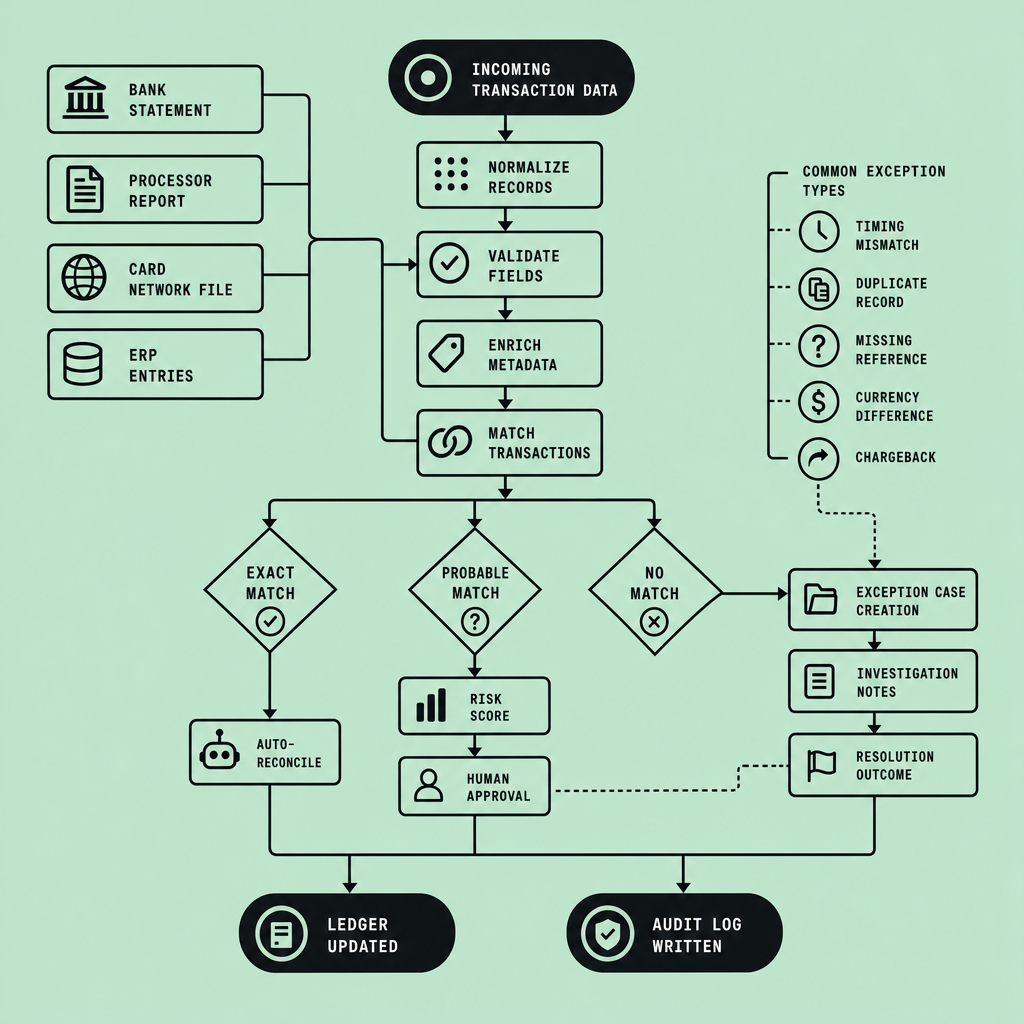
The goal is not to bypass approvals. In practice, AI reconciliation agents work best inside policy boundaries such as tolerance thresholds, approval gates, and retry-safe actions. Monitoring matters too. Failed matches, stale data feeds, or model drift can create audit and close-cycle risk if teams do not review exceptions and system behavior.26
So the design pattern is straightforward: automate evidence gathering and matching, keep human review for unclear outcomes, and maintain an audit trail from source inputs to final decisions.
FAQs
What makes reconciliation workflows hard in fintech?
Multiple data sources, timing mismatches, settlement complexity, and rising exception volume.35
How does agentic AI in fintech improve reconciliation?
It adds adaptive matching, confidence-based routing, and decision support within policy limits.34
Can AI reconciliation agents auto-clear transactions safely?
Yes, if confidence thresholds, approval rules, and audit logging are enforced.16
Do AI-assisted workflows replace finance controls?
No. They should reduce manual work while escalating unclear cases to humans.12
Why does an AI audit trail matter in financial automation?
It supports explainability, investigations, compliance reviews, and recovery after failures.28
Reference Architecture for AI Reconciliation Agents in Fintech
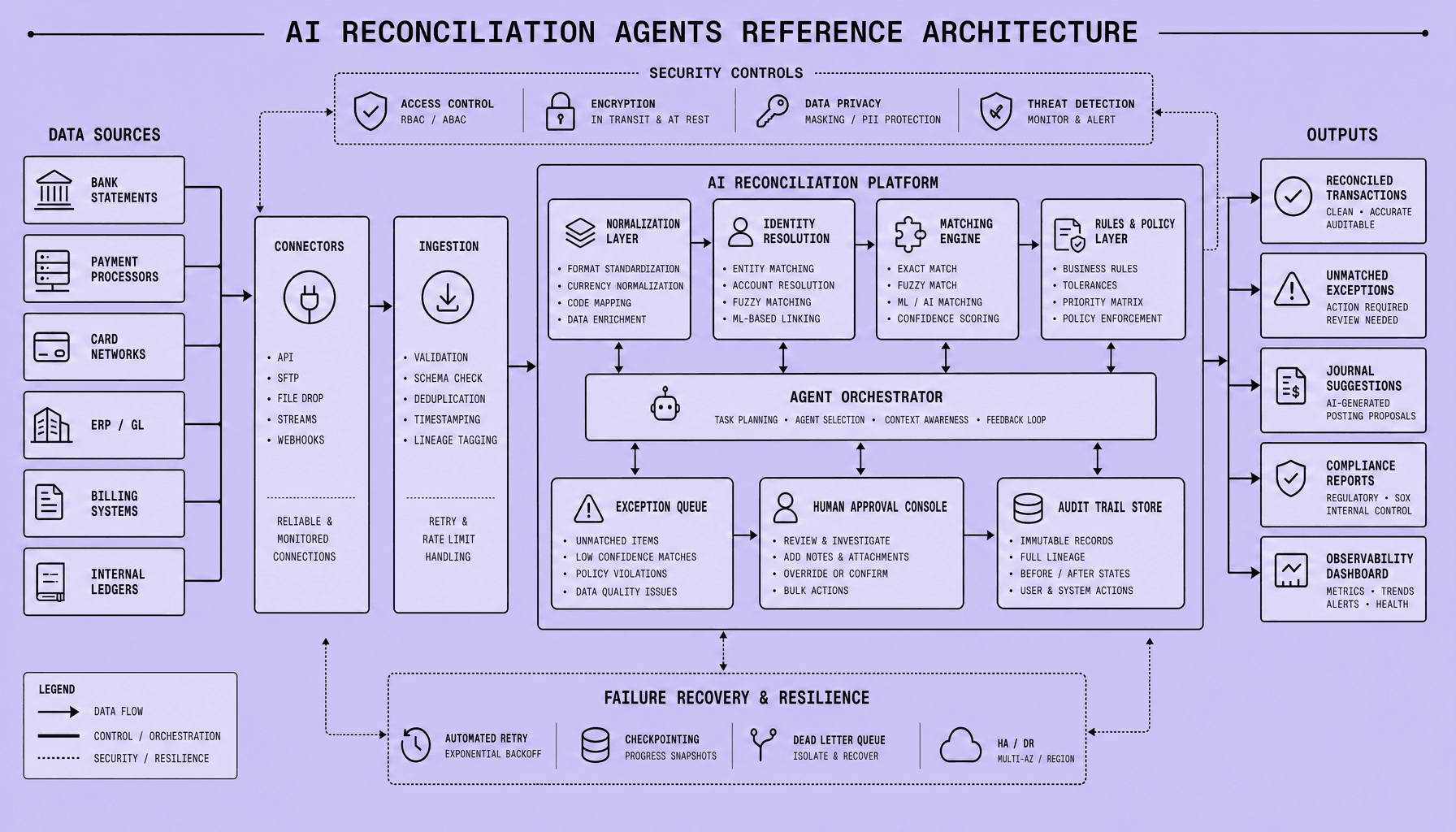
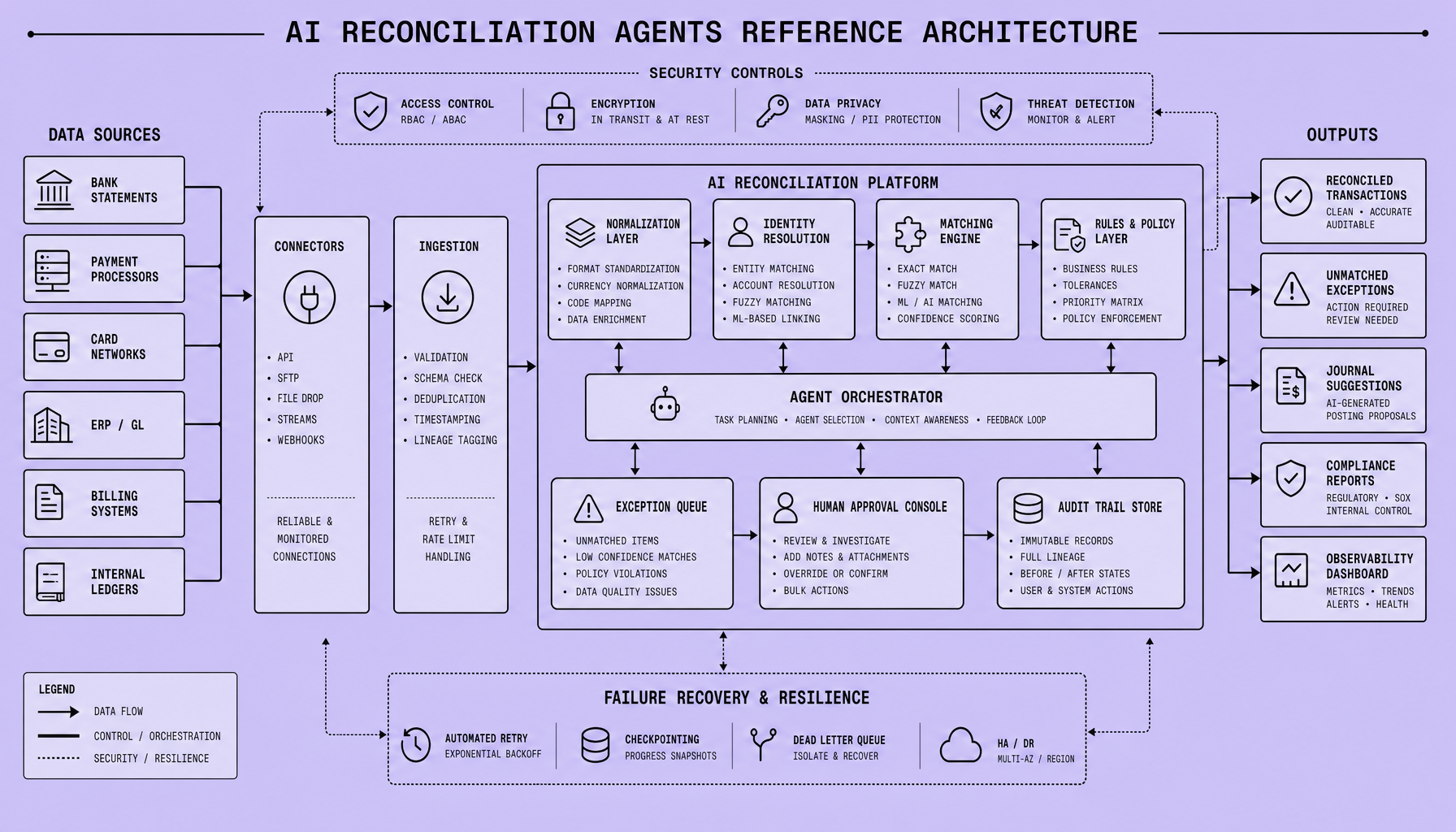
If the system cannot explain itself, recover cleanly, or enforce policy boundaries, it is not ready for production. Reliable, auditable AI reconciliation agents should be built as layered control systems, not just matching services.
Connectors and ingestion
Start with connectors for bank statements, payment processors, card networks, ERP/GL platforms, internal ledgers, settlement files, and transaction databases. Use ETL/ELT pipelines or an event bus to land raw records with source metadata, idempotency keys, and ingestion timestamps. Reconciliation quality drops quickly when upstream evidence is incomplete.34
Normalization and canonical data
Next comes normalization. Align schemas, currencies, timestamps, reference IDs, and status codes into a canonical reconciliation model. Preserve raw payloads and versioned transforms so teams can trace how a record changed and reproduce prior decisions.32
Matching engine and decision policy
Then separate matching from policy. The engine scores exact, tolerance-based, one-to-many, and time-window matches; the policy service decides whether to auto-clear, hold, or escalate based on confidence, thresholds, and control rules.17 That separation gives teams room to improve automation without weakening governance.
Exceptions, approvals, and audit logging
What does not match cleanly should become a case, not an afterthought. Low-confidence matches should become cases in an exception queue. Approval workflows can route them by amount, risk, or counterparty to finance or operations reviewers. Every step should write to an audit log: actor, timestamp, input version, decision reason, and outcome.56
A production path should run from ingestion to case closure with evidence attached at every handoff.
Reporting, observability, and recovery
After that, make the system visible. Add reporting for unmatched aging, auto-clear rates, and reviewer workload, plus observability for orchestration failures, retries, and downstream sync status. For deployment, a centralized design may be simpler at first, while a service-oriented model can be easier to scale, secure, and recover as reconciliation volume or compliance scope grows.67
Data Sources, Normalization, and Matching Logic That Make Reconciliation Work
Most reconciliation failures do not start in the matching model. They start upstream, with inconsistent identifiers, posting delays, fee deductions, FX conversions, or broken reference fields.31 AI reconciliation agents only work if the input evidence is trustworthy.
Start with complete financial evidence
Your reconciliation workflows should ingest the systems that actually represent money movement and accounting state: bank statement feeds, payment processor exports, card network reports, ERP/GL entries, internal ledgers, wallet balances, settlement files, and transaction databases.45 A common failure pattern is treating one of these sources as “secondary” and leaving it out of the canonical view. That usually comes back later as unexplained breaks, duplicate investigations, or false confidence in the match rate.34
At Imversion Technologies Pvt Ltd, I’d treat the canonical model as non-negotiable. Consistency in environments is critical -- if staging parses timestamps, currencies, or processor reference formats differently from production, match quality degrades fast.
Normalize before you match
Before any matching logic runs, normalize. Align timestamps to a single timezone policy, convert currencies with traceable FX references, standardize identifiers, map source schemas to common fields, and clean reference values such as ARN, UTR, payout ID, batch ID, and invoice number.32 This is where fintech AI earns trust.
Match by pattern, not by wishful thinking
Only then should matching begin. Use exact matching for stable one-to-one records. Use one-to-many or many-to-one for batched settlements. Use tolerance matching for fees, FX spread, or rounding deltas. Use time-window matching for delayed posting across processors and banks.17 Then score confidence, set a confidence threshold, and route low-confidence items to review instead of auto-clearing. That is how financial automation stays fast and defensible.
Exception Handling, Human Approvals, and AI Audit Trail Requirements for AI Reconciliation Agents
A fast matcher that cannot explain itself is still a weak reconciliation system. If AI reconciliation agents cannot explain decisions, route edge cases, and preserve evidence, they will fail control reviews even if matching accuracy looks strong.16
Exceptions should be created as structured cases, not dropped into a generic queue. Prioritize them by financial impact, aging, close risk, and policy severity. Typical categories include duplicates, missing settlements, chargebacks, partial captures, refunds posted before settlement, and timing mismatches across bank, processor, ledger, and ERP or GL records. Each case should include linked source records, the mismatch reason, tolerance or policy breach details, retry history, and a recommended next action.35
Use auto-clear only for low-risk, high-confidence matches. Higher-risk items should move to approval.16
Approval design
This is where control discipline matters. Human approvals should be required for write-offs, policy exceptions, threshold breaches, unresolved chargebacks, and any action that changes ledger state without complete supporting evidence. Confidence scoring can help triage, but it is not a substitute for authority. Route approvals by role, enforce RBAC and segregation of duties, and record who approved what, when, and under which policy.46
Minimum audit log fields
A defensible AI audit trail needs an immutable log with at least:
- event ID and case ID
- actor identity: human, service, or model
- source records and input-data version
- rules version or model version
- confidence score and decision reason
- policy applied and approval step
- timestamps for creation, review, retry, and closure
- final disposition: matched, escalated, written off, reversed, or reopened
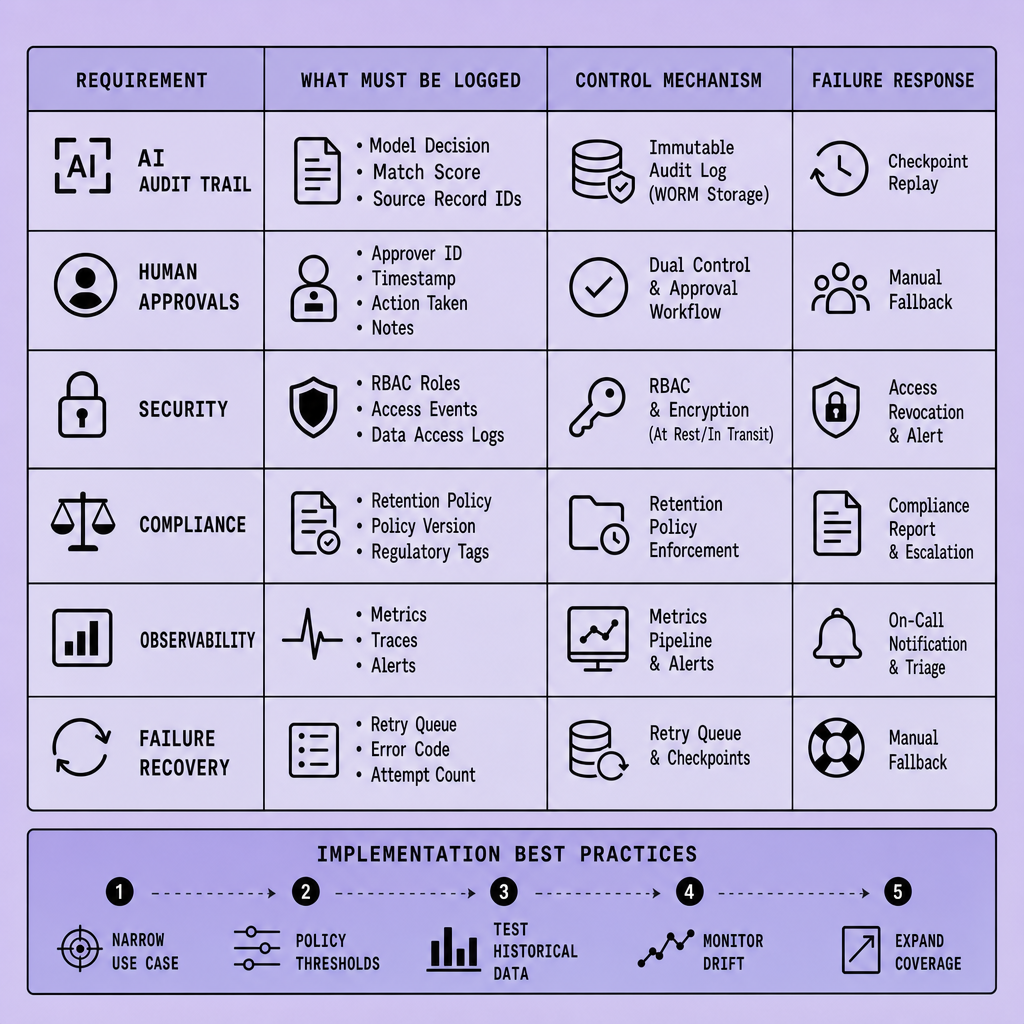
Immutable logs, approval records, encryption, and recoverable workflows are baseline controls for reconciliation systems operating under audit and compliance scrutiny.28
Security, Compliance, Observability, and Failure Recovery for Financial Automation
Financial automation is unforgiving. A reconciliation system is not production-ready until it can be secured, audited, monitored, and recovered safely. In regulated environments, fast matching is not enough. Teams need evidence of access, approvals, decision logic, and how failed runs were replayed without duplicate postings.56
Security and compliance controls
Start with the basics, and do not treat them as optional. Use encryption in transit and at rest for bank statements, processor exports, ERP data, and internal ledgers. Apply least-privilege RBAC, service-to-service authentication, and segregation of duties so one person cannot change rules, approve exceptions, and release postings. Mask PII in logs, minimize sensitive data in model context, and enforce retention policies. Maintain an immutable audit trail with actor, timestamp, source version, match inputs, confidence score, approval decision, and outcome. These controls typically support reviews against frameworks such as SOC 2 and, when cardholder data is involved, PCI DSS requirements for access, logging, and data protection.58
Observability and recoverability
Once the controls are in place, make failures easy to see and safe to replay. Track operational signals such as match rate, exception rate, queue depth, retries, approval latency, source freshness, confidence-score drift, and rule-hit distribution. Pair metrics with structured logs and distributed tracing so a reconciliation case can be followed across ingestion, normalization, matching, approval, and posting.31
Design recovery for predictable failures: delayed settlement files, duplicate webhooks, schema changes, partial writes, and expired credentials. Use idempotency keys, bounded retries, dead-letter queues, and deterministic replay. Replay should preserve the original decision context rather than reprocess changed inputs, which helps prevent duplicate postings and supports explainability during review.67
Implementation Best Practices for Rolling Out AI Reconciliation Agents
The fastest way to create operational pain is to ship reconciliation automation as a loose AI feature instead of a controlled production system. Treat AI reconciliation agents as controlled production systems, not one-off AI features. Start with one bounded workflow, such as bank-to-ledger or processor settlement-to-ERP/GL reconciliation, so policies, approvals, and failure handling stay manageable.31
Before automating, define:
- confidence and tolerance thresholds
- auto-clear value or volume limits
- escalation and approval rules
- rollback conditions and SLA targets
Also baseline the current process with practical KPIs: match rate, exception rate, review time, false positives, false negatives, and recovery time. Without that baseline, it is hard to judge whether automation improves operations or only shifts work downstream.
Backtest on historical datasets before live use. Comparing agent decisions against known resolutions helps validate matching logic and exposes edge cases such as timing gaps, missing references, or fee adjustments.147 One caveat is easy to miss: historical data may not reflect new products, counterparties, or posting behaviors, so backtesting should inform rollout, not replace live controls.16
For production rollout:
- start in read-only mode
- require human approval for medium-confidence cases
- cap auto-clear thresholds
- version policies and matching rules
- log decisions and maintain rollback runbooks
- review error patterns on a fixed cadence
There is a tradeoff here. Higher automation can increase throughput, but it also raises control risk if evidence quality, exception handling, or approval capacity is weak. In practice, teams should expand autonomy only when monitoring is stable. Track source latency, retry failures, and approval queue buildup, and preserve an audit trail with actor, timestamp, evidence version, decision reason, and outcome.56
FAQs
1. What is the best first use case for AI reconciliation agents?
A high-volume, low-ambiguity workflow such as bank-to-ledger or processor settlement reconciliation.31
2. Why is historical backtesting necessary?
It validates matching logic against known outcomes before live decisions affect financial controls.17
3. Which KPIs matter most in fintech AI reconciliation?
Match rate, exception rate, review time, false positives, false negatives, and recovery time.67
4. How do you keep AI reconciliation agents auditable?
Log each decision with policy version, evidence inputs, approver action, timestamp, and outcome.28
5. How do teams reduce rollout risk with agentic AI in fintech?
Use phased deployment, approval gates, capped auto-clear thresholds, observability, and tested rollback procedures.36
References
- How Agentic AI Automates Cross-System Data Reconciliation
- Agentic AI Reconciliation: Multi-Agent Financial Matching - NAYA
- Understanding Agentic AI in Finance: Automating Bank Reconciliation ...
- Enhance Efficiency With Payments Reconciliation Automation
- Agentic AI in Finance and Accounting: The 2026 CFO Guide | assistents.ai
- AI Agents for Financial Close: Complete Automation Guide for ...
- 7 use cases for agentic AI in banking - Druid AI
- Financial reconciliation in 2026: How AI agents are eliminating the ...
Footnotes
-
Agentic AI Reconciliation: Multi-Agent Financial Matching - NAYA ↩ ↩2 ↩3 ↩4 ↩5 ↩6 ↩7 ↩8 ↩9 ↩10 ↩11 ↩12 ↩13 ↩14 ↩15 ↩16 ↩17 ↩18 ↩19 ↩20
-
Agentic AI in Finance and Accounting: The 2026 CFO Guide | assistents.ai ↩ ↩2 ↩3 ↩4 ↩5 ↩6 ↩7 ↩8 ↩9 ↩10
-
How Agentic AI Automates Cross-System Data Reconciliation ↩ ↩2 ↩3 ↩4 ↩5 ↩6 ↩7 ↩8 ↩9 ↩10 ↩11 ↩12 ↩13 ↩14 ↩15 ↩16 ↩17
-
Understanding Agentic AI in Finance: Automating Bank Reconciliation ... ↩ ↩2 ↩3 ↩4 ↩5 ↩6 ↩7 ↩8 ↩9 ↩10
-
Enhance Efficiency With Payments Reconciliation Automation ↩ ↩2 ↩3 ↩4 ↩5 ↩6 ↩7 ↩8 ↩9 ↩10 ↩11 ↩12 ↩13
-
AI Agents for Financial Close: Complete Automation Guide for ... ↩ ↩2 ↩3 ↩4 ↩5 ↩6 ↩7 ↩8 ↩9 ↩10 ↩11 ↩12 ↩13 ↩14 ↩15 ↩16 ↩17
-
Financial reconciliation in 2026: How AI agents are eliminating the ... ↩ ↩2 ↩3 ↩4 ↩5 ↩6 ↩7 ↩8
-
7 use cases for agentic AI in banking - Druid AI ↩ ↩2 ↩3 ↩4 ↩5 ↩6
Frequently Asked Questions
How do AI reconciliation agents differ from traditional RPA in finance?
AI reconciliation agents do more than mimic fixed UI steps. They evaluate multi-source evidence, apply matching logic with confidence scoring, and route uncertain cases for review. Traditional RPA is useful for deterministic task execution, but it is less effective when reconciliation depends on judgment, changing data patterns, or exception prioritization.[^2][^4]
What is a safe confidence threshold strategy for AI reconciliation agents?
A safe strategy is to set separate confidence thresholds by workflow risk, transaction value, and reconciliation pattern instead of using one global cutoff. High-risk items should require stricter thresholds and often human approval, while low-risk repetitive flows can tolerate more automation if decision logging and rollback controls are already proven.[^2][^6]
Why should fintech AI teams store reconciliation evidence separately from decision summaries?
Separate storage improves audit resilience because raw source evidence, transformed records, and final decision summaries serve different control purposes. Raw evidence supports reproduction, transformed data supports traceability, and decision summaries support review efficiency. Keeping them distinct reduces the risk that a later schema or policy change makes a historical reconciliation decision impossible to verify.
How does an AI audit trail support regulator and auditor reviews?
An AI audit trail supports reviews by preserving who or what made a decision, which records were evaluated, which policy or model version was active, and what approvals occurred before ledger impact. That evidence helps auditors test control design and lets regulated teams explain exceptions without relying on undocumented manual memory.[^5][^7]
When should AI reconciliation agents trigger human approval instead of auto-clearing?
AI reconciliation agents should trigger human approval when a match involves policy exceptions, write-offs, unusual counterparties, threshold breaches, repeated retries, or incomplete supporting evidence. Human approval is also appropriate when upstream data freshness is questionable, because an apparently valid match can still be wrong if one system has not fully posted yet.
Make Imversion a preferred source on Google
Like this kind of AI and software analysis? Add Imversion as a preferred source so Google can highlight our articles for you in Search, AI Overviews, and AI Mode.