HIPAA AI: Automating Healthcare Compliance Safely 2026
Learn what HIPAA AI allows you to automate in healthcare and how to safely implement AI agents while ensuring compliance.

What HIPAA AI Actually Lets You Automate
Most healthcare teams are not asking whether AI is fashionable. They are trying to figure out what they can automate without creating a compliance mess, exposing PHI, or pushing risky decisions onto software that should never be making them.123
HIPAA AI Key Takeaways
- Start with administrative healthcare automation -- scheduling, intake, eligibility, and prior authorization prep are the safest early uses for AI agents in healthcare.14
- HIPAA AI works only when PHI access is tightly limited under the minimum necessary standard, with role-based access, encryption, and audit logs.23
- A vendor handling PHI is typically a business associate, so a BAA and documented risk assessment are baseline HIPAA compliance requirements.13
- Use HIPAA compliant AI with human review for sensitive actions, exceptions, and anything that could affect care, billing, or disclosures. Monitoring matters as much as deployment.23
HIPAA Basics That Define What AI Agents in Healthcare Can Do
The fastest way to get HIPAA AI wrong is to frame it as a yes-or-no question. HIPAA does not ban AI healthcare automation. It defines the conditions under which AI agents in healthcare can use PHI. The real question is not “Can we use AI?” but “What PHI can this system access, for what purpose, and under what controls?”12
HIPAA Privacy Rule
The HIPAA Privacy Rule governs how PHI is used and disclosed. For AI workflow design, the practical constraint is the minimum necessary standard: an agent should access only the data needed for a specific task.23 A scheduling agent may need demographics, appointment details, and provider availability, but not full clinical notes. A prior authorization assistant may need payer, diagnosis, and procedure context, not unrestricted chart access.
HIPAA Security Rule
The HIPAA Security Rule governs how electronic PHI is protected. In practice, HIPAA-compliant AI needs access controls, encryption, audit logs, authentication, and documented risk analysis.123 This rule shapes architecture choices directly, including least-privilege service accounts, scoped API access, log retention, and review steps for higher-risk actions.
Breach Notification Rule
If PHI is exposed, improperly accessed, or disclosed through an AI workflow, the Breach Notification Rule defines the response: investigation, documentation, and required notifications.23 Which means breach readiness belongs in implementation from the start, not after something goes wrong.
When is an AI vendor a business associate?
If a vendor creates, receives, maintains, or transmits PHI for a covered entity, it is typically a business associate and needs a BAA.123 Covered entities include providers, health plans, and clearinghouses. Without a BAA, PHI use is usually not appropriate.
That leads to a fairly clear implementation pattern: limit PHI, document the use case, validate security controls, perform a risk assessment, and keep human review for exceptions or sensitive outputs. That is the baseline HIPAA framework that defines what AI agents in healthcare can do.123
FAQs
Is AI allowed under HIPAA?
Yes. HIPAA allows AI agents in healthcare if PHI use is permitted, secured, limited to minimum necessary access, and covered by the right agreements and controls.12
Do AI vendors need a BAA?
If they handle PHI on behalf of a covered entity, yes—they are typically business associates and need a BAA.13
What can AI agents in healthcare automate safely?
Administrative workflows are common starting points, including scheduling, intake, eligibility checks, and prior authorization prep, with scoped PHI access and auditability.14
What HIPAA AI Can Safely Automate First
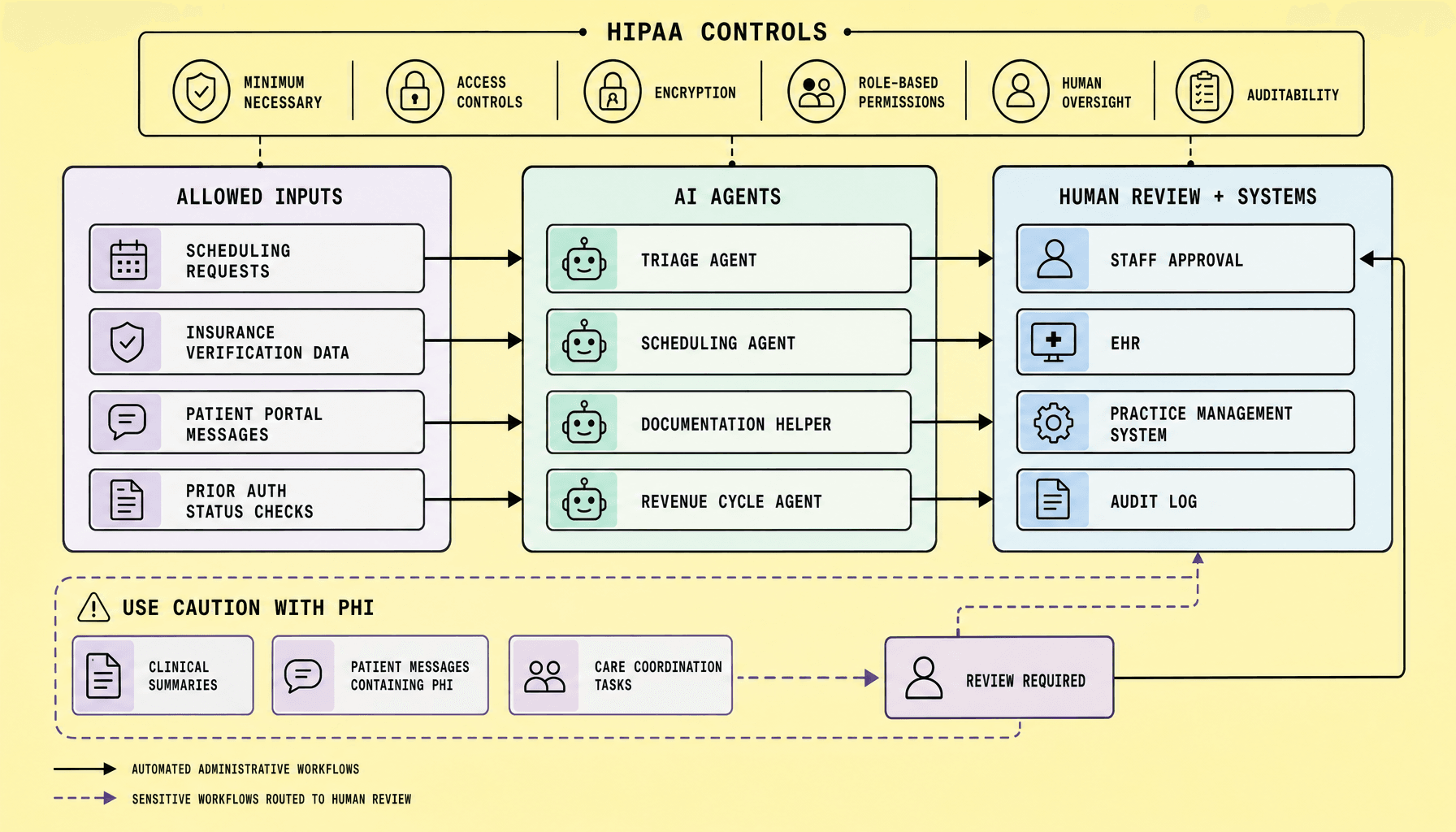
This is where teams either save time or create trouble. Start with repetitive administrative work, not clinical judgment. That is the safest line for HIPAA AI -- automate tasks that move data, collect documents, trigger follow-ups, and prepare staff work, while keeping diagnosis, treatment decisions, and edge-case exceptions under human control.12
Scheduling, reminders, and front-desk workflows
AI agents in healthcare are well suited to appointment scheduling, rescheduling, cancellation handling, and reminder messages. These workflows are structured, rules-driven, and easy to verify in audit logs. Patient-facing agents can confirm provider availability, collect basic reason-for-visit details, and route urgent cases to staff rather than making triage decisions themselves.54
This is where healthcare automation usually pays off first. Fast.
Patient intake and document collection
Patient intake is another strong early use case for AI healthcare. Agents can send intake forms, request insurance cards, collect consent documents, validate missing fields, and push completed packets into the EHR or document management system.64 But they should not interpret symptoms, rewrite clinical history without review, or decide what is medically relevant.
Use them to gather. Not to diagnose.
Eligibility verification and prior authorization prep
Eligibility verification, benefits checks, and prior authorization preparation are high-volume tasks with clear inputs and outputs. AI agents can extract payer details, assemble required documents, draft submission packets, and flag missing information for staff review.15 That cuts manual effort without handing over final approval authority.
There is a reason to stay disciplined here. Prior auth failures create downstream billing and care delays, so human oversight should stay in the loop for exceptions and payer-specific rules.
Billing support and claim status follow-up
Billing support is a practical next step: claim status checks, denial categorization, coding support drafts, payment posting assistance, and follow-up task creation.16 The safe boundary is simple -- let the agent prepare and route work, but require staff sign-off for coding changes, appeals language, or any action that could affect reimbursement accuracy or patient liability.
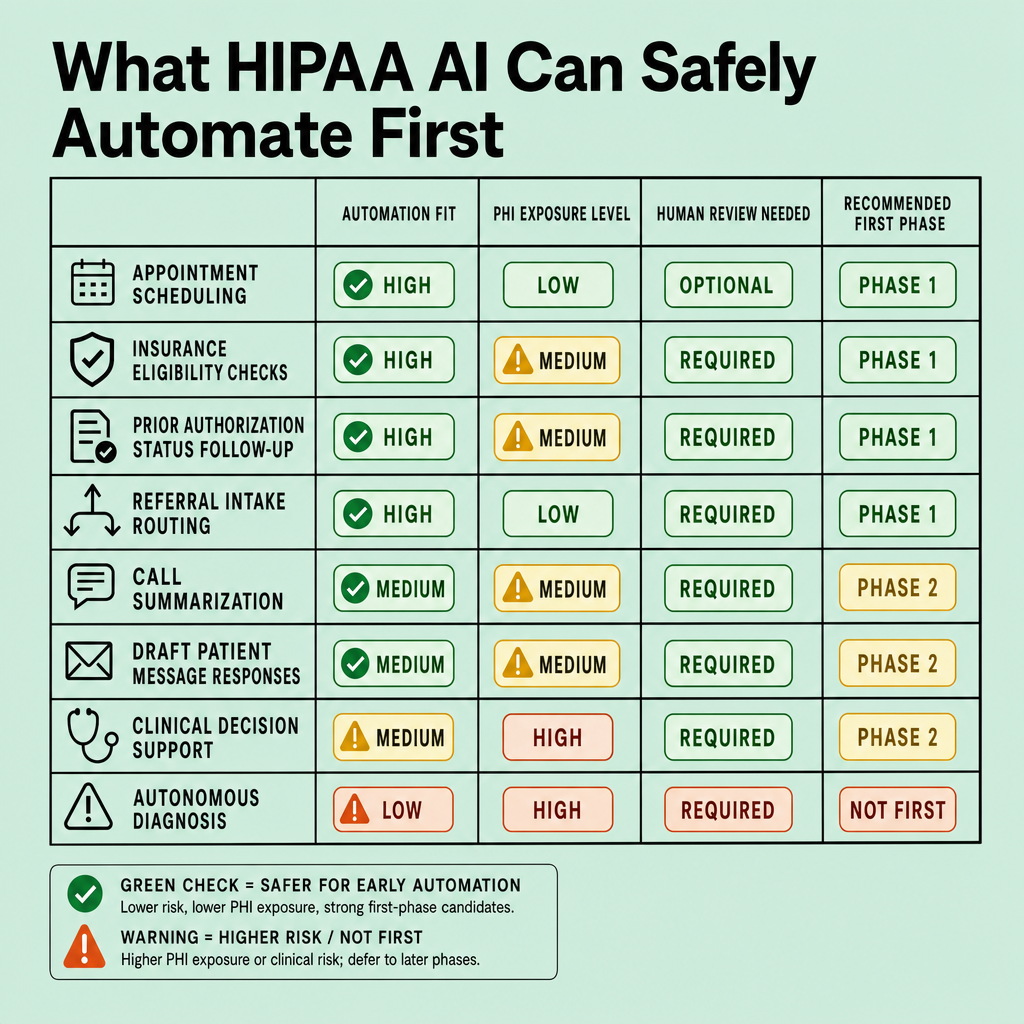
Monitoring matters as much as deployment -- especially for AI agents in healthcare that touch PHI, payer workflows, and audit-sensitive records.
In practice, the lowest-risk healthcare automation uses structured workflows with minimum necessary PHI, role-based access, and clear human approval points before anything consequential is submitted or changed.23
HIPAA AI PHI Handling Rules, Human Oversight, and Security Controls
Once AI agents in healthcare touch PHI, vague policy language stops being useful. You need hard operational guardrails. HIPAA compliance becomes defensible when the agent only gets the minimum necessary data, under role-based access control, with a signed BAA, documented risk assessment, and traceable system activity.23
Use the simplest rule first: do not give a scheduling bot full chart access if it only needs name, appointment slot, and contact details. Redact or tokenize where possible. Keep PHI encrypted in transit and at rest, and separate environments so test systems never use live patient data. Teams often create compliance gaps during staging, debugging, or support handoffs, so environment discipline matters.23
Required controls for HIPAA compliant AI
At a minimum, HIPAA compliant AI should enforce:
- minimum necessary PHI access
- role-based permissions
- encryption at rest and in transit
- audit logs for access, actions, prompts, and outputs
- monitoring for anomalous access or failed controls
- retention and deletion rules
- incident response tied to breach handling obligations123
If you cannot see who accessed PHI, what the agent produced, and where data moved, your AI healthcare workflow is not auditable.2
Where human-in-the-loop is mandatory
Human-in-the-loop review should be explicit for approvals, outbound patient communications, exceptions, and any irreversible action. An agent can draft a prior authorization packet, route intake forms, or prepare a message. But a human should release sensitive outputs, validate ambiguous records, and resolve edge cases before PHI leaves the system. That is the safe line between useful healthcare automation and unsafe delegation.74
BAA Requirements, Risk Assessment, and Common HIPAA AI Mistakes
This is the part teams try to rush, and it is usually where avoidable risk starts. If an AI vendor will create, receive, maintain, or transmit PHI for you, a BAA is not optional. That includes many HIPAA AI and AI agents in healthcare use cases -- even “back-office” automations like intake, eligibility, routing, summarization, or prior authorization support if PHI passes through the tool.123
What procurement and compliance should verify
Vendor review needs more than a sales deck. You should confirm a signed Business Associate Agreement, documented data retention and deletion terms, encryption in transit and at rest, role-based access controls, subcontractor disclosures, breach notification terms, and a usable audit trail.123 Then ask a blunt question: where does the data go, exactly? If the vendor cannot show clear data flow mapping, your HIPAA compliance posture is weak before implementation even starts.
“HIPAA-ready” marketing is not proof of HIPAA compliant AI.73
How risk assessment applies to AI tools
Run a risk analysis before exposing any PHI. Map what data the agent can access, what actions it can take, which systems it touches, and where human approval is required.23 An agent with broad permissions and no review path can create silent audit and disclosure risk fast, which is why monitoring needs to be built into the design, not stapled on later.23
Common mistakes that derail safe healthcare automation
Teams still make the same avoidable errors:
- using consumer AI tools without a BAA3
- granting broad PHI access instead of minimum necessary2
- skipping audit logs and access review12
- failing to document data flows and subprocessors
- assuming vendor claims equal HIPAA compliance73
For AI healthcare, the safe path is simple. Signed agreements first. Documented controls next. PHI access last.
Safe Implementation Practices for HIPAA Compliant AI
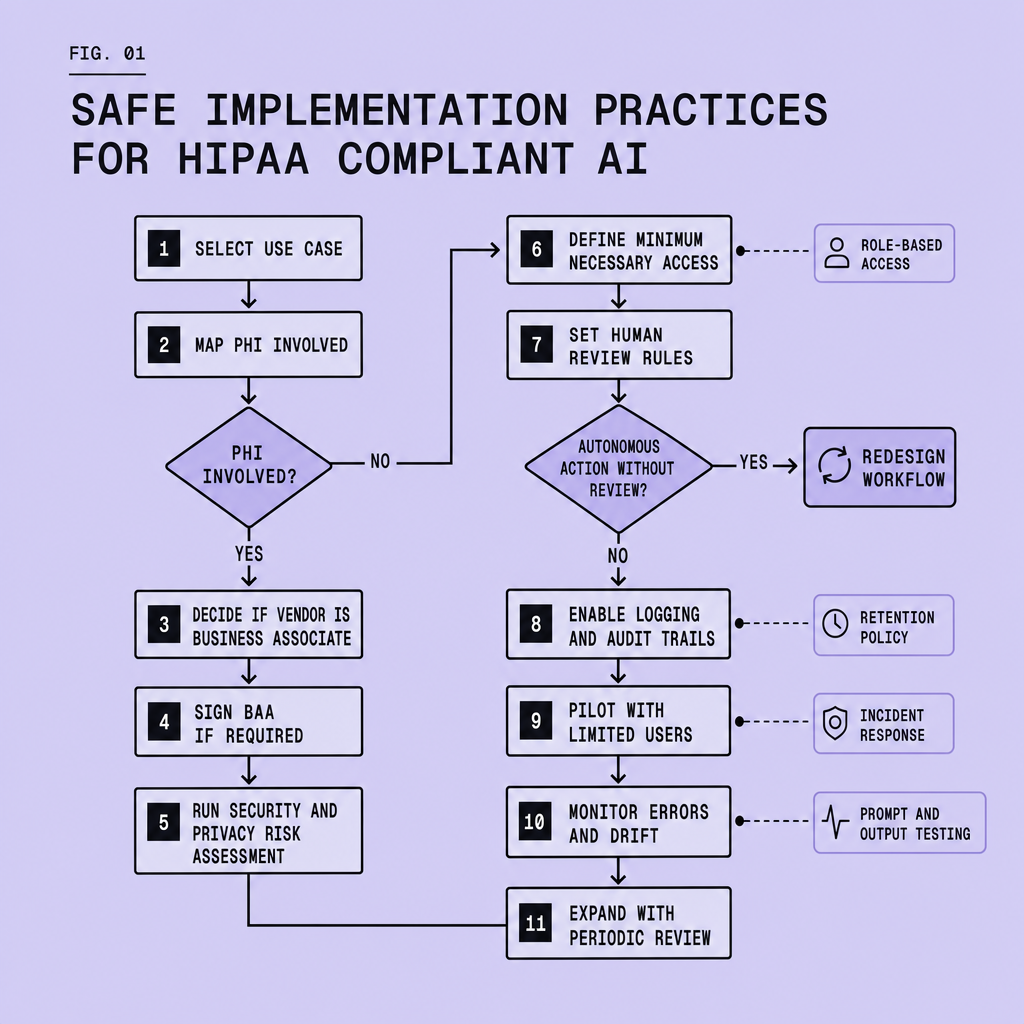
Most failures do not happen because the first workflow was too small. They happen because the rollout was too wide. Broad PHI access, vague approvals, multiple workflows at once, no clear owner for exceptions -- that is how healthcare automation gets risky fast.
Roll out slowly. That is the safest path for HIPAA compliant AI.
Start with one low-risk pilot workflow
Pick a single administrative use case such as scheduling, intake document collection, eligibility verification, or prior authorization prep. These are common starting points for AI agents in healthcare because they deliver operational value without pushing the system into clinical decision-making.14 Define the exact inputs, outputs, users, and escalation path before you connect any system.
Map PHI touchpoints and contract coverage
Document where PHI enters, where it is processed, where it is stored, and which vendor systems can access it. Then confirm Business Associate Agreement coverage for every vendor that creates, receives, maintains, or transmits PHI.23 If the workflow crosses EHR, ticketing, email, and file-sharing systems, map all of them. No blind spots.
Lock down access, logging, and approvals
Use least privilege from day one: service accounts, role-based access control, scoped API tokens, and encryption in transit and at rest.12 Enable audit logs for prompts, actions, record access, and human overrides. Post-launch review should be part of the rollout plan, not an afterthought, because monitoring matters as much as deployment.16
If you cannot show who accessed PHI, what the agent did, and who approved exceptions, you do not have a safe deployment.
Test failure cases before production
Run failure testing on bad inputs, incomplete records, wrong-patient scenarios, timeout conditions, and unauthorized access attempts. Define human-in-the-loop approvals for anything that affects records, patient communications, billing submission, or workflow exceptions. Vendors promoting HIPAA AI often emphasize security controls, but your team still owns change management, exception handling, and output review.75
Train staff and review outputs regularly
Staff training should cover PHI boundaries, escalation rules, approval points, and how to report incorrect outputs. Then review sampled outputs, logs, and incidents on a fixed cadence as part of governance and risk assessment.63
Start small. Verify controls. Expand in phases only after the pilot workflow proves safe in practice.
References
- HIPAA Compliant AI: Tools and Agents for Healthcare
- 10 No-Code AI Agent Builders for Healthcare (HIPAA) - Nirmitee.io
- AI Agents and HIPAA: Solving the PHI Access Challenge - Kiteworks
- 7 HIPAA-Compliant Automation Tools for Healthcare - Zenphi
- Top 10 AI Agents Healthcare for 2026 (HIPAA-Compliant) - Prosper AI
- How To Use AI While Staying HIPAA Compliant
- Healthcare AI Agents: Automating Patient Intake, Scheduling, and ...
- HIPAA-Compliant AI Agents: How Medtech Can Automate ... - YouTube
Footnotes
-
HIPAA Compliant AI: Tools and Agents for Healthcare ↩ ↩2 ↩3 ↩4 ↩5 ↩6 ↩7 ↩8 ↩9 ↩10 ↩11 ↩12 ↩13 ↩14 ↩15 ↩16 ↩17 ↩18 ↩19 ↩20
-
AI Agents and HIPAA: Solving the PHI Access Challenge - Kiteworks ↩ ↩2 ↩3 ↩4 ↩5 ↩6 ↩7 ↩8 ↩9 ↩10 ↩11 ↩12 ↩13 ↩14 ↩15 ↩16 ↩17 ↩18 ↩19 ↩20 ↩21 ↩22 ↩23 ↩24
-
How To Use AI While Staying HIPAA Compliant ↩ ↩2 ↩3 ↩4 ↩5 ↩6 ↩7 ↩8 ↩9 ↩10 ↩11 ↩12 ↩13 ↩14 ↩15 ↩16 ↩17 ↩18 ↩19 ↩20 ↩21 ↩22 ↩23
-
Healthcare AI Agents: Automating Patient Intake, Scheduling, and ... ↩ ↩2 ↩3 ↩4 ↩5 ↩6
-
Top 10 AI Agents Healthcare for 2026 (HIPAA-Compliant) - Prosper AI ↩ ↩2 ↩3
-
7 HIPAA-Compliant Automation Tools for Healthcare - Zenphi ↩ ↩2 ↩3 ↩4
-
10 No-Code AI Agent Builders for Healthcare (HIPAA) - Nirmitee.io ↩ ↩2 ↩3 ↩4
Frequently Asked Questions
What makes a HIPAA AI tool different from a standard AI tool?
A HIPAA AI tool is designed to operate under healthcare privacy and security requirements, which means it supports controls such as minimum-necessary PHI access, audit logging, encryption, and business associate contracting when PHI is involved. A general-purpose AI tool may be useful technically but still be inappropriate for regulated healthcare workflows without those safeguards.[^1][^6]
How does HIPAA AI affect model training on patient data?
HIPAA AI does not automatically permit vendors to train models on patient data just because the tool is used by a healthcare organization. Training rights, data use limits, de-identification standards, and retention terms should be explicitly defined in contracts and reviewed during vendor assessment to avoid secondary use of PHI beyond the intended workflow.[^3][^6]
Why should AI agents in healthcare keep separate production and test environments?
Production and test separation reduces the chance that live PHI will be exposed during debugging, quality assurance, or workflow changes. It also makes access review, incident investigation, and data lifecycle control more reliable, which is especially important when multiple teams or vendors support the same healthcare automation environment.
Can AI agents in healthcare send patient messages automatically?
Yes, but only within narrow guardrails. Routine reminders, intake prompts, and administrative follow-ups are better candidates than messages involving diagnosis, treatment interpretation, or unusual exceptions. The safest approach is to predefine approved message types, log every outbound action, and require human release for sensitive or ambiguous communications.[^2][^7]
What is the best first step for a HIPAA AI rollout?
The best first step is to select one low-risk administrative workflow and document it end to end before any deployment begins. That means defining the purpose, PHI used, systems touched, human approval points, vendor obligations, and failure scenarios so the organization can evaluate compliance and operational risk in a controlled way.[^1][^3]
Make Imversion a preferred source on Google
Like this kind of AI and software analysis? Add Imversion as a preferred source so Google can highlight our articles for you in Search, AI Overviews, and AI Mode.