Fine Tuning vs Prompting: A Practical Team's Guide for 2026
Explore why teams should consider prompting over fine tuning for LLMs. Learn practical tips and when fine tuning is truly necessary.

On this page
Fine Tuning vs Prompting: Why Most Teams Should Start With Prompting, Retrieval, and Tools
If your LLM output is drifting, breaking JSON, or confidently getting facts wrong, fine-tuning is rarely the first fix. Most teams get better results faster by tightening prompts, adding a few strong examples, enforcing structured outputs, grounding answers with retrieval, and giving the model access to tools.
Teams ask, should you fine tune an llm, before they have isolated the failure. Usually, weak output comes from missing context, vague instructions, bad formatting constraints, or the wrong base model. Fix those first: a tighter system prompt, 3-10 strong examples, JSON Schema or function calling, retrieval over current docs, and tools like SQL, search APIs, or calculators.
That is the practical split in prompt engineering vs fine tuning. Prompting and tools improve behavior at the system level. Fine-tuning is a second-order optimization.
Fine-tuning earns its keep later -- when to fine tune llms is clear: stable style, rigid format, domain vocabulary, smaller-model cost or latency targets, and narrow classification. But it rarely adds reliable new knowledge. For that, retrieval usually wins because content changes. And llm fine tuning costs do not stop at training; they continue with labeling, evaluation, retuning after model upgrades, and ongoing maintenance.
Key Takeaways
-
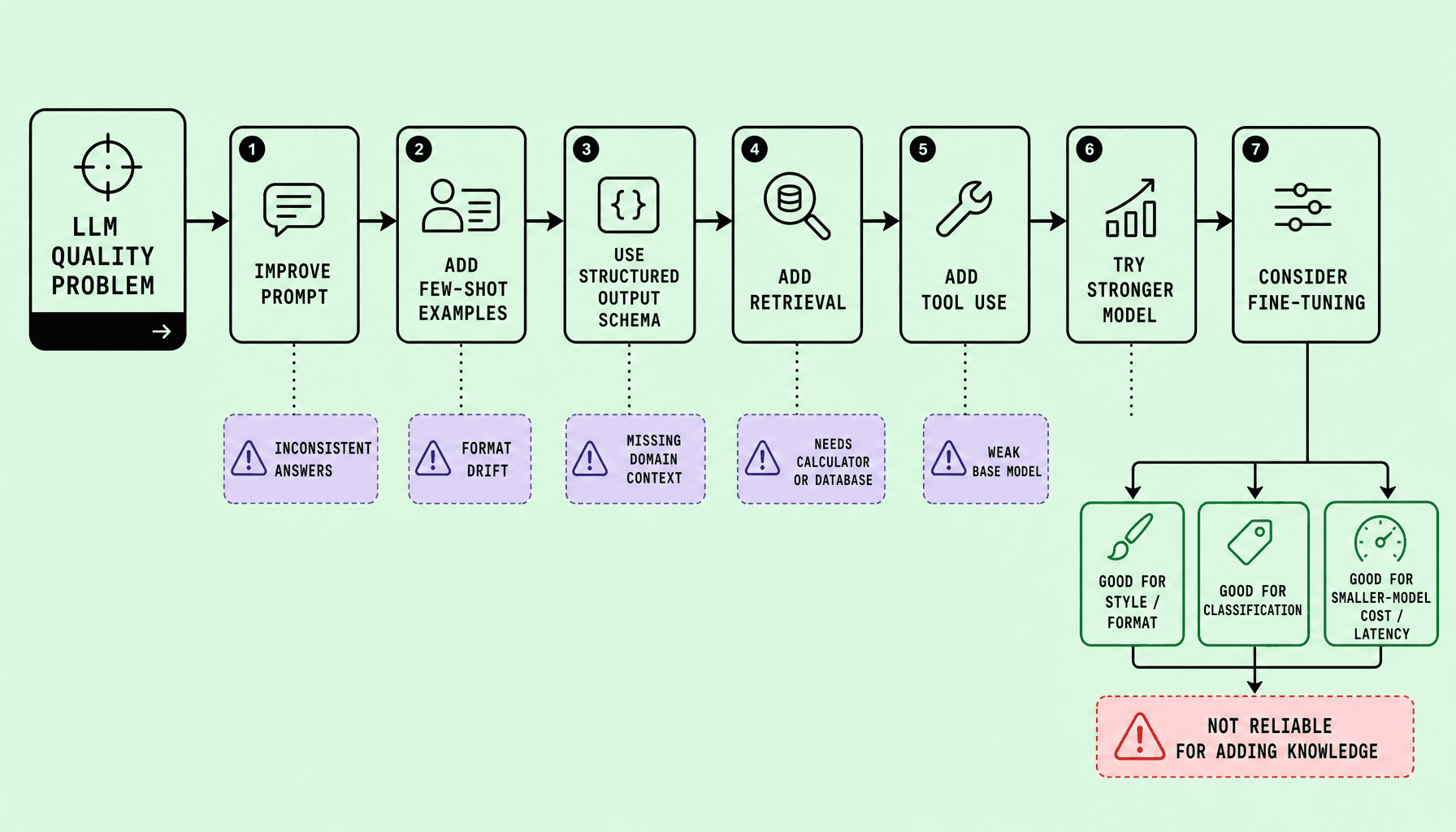
Most teams should treat fine tuning vs prompting as a sequencing question, not a philosophy debate. Try prompt engineering vs fine tuning in the right order: tighten the system prompt, add a few strong examples, enforce JSON Schema or function calling, plug in retrieval, test tool use, and swap in a better base model before training anything.
-
When to fine tune LLMs: after the basics work, but you need tighter style, repeated output formats, domain vocabulary, smaller-model cost or latency gains, or stable classification behavior. Fine-tuning helps with behavior shaping. It is not the first fix for a weak system.
-
Fine-tuning does not reliably add knowledge. If facts change -- pricing, policies, product docs, SQL data, internal wiki content -- retrieval and tools beat training because they stay current and are easier to verify.
-
The hidden drag is operational. LLM fine tuning costs include dataset creation, labeling rules, annotation time, eval design, failed runs, and retraining after model upgrades. Teams often underestimate this.
-
A practical rule: if better retrieval plus stronger evaluation raises pass rate enough, stop there. At Imversion Technologies Pvt Ltd, the better path is usually the simpler one -- clarity beats complexity.
Why Teams Reach for Fine-Tuning Too Early
When an LLM starts slipping in production, the temptation is predictable. The answers drift. JSON breaks. Domain terms get mangled. A hallucination leaks into a user-facing flow. Fine-tuning feels like the obvious fix.
Usually, it is not.
Most of these failures are system design failures, not training failures. If a model ignores format rules, start with a tighter system prompt, few-shot prompting, or constrained decoding against a JSON Schema. If it lacks current product or policy knowledge, retrieval beats training because the knowledge can change tomorrow. If it needs exact numbers, SQL, or live status, give it tool use and function calling instead of asking it to guess. If outputs are still weak after that, test a stronger base model before starting a tuning pipeline. Prompt engineering vs fine tuning is not a philosophy debate. It is a sequencing decision.
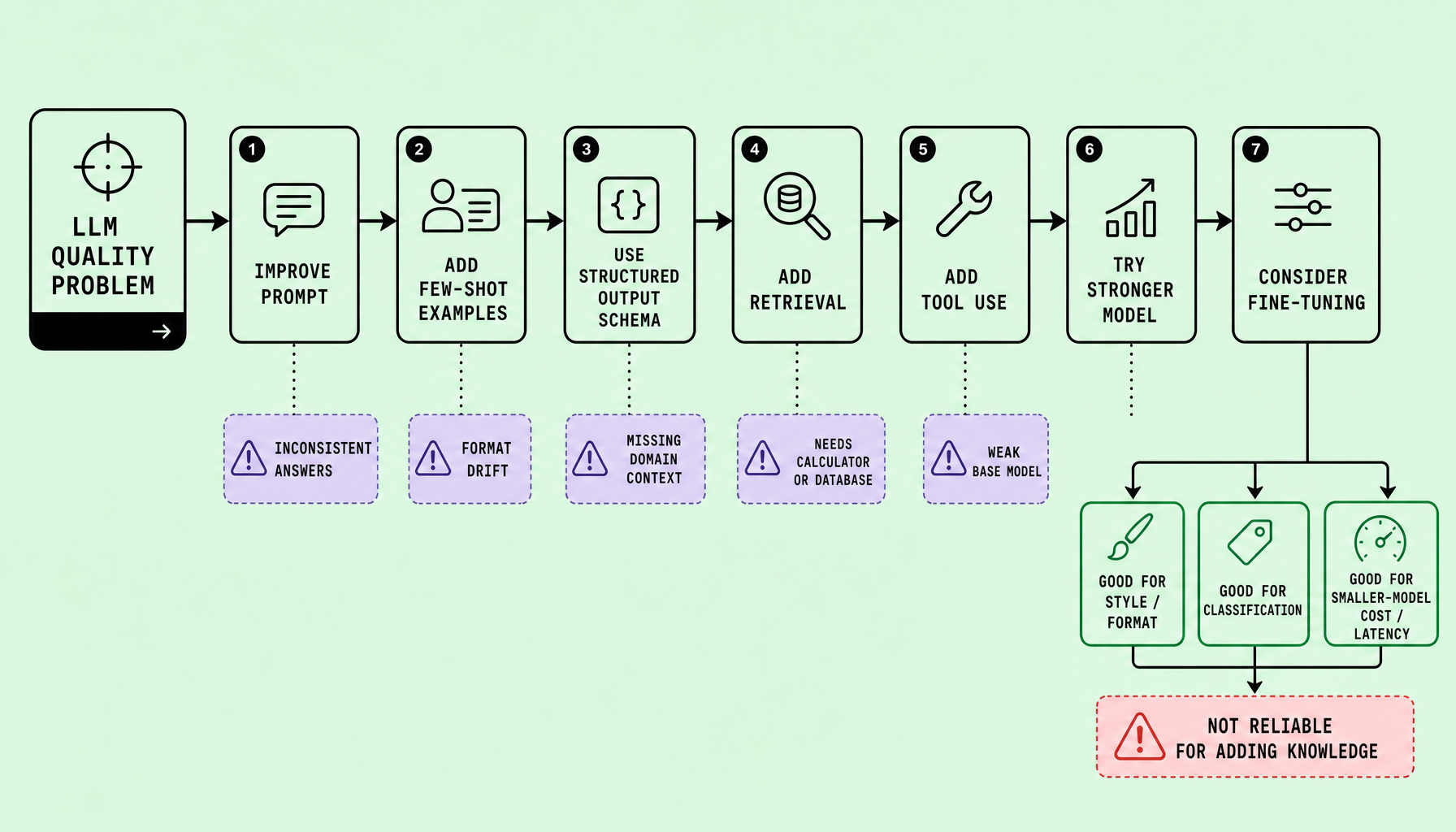
Here is the practical test: if the team cannot clearly say whether the issue is knowledge, formatting, reasoning, or workflow integration, they are not ready to fine-tune.
The reason is simple. Fine-tuning does not reliably add usable knowledge. It teaches patterns from examples. That helps for style, vocabulary, classification, and making a smaller model behave more like a bigger one at lower latency or token cost. But hallucination caused by missing facts, stale docs, or absent tools usually survives training. Sometimes it gets harder to spot.
Then the maintenance bill shows up. Fine-tuning means dataset curation, labeling rules, annotation review, an evaluation harness, retraining after base model upgrades, and re-checking regressions every time prompts, schemas, or workflows change. Teams asking should you fine tune an llm often skip that burden in the first discussion.
A good rule: before asking when to fine tune llms, prove that prompting, retrieval, tools, schemas, and base model substitution have already failed on a real eval set.
Understanding why the model fails is what keeps this grounded. Without that, fine-tuning becomes an expensive way to hide unclear requirements.
Fine Tuning vs Prompting in Practice: What to Try Before You Train
Most teams do not need a training pipeline. They need a better order of operations.
In practice, fine tuning vs prompting is a sequencing question. Start with the lowest-cost fixes that address instructions, structure, knowledge access, and tool use. If those do not solve the problem, training may be justified.
A useful order looks like this:
1) Fix the prompt before the model
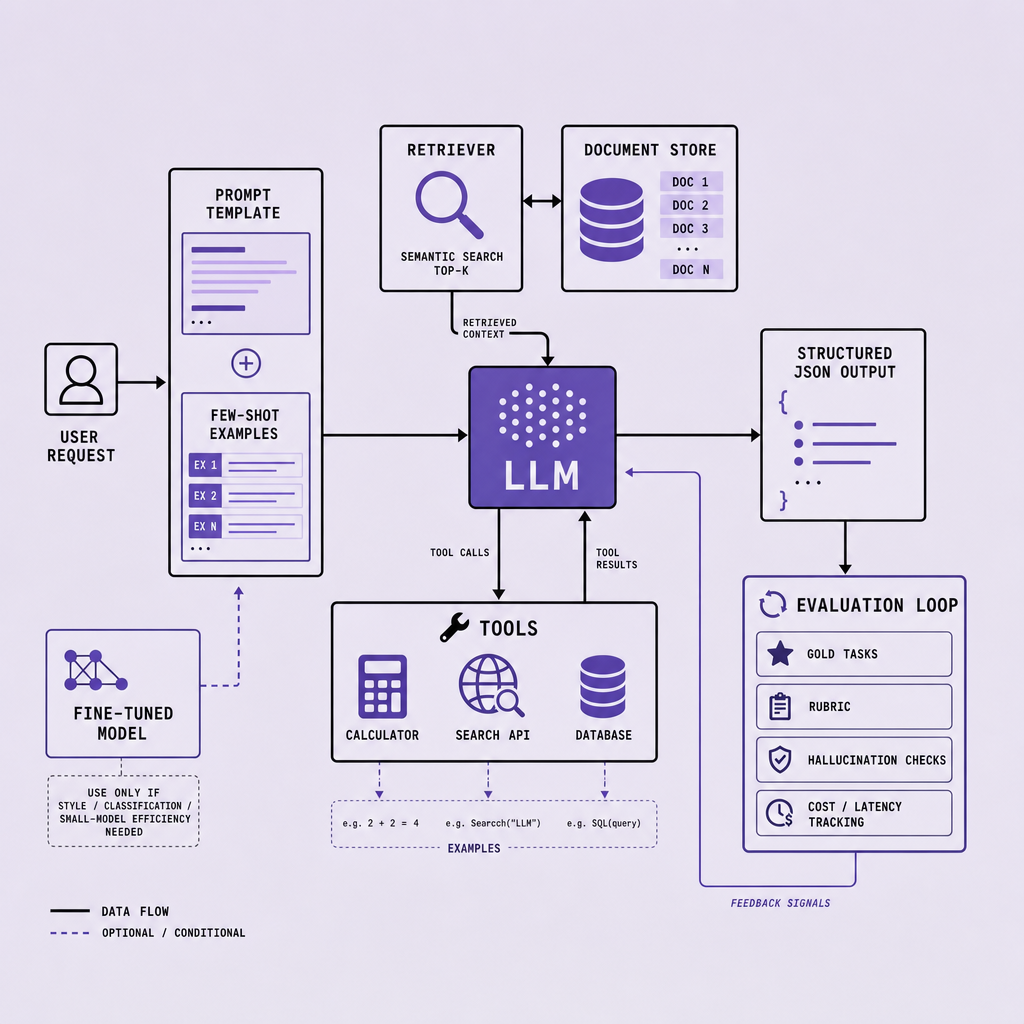
If the model rambles, misses edge cases, or applies the wrong policy, prompt engineering vs fine tuning is the first test. Tighten the system prompt and add 3-10 few-shot examples that demonstrate the exact behavior you want.
For support triage, do not say “classify this ticket.” Say: classify into billing, bug, or account_access; explain in one sentence; escalate if refund or legal risk appears.
2) Control the output shape
If the failure is broken JSON, inconsistent fields, or formatting drift, training is often the wrong tool. Use JSON Schema, function calling, or constrained decoding.
That kind of failure is usually a control problem, not a knowledge problem.
3) Add retrieval for changing knowledge
If answers depend on current docs, policies, or internal wiki content, retrieval vs fine tuning is usually the clearer choice. Use RAG with a search index or vector database and pass relevant snippets at runtime.
Fine-tuning may reinforce patterns from historical data, but it is not the best way to keep answers current.
4) Give the model tools
If the task needs exact answers or live system data, let the model call SQL, APIs, or a calculator. Retrieval can find the policy; tool use can fetch the current customer record. That is more reliable than expecting the model to infer or memorize dynamic information.
5) Try a better base model
Many teams skip this step. Test stronger model options before training around base-model limitations.
| Approach | Best fit | Main risk | Ongoing work |
|---|---|---|---|
| Prompting + few-shot | Behavior drift, weak instructions | Fragile examples | Low |
| Structured outputs | JSON, extraction, schema control | Over-constrained responses | Low |
| RAG / tool use | Changing knowledge, precise lookup | Retrieval quality | Medium |
| Model substitution | Base model weakness | Higher per-call cost | Low |
| Fine-tuning | Style, vocabulary, classification, small-model optimization | Data, eval, retraining | High |
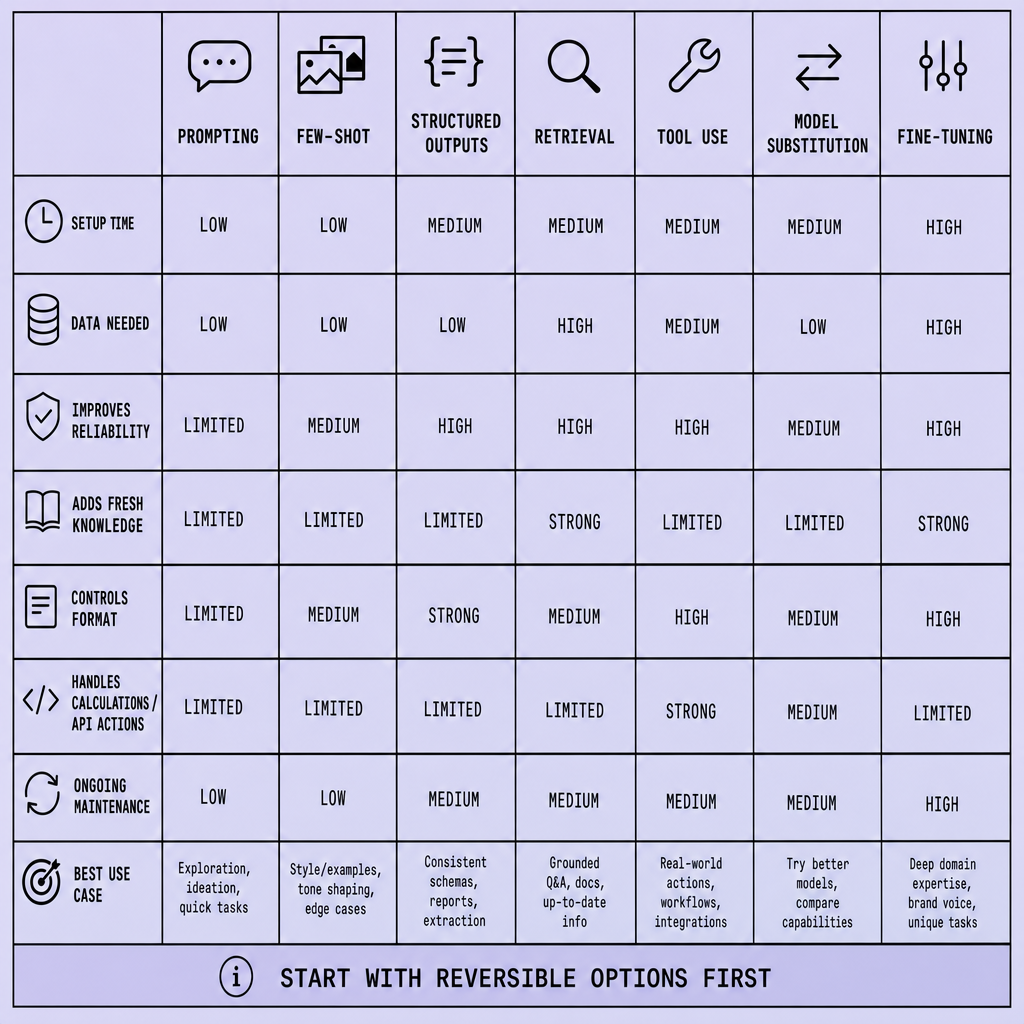
Recommendation: measure eval pass rate before and after each step. Decisions should be backed by data, not frustration with one bad demo.
If prompt engineering vs fine tuning still points to training after these checks, then fine-tuning has earned its place.
When Fine-Tuning Actually Works: Style, Vocabulary, Small Models, and Classification
Fine-tuning has real value. The mistake is expecting it to solve the wrong class of problems.
The best cases are narrow, measurable, and operationally clear: better house style, tighter format adherence, stronger handling of domain vocabulary, higher classification accuracy, or acceptable quality from a small language model that needs to hit a hard latency budget or throughput target.
Style and format are trainable behaviors because they repeat. If every good answer follows the same structure, tone, disclaimer pattern, or JSON shape, instruction tuning can compress that behavior into the model so the prompt does less work. This becomes relevant when prompt engineering vs fine tuning turns into a cost question rather than a capability question. A shorter prompt can reduce tokens on every call. Across high-volume traffic, llm fine tuning costs may be justified by lower inference spend and fewer formatting failures.
Vocabulary is similar. If a model keeps mishandling domain vocabulary -- insurance codes, medical abbreviations, internal product names, legal clauses -- a curated dataset can teach the model how those terms appear in context. But this is pattern learning, not broad knowledge transfer. Fine-tuning helps the model speak the language more reliably. It does not make the model a living database.
Small models are one of the strongest ROI cases. A tuned Llama or Mistral-class model can be good enough for a narrow workflow where a larger frontier model is too slow or too expensive. Think support routing, form normalization, or constrained summarization at scale. If success means meeting a response-time target and passing evals often enough, fine-tuning can close the gap.
Classification is another strong fit because the task is explicit and measurable. Labels, confusion matrices, pass rates. Clear feedback loops. Classification gives teams a clean way to test whether tuning actually improved production behavior.
Fine-tuning earns its keep when success is narrow and measurable: lower prompt tokens, better schema adherence, cheaper inference, or higher label accuracy.
So, when to fine tune llms? After simpler fixes. And only when the win is specific enough to measure against the ongoing llm fine tuning costs of data prep, labeling, evaluation, retraining, and model upgrades.
Why Fine-Tuning Does Not Reliably Add Knowledge in Fine Tuning vs Prompting
A model that sounds informed is not the same as a model that has dependable access to current facts. That distinction drives most of the confusion here.
Fine-tuning is a weak primary strategy for factual knowledge. It can teach patterns. It does not give the model a dependable source of truth.
That gets missed constantly.
A fine-tuned model may learn that certain phrases often follow other phrases, that a support answer should mention a refund window, or that a contract summary usually highlights termination clauses first. But memorized patterns are not the same as grounded access to current information. If the answer lives in product docs, pricing data, policy documents, legal text, or an internal wiki, the model should retrieve it from a knowledge base or a document index at runtime.
Because facts change.
If the answer changes weekly, monthly, by region, or by customer account, training is the wrong place to store it. Pricing pages get revised. Policy documents change. Internal wiki pages drift. Legal language gets updated. In the retrieval vs fine tuning debate, this is the core issue: freshness and traceability are retrieval problems, not training problems.
And stale training data is expensive to fix. You have to collect examples, label them well, run a new fine-tune, re-test behavior, and then repeat that work after model upgrades. Those are real llm fine tuning costs -- not just compute, but annotation hours, eval maintenance, and operational drag.
Retrieval-augmented generation handles this better. Search the right documents. Pass the relevant chunks. Cite them. Or use tool access -- SQL, search APIs, business systems -- when the answer should come from live data.
So, should you fine tune an llm for knowledge-heavy tasks? Usually no.
Use fine-tuning for behavior. Use retrieval for facts.
That is the practical answer to prompt engineering vs fine tuning, and a big part of when to fine tune llms: after the team has already solved knowledge access with retrieval, not before.
The Hidden Cost of Fine-Tuning: Data, Labeling, Evaluation, and Retraining After Model Upgrades
The expensive part of fine-tuning is usually not the training run. It is everything around it.
The biggest mistake is treating fine-tuning like a one-time experiment. It is an ongoing system commitment.
The hidden work starts before training. Someone has to define the task precisely, write annotation guidelines, collect examples, remove bad samples, and build a train-validation split that reflects real production traffic instead of a convenient spreadsheet. If the labels are inconsistent, the model will learn that inconsistency. Fast.
This is where many llm fine tuning costs actually live.
A usable pipeline usually needs four separate workstreams: dataset design, labeling, evaluation, and maintenance after deployment. Miss one and the result gets fuzzy. Teams say the model feels “better,” but they cannot prove it. That is a weak place to be.
Do not fine-tune until there is a golden dataset and a success metric that can separate real gains from noise.
Evaluation is the hard part. Offline evaluation should test exact failure modes: schema validity, refusal behavior, classification accuracy, tone compliance, tool-selection accuracy. Then online evaluation has to check what happens with real users, real latency, and real edge cases. Without regression testing, one “improvement” can quietly break another path.
This is why prompt engineering vs fine tuning is often the wrong first framing. The better question is: can the team measure improvement reliably?
Model upgrades make the cost recurring. Switch from one GPT, Claude, Llama, or Mistral base model to another, and behavior shifts -- sometimes enough to require retuning, reevaluating, or even rebuilding the dataset. Old examples may stop being representative. Old pass rates may stop meaning much.
So when to fine tune llms? Usually after retrieval, structured outputs, and stronger evals are already in place. Retrieval plus better evaluation often beats another training cycle because it is easier to test, easier to update, and far easier to maintain than a custom model that must be re-validated on every model upgrade.
Should You Fine-Tune an LLM? A Decision Checklist and Realistic Use Cases
If you are asking this early, the answer is probably no. Not because fine-tuning never works, but because most teams are still diagnosing a weaker system problem.
Fine-tuning is usually a second-order optimization, not the default fix. Most teams asking when to fine tune llms are really trying to diagnose underperformance: weak instructions, missing context, unstable formatting, lack of live data, or a base model that is simply not strong enough. Use a checklist before you train.
First ask: what is actually failing?
Before training anything, identify the failure mode.
If outputs are inconsistent, start with prompting. Tighten the system message, add a few high-quality examples, and remove conflicting instructions. Prompt engineering vs fine tuning is usually a sequencing question, not a philosophy debate.
If the model knows what to say but returns it in the wrong shape, use structure: JSON Schema, function calling, constrained decoding, or typed response contracts. A formatting problem is often a product design problem wearing a model label.
If the model misses facts that change over time, use retrieval. Product docs, policy pages, pricing tables, internal wikis, and legal text belong in a searchable knowledge layer, not in training data that starts aging as soon as it ships.
If the task requires exactness, use tools. SQL for lookup, calculators for arithmetic, search for current information, and business APIs for stateful actions. Do not train a model to imitate a deterministic system that already exists.
If the base model is too weak, test a better one before training the weaker one into a corner.
A practical decision checklist
Use this in order.
-
Can a better prompt solve it?
Try a stronger system prompt and a small set of few-shot examples. -
Can structured outputs solve it?
If the problem is malformed JSON, missing fields, or unstable schemas, enforce structure in generation. -
Is the issue missing or changing knowledge?
If yes, use retrieval. Fine-tuning is not a dependable knowledge base. -
Should the model call a tool instead?
Search, SQL, calculators, code execution, policy engines, CRMs, and ticketing APIs often fit better. -
Did you test another base model?
Model substitution can outperform a fine-tune with less maintenance. -
Do you have a narrow, repetitive output pattern?
This is where fine-tuning starts to make sense: house style, fixed templates, specialized vocabulary, or short classification labels. -
Do you have enough clean labeled data?
Use clear examples with reliable targets, not loosely reviewed outputs. -
Can you evaluate success before and after training?
Without an eval set, rubric, or pass/fail criteria, training turns into opinion theater. -
Can you afford the ongoing work?
Fine-tuning adds annotation, review, retraining after model upgrades, regression testing, and deployment complexity. -
Will the fine-tune reduce cost or latency enough to matter?
Tuning a smaller model can be worth it if it replaces a larger one while preserving acceptable quality.
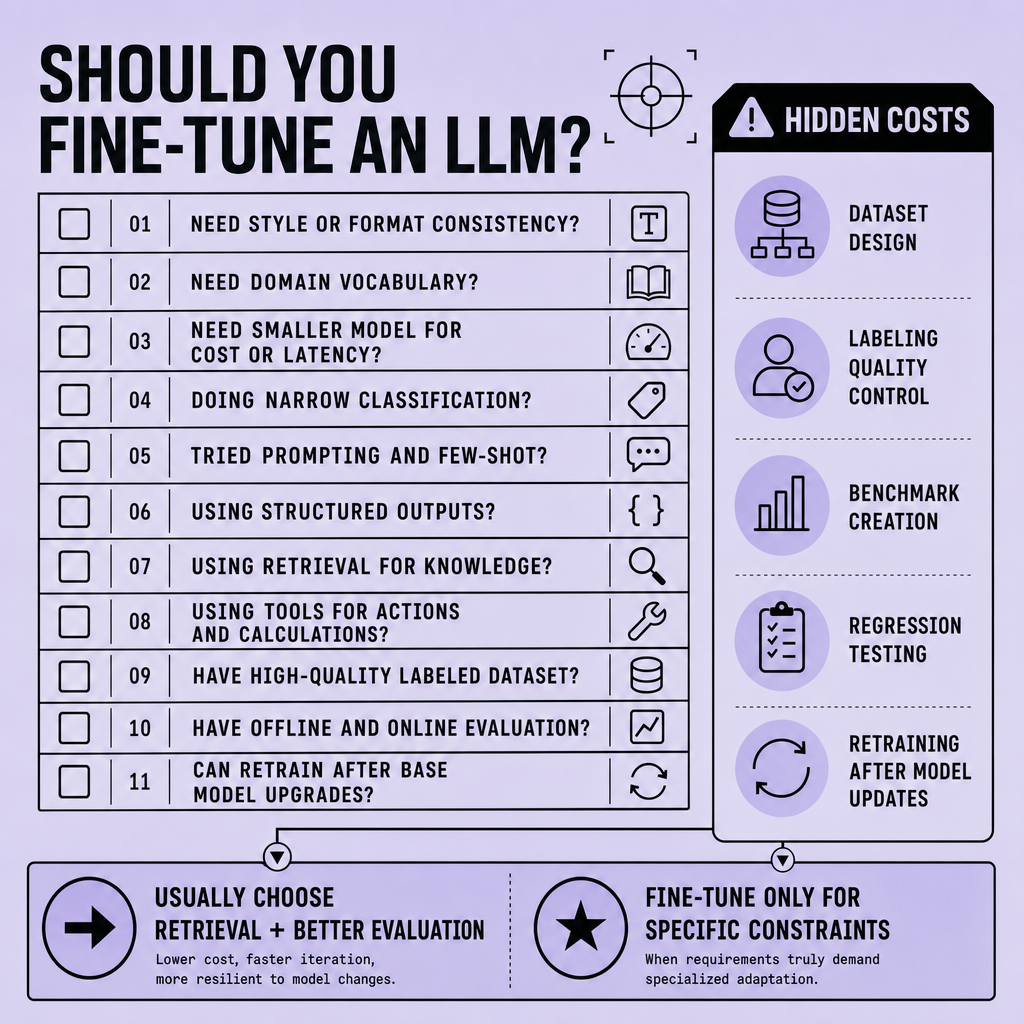
Fine-tuning should come after diagnosis, not before it.
Realistic use cases where fine-tuning earns its keep
Fine-tuning is most useful when the task is narrow, repetitive, and easy to evaluate.
A strong use case is style and format control: rigid support reply formats, compliance-safe summary templates, or tightly defined report structures. Prompts can help, but a repeated pattern at scale may justify training.
Another is domain vocabulary. Specialized abbreviations, internal taxonomy, or product-specific labels are pattern-heavy tasks where fine-tuning can improve fluency and consistency.
A third is the cost and latency case. If a tuned smaller model can handle a constrained task well enough, it may be a practical alternative to a larger general model.
And classification remains one of the clearest fits: route this ticket, assign this label, detect this intent, or map this message to a fixed category set.
Cases that look like fine-tuning problems but are not
Teams often misread the symptom.
A support bot gives outdated refund guidance. That is a retrieval problem.
A contract assistant invents clause details. That points to weak grounding and answer constraints.
A data assistant makes bad calculations. That is a tool-use problem.
A model returns nearly correct JSON but breaks one field every tenth response. Try schema-constrained generation first.
Fine-tuning can make a weak architecture feel smoother for a while, but it does not fix the underlying system design.
The tradeoff most teams underestimate
Fine-tuning improves specialization, but it also adds operational burden. You may gain consistency on one slice of behavior while making other slices harder to predict.
Use it when the task is stable, narrow, and measurable, and when the model needs to learn a repeatable behavior rather than fetch changing facts.
If the task depends on current knowledge, external systems, exact computation, or strict formatting, retrieval, tools, structure, and better evaluation usually win first. The real question is not whether fine-tuning works. It is whether your problem actually needs it.
Frequently Asked Questions
What is the practical difference in fine tuning vs prompting for a production team?
Prompting changes model behavior at runtime through instructions, examples, schemas, retrieval, and tools, so it is fast to test and easy to revise. Fine-tuning changes model behavior through training data, which can improve consistency but adds a long-term maintenance burden. In production, the real difference is not theory but how expensive each fix is to change, validate, and keep current.
How does fine tuning vs prompting affect compliance and auditability?
Prompting usually gives better auditability because teams can inspect the exact prompt, retrieved documents, tool calls, and output schema used for each response. Fine-tuning is harder to audit because behavior is partially embedded in weights and training examples rather than exposed at runtime. For regulated workflows, visible prompts plus retrieval logs are often easier to govern than custom-trained behavior.
Why should most teams treat fine tuning vs prompting as a sequencing problem instead of a model choice?
Most LLM failures come from missing context, weak constraints, or no connection to live systems, which prompting and architecture changes can fix quickly. Fine-tuning should only enter the picture after those cheaper interventions plateau on evaluation. Treating it as a sequence prevents teams from paying training costs to solve problems that were never training problems in the first place.
When does fine-tuning beat retrieval and tools?
Fine-tuning beats retrieval and tools when the task is mostly about repeating a stable behavior rather than accessing changing facts or external state. Good examples include fixed response style, domain phrasing, compact classification labels, and making a smaller model good enough for a narrow workflow. If the task depends on freshness, exact values, or system actions, retrieval and tools still win.
How much data do you usually need before fine-tuning is worth trying?
There is no universal threshold, but fine-tuning is usually only worth trying when you have enough labeled examples to represent real production variation, edge cases, and failure modes. A small but clean dataset can be useful for narrow classification or style shaping, while a messy or biased dataset will often degrade reliability no matter how much of it you collect.
Make Imversion a preferred source on Google
Like this kind of AI and software analysis? Add Imversion as a preferred source so Google can highlight our articles for you in Search, AI Overviews, and AI Mode.