Kubernetes for Startups: Is It Too Early to Adopt K8s?
Is it too early for startups to adopt Kubernetes? Dive into the complexities, costs, and when to choose K8s over simpler solutions.

Introduction to Kubernetes for Startups
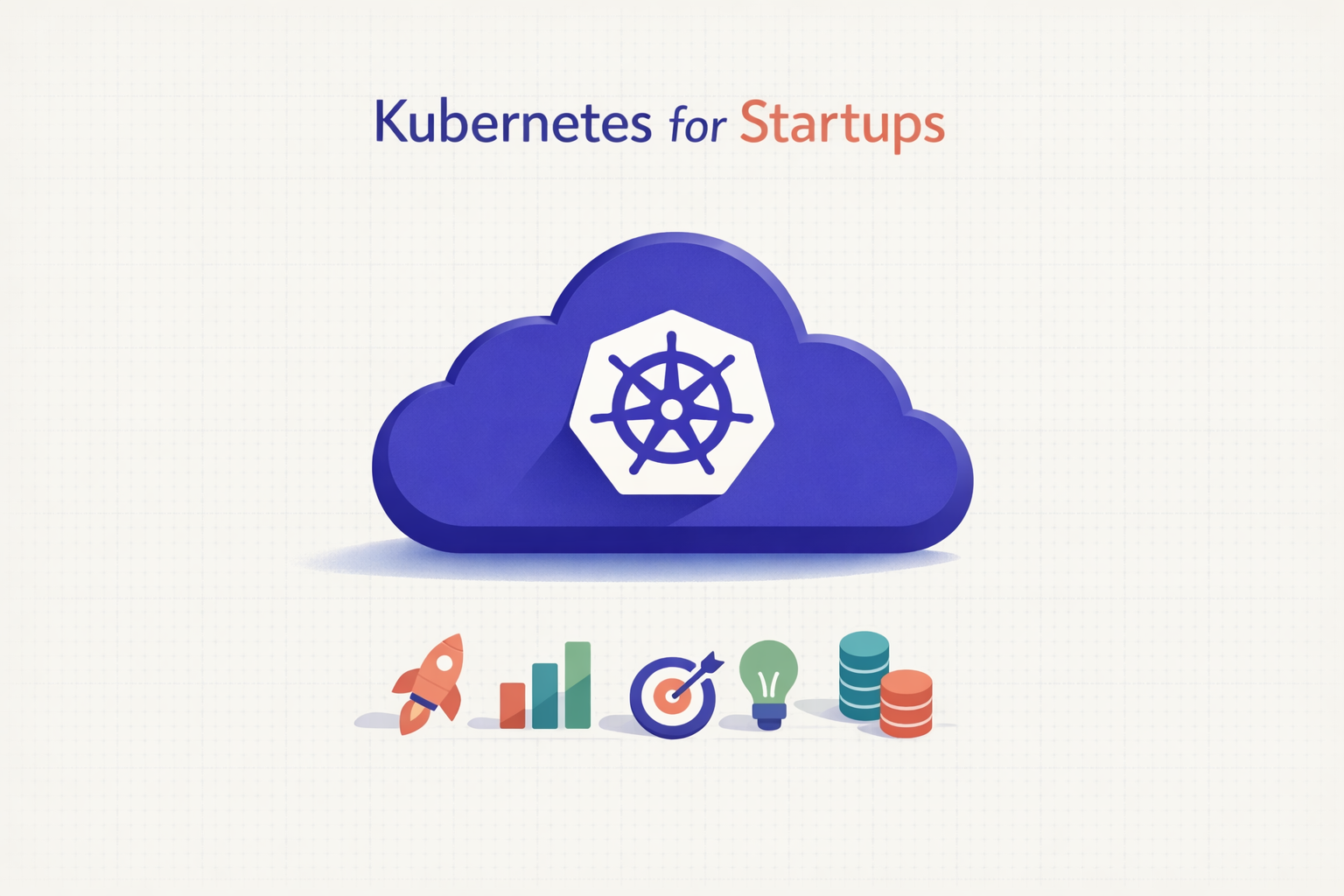
As startups embark on their digital journey, selecting the right tool to manage their growing infrastructure is a critical decision. In this context, Kubernetes (also known as K8s) has emerged as a highly sought-after solution. However, a common question arises when discussing Kubernetes for startups: "Is it too early for startups to adopt Kubernetes?"
Kubernetes is more than just open-source software; it is an automated container orchestration platform that offers scalability and robust fault tolerance to evolving businesses. Nonetheless, startup constraints must be taken into account before fully embracing Kubernetes. Its complexity and comprehensive scope can often render it a burden rather than an asset, particularly for startups with limited resources and an urgent need for fast time-to-market.
Companies must carefully consider Kubernetes alongside simpler alternatives, such as Virtual Machines (VMs) or Platform as a Service (PaaS). The following comparison outlines key insights:
| Solution Type | Pros | Cons |
|---|---|---|
| Virtual Machines (VMs) | Generally simpler to manage | Lacks the scalability inherent to Kubernetes |
| Platform as a Service (PaaS) | Well-structured single platform | May become overly restrictive as the company grows |
Tip: Assess your startup's infrastructure needs and determine when incorporating Kubernetes makes sense. While it can introduce added complexity, the trade-offs can be beneficial when the situation warrants.
In some cases, it may be advantageous for a startup to adopt Kubernetes early in its lifecycle. Conversely, waiting to integrate Kubernetes until a later stage may be preferable in other scenarios.
Successful migration paths, practical use cases, and real-world examples can provide valuable insights into these decisions. For instance, startups experiencing rapid growth may find that the scalability offered by Kubernetes outweighs its complexity.
In conclusion, the decision to adopt Kubernetes is not one-size-fits-all and should be approached with a nuanced understanding of the startup's specific needs and constraints. A thoughtful, informed decision can significantly impact the balance between efficient scaling and the risk of overengineering.
Feel free to reach out to us via contact for a customized approach to your startup's infrastructure needs. Stay tuned for our upcoming sections discussing frequently asked questions about Kubernetes, the solutions it offers, and testimonies from real startups who decided when the time was right for them.
What Kubernetes Solves for Startups
When it comes to managing startup infrastructure, Kubernetes has proven to be a game-changer. Often recognized as a superior alternative to simpler solutions, Kubernetes offers a comprehensive toolkit of features designed to address the complexities that startups encounter as they scale their businesses.
Scalability
First and foremost, the key advantage of Kubernetes lies in its scalability features. It provides a versatile approach to managing increasing demands through both vertical and horizontal scaling:
| Scaling Type | Description |
|---|---|
| Vertical Scaling | Adding more power (CPU, RAM) to the existing system |
| Horizontal Scaling | Adding more machines to the network |
This flexibility in scaling is particularly advantageous for startups, which often experience unpredictable growth patterns. Kubernetes allows you to quickly adjust your resources based on current needs, ensuring that your infrastructure can keep pace with the demands of your business.
Fault Tolerance
In addition to scalability, Kubernetes enhances fault tolerance by providing self-healing capabilities that effectively manage application state and system failures. These features ensure that applications remain accessible to end-users, thereby increasing reliability and improving system uptime.
With Kubernetes, startups can automatically revert to stable versions of their applications in the event of a failure. This capability is crucial for startups, where every user interaction can significantly impact the company's future.
Application Management
Another compelling reason to adopt Kubernetes is its robust application management capabilities. For startups, Kubernetes ensures consistent environments across development, testing, and production stages. Its declarative configuration and automation eliminate time-consuming manual tasks, streamlining the entire delivery process.
This is particularly beneficial for startups, where time is often a scarce resource. It empowers developers to concentrate on writing quality code rather than becoming bogged down by operational tasks.
Tip: When considering the adoption of Kubernetes, startups should carefully weigh these benefits against potential challenges, including complexity and the need for knowledgeable staff.
Kubernetes vs. Simpler Solutions
When compared to simpler solutions such as PaaS or virtual machines (VMs), Kubernetes distinguishes itself with its flexibility, scalability, and robustness. Although VMs are generally easier to manage, they fall short in scaling capabilities compared to what Kubernetes can provide. Conversely, while PaaS offers a uniform and streamlined environment, it can become restrictive and rigid, especially for rapidly evolving startups.
| Solution | Advantages | Disadvantages |
|---|---|---|
| Kubernetes | Highly flexible and scalable | Can be complex to set up and manage |
| VMs | Easier management | Limited scaling capabilities |
| PaaS | Streamlined and uniform platform | Potentially restrictive and rigid |
Important Tip: In summary, the Kubernetes solution is akin to a Swiss Army knife for startup infrastructure. The decision to adopt Kubernetes should be based on the specific needs, resources, and objectives of the organization. Although it may appear daunting at the outset, the scalability, fault tolerance, and application management capabilities make Kubernetes an appealing choice for startups seeking rapid and sustainable growth.
Startup Constraints with Kubernetes
For startups, determining the right moment to adopt Kubernetes can be challenging. Common constraints include limited resources, the urgent need for rapid time-to-market, the technical capabilities of the team, and a host of other factors. While Kubernetes has the potential to effectively manage infrastructure, it also introduces several significant hurdles for startups.
Resource Intensive
Kubernetes is a powerful and intricate orchestration tool, and its complexity can often hinder startups that are already dealing with resource constraints. This challenge encompasses not only the requirements for hardware but also the necessity for specialized human resources. The learning curve associated with Kubernetes is steep, and preparing a team to effectively operate it may require significant time and financial investment.
Consideration: Effective monitoring, logging, and security mechanisms necessitate additional decisions and configurations within the Kubernetes ecosystem. In essence, adopting Kubernetes goes beyond mere implementation—it requires seamless integration into your startup's operational practices and principles.
Complexity and User-friendliness
For startups in their early stages focused on swiftly bringing a product or service to market, managing Kubernetes's intricacies might detract from their primary objectives. Beyond its comprehensive architecture, Kubernetes also lacks an intuitive, out-of-the-box user interface. This complexity can be daunting for smaller teams evaluating Kubernetes alongside simpler alternatives.
Cost Complexity Trade-offs
Although Kubernetes is open-source and free to use, its management is far from cost-free. Accurately estimating the total cost of running Kubernetes can be complex due to various contributing factors, including:
| Cost Elements | Description |
|---|---|
| Infrastructure Costs | Expenses for the underlying hardware and cloud services. |
| Management Layer Costs | Costs related to maintaining the Kubernetes environment. |
| Operational Complexity Costs | Additional expenses stemming from the challenges inherent in managing Kubernetes. |
Consequently, choosing between Kubernetes and other solutions like Platform-as-a-Service (PaaS) or Virtual Machines (VMs) should entail a thorough cost-benefit analysis that considers both direct and indirect expenses.
When contemplating Kubernetes for a startup, there is no one-size-fits-all answer. It is crucial to evaluate your startup's specific constraints, including your team's readiness to manage Kubernetes, the clarity of your growth strategy, and your approach to navigating potential challenges. For early-stage startups with limited resources, it may be wise to explore simpler solutions before diving into Kubernetes prematurely.
In the next section, we will present real-world scenarios and FAQs regarding Kubernetes adoption. Remember, there's no universal solution. Join the discussion at /contact.
Kubernetes vs PaaS/VMs for Startups
Startups seeking to manage their infrastructure frequently encounter the decision between implementing Kubernetes or opting for simpler solutions such as Virtual Machines (VMs) or Platforms as a Service (PaaS). Each of these options offers distinct benefits and challenges, making the choice of when to utilize Kubernetes a significant consideration.
Comparing Kubernetes and Virtual Machines
In theory, both Kubernetes and VMs aim to manage applications, but they differ fundamentally in their approaches:
| Feature | Kubernetes | Virtual Machines (VMs) |
|---|---|---|
| Scalability | Provides flexibility and scalability, enabling startups to adjust resources quickly in response to demand. | Requires manual configuration of new VMs for scaling. |
| Resource Utilisation | Containers are lightweight, resulting in superior resource utilisation. | Monolithic design leads to lower resource efficiency. |
| Complexity | Offers robust features but comes with a moderately steep learning curve. | Easier to manage, making it more intuitive for beginners. |
Comparing Kubernetes and Platform as a Service
Platform as a Service solutions offer startups a streamlined environment to deploy applications without the burden of managing underlying infrastructure details. However, when compared to Kubernetes, PaaS solutions may have limitations in the following areas:
| Feature | Kubernetes | Platform as a Service (PaaS) |
|---|---|---|
| Flexibility | Supports any language, host, or database that meets startup needs. | Limited options for languages and technologies. |
| Vendor Lock-in | An open-source solution allowing the flexibility to switch or modify services based on requirements. | Potential for vendor lock-in, restricting future changes. |
| Cost | May involve a higher initial investment but offers enhanced control and scalability. | Generally more affordable, albeit with limited control and scalability. |
Note: Startups should carefully evaluate their technical capabilities, infrastructure requirements, and long-term growth strategies when choosing between Kubernetes and simpler solutions like PaaS or VMs. Although Kubernetes may initially appear complex and intimidating, its scalability and flexibility can significantly contribute to a startup's growth, provided the implementation is supported by the right skills and resources. Consequently, understanding when to deploy Kubernetes is crucial for establishing a sustainable startup infrastructure.
Kubernetes is not a cure-all for every infrastructure challenge that startups face, but rather a valuable tool to consider once the startup has advanced past its early stages and is prepared to manage increased complexity.
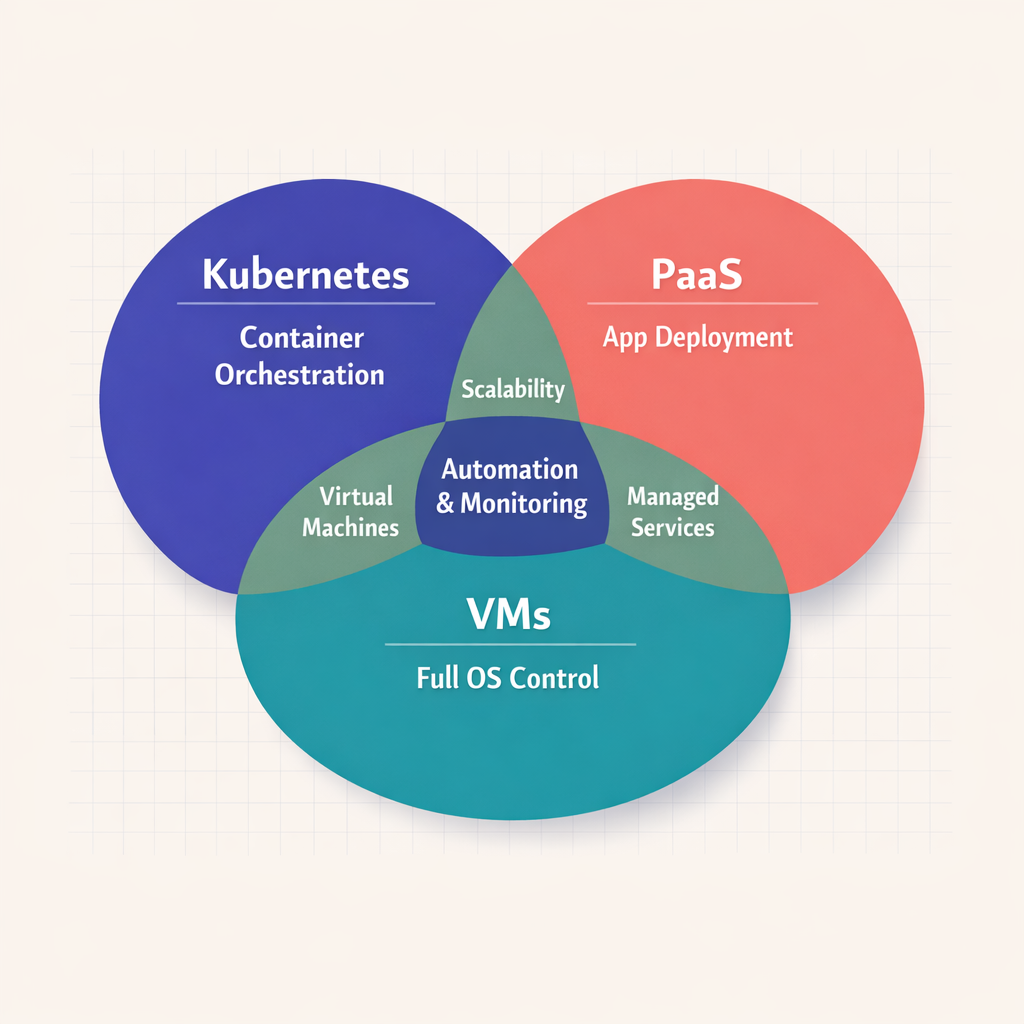

Cost-Complexity Trade-offs of Adopting Kubernetes
At the crossroads of nearly every startup's digital journey lies the critical decision to invest both time and resources in comprehensive infrastructure tools like Kubernetes, or to opt for simpler, potentially less costly solutions. Kubernetes for Startups is thus not a straightforward choice, but rather a careful analysis of the cost-complexity trade-offs involved.
The Inherent Complexity of Kubernetes
Kubernetes is not a walk in the park; it requires a sophisticated understanding of its inner workings and dedicated personnel to manage it. While Kubernetes offers a robust, scalable framework for your applications, it brings a significant level of complexity. Without an experienced team and a substantial initial time investment, startups may struggle with configuration, management, and troubleshooting.
The Financial Implications
The financial investment also deserves careful consideration. Although Kubernetes is an open-source platform, it is not synonymous with ‘free.’ Running Kubernetes necessitates a solid infrastructure, along with the costs of hiring or training your team to effectively utilize it. Additionally, there are ongoing expenses associated with maintaining your Kubernetes cluster. However, it's crucial to highlight that these costs are often counterbalanced by the scalability benefits Kubernetes offers. For certain startups, these advantages may offset the initial investment.
Kubernetes vs. Simpler Solutions
At the same time, it is important to consider alternative solutions. Simpler options, such as Platform as a Service (PaaS) and virtual machines (VMs), have their own respective advantages and disadvantages:
| Solution Type | Pros | Cons |
|---|---|---|
| Kubernetes | Scalable, robust framework | High complexity, resource-intensive |
| PaaS | Easier to implement, immediate cost savings | May lack scalability and flexibility |
| VMs | Familiar environment for developers | Potential long-term management overhead |
Will simpler solutions adequately meet your Startup’s Infrastructure scalability and flexibility demands?
The Ultimate Trade-off
Ultimately, the decision hinges on the individual startup's specific needs and resources. Determining when to adopt Kubernetes is a strategic choice influenced by factors such as expected growth rate, the complexity of application deployment, and available resources.
For many startups, it may be more advantageous to start with a simpler solution and progressively transition to Kubernetes.
An informed decision requires weighing the short-term convenience of simpler platforms against the long-term scalability benefits that Kubernetes can provide.
In conclusion, while Kubernetes offers significant rewards, it comes with considerable complexity and investment requirements. Therefore, startups must thoroughly evaluate their specific needs, existing resources, and long-term goals before making the leap.
[^next_section] Still wondering if Kubernetes is right for your startup? Listen to these real-world scenarios.
When to Use Kubernetes for Your Startup
Making decisions about your startup's infrastructure can be daunting. Among the many choices you face, one of the most critical is selecting an appropriate tool to manage your growing operations. So, the question arises: When should you use Kubernetes?
What Makes Kubernetes Attractive
Before deciding when to adopt Kubernetes, it's essential to understand why this solution may be appealing. As discussed in previous sections, Kubernetes offers automation for application deployment, scaling, and management—benefits that can significantly impact startups with small teams and numerous tasks. Its robustness, fault tolerance, and high scalability are particularly noteworthy.
However, comparing Kubernetes to simpler solutions can be challenging. Its complexity may become burdensome for lean startups that grapple with limited resources and tight timelines.
Considering Your Startup Constraints
Every startup has unique constraints and requirements concerning infrastructure. New tech ventures often prefer to keep things simple, utilizing virtual machines (VMs) or Platform as a Service (PaaS) solutions. In such cases, adopting Kubernetes too early can introduce unnecessary complications, straining both manpower and financial resources.
Conversely, if your startup aims for significant scaling, especially with high-volume data processing through a microservices architecture, implementing Kubernetes from the outset may be warranted.
Taking the Migration Path
When considering a transition to more sophisticated solutions like Kubernetes, startups should remember that it is not a binary switch; rather, it involves a gradual migration. Introducing Kubernetes can be done in phases, starting with non-critical services and progressively transitioning larger components of the system into the Kubernetes-managed framework.
Tip: A phased migration minimizes disruptions and allows your team to adapt gradually.
Real Scenarios
Examining real scenarios can provide startups with clearer insights on when to implement Kubernetes. Many startups have opted for Kubernetes once they reached a more mature stage. For instance, Spotify famously migrated to Kubernetes after recognizing the limitations of their initial system.
FAQs
-
Is it too early for my startup to use Kubernetes?
This depends on the specific needs and growth plans of your startup. While Kubernetes offers numerous advantages, its complexity may not be necessary for early-stage companies. -
How does the cost of Kubernetes compare to other options?
Although Kubernetes itself is open-source and free, the costs associated with deploying and maintaining it can be significant due to its complexity and the expertise required. -
What are the alternatives to Kubernetes?
There are several alternatives for startups, including simpler solutions like virtual machines (VMs) or platform-as-a-service (PaaS) options. These alternatives may lack some of the advanced features offered by Kubernetes but could be more appropriate for early-stage startups.
Tip: Should your startup embark on the Kubernetes journey? It’s important to carefully evaluate your unique needs, resource allocation, and long-term goals. If you require assistance in navigating these technical considerations or need customized software development solutions, our experts are here to help. Feel free to reach out to us through our contact page.
Transitioning to Kubernetes: A Guide for Startups
The decision to adopt Kubernetes can be daunting for startups. While it is a powerful solution for managing infrastructure, it does come with a learning curve and inherent complexities. This guide aims to facilitate a smoother transition by exploring the migration path and comparing Kubernetes to simpler alternatives.
What Kubernetes Solves
As previously mentioned, Kubernetes automates the deployment, scaling, and management of applications. Its value is undeniable: it offers scalability, robust fault tolerance, and minimal downtime during updates. However, the critical consideration is not just when to use Kubernetes, but how and when not to.
When It Doesn’t Make Sense
Startups thrive on innovation and rapid action, leaving little room for complex systems that may hinder progress. For smaller startups with less complex needs, simpler solutions may be more than adequate. In some cases, traditional PaaS or virtual machines may be a more suitable choice, given the operational complexities and steep learning curve associated with Kubernetes.
Pro Tip: If your current system effectively meets your needs, it may not yet be the right time for a transition.
The Migration Path
Transitioning to Kubernetes should be a gradual process rather than an abrupt change. Companies generally start with a non-critical aspect of their operations. This initial foray allows the team to familiarize themselves with the system's intricacies.
Here are some key steps to follow if Kubernetes appears to be the right fit for your organization:
- Appraise your current infrastructure: Assess whether your existing systems are inadequate in terms of scalability and application container management.
- Orient your team: Ensure your team has a thorough understanding of the platform through training before embarking on the migration process.
- Pilot Project: Begin with a small, non-critical project. Monitor its progress, and if successful, gradually expand the scale.
Real Scenarios
Several innovative startups have successfully leveraged the power of Kubernetes. For instance, Buoyant, which focuses on creating open source software for cloud-native applications, transitioned smoothly to Kubernetes by employing a phased approach.
Kubernetes isn’t a silver bullet, and adopting it doesn't have to be an all-or-nothing decision.
FAQs
When it comes to deciding on Kubernetes for startups, here are a few common questions and brief insights:
| Question | Insight |
|---|---|
| Is Kubernetes better than Docker? | While Docker is a platform for containerizing applications, Kubernetes serves as an orchestration tool for Docker containers. They fulfill different functions and can be used together. |
| Can Kubernetes be used for small projects? | It is possible, but for very small projects, it may be overkill due to its operational complexity and steep learning curve. |
| Does Kubernetes reduce cost? | In the long run, Kubernetes can help reduce costs through efficient resource allocation and automation. |
Remember, transitioning to Kubernetes is a strategic decision driven by your organization's specific needs. Want to discuss your unique situation? Get in touch with our team.
Real Scenarios of Kubernetes Adoption in Startups
Transitioning to Kubernetes can be an intimidating endeavor for startups, which often face critical decisions regarding scalability, future growth, and survival. Nevertheless, many startups have reaped significant benefits from integrating Kubernetes into their infrastructure. Let’s explore some real scenarios, examining the rationale behind their adoption of Kubernetes, the challenges they encountered, and the degree of their success.
Scenario 1: Rapidly Scaling User Traffic
Startup "A," a highly popular multiplayer game, struggled to manage unpredictable spikes in user traffic. They turned to Kubernetes, viewing it as an effective solution to automatically scale their resources. By utilizing Docker containers to deploy application components, they employed Kubernetes to orchestrate these containers, managing deployment, scaling, and load balancing. Despite facing initial complexities, their decision led to substantial cost reductions, improved speed and resilience, and enabled seamless scalability in response to traffic fluctuations.
Scenario 2: Simplifying Microservice Architecture
Startup "B," a SaaS provider, recognized the need for more effective management of their microservices. By adopting Kubernetes, they transitioned from a monolithic to a microservice architecture. This shift facilitated a decoupled design that allowed for individual updates of each microservice, resulting in fewer bugs and faster iterations. Kubernetes enhanced their operational efficiency by balancing loads between services and automatically scaling instances based on demand. However, the team faced challenges due to Kubernetes' steep learning curve and required several iterations to fine-tune their implementation.
Scenario 3: Startups Seeking Flexibility and Control
Startup "C," a fintech company, aimed to avoid the vendor lock-in typically associated with PaaS solutions. Preferring to maintain control over their ecosystem, they evaluated Kubernetes in comparison to simpler alternatives. They ultimately chose Kubernetes, appreciating its vendor-agnostic nature and compatibility with a variety of cloud offerings. Although the initial implementation proved complex, this decision paid off through long-term cost efficiency, improved portability, and greater control over their infrastructure decisions.
Insight: Businesses should assess whether Kubernetes aligns with their long-term goals, carefully weighing its initial complexity against the potential drawbacks of slower speed and lesser scalability associated with simpler solutions.
In conclusion, the choice to adopt Kubernetes depends on the specific needs of a startup. Startups focused on rapid scalability, complex microservices, or the desire to avoid vendor lock-in should consider Kubernetes while acknowledging the steeper learning curve it entails. Conversely, startups operating on a smaller scale or requiring a quick market launch may find simpler solutions more suitable. Crafting your own “Kubernetes for startups” journey involves understanding your business objectives, available resources, and evaluating the practical, long-term benefits that this robust platform offers.
For more guidance, reach us at /contact, and let's collaboratively lay the groundwork for your Kubernetes journey.
Frequently Asked Questions about Kubernetes for Startups
The use of Kubernetes (or K8s) as part of startup infrastructure has become an increasingly popular topic for discussion. Many emerging businesses grapple with the question, "Is K8s too early for us?" Let's address this and other related queries to provide clarity on the matter.
1. Is it too early for my startup to adopt Kubernetes?
The answer to this question hinges on the specific needs and constraints of your startup. While Kubernetes offers a variety of features ideal for managing and scaling applications, it may be perceived as complex for smaller teams with limited resources. As such, it is vital to evaluate your scalability requirements, technical capabilities, and resource availability before determining the right time to implement Kubernetes.
Takeaway: It is never 'too early' or 'too late' to adopt a technology like Kubernetes, as long as its advantages align with your business needs and capabilities.
2. What makes Kubernetes a better choice compared to simpler solutions?
Kubernetes stands out for its ability to provide scalability, self-healing features, and consistency across multiple environments. Although solutions like virtual machines (VMs) may be easier to set up initially, they lack the advanced scalability capabilities that Kubernetes offers. In contrast to platform-as-a-service (PaaS) solutions, which can appear more streamlined, Kubernetes delivers flexibility, allowing you to avoid the rigidity commonly encountered in such environments.
Takeaway: Kubernetes surpasses simpler solutions in terms of scalability, fault tolerance, and versatility, but its adoption should be evaluated within the context of your startup's specific needs and capacities.
3. What are the cost and complexity trade-offs involved in using Kubernetes in startup infrastructure?
The complexities associated with Kubernetes stem primarily from its steep learning curve and the technical expertise required, which may temporarily hinder productivity. Regarding costs, while K8s itself is open source, its deployment and maintenance can incur infrastructure expenses, staffing costs for skilled personnel, and potentially consultation fees. Nevertheless, in the long run, Kubernetes can provide cost-effective scalability, optimized workflows, and improved resilience.
Takeaway: The costs and complexities tied to deploying Kubernetes must be weighed against potential long-term benefits, including scalability, efficiency, and robustness.
Conclusion: Considering Kubernetes for your startup is a significant decision that requires careful planning and foresight. Remember that there is no absolute 'right or wrong' time to integrate it into your startup infrastructure. It all comes down to understanding your specific needs, constraints, and future growth strategies. For a more personalized consultation, feel free to reach out to us for further assistance.

Conclusion: Is it Too Early for Kubernetes in Startups?
Reflecting on Kubernetes' suitability for startups and reevaluating the question, "Is K8s too early?" is a nuanced process that requires context-specific discernment. It's essential to balance the capabilities of Kubernetes against startup constraints concerning timing, resources, and complexity.
Startups should evaluate whether the scalable and reliable orchestration that Kubernetes offers addresses their specific needs. If your startup experiences high traffic, requires aggressive scaling, or views technology as a core differentiator, then Kubernetes may be an effective solution. Conversely, a nascent startup with moderate traffic and simpler infrastructural requirements might find Kubernetes to be an over-engineered option when more straightforward alternatives are available.
Kubernetes is not inherently superior or inferior to VMs or PaaS; rather, it presents a different approach, each with its own strengths and weaknesses. The decision between Kubernetes, PaaS, and VMs depends significantly on the operational context of the startup.
Important Consideration: When deciding whether to adopt Kubernetes, keep the following factors in mind:
- Expertise: The development team's ability to manage Kubernetes' complexity.
- Goals: The startup's long-term strategic objectives and anticipated growth trajectory.
- Requirements: The necessity for scalability, fault tolerance, and the desired level of infrastructure control.
- Analysis: A cost/benefit evaluation of implementing Kubernetes versus leveraging simpler solutions.
There are numerous success stories of startups that have successfully transitioned to Kubernetes and enjoyed significant rewards; however, each of these narratives is rooted in its unique context. Migrating to Kubernetes is a major endeavor that necessitates strategic planning and investment.
Regardless of your startup's stage, the decision to adopt Kubernetes is not binary—it's not a matter of "now or never." A gradual, phased migration presents a feasible strategy when readiness and necessity align.
In summary, the context of your startup drives the decision to embrace Kubernetes. Are you contemplating Kubernetes for your startup while grappling with the question of whether "K8s is too early"? Our experts are ready to provide practical advice and guidance tailored to your startup's distinct needs. Feel free to contact us to discuss your infrastructure challenges and explore how Kubernetes might integrate into your growth strategy.
Make Imversion a preferred source on Google
Like this kind of AI and software analysis? Add Imversion as a preferred source so Google can highlight our articles for you in Search, AI Overviews, and AI Mode.