PostgreSQL vs MongoDB: Choosing the Right Database for Your App
Struggling to choose between PostgreSQL and MongoDB? This guide breaks down their key differences, helping you make the best decision for your application.

Introduction to PostgreSQL vs MongoDB
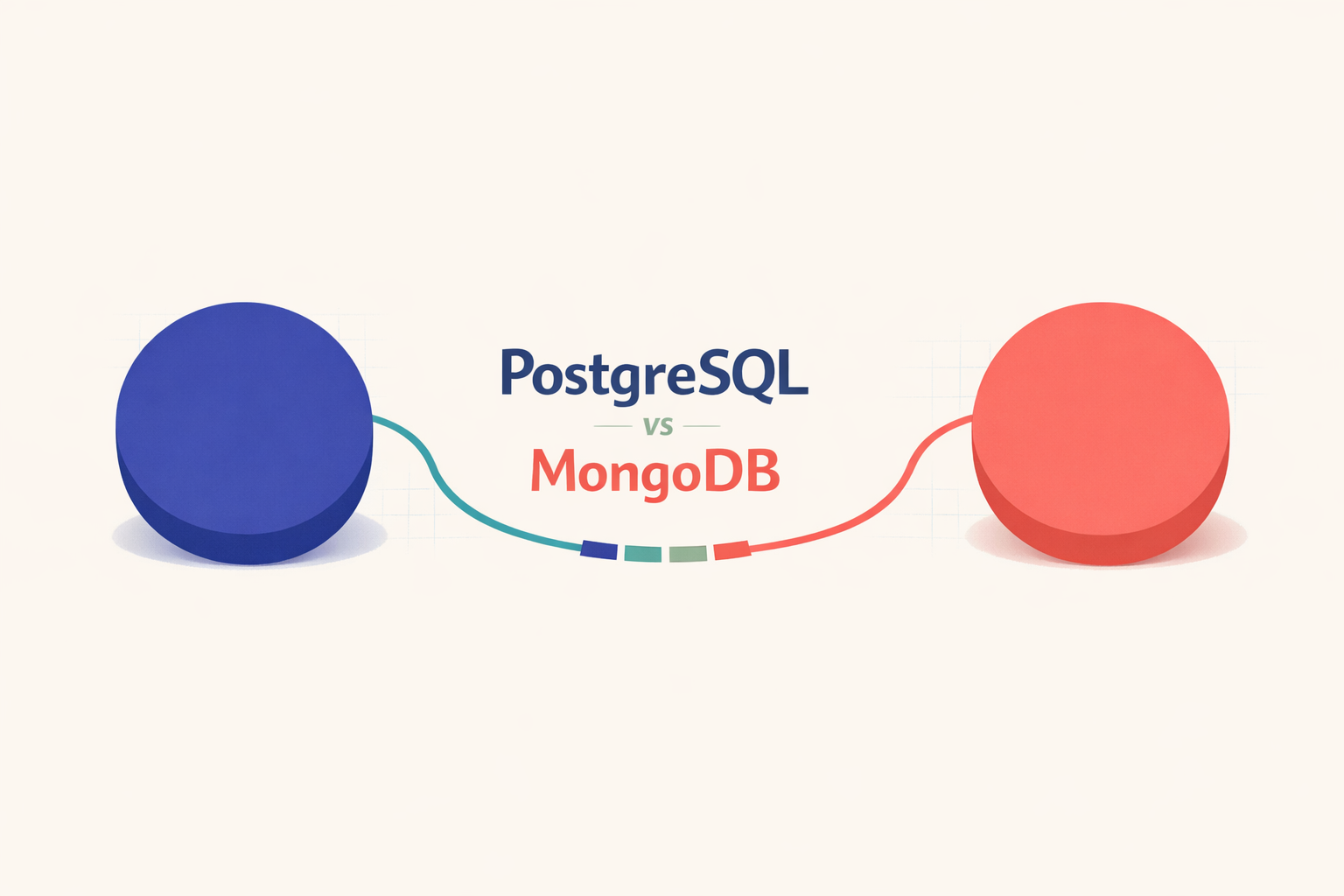
In application design, selecting the appropriate database is a critical decision that influences both system efficiency and the overall user experience. Among the myriad of available database systems, PostgreSQL and MongoDB stand out as two prominent options.
To begin this comparison of PostgreSQL vs MongoDB, it's essential to understand that PostgreSQL is a powerful open-source object-relational database system, renowned for its exceptional reliability and robustness. By adhering to the established structure of SQL, it equips users with comprehensive tools for managing complex queries and executing precise multi-row transactions.
Conversely, MongoDB – a modern document-based NoSQL database – offers teams exceptional flexibility and scalability. This makes it particularly appealing for handling extensive volumes of rapidly evolving data, a common requirement in today's landscape of real-time analytics and IoT services.
Both databases present unique advantages, and the choice between SQL and NoSQL systems—the classic debate of relational versus document databases—primarily depends on your application’s specific needs. Despite their fundamental differences, PostgreSQL and MongoDB are widely adopted and trusted, highlighting the importance of understanding each database system’s strengths, limitations, and appropriate use cases.
Tip: In the following sections, this post will delve deeper into the PostgreSQL vs MongoDB comparison, examining their core differences, data models, query capabilities, scalability, performance, transaction support, use cases, and trade-offs. This comprehensive guide will aid you in selecting the most suitable database for your application.
Whether you are at the initial design phase or scaling your application, a thorough understanding of the specific merits of PostgreSQL and MongoDB can greatly enhance your development process and operational efficiency. Key factors to consider include their respective models, performance metrics, transaction support, scalability, and the complexity of queries they can accommodate.
This blog aims to provide you with a balanced and thorough understanding of both PostgreSQL and MongoDB. Remember, no single database is a one-size-fits-all solution. The right choice requires careful consideration of your application’s requirements, weighing the benefits and trade-offs offered by each system.
We are here to assist you in your decision-making process. At /services/custom-software-development, we provide in-depth technical consulting to translate your specific requirements into actionable insights. Feel free to reach out to us through our /contact page for any inquiries or assistance regarding selecting the most suitable database for your application.
PostgreSQL vs MongoDB: Frequently Asked Questions
Do you want to learn more about the comparison between PostgreSQL and MongoDB? Please refer to the following Frequently Asked Questions (FAQs) section.
-
How do PostgreSQL and MongoDB differ in terms of data models and the types of queries each can handle?
-
Which database offers better performance, PostgreSQL or MongoDB?
-
What are some typical use cases for each of these databases?
These questions will reveal the intricacies of the PostgreSQL vs MongoDB dilemma, helping you choose the most effective database for your application.

Core Differences and Data Models: PostgreSQL vs MongoDB
Choosing the right database for your application necessitates a thorough PostgreSQL vs MongoDB comparison. This involves understanding the fundamental distinctions between relational and document databases, recognizing the nuances of SQL versus NoSQL, and comprehending each system's distinct data model.
Relational vs Document Database: PostgreSQL's and MongoDB's Structures
In exploring the core differences, PostgreSQL employs a relational model that adheres closely to SQL standards. It utilizes table-like structures governed by a predefined schema for data storage and organization. This characteristic positions PostgreSQL as a robust choice for complex queries and multi-row transactions, particularly in scenarios where data integrity is paramount.
Conversely, MongoDB embraces its NoSQL heritage through a document database model, storing data in a flexible, JSON-like BSON format. Unlike PostgreSQL, it does not impose a fixed schema, granting it remarkable adaptability in managing diverse data types and hierarchies. This flexibility enables efficient handling of large data volumes, especially in dynamic environments where data is constantly evolving—often seen in real-time analytics or IoT applications.
SQL vs NoSQL: Implications of PostgreSQL's and MongoDB's Data Models
The intrinsic differences between SQL and NoSQL significantly influence the performance and functionality of PostgreSQL and MongoDB. PostgreSQL's SQL-centric, table-based architecture is ideally suited to environments necessitating rigorously structured data and strong ACID (Atomicity, Consistency, Isolation, Durability) properties. This makes PostgreSQL a preferred choice for financial systems, CRM, ERP, and other transaction-based applications.
In contrast, MongoDB's NoSQL, document-oriented framework promotes dynamic data handling and scalability. It is engineered to efficiently navigate varied data sets and enhance horizontal scalability, making it an attractive option for content management systems, mobile applications, real-time analytics, and IoT services. MongoDB excels in scenarios where data structures evolve over time, due to its schema-less architecture.
Tip: The more specific your application's requirements, the more crucial the comparison between PostgreSQL and MongoDB becomes. The ultimate decision between a relational or document database should be based on a comprehensive understanding of your app's unique needs and how each database would perform in those contexts.
Ready to embark on your PostgreSQL vs MongoDB journey? Our custom software development services are here to assist you. Please feel free to reach out through our contact page with any inquiries.
Queries and Scalability: PostgreSQL vs MongoDB
When selecting the most suitable database for your application, understanding the distinctions between SQL and NoSQL querying mechanisms, as well as the scalability options of MongoDB and PostgreSQL, is essential. These factors significantly influence overall performance.
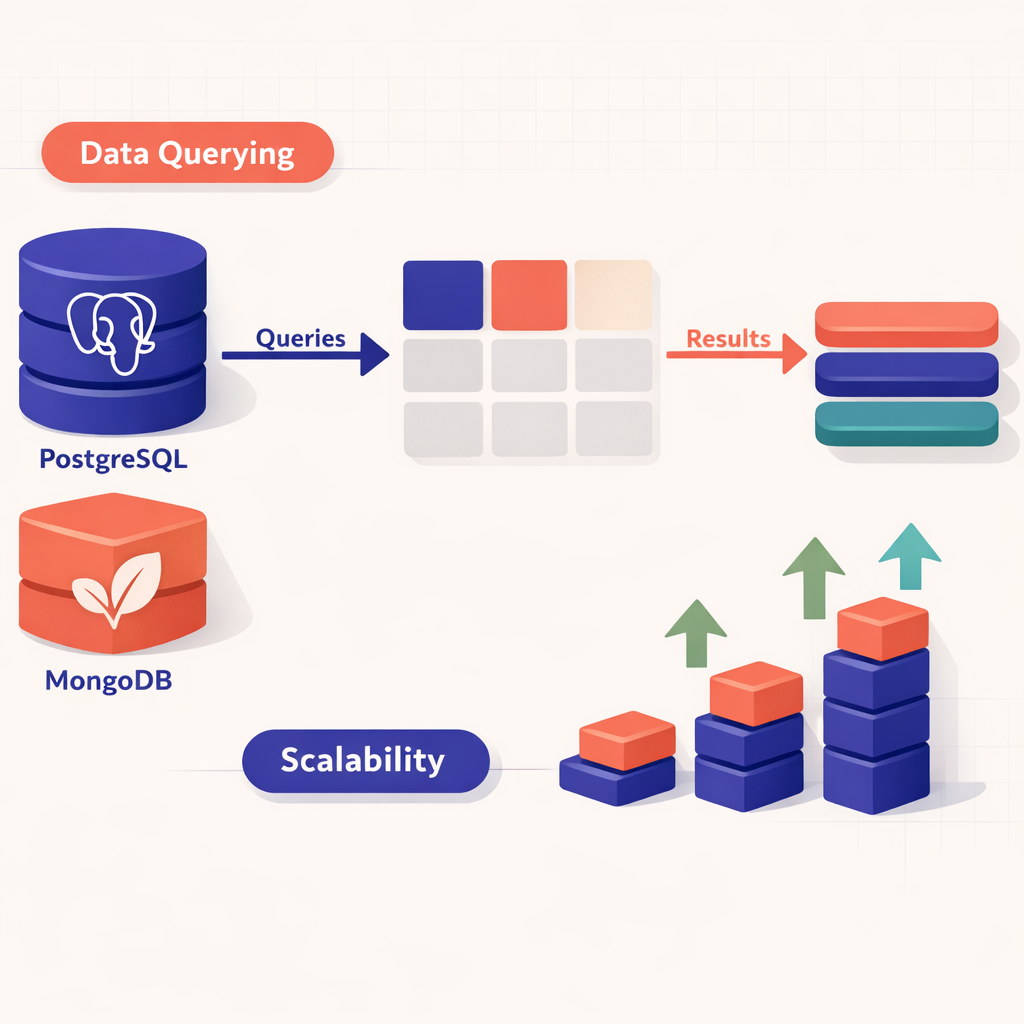
Data Querying: The SQL vs NoSQL Consideration
The fundamental difference between PostgreSQL and MongoDB in terms of querying lies in their respective SQL and NoSQL architectures. PostgreSQL, built on an SQL foundation, supports complex queries that involve advanced manipulations across multiple tables through the use of JOIN operations and other SQL functionalities. Its robust transaction management ensures data integrity, which is vital for various system-critical applications. The versatility and consistency offered by PostgreSQL create a clear and reliable environment for data handling.
Conversely, MongoDB operates as a NoSQL database, making the process of composing queries more straightforward. This approach facilitates a more agile data handling mechanism, particularly advantageous when working with unstructured or semi-structured data. By eliminating the need for JOIN operations, MongoDB allows related data to be stored within a single document, resulting in improved management, speed, and overall performance.
Scalability: Vertical and Horizontal Growth Options
Scalability stands out as a decisive factor in the comparison between PostgreSQL and MongoDB. PostgreSQL utilizes a vertical scalability model, which enhances the capacity of the existing server infrastructure—such as memory and CPU. While this can lead to significant performance boosts, it also imposes limitations due to the inherent constraints of hardware capacity.
In contrast, MongoDB employs a horizontal scalability model, enabling it to manage larger volumes of data and increased read/write operations by expanding outward—effectively distributing data across multiple servers. This capability is supported by MongoDB's built-in sharding mechanism, which partitions datasets across various servers, facilitating efficient growth management.
Tip: When choosing between MongoDB and PostgreSQL, consider your application's projected data and traffic growth patterns, alongside your scaling budget and long-term planning needs.
In summary, grasping the differences between relational and document databases—and how these distinctions influence querying and scalability—is crucial for any database selection process. With this understanding, you can make a more informed choice that aligns with your application's specific requirements and future expectations.
Questions or Need Assistance?
If you are still uncertain about which database to choose or require professional guidance, please feel free to contact us. Our expertise in custom software development services and database selection allows us to help you navigate the complexities of the choices available, ensuring your app is set up for success.
Tip: Selecting the right database is essential for your app's performance and scalability. Don't hesitate to reach out for personalized advice!
Performance Comparison: PostgreSQL vs MongoDB
When selecting the most suitable database for your application, it is essential to thoroughly analyze the performance aspects of the PostgreSQL versus MongoDB comparison.
Understanding Performance: A PostgreSQL vs MongoDB Comparison
In this insightful comparison, we will examine the performance characteristics of PostgreSQL and MongoDB. PostgreSQL excels at managing complex queries that involve multiple tables and data points. Its robust architecture supports high data integrity, making it ideal for applications that require the preservation of comprehensive transactional history.
On the other hand, MongoDB impresses with its speed and scalability, particularly when dealing with large datasets in real-time—an essential feature for real-time analytics and Internet of Things (IoT) services. While each database offers unique advantages, it is crucial to evaluate your application's requirements to determine the best fit between a relational and document database structure.
How Data Models Influence Performance
The SQL versus NoSQL debate encompasses the wider context of Relational vs Document Databases, significantly impacting performance in the PostgreSQL versus MongoDB comparison.
| Database | Model Type | Key Performance Features |
|---|---|---|
| PostgreSQL | SQL-based | Structured data storage; complex transactions and manipulations; robust data integrity. |
| MongoDB | NoSQL | Document-based; high flexibility and speed; adept at handling diverse data types and large volumes. |
Tip: Performance encompasses more than just speed. Robustness, data consistency, and scalability are equally vital factors, depending on the nature and requirements of your application.
Transaction Handling and Its Impact on Performance
The ability to handle transactions can significantly influence your choice between PostgreSQL and MongoDB. PostgreSQL’s Multi-Version Concurrency Control (MVCC) feature enables efficient concurrent processing, thereby enhancing performance efficiency. While MongoDB recently introduced multi-document ACID transaction support, it may still struggle with complex transactions to the same extent as PostgreSQL.
In conclusion, both PostgreSQL and MongoDB offer impressive performance capabilities. However, the ultimate decision should be based on a thorough evaluation of your application's specific needs. Whether you prioritize the consistent reliability of PostgreSQL or the agility and speed of MongoDB, selecting the right database is critical to your application's success.
To discuss your specific requirements, contact our team of database experts, who can provide additional insights into performance, scalability, and other factors relevant to your custom software development project.
FAQs
-
When should I choose PostgreSQL over MongoDB?
If your application necessitates complex transactions or stringent data consistency due to regulatory standards, PostgreSQL may be the more advantageous option.
-
When is MongoDB more appropriate than PostgreSQL?
MongoDB excels in managing large volumes of rapidly changing data. If your application is aligned with real-time analytics or IoT services, MongoDB would be the preferable choice.
-
Do the data models of PostgreSQL and MongoDB impact their performance?
Absolutely. PostgreSQL's structured model facilitates complex transactions, while MongoDB's flexibility enables it to efficiently manage large data volumes.
Transactions in PostgreSQL vs MongoDB
When selecting a database for your application, it is vital to comprehend how different systems manage transactions. Effective transaction management can greatly influence both the development process and the eventual performance of your application. This section presents a comparative analysis of transaction handling in PostgreSQL, a relational database, and MongoDB, a document database, highlighting key insights that are valuable in the PostgreSQL vs MongoDB decision-making process.
PostgreSQL Transactions
PostgreSQL adheres to the traditional SQL framework for transaction management. Its comprehensive support for multi-statement transactions is grounded in its commitment to the ACID properties (Atomicity, Consistency, Isolation, Durability) that characterize SQL databases.
In PostgreSQL, each transaction is managed as a single unit of work. This approach allows multiple changes to be grouped together and treated as one operation, ensuring that either all changes are committed to the database or none at all in the event of an error. If an error occurs during a transaction, the system automatically rolls back to its prior state, thereby maintaining data integrity.
Additionally, PostgreSQL’s structured schema and robust transactional capabilities make it particularly well-suited for applications that involve highly interrelated data or require complex, join-heavy queries.
Key Takeaway: PostgreSQL’s dependable transactional support and adherence to ACID principles provide an efficient mechanism for managing complex, multi-statement operations while ensuring data integrity through an all-or-none execution model.
MongoDB Transactions
In contrast, MongoDB, as a NoSQL document database, has historically had limitations in transaction support. However, with the introduction of MongoDB 4.0, multi-document transactions became feasible.
This enhancement aligns MongoDB more closely with relational databases in terms of transaction handling, allowing it to effectively manage applications that require intricate operations involving diverse and potentially unrelated data.
While MongoDB’s transaction capabilities offer enhanced flexibility, they also bring certain trade-offs. Transactional operations in MongoDB can incur performance overhead and potential contention, which may slow down systems under heavy load.
Key Takeaway: The addition of multi-document transactions in MongoDB provides welcome flexibility, but this comes with the trade-off of potential performance overhead in high-load environments.
Comparison Summary
| Feature | PostgreSQL | MongoDB |
|---|---|---|
| Transaction Model | ACID-compliant | Multi-document transactions |
| Performance Overhead | Generally low | Potential for overhead |
| Data Structure | Rigid schema | Flexible schema |
| Ideal Use Case | Complex queries, structured data | Flexibility with diverse data |
Conclusion
In summary, the decision between SQL vs. NoSQL or relational vs. document databases largely depends on the specific transactional requirements of your application. PostgreSQL offers a more mature and robust transactional support system, making it suitable for applications involving complex, multi-statement operations. On the other hand, MongoDB's multi-document transaction support can be advantageous for applications requiring flexibility with diverse, potentially unrelated datasets, though it may result in increased overhead and reduced performance.
Final Note: When evaluating the PostgreSQL vs. MongoDB comparison, keep in mind that there is no universally applicable solution. The optimal choice depends on your application's unique requirements, your team's expertise, and considerations such as scalability, performance, and cost.
Explore more on how to choose the right database for your custom software development needs here and don't hesitate to get in touch for all your application development needs.
Use Cases: PostgreSQL vs MongoDB
When embarking on the journey of selecting a database, it is crucial to consider use cases that showcase the strengths of both PostgreSQL and MongoDB. These scenarios serve as representative examples of real-world applications where one database may outperform the other. This exercise falls within the broader context of comparing PostgreSQL and MongoDB, offering valuable insights into the SQL versus NoSQL debate and highlighting the trade-offs between relational and document databases. Below, we evaluate several key use cases:
Relational Database Use Cases
PostgreSQL, a powerful SQL-based relational database, excels in the following scenarios:
| Use Case | Description |
|---|---|
| Complex Transactions | For applications catering to financial systems or enterprise-grade operations that require multi-row transactions, PostgreSQL emerges as the superior choice. Its strict adherence to schema, compliance with ACID properties, and advanced transaction handling make it ideal for applications where data consistency and integrity are critical. |
| Applications Needing Joins and Foreign Keys | PostgreSQL’s commitment to SQL standards, coupled with its sophisticated querying capabilities, makes it well-suited for applications that require intricate joins and foreign keys. |
| Reporting and Data Warehousing | PostgreSQL's ability to manage complex queries and large datasets makes it the preferred option for reporting, data analysis, and data warehousing. |
Document Database Use Cases
Conversely, MongoDB excels at addressing use cases that leverage its schema-less, document-oriented model:
| Use Case | Description |
|---|---|
| Real-time Analytics and High-speed Logging | MongoDB's capacity for handling high write loads and facilitating rapid logging makes it ideal for real-time analytics, live feeds, and content management systems. |
| IoT and Big Data | MongoDB shines in scenarios involving large volumes of structured or unstructured data, particularly in Internet of Things (IoT) applications, where its NoSQL model outperforms traditional databases. |
| Scalable Content Management Systems (CMS) | Use cases that involve self-descriptive, hierarchical, and semi-structured data align well with MongoDB, making it an excellent fit for scalable CMS, mobile applications, and real-time personalization. |
Important Tip: The choice between PostgreSQL and MongoDB fundamentally hinges on your application's business requirements, data types, and transaction volumes, among other factors. A careful examination of these elements can optimize your application's performance and deliver a seamless user experience.
Ultimately, your comparison of PostgreSQL and MongoDB should adopt a balanced perspective, taking into account both technical capabilities and business needs. Ready to make that database decision for your application? We can help. Reach out to our team for a customized analysis tailored to your unique requirements.
Trade-offs: Choosing PostgreSQL or MongoDB
In the assessment of PostgreSQL versus MongoDB, it is imperative to address the core issue: the trade-offs involved. Both databases present strong arguments that make them suitable choices under particular circumstances. Understanding these trade-offs can significantly enhance your decision-making process when selecting a database.
PostgreSQL: Strengths and Drawbacks
| Strengths | Drawbacks |
|---|---|
| PostgreSQL's relational database structure is ideally suited for applications with complex transactional systems or those requiring multi-row transactions. | PostgreSQL necessitates a defined schema for data storage, which can pose challenges when handling diverse data types and hierarchies. |
| Its adherence to SQL standards enhances efficiency and power for comprehensive data manipulations. | Applications that require rapid scaling or need to manage large volumes of rapidly changing data may find PostgreSQL less optimal. |
MongoDB: Strengths and Drawbacks
| Strengths | Drawbacks |
|---|---|
| MongoDB offers high scalability and flexibility, operating within a schema-less data model, making it well-suited for real-time analytics and IoT services. | A notable drawback of MongoDB is its comparatively limited capability for data manipulation and transaction handling when stacked against SQL databases like PostgreSQL. |
| For applications that need to support diverse data types and hierarchies, MongoDB's flexible BSON model can be a valuable choice. | However, for applications that prioritize data integrity, the NoSQL model of MongoDB may not be the best fit. |
In summary, the decision between PostgreSQL and MongoDB—or SQL versus NoSQL, relational versus document databases—primarily depends on your specific requirements and constraints. Achieving a balance between flexibility, performance, scalability, and data integrity is crucial. This choice can profoundly impact your application's functionality, so it is advisable to conduct a thorough analysis.
If you need assistance in selecting the right database for your custom software development needs, please do not hesitate to contact us. Our experienced team is ready to guide you through this critical decision-making process.
Deciding Between PostgreSQL and MongoDB: A Helpful Framework
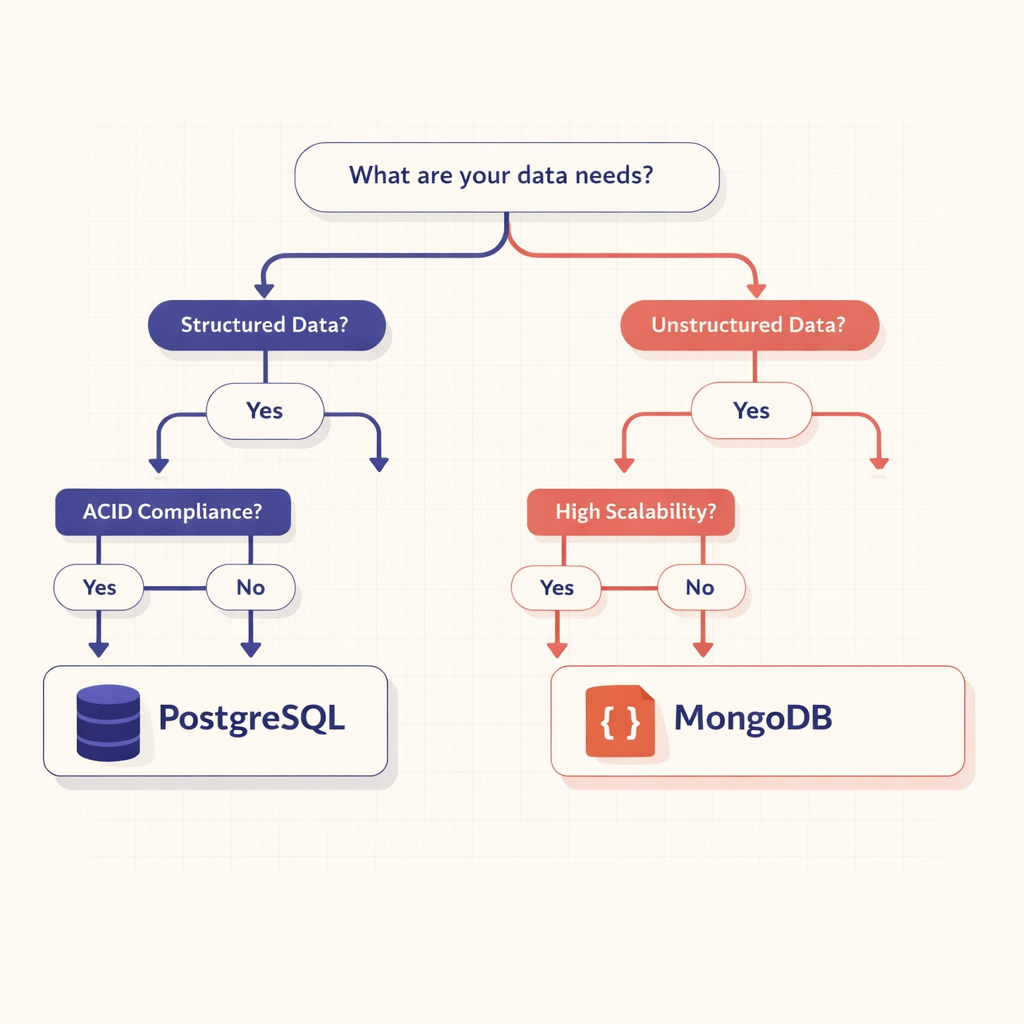
When choosing between PostgreSQL and MongoDB, a variety of factors must be taken into account. This decision transcends a straightforward PostgreSQL vs. MongoDB comparison; it involves understanding the inherent strengths and limitations of SQL and NoSQL systems as well as making a well-informed choice that aligns with your application's specific needs. Below is a simple framework to assist you in this decision-making process.
1. Determine Your Data Structure Needs
Assess the type of data structure you will primarily be managing. If your data is structured, possesses a predictable schema, and you foresee a need for complex, multi-row transactions, PostgreSQL’s relational database model will likely serve you best. Conversely, if your data is heterogeneous or lacks a well-defined schema, MongoDB’s document database model offers the flexibility you require.
2. Evaluate Your Query Needs
Consider your requirements for querying and data manipulation. PostgreSQL harnesses the power of SQL to facilitate comprehensive data manipulations and sophisticated transactions. If your application demands real-time analytics or advanced querying capabilities, PostgreSQL may be your optimal choice. On the other hand, if your application does not necessitate complex querying but instead needs to efficiently manage large volumes of rapidly changing data, MongoDB’s flexibility could prove advantageous.
Tip: Carefully consider your application's querying patterns when selecting the appropriate database.
3. Appraise Your Scaling Demands
Critically examine your scalability needs. SQL databases, such as PostgreSQL, are recognized for their vertical scalability, allowing you to enhance performance by upgrading to more powerful hardware. In contrast, NoSQL databases like MongoDB excel in horizontal scalability, enabling you to handle increased traffic simply by adding more servers.
4. Assess Your Performance Expectations
If high performance is a top priority, you should review the outcomes of benchmark tests. PostgreSQL typically excels in scenarios where read and write speeds are paramount, while MongoDB is particularly well-suited for high-volume, high-velocity data, commonly associated with Big Data and real-time applications.
5. Factor in Your Transactional Needs
PostgreSQL is ACID-compliant by default, ensuring reliable processing of all database transactions. Although MongoDB has recently added ACID compliance, PostgreSQL may still be the safer choice for complex, multi-document transactions.
Ultimately, the debate between PostgreSQL and MongoDB isn't about which database is unequivocally superior; rather, it is about which one is better suited to meet your unique application requirements. If you need assistance with this crucial decision or wish to discuss a custom software development solution, please feel free to reach out to us here.
FAQs on PostgreSQL vs MongoDB
As you explore the comparison between PostgreSQL and MongoDB, you may have several questions. To facilitate this process, we present answers to the most frequently asked queries.
1. What are the core differences between PostgreSQL and MongoDB?
| Feature | PostgreSQL | MongoDB |
|---|---|---|
| Database Type | SQL-based, object-relational | NoSQL, document-based |
| Data Storage | Utilizes tables and schemas for structured data | Employs a flexible BSON format for dynamic data |
| Strengths | Robustness, reliability, support for complex queries | High scalability, flexibility |
PostgreSQL is well-regarded for its robustness and reliability, leveraging tables and schemas for data storage, making it highly effective for complex queries and multi-row transactions. In contrast, MongoDB, a NoSQL document-based database, is known for its high scalability and flexibility, which makes it adept at managing rapidly changing data.
2. Which database should I choose if my data model is complex and my queries are multi-row?
If your primary focus is on data integrity and consistency in complex, multi-row transactions, PostgreSQL's relational database model is the optimal choice. Its SQL-based framework offers a powerful and efficient querying language.
3. Can MongoDB handle ACID transactions as efficiently as PostgreSQL?
Historically, NoSQL databases, including MongoDB, faced criticism for their limited support of ACID (Atomicity, Consistency, Isolation, Durability) transactions. However, MongoDB has made significant strides in this area and now supports multi-document transactions. Nevertheless, it is important to recognize that it may not match PostgreSQL's level of reliability and robustness, particularly in high-concurrency scenarios.
Selecting the appropriate database for your application involves several considerations, including your application's specific requirements, the database structure, and the nature and volume of your data. While the choice between a relational versus a document database, or SQL versus NoSQL, may appear daunting, a thorough understanding of your needs along with the strengths and weaknesses of PostgreSQL and MongoDB can lead you to an informed decision. For a deeper discussion or to explore custom software development options, please visit our contact page.
Remember, in the comparison of PostgreSQL and MongoDB, your application's requirements ultimately take precedence.
Make Imversion a preferred source on Google
Like this kind of AI and software analysis? Add Imversion as a preferred source so Google can highlight our articles for you in Search, AI Overviews, and AI Mode.