React Native vs Native Development: Choosing the Best Mobile Approach
Dive into the debate of React Native vs Native Development. Uncover essential insights on performance, cost, and when to choose each approach for mobile app success!

Introduction to React Native vs Native Development
Choosing the right tool for mobile app development is crucial to the success of your project. With a multitude of methods available, making an informed decision requires careful consideration of factors such as:
- Key differences
- Cost
- Performance
- Speed
- Maintenance
- Scalability
- Team proficiency
- Use cases
This blog will delve into the insights surrounding React Native vs Native Development, clarifying when to choose each approach for your project.
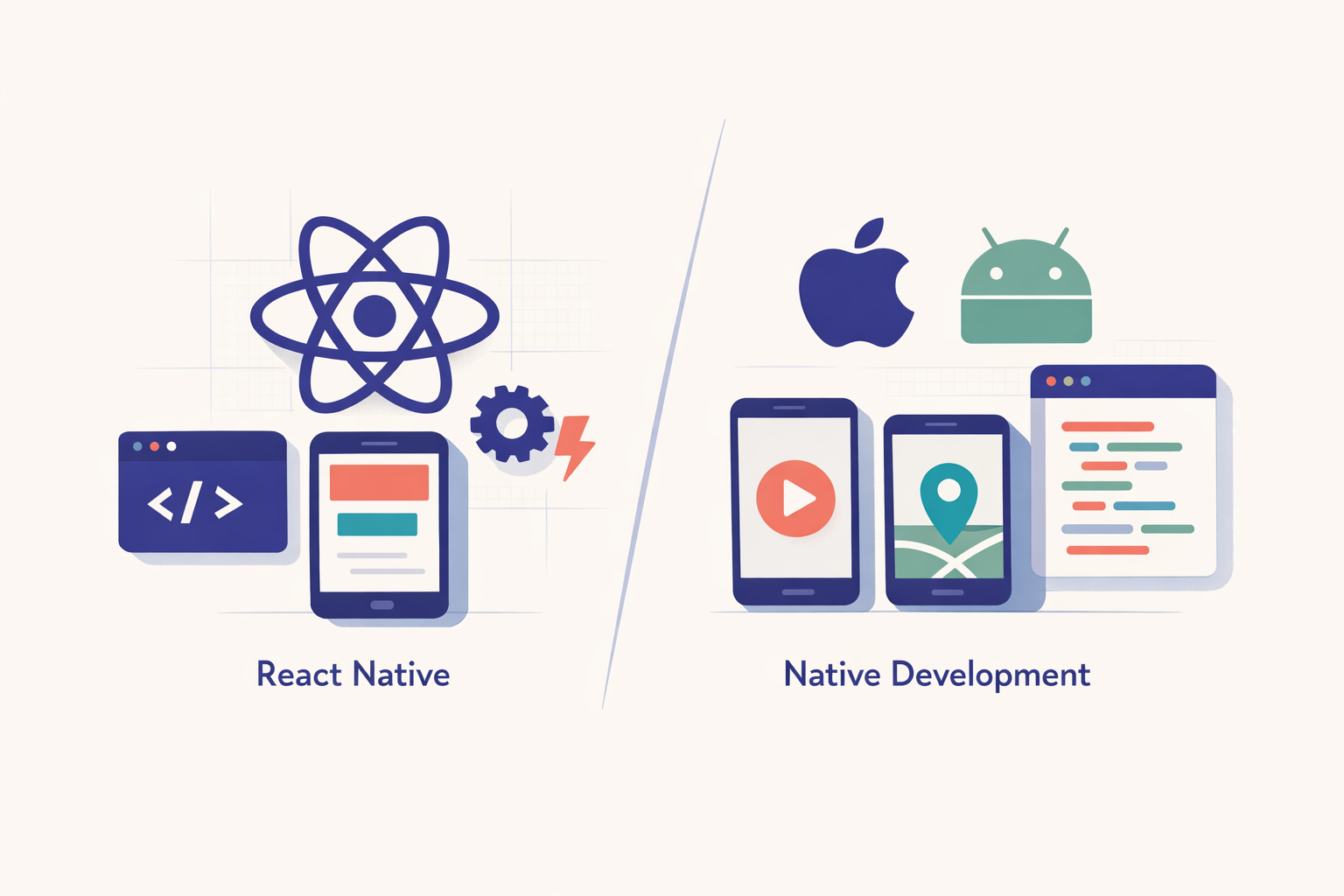
The two primary contenders in the mobile app development arena are React Native and native development options—Swift for iOS and Kotlin for Android. Our focus will primarily rest on these two contrasting methodologies, providing a comprehensive comparison between React Native and Swift/Kotlin. This discussion will offer profound insights that go beyond surface-level considerations, closely examining the inherent strengths and potential drawbacks of each, thereby delivering actionable guidance for your project.
Important Tip: React Native, developed by Facebook, has gained significant traction for its cross-platform capabilities, enabling developers to create a single codebase in JavaScript for deployment on both Android and iOS platforms. How convenient is that? However, does React Native sacrifice performance or other critical aspects for this convenience? We will explore these questions in the section on Cross-platform vs Native Development.
Conversely, native development necessitates separate codebases for each platform, utilizing Swift for iOS and Kotlin for Android. The appeal of native development lies in its superior performance due to close interactions with the operating system. Advocates argue that this approach facilitates a smoother user experience that outperforms cross-platform alternatives. But does native development come without its own challenges? We will investigate this in the following sections of the blog.
What about critical considerations such as React Native's performance, development speed, maintenance, scalability, and the costs involved with each platform? We will explore these aspects in detail, fostering a well-rounded understanding that will aid your decision-making process. Furthermore, what does migration between platforms entail? What are the common questions that arise surrounding React Native and native development? Stay tuned as this blog will uncover intricate details about these topics and more.
In summary, this blog aims to provide a balanced analysis that clarifies the differences between React Native and Native development, enhancing your technical comprehension and offering practical insights for informed decision-making. Prepare to dive deep into the realm of mobile app development tools. Stay tuned!
Understanding the Mobile App Development Landscape
As the digital landscape continues to evolve, so too does the landscape of mobile app development methods. The ongoing debate of "React Native vs Swift/Kotlin" encapsulates this dynamic environment. Broadly speaking, this contention can be framed as cross-platform vs native development.
React Native, championed by Facebook, facilitates the creation of apps that can function on both Android and iOS devices from a shared JavaScript codebase. The advantages include:
- Reduced timelines
- Lower costs
- Code reuse
- Simplicity
In contrast, native development, utilizing Swift for iOS and Kotlin for Android, requires separate codebases. While this may seem more demanding, it boasts superior performance due to direct interaction with the operating system. Native development excels in graphics-intensive applications or those necessitating extensive hardware interaction.
Though the allure of React Native's cross-platform development is undeniable, the decision is not entirely straightforward. As developers, we must engage in a balanced evaluation. Specific business requirements, resource limitations, and performance trade-offs will guide the selection of your mobile app development strategy.
Understanding React Native vs Native Development
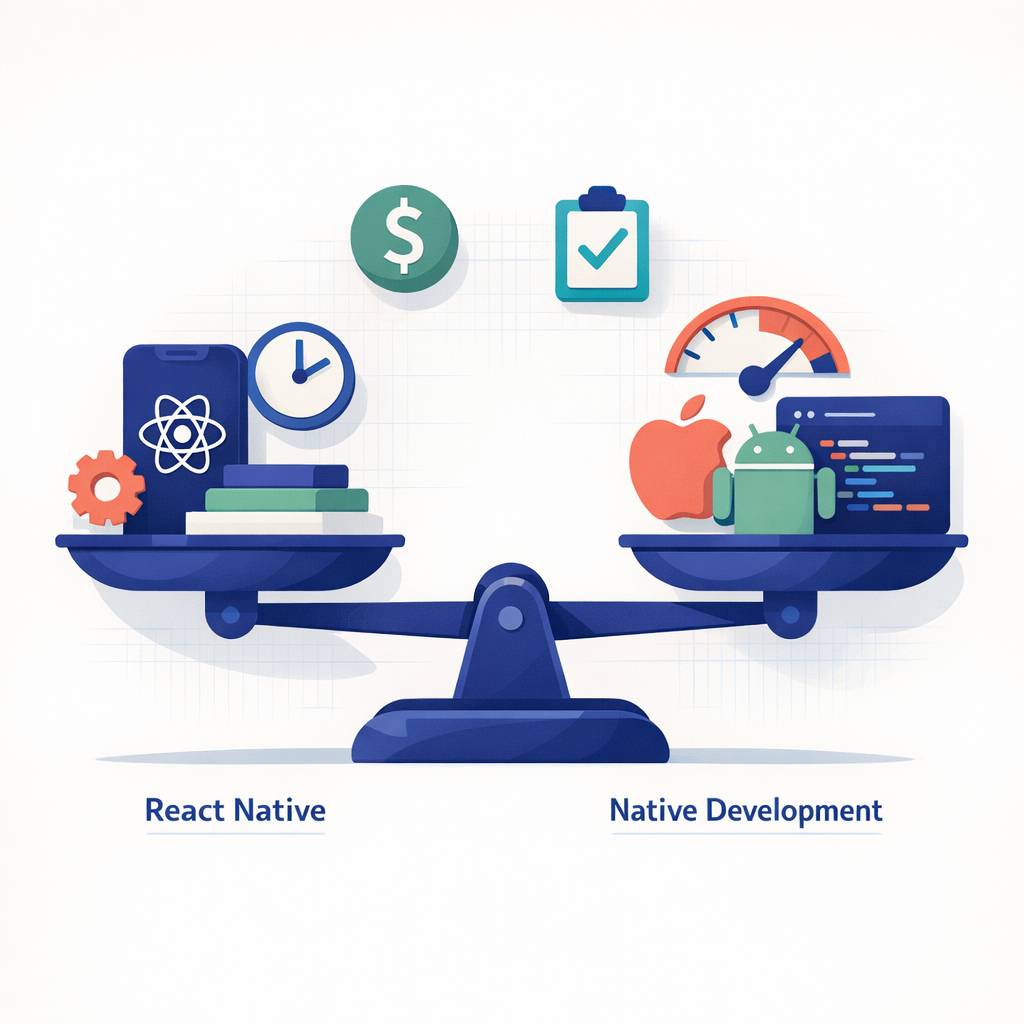
Mobile app development necessitates the selection of an appropriate technology stack. This brings us to a frequently debated topic: React Native vs Native Development.
React Native, introduced by Facebook, facilitates cross-platform app development. This means that developers can create applications for both iOS and Android using a single JavaScript codebase. The most notable advantage is the ability to share code across platforms, resulting in shorter development times and reduced costs. In contrast, native app development employs distinct programming languages for each platform: Swift for iOS and Kotlin for Android.
In the comparison of React Native versus Swift and Kotlin, it is essential to acknowledge that both frameworks possess unique strengths. The pivotal factor determining their applicability largely depends on the specific requirements of the project at hand.
Performance Trade-Offs
While native apps may exhibit a performance edge due to their direct interaction with the operating system, React Native is not far behind. For the majority of use cases, React Native delivers performance that is nearly equivalent to that of native apps. However, for graphics-intensive applications or those requiring substantial interaction with device hardware, native development has the upper hand.
Cost Considerations
From a cost perspective, React Native is typically more economical due to its code reusability feature. In contrast, native apps necessitate separate development efforts for each platform, which can escalate overall costs.
Maintenance and Scalability
Maintenance is a practical concern in app development. Both options necessitate ongoing maintenance, but the extent and type of maintenance can differ significantly. The React Native framework benefits from JavaScript’s mature ecosystem, which can simplify the maintenance and updating of applications. On the other hand, native development may require more frequent updates due to changes specific to each platform but offers superior scalability for complex projects.
Team Skills
The choice between React Native and native development also hinges on the skills of your development team. If your team is proficient in JavaScript, React Native can be an excellent option. However, in the absence of JavaScript developers, expertise in Swift or Kotlin becomes critical.
Use Cases and Selection
The application’s use case emerges as a significant factor in the debate between cross-platform and native development. Applications that demand high performance and native device interactions may derive significant benefits from native development. Conversely, simpler projects that prioritize speed and cost-effectiveness can choose React Native.
Migration
Migrating from one platform to another is generally challenging. Therefore, it is crucial to select the appropriate platform based on current and anticipated future requirements.
FAQ about React Native vs Native Development
- Is React Native better than native development?
There isn’t a “one-size-fits-all” answer. The choice depends on the project requirements, available resources, and team skill sets.
- Can React Native match the performance of native apps?
Generally, React Native can offer performance that is nearly comparable to native apps. However, native applications tend to excel in graphics-intensive scenarios or those involving significant device hardware interaction.
- Which is more cost-effective: React Native or Native Development?
Typically, React Native is more cost-effective due to its ability to reuse code across platforms.
In conclusion, both React Native and Native Development hold distinct positions within the realm of mobile app development. The decision between the two rests entirely on factors such as project requirements, budgetary constraints, and team expertise. Therefore, a comprehensive understanding of the advantages and disadvantages of each option will empower you to make a more informed decision.
Performance Comparison: React Native vs Native Development
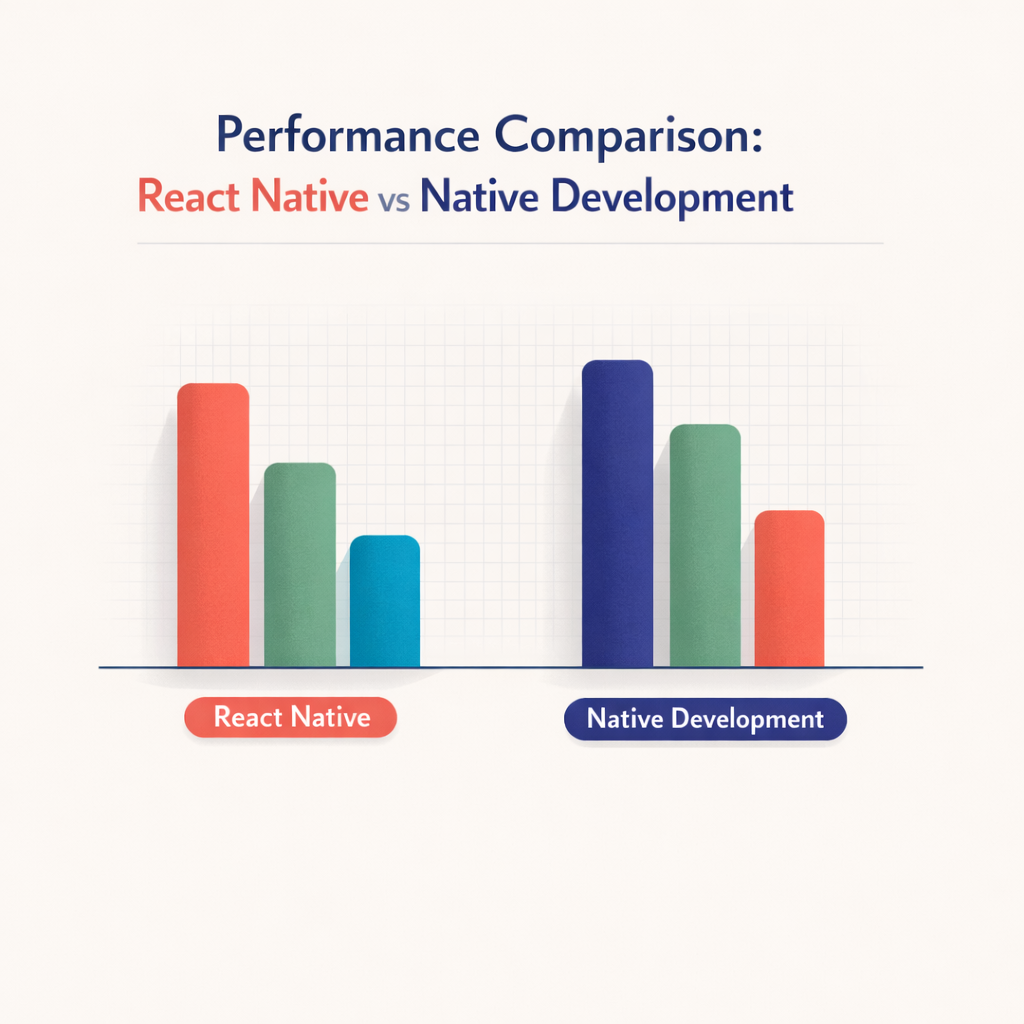
In the realm of mobile app development, the "React Native vs Native Development" debate is a recurring theme. A critical aspect that deserves thorough analysis is performance, specifically comparing React Native's performance to that of native development using Swift for iOS and Kotlin for Android.
Speed and Performance Trade-offs
React Native, built on a JavaScript-based code foundation, is designed for efficiency; however, it sometimes experiences limitations in speed. Nevertheless, the cost-effectiveness and rapid development advantages may make these trade-offs worthwhile in certain contexts.
Conversely, native development with Swift or Kotlin facilitates direct interaction with the operating system, resulting in smoother and faster performance.
Graphically Intense Applications
Companies aiming to develop graphically intensive applications, such as games or complex AR/VR experiences, typically opt for native development. This choice is driven by the enhanced power and control it offers, making it ideal for scenarios where speed, graphical performance, and fluidity are crucial.
Use Cases and Scalability
| Target Audience | Recommendation | Reasons |
|---|---|---|
| Startups | React Native | Flexibility and compatibility with both platforms |
| Larger Enterprises | Native Development | Better performance, robustness, and extensive API access |
Maintenance and Migration
React Native applications are generally easier to maintain and upgrade, thanks to the single codebase. However, migrating an existing native application to a React Native framework can be a challenging endeavor, potentially requiring significant resources and time.
Choosing the Right Approach
The "React Native vs Native Development" debate lacks a one-size-fits-all solution. The choice largely depends on the specific needs, goals, and constraints of the company, including budget, timeline, target audience, and market niche.
Tip: The appropriate mobile app development approach not only influences performance but also affects costs, maintenance, scalability, and the future growth trajectory of your application.
Frequently Asked Questions
- Does a React Native application perform the same as a Native application?
- React Native applications can provide nearly native-like performance for standard use cases, but may underperform in graphically intensive scenarios.
- Is it possible to start with React Native and switch to Native?
- Yes, it is feasible; however, it may require considerable effort. Migrating from one framework to another could necessitate rebuilding the application from the ground up.
- Which approach is more likely to lead in the future: React Native or Native?
- Both approaches have their distinct advantages. While React Native offers efficiency and faster development cycles, native development maintains a competitive edge in terms of robust performance and direct OS integration.
In conclusion, the decision between React Native and Native Development should center on aligning with your project's specific requirements and long-term vision. A clear understanding of the capabilities and trade-offs associated with each approach can significantly enhance the decision-making process.
Cost-Benefit Analysis: React Native vs. Native Development
When selecting the optimal mobile app development approach, cost considerations frequently emerge as a decisive factor. Conducting a structured cost-benefit analysis between React Native and Native Development can significantly influence your decision.
Cost Implications
React Native allows developers to utilize a single JavaScript codebase that caters to both Android and iOS platforms. This advantage considerably reduces overall development time and costs by eliminating the need to maintain separate codebases and teams for different platforms, making it a cost-effective solution.
In contrast, native development using Swift for iOS and Kotlin for Android necessitates maintaining distinct codebases, which increases development costs. However, the initial expense of native development may be justified due to the superior performance, fluid animations, and enhanced user experience it provides.
Maintenance and Scalability
Maintaining React Native applications is more straightforward, thanks to the unified codebase. Upgrades and bug fixes can be efficiently implemented across platforms. Nonetheless, scalability may be challenged in complex applications due to the additional layer of abstraction it introduces.
Conversely, native development with Swift and Kotlin, while incurring higher upfront costs and independent maintenance efforts, is better equipped to handle larger, more complex applications efficiently. It also offers a more native-like user experience and performance.
In the realm of mobile app development, the decision between React Native and Swift/Kotlin ultimately hinges on your product's scope and long-term vision.
Team Skills and Migration
The choice between cross-platform and native development can also be influenced by your team’s skill set. If your team is proficient in JavaScript, React Native becomes a faster and more viable option. Conversely, if your team excels in Swift or Kotlin, a native approach may be more suitable.
React Native facilitates a smoother migration from a web platform to a mobile application due to its JavaScript foundation. However, transitioning from React Native to native development at a later stage can prove to be a complex undertaking.
Use Cases
| Framework | Best Suited For |
|---|---|
| React Native | Simple applications that require rapid development without heavy hardware usage |
| Native Development | Graphically rich applications and those needing deep integration with device features |
Conclusion
The choice between React Native and native development is not one-size-fits-all. As a decision-maker, you must weigh various factors, including:
- Development Cost
- Product Complexity
- Team Skills
- Maintenance
- Scalability
Both approaches have their unique strengths and weaknesses; the ideal choice depends on a clear understanding of your priorities.
Tip: Prioritize the factors that align with your project goals to make an informed decision.
Consideration of Team Skills and Scalability with React Native vs Native Development
When weighing the decision between React Native and native development, a critical factor to consider is the proficiency of your development team. React Native utilizes JavaScript, a widely-used programming language, allowing teams that are already experienced in JavaScript to transition seamlessly into React Native development. In contrast, Swift and Kotlin require a more specialized skill set, particularly when developing separately for Android and iOS platforms.
From a scalability perspective, React Native offers a distinct advantage. By leveraging a single codebase, developers can create larger applications with less effort compared to managing separate codebases for Swift and Kotlin.
Team Skills
| Development Approach | Team Skills Required |
|---|---|
| React Native | Ideal for teams with strong proficiency in JavaScript. While knowledge of native languages like Swift or Kotlin can be beneficial, it is not essential. |
| Native Development | Team members must have a robust understanding of Swift for iOS and Kotlin for Android, in addition to a comprehensive grasp of each platform's unique characteristics. |
Scalability
| Development Approach | Scalability Characteristics |
|---|---|
| React Native | Provides superior scalability due to the single JavaScript codebase, making it advantageous for larger projects aiming to reach both iOS and Android audiences. |
| Native Development | Scaling can be more complex, as each platform requires separate codebases in Swift or Kotlin, which can increase the level of effort and resources needed. |
Tip: The decision between React Native and native development frequently depends on specific project requirements, team expertise, and scalability objectives. Evaluating these factors will help guide your mobile app development strategy, ensuring a balance between technical capabilities and strategic growth.
Choosing between React Native and Native Development: Factors to Consider
When selecting the optimal mobile app development approach, several critical factors must be taken into account. This section clarifies the distinctions between React Native and Native Development, particularly in the context of React Native versus Swift or Kotlin, and offers insights into influential considerations.
Complexity of the App
Native applications developed using Swift or Kotlin have a proven track record of delivering exceptional performance, particularly for apps that require advanced graphics or extensive hardware interaction. If your future app falls within this category, you might prefer the cross-platform versus native approach.
Audience and Market
React Native has a distinct advantage due to its capability for simultaneous development on both Android and iOS platforms. If your goal is to reach a broader audience across multiple platforms, React Native is the ideal choice.
Budget and Deadline
The code reusability feature of React Native facilitates rapid development, leading to enhanced cost efficiency. If you are constrained by a tight budget or deadline, React Native could provide a pragmatic solution.
Future Maintenance and Updates
Tip: React Native promotes code reusability and boasts a large community for support, making maintenance and updates easier. Conversely, enterprises that can allocate dedicated teams for each platform might find native development to be more suitable.
Each of these factors plays a crucial role in the decision-making process between React Native and Native Development. It is essential to carefully assess these differences to tailor the best strategy for your app's success. The choice between the two approaches largely depends on the app’s specific requirements, your organization’s resources, and long-term objectives. When making this decision, it’s vital to keep your overarching vision in focus.
Frequently Asked Questions about React Native vs. Native Development
This section addresses commonly asked questions related to React Native and native development. It provides concise and comprehensive answers to enhance your understanding of these technologies.
1. What are the main trade-offs between React Native and Swift (iOS) or Kotlin (Android)?
React Native utilizes a single JavaScript codebase for both iOS and Android platforms, resulting in significant time and cost savings during development. In contrast, Swift and Kotlin are the native programming languages for iOS and Android, respectively. These languages offer superior performance due to their direct integration with the operating systems.
Key takeaway: React Native sacrifices some level of performance for cost efficiency and faster development, while native development with Swift or Kotlin compromises cost efficiency and speed in exchange for enhanced performance.
2. When should I choose cross-platform (React Native) over native development?
If your project requires a rapid go-to-market strategy and prioritizes cost efficiency—particularly if your team has strong JavaScript skills—opting for React Native may be advantageous. Conversely, native development (using Swift or Kotlin) is the preferred choice for demanding applications that need high performance, extensive OS interaction, or specialized graphical effects and analytics.
3. Can I migrate from one mobile app development approach to another?
Yes, migrating from a React Native codebase to native (or vice versa) is feasible; however, it involves complexities. Such a transition requires careful planning and can be time-consuming and costly.
Conclusion
Choosing between React Native and native development ultimately depends on project requirements, team expertise, and the mobile app development strategy that aligns with your overall business objectives.

Conclusion: Making the Choice between React Native and Native Development
In the field of mobile app development, the choice between React Native and native development often hinges on the specific requirements of the project. While both approaches have their distinct advantages, each excels in particular scenarios.
Comparison of Development Approaches
| Aspect | React Native | Native Development |
|---|---|---|
| Cross-Platform Capability | Single codebase accelerates development and reduces costs | Platform-specific development (iOS with Swift; Android with Kotlin) |
| Performance | Adequate for basic applications | Exceptional for graphically intensive applications |
| Migration Ease | Simplified migration between platforms | Complex transitions when moving between platforms |
| Team Expertise | Suited for teams proficient in JavaScript | Ideal for teams experienced in Swift/Kotlin |
React Native's cross-platform capabilities make it an advantageous option for projects where speed and cost efficiency are priorities; its single codebase accelerates development and significantly reduces costs. Furthermore, it allows for easier migration between platforms, positioning it as a strong contender in the "React Native vs. Native Development" debate.
Conversely, native development—utilizing Swift for iOS and Kotlin for Android—outperforms in terms of performance, particularly for graphically demanding applications and those that require deeper integration with device hardware. It is the preferred choice for applications that demand high performance and enhanced user experiences.
Important Tip: There is no universal solution when selecting a mobile app development approach. Both React Native and Native Development have their respective strengths and can contribute equally to the success of your application, depending on the specific needs and circumstances involved.
In summary, it is essential to make informed decisions based on the unique criteria related to your project’s scope, requirements, and team expertise.
Make Imversion a preferred source on Google
Like this kind of AI and software analysis? Add Imversion as a preferred source so Google can highlight our articles for you in Search, AI Overviews, and AI Mode.